In which we look at preparations for the great river procession, and consider whether Sotherton Backler, Acting Clerk to the Society, might have ridden on the Society’s barge.

At a special Court meeting on 15 January 1806, the Master of the Worshipful Society of Apothecaries announced that a Clerk was to be elected ‘in the roome’ of Mr Robert Cooke, who had died. An election took place, and Sotherton Backler duly became Clerk, in addition to his roles as Accountant to the Navy Stock (the Society’s trading company set up to supply the Navy with apothecaries’ supplies), and Secretary to the Friendly Medical Society, to which post he had been elected on 25 June 1799. This was a social dining club, unique to the Society of Apothecaries. The membership was limited to 26 Assistants and Liverymen, plus the Clerk. They dined together four times a year, generally at the Crown and Anchor in the Strand. (Penelope Hunting, History of the Society of Apothecaries, 1998, p 195) 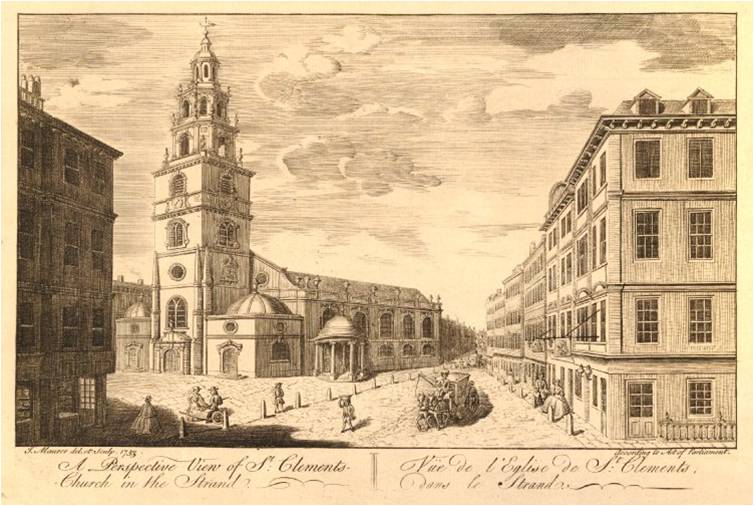
The rather grand four-story Crown and Anchor, on the Strand opposite St Clement Danes (you can see the sign on the right of the picture) had long served as a venue for meetings of well-to-do Londoners. It was the customary dining venue for fellows of the Royal Society, and was said to be ‘the birthplace of the general practitioner’.
It had an enormous Assembly Room and a grand dining room, and in the first decades of the 19th century it was known as a hotbed of radical politics.
The Barge – Lord Nelson’s funeral
As I scanned the Society’s Court Minute books, I was struck by the juxtaposition of Sotherton’s role as Acting Clerk – to be elected Clerk on 15 January 1806 – and arrangements for the Funeral of Admiral Lord Nelson.
This arguably could have been one of the biggest events in London in the first decade or more of the 19th century. Could my 4x great grandfather have ridden in the Society’s barge along with many others behind that carrying Nelson? At the very least I have no doubt that he and his children, including my 3x great grandfather Samuel Backler, would have watched the procession on 9 January as it made its way from Westminster to St Paul’s. Indeed, so would my Pellatt ancestors who lived at their glass showroom in St Paul’s Churchyard.
The Court of Assistants had a special meeting on 31 December 1805 to respond to the invitation of the Mayor of London to take part in the funeral procession on the Thames. The Clerk was directed to write to the Lord Mayor to say the request would be complied with, and the barge master attended to receive orders to prepare the Barge. It was ‘Ordered that Mr Platt do provide a Band of Music suitable to the solemn occasion’, and a special Committee was to sit each day at 1 pm to make arrangements.
The Society’s third and last barge had been built in 1765 and repaired in 1786. By 1802 it had been declared unsafe for the herbarising expedition to Greenwich, but it appears to have been seaworthy enough for the funeral procession! The papers of the day show just what a momentous event this was, first with the viewing of the body at Greenwich and then for the procession along the Thames on 8 January. Fairburn’s report of the funeral describes the order of the river procession, and vividly comments on the order of the day. The Society’s Barge appears last in the order of City Barges, which included in addition, those of the Drapers, Fishmongers, Goldsmiths, Skinners, Merchant Taylors, Ironmongers and Stationers.
On the 9th, the procession went from Whitehall to St Paul’s (of which the front end reached St Paul’s before the back end had left Westminster). Adverts proliferated for the hire of desirable and genteel viewing places along the route; and special stands were built in St Paul’s for the 12,000 or so people who attended the ceremony itself.

The Morning Post of 7 January, 1806 advertised:
A large drawing room with two windows and a balcony in the Strand
First, 2nd, 3rd and 4th floor viewing of the entrance to St Paul’s and nearly up to Temple Bar – apply at the British Neptune Office, 119 Fleet St
A ‘long and commodious room with seats’ is being prepared at the Dundee Arms Tavern, Wapping
A commodious room in Fleet Street to accommodate 30 people has a back entrance from Lincoln’s Inn down Bell-Yard so the party may come and go at what hour they please
Later that Spring Sotherton Backler reported the expenses incurred in attending the funeral, which the Court Minutes in March 1806 showed in total amounted to £50-19-6.
Angell & Son, £6 – 15-6 [for food?]
The Barge £20 – 13 –
Music £ 9 – 9s
Wine, 3 doz £ 8 – 2s
Mr Kanmacher £ 1 – 11 – 6 [the Beadle]
Mrs Hodder £ 4 – 3 – 6 [the Butler]
Porters at Tower Wharf – 5s
We learn a little more detail about what was involved for a Livery Company Barge in the procession in the story of the Ironmongers, which reports that the ‘liverymen in livery gowns and mourning … were accompanied by a band of two flutes, four clarinets, two horns, two bassoons, a serpent, a trombone, a pair of kettle drums and two trumpets. The start was early, 8.30 a.m., so they were fortified by breakfast at the Hall, and refreshments were provided on Board.’ (p. 99 A History of the Ironmongers Company’ by Elizabeth Glover, 1991)
As with many other Livery Companies, the Society eventually abandoned ownership of a barge, with its sale in 1817 and the demise of the Barge House at Chelsea Physic Garden.
There appears to be no record at the Society of who actually travelled on the barge that eventful day. But my ancestor Sotherton Backler was surely involved in some way as – although this remains to be researched – were the soon-to-be Backler in-laws, the family of Apsley Pellatt, glassmaker and lately Master of the Ironmongers.
In my next blog I will depart from this chronology of the Sotherton Backler family, and explore the mysteries around the life of Thomas Meriton Pellatt, son of Sotherton’s grand-daughter Mary Backler, and her husband and cousin, Henry Pellatt – or was there a different father?? I’ve wanted to tell this story for a while now – and the time seems ripe.


 backlers