Month: August 2025

51. Thomas Pellatt (1765-1829), Clerk to the Ironmongers

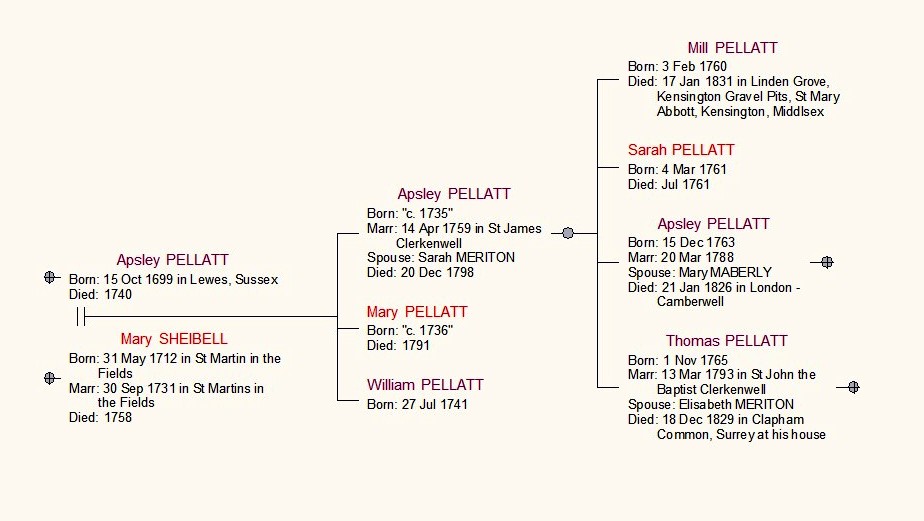
In which we meet Thomas Pellatt (1765-1829), Clerk to the Ironmongers, son of Apsley Pellatt II and Sarah nee Meriton, married to his cousin Elizabeth Meriton and father to Henry Pellatt, who married his cousin Mary Backler, as the diagram below attempts to show. We learn a bit more about the Ironmongers Company and note that the Pellatts showed nonconformist tendencies throughout the late 18th and early 19th centuries, as did many of the Ironmongers.

The diagram above shows two generations in one line, ie Apsley Pellatt II is at the top left, while his son Apsley Pellatt III is at the bottom left and is the brother of Thomas Pellatt, top middle row. Hopefully readers get the gist!

We briefly met Thomas Pellatt in Post 50, noting he had been apprenticed Clerk to William Leeson and admitted free of the Ironmongers by patrimony in 1789. The Articles of Clerkship for his son Henry (see below) show that Thomas was ‘of Ironmongers Hall [by patrimony] in the City of London Gentleman and one of the Attorneys of His Majesty’s Court of Kings Bench Common Pleas and Exchequer at Westminster, and a Solicitor in the High Court of Chancery…’ He was also known to be ‘of Gray’s Inn’ .

He married his cousin Elizabeth Meriton by License at St James Clerkenwell in March 1795. They had four sons, baptised at Fetter Lane Independent Chapel, but for Thomas the future of his marriage and family were bleak. Three of the four sons died in childhood, with the deaths in Peckham of son Apsley Meriton Pellatt in 1803, aged nearly five, and young John (1800-1804), and in Brighton of first son Thomas in 1807, aged 11. He was buried there at the Union Street Meeting House and Ground – in what then was still known as Brighthelmstone. During those traumatic years, Elizabeth nee Meriton Pellatt died in Peckham in September 1804, perhaps in childbirth. This left just son Henry Pellatt, born in 1797 and articled for five years as Clerk to his father in 1815. We have already met him in posts 11 and 29, in which we traced some interesting relationships arising from the marriage and offspring of Henry and my many times great aunt Mary Backler, who had married in Kennington in 1831. I do not propose to investigate Henry any further.

Clerk to the Ironmongers Company: And so to the career and good works of Thomas Pellatt. Perhaps it was because he had precious little family that he seems to have thrown himself into a range of charitable and legalistic roles, primarily by his becoming Clerk to the Ironmongers Company in 1803, shortly before the death of his wife. He remained in this role until 1830, to be succeeded for four years by his son Henry. His name appears in many newspaper notices as signatory, Clerk of the Ironmongers. According to A History of the Ironmongers Company (Elizabeth Glover, 1991), Thomas Pellatt assumed the role of Clerk while the affairs of the Company were in some disarray. In his early years he fulfilled his legalistic and administrative duties efficiently, but according to Glover, ‘despite his excellent early work, Thomas Pellatt was .. to die with his affairs in disorder, and Henry Pellatt, the son who succeeded him for four years, was obliged to call upon his sureties, much to their indignation, for £343.2s.9d. in 1834’ (p. 105).

The Ironmongers were known for their charitable works, and for their Independent church leanings. On news of his death, the Trades’ Free Press on 26 December 1829 reported: ‘Died – a few days since, Thomas Pellatt, Esq., Clerk to the Ironmonger’s Company, Secretary to the Female Penitentiary, and Joint-Secretary of the Protestant Society for the Protection of Religious Liberty. The deceased was an eminently upright man, and a faithful friend to the various religious institutions which adorn and enlighten the country. His sudden death is greatly lamented by all who had the pleasure of his acquaintance.’

Protestant Society for the Protection of Religious Liberty: In 1815, at the time of persecution of Protestants in the South of France, a very long letter in protest appeared in many newspapers around the country, signed by Thomas Pellatt and John Wilks, joint secretaries to the Committee of the above-mentioned Protestant Society, which had met at the New London Tavern, Cheapside on 21 November 1815, The Committee expressed their ‘astonishment and deep regret’ at learning of persecution in Nimes, and stressed their belief that it should be a matter of conscience for all people how they worship God. (See, for instance, Star, London, 30 November 1815)

IN 1825, Pellatt as Secretary to the Protestant Society wrote on their behalf to condemn the many Protestants who were petitioning against a Bill to remove the various disqualifications applying to Roman Catholics, stressing their overall belief that people should be free to worship according to their consciences. (See, for instance, Morning Herald, London, 2 May 1825) Later in the century, Apsley Pellatt IV, MP, would campaign on behalf of Jews.

London Female Penitentiary: The London Female Penitentiary was founded in 1807, and from the beginning, Thomas Pellatt was the ‘Gratuitous Secretary’. In 1817 he underwent a lengthy examination by the Metropolitan Police about the conduct, finances and more of the institution, reported on three days by the Morning Post – on 17, 18 and 23 December 1817. Thomas Pellatt stated the object of the institution was: ‘to afford an asylum to females who, having deviated from the paths of virtue, and who are desirous of being restored by religious instruction and the formation of moral and industrious habits, to a reputable situation in society.’

The word ‘Penitentiary’ derived from the 1779 Penitentiary Act, which focussed on deterrence and reform of miscreants, through religion, solitude and labour. Thus the ‘fallen women’ to whom Pellatt refers (who could have been prostitutes or sex workers, in modern parlance, but also any woman whose virginity was lost outside marriage). According to Pellatt, the people applying for admission were mainly ‘persons who have lived in service, maid servants, orphans, persons who have been left with one parent, and that parent being under the necessity of going out to work, they have been neglected and permitted to rova about the streets and with bad connexions with other females and other causes, have been led astray’. Pellatt reported ‘only some few of applications from the higher ranks’, and that the average age of admission was 17 or 18. One of the greatest causes of ‘this great evil’ was attendance at fairs: ‘We have more cases upon our books of women ruined at these nurseries of vice than of any other; those fairs I mean in the neighbourhood of the metropolis’.

Of the labour in which the women were occupied, Pellatt said: ‘Washing for hire, that is all the business of a laundry, to qualify them for service; making child bed linen and all kinds of needle work; spinning thread and worsted and knitting various articles, and general fancy works.’ The aim was to send women out to employment. But this was not a life of any luxury. The inmates had meat three times a week, on other days, soup, broth or pudding, and on Thursday, bread and cheese only, that being ‘the day on which the house is open for inspection of the public, and the sale of articles manufactured’. As for those leaving, unless dismissed for misconduct, women only left to go to employment after a maximum stay of two years, and there were more applications for servants than the institution could provide.

With the demise of Thomas Pellatt in 1829, it appears that his nephew Apsley Pellatt IV, son of Apsley Pellatt III and Mary Maberly (and brother to our very own Mary Pellatt) took over the role of Secretary. Apsley Pellatt IV was to become the famous glass maker and MP – much more of him later on.

I have tried in this post to give some flavour of the work of Thomas Pellatt, and more generally of the Pellatts as supporters of a range of liberal religious and charitable causes.

In my next post I will try to trace our Meriton line back a bit – it doesn’t go with any certainty beyond the early 19th century, but introduces a prosperous family in Bermondsey, south of the river Thames.

For an interesting piece on the London Female Penitentiary on Pentonville Road, see https://legalhistorymiscellany.com/2024/02/21/betrayed-seduced-trepanned-or-cruelly-driven-into-sin-the-london-female-penitentiary/
50. Apsley Pellatt II (1735-1798)

In which we meet Apsley Pellatt II (1735-1798). and his wife Sarah Meriton (c. 1738-1798), and their three children.  We are re-introduced to The Worshipful Society of Ironmongers,  with which Company successive generations of Pellatts would be associated for more than 100 years. 

Apsley Pellatt II (1735-1798) was the oldest of three children born to Apsley Pellatt 1 (1699-1740) and Mary nee Sheibell (1712-1758).   We have seen in previous posts that Apsley Pellatt I died just five years after his oldest child’s birth.  Of the younger Apsley’s siblings, we can take a very brief look, since I can trace nothing about his sister Mary, other than that she died at Camden Street, Islington, in 1791, and in her will left many legacies to nieces and nephews, various charities, and the residue to her brother and executor, the above-name Apsley II.  Of William we know even less. His impending birth was mentioned in his father’s will.  I had long puzzled about his apparent birth date, more than a year after his father’s death, until I realised that these events took place before the change of the calendar from Julian to Gregorian in 1752.  Before this date, the first three months of what is now our calendar year were considered to be of the previous year – so that Apsley Sr died early in 1740/1, with William appearing a few months later.  Other than that – of William, there is nothing. I suspect he may have died in infancy, as he is not mentioned in the Will of his grandmother, Mary Sheibell, below.

So, back to young Apsley II.  He was to benefit from a number of legacies, for instance from his grandmother Mary (nee Houghton) Sheibell, both silver and a sum of money, payable upon his reaching the age of 21.  Before he reaches that age, the executors of the will are instructed to use the interest on these gifts ‘to put him apprentice to some genteel and reputable trade’.  And so, we renew acquaintance with the Worshipful Company of Ironmongers, whom we first met in Post 6c, John Freeman (1740-1803), Indigo Maker and Ironmonger.   To recap, John Freeman had married Ann Backler (1741-1820), who was sister to apothecary Sotherton Backler (1746-1819) and aunt to Sotherton’s son Samuel Backler (1784-1870), who in 1810 married Mary Pellatt (1789-1857), daughter of Apsley Pellatt III (1763-1826), to whom we will briefly be introduced later in this post.  The point of all this is to show that almost certainly there were long standing links between the Pellatts and the Backlers.

Apprentice: In 1750, on payment of the sum of £80, Apsley II was put apprentice to William Bliss: ‘I Apsly Pellat [sic] Apprentice to William Bliss do promise to be obedient to the Master and Wardens of the Worshipful Company of Ironmongers during my life and my said Master during my Apprenticeship. Witness my hand this 12 day of July 1750 Apsley Pellat [sic].’ (image on findmypast)

Apsley Pellatt served out his seven years as an apprentice, and was made free of the Ironmongers Company on 18 August 1757.  By this time, aged 21, he would also have come into his various inheritances, which undoubtedly gave him the resources to marry, and to set up in business as an Ironmonger, where he is to be found for many years at 13 St John Street, Clerkenwell.

Marriage to Sarah Meriton  This took place at St James Clerkenwell, Clerkenwell Green, on 14 April 1759.  Sarah was a minor, and married with the consent of her father Thomas Meriton ( – 1865).  Witnesses were Thos. Meriton (possibly/probably her father) and John Godfrey (not sure who he is).  We will learn more about the Meritons in a future  post, but here it is important to note that Thomas Meriton was an Ironmonger, albeit south of the river in Bermondsey, and not of the Ironmongers Company. It seems likely that the Pellatt/Meriton marriage resulted from the partnership between the families, as noted in the following item from The London Gazette, shortly before Thomas Meriton’s death in Bermondsey.  His marriage to Sarah Wilkinson in 1731 had taken place in Clerkenwell, so although he was located south of the river, she had links in Clerkenwell.  

London Gazette 1 January 1765: The Ironmongery Business carried on by Thomas Meriton of Dockhead, Southwark and Apsley Pellatt of Clerkenwell, was dissolved the 31st of December last, 1764. Witness our hand Thomas Meriton, Apsley Pellatt.  N.B. Thomas Meriton is to pay and receive what is Debtor and Creditor to that time.

And so, for some 30 years, Apsley Pellatt II carried on as Ironmonger of Clerkenwell.  In 1789 he was Master of the Ironmongers Company, elected to the post by the Court of Assistants.  His tenure lasted a year.

He and Sarah had four children, three sons and the sadly short-lived Sarah Pellatt (1861-1861).  Let’s look at the three sons.

Mill Pellatt (1760-1805): Was apprenticed to his father, of St John’s Street, St Sepulchre Without, on 27 July 1775.  He was duly made free of the Ironmongers Company by service to his father on 28 November 1782 (both images on findmypast).  In the 1796 Electoral Register for London, we find Mill Pellatt and Apsly Pellatt [sic] [II] as Ironmongers at St John Street.  And in 1831 we find the death of Mill Pellatt Esq on 17 January and his subsequent burial on 21 January 1831 at St Mary Abbotts Kensington.  His address was given as Linden Grove, which rang a bell – it was where Samuel Backler and Mary [nee Pellatt] Backler were living when their daughter Esther Maria Backler was born in 1830.  See Post 26!  Mary was Mill’s niece.  The Backlers were about to embark on a rather turbulent year, featuring Samuel’s bankruptcy proceedings, among other things.  

Mill Pellatt had profited handsomely from his father’s Will in 1799, but apparently became ill or somehow dependent, because his brother Apsley III’s Will in 1826 [which complicated document we will peruse at a later date] made provision for funds to be invested to produce ‘the yearly sum of eighty pounds and to pay the sum of eighty pounds yearly and every year unto and for or towards the support of my dear brother Mill Pellatt for his life’.   Presumably this care was being provided by Mill’s niece Mary Backler and her husband.

Apsley Pellatt III ( 1763-1826) we will leave until a subsequent post.

Thomas Pellatt (1765-1829) further complicates this complicated family, and I have come to the conclusion that he needs a post of his own.  In short, he was apprenticed Clerk to Attorney William Leeson on 4 October 1780, and  was made free of the Ironmongers Company in 1757 by Patrimony.  He was later to have a significant role with the Ironmongers, and in wider civic life, which is why he merits a post on his own.  For the purposes of this post, suffice to say that he married his cousin Elizabeth Meriton, daughter of Henry Meriton (Thomas Meriton’s brother) in 1795.  Their son Henry Pellatt would marry Mary Backler, daughter of Mary Pellatt (daughter of Apsley Pellatt III) and Samuel Backler. Are you staying with this?  We will leave that for the moment and just focus on the latter years of Apsley Pellatt II. 

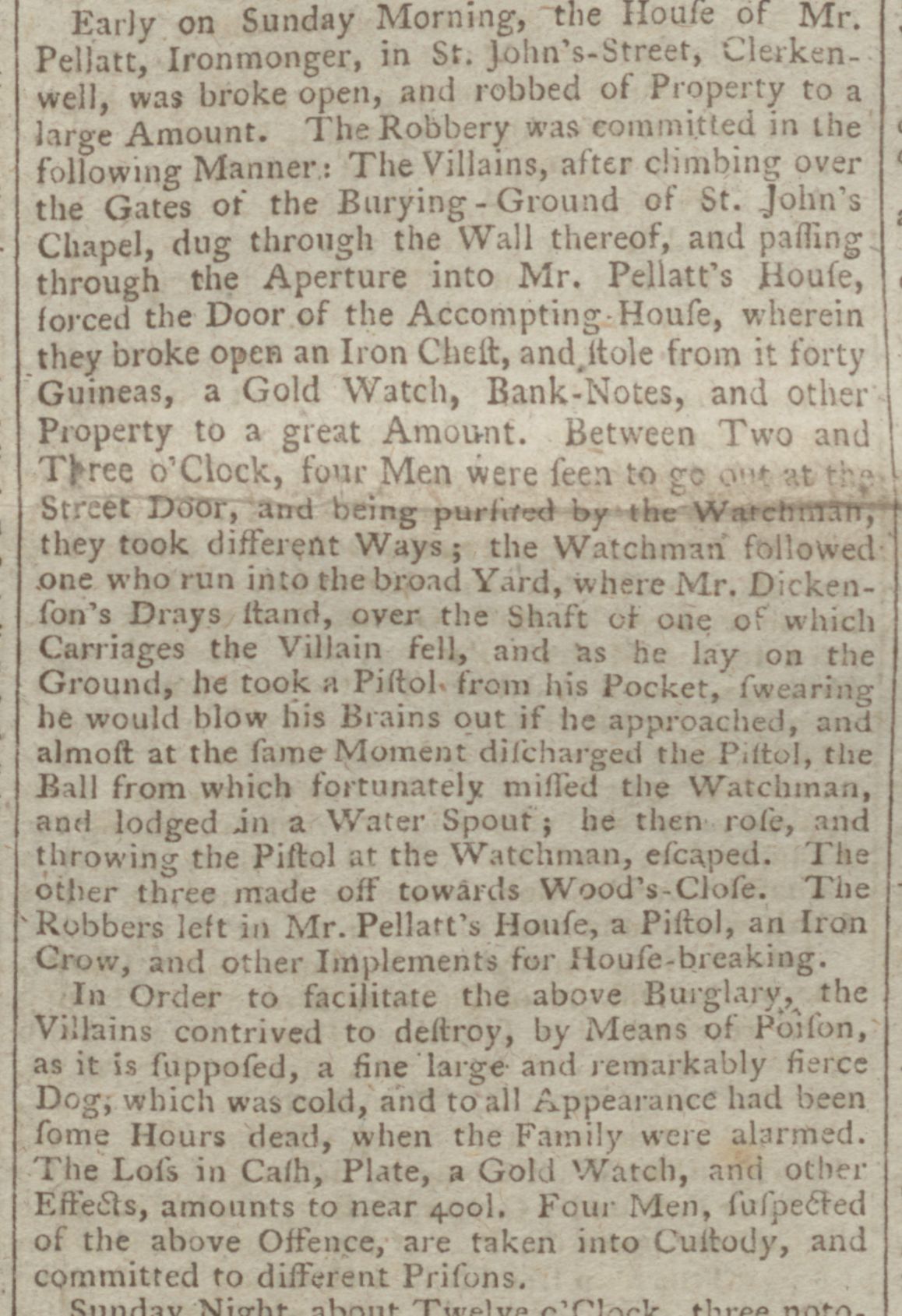
There is plenty of evidence that Apsley Pellatt II traded at St John’s Street, but perhaps none so colourful as the events described in the following newspaper clipping:

Northampton Mercury 25 October 1784. Image reproduced from British Newspapers collection by kind permission of Findmypast

This clipping tells us a lot about Apsley Pellatt at the time. His home was adjacent to St John’s Chapel and the burying ground, both on the western side of St John’s Street as it heads north towards Islington. Not far away is St James Clerkenwell, where Apsley Pellatt II married Sarah Meriton. The value of stolen goods was some £400 – around £60-80,000 today, depending on which website you peruse. They owned a dog! I have not managed to find court reports about the suspected thieves.

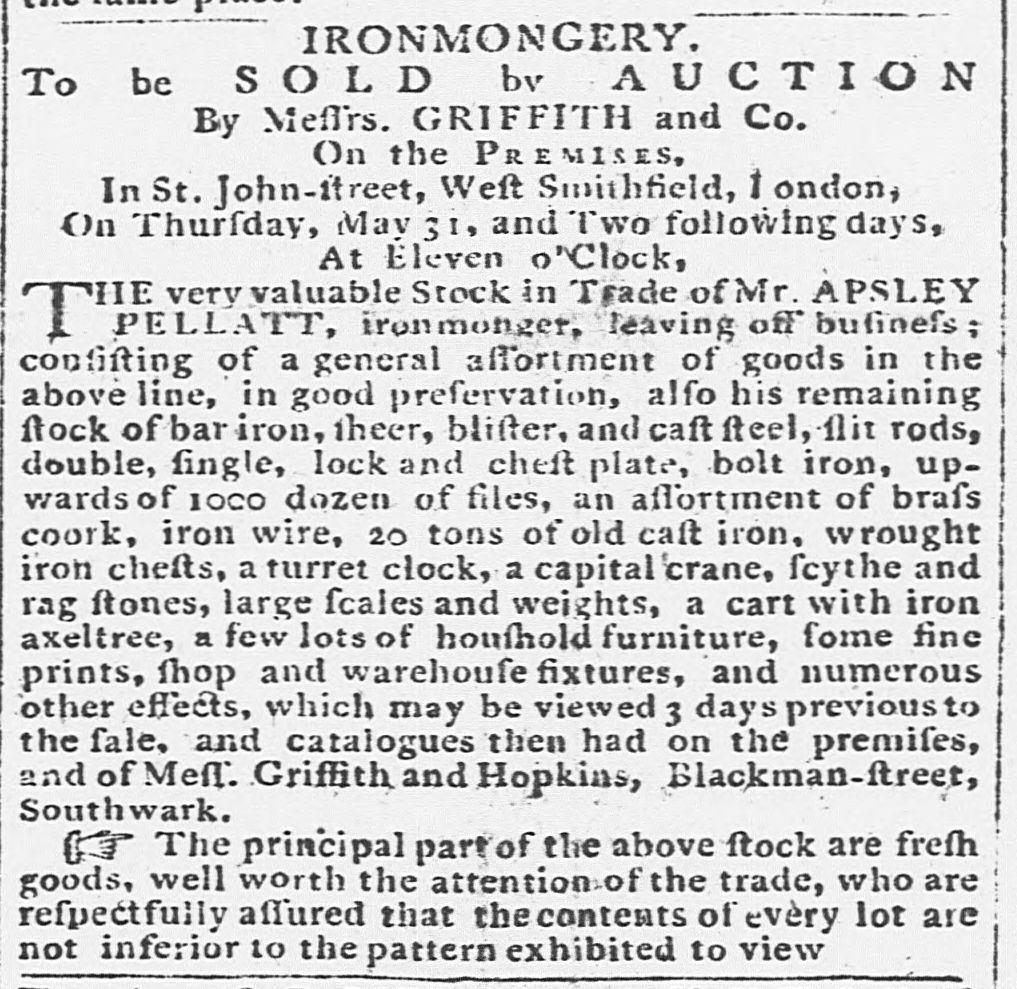
More context of Apsley Pellatt’s working life is given in the advert seen below, not long before his death in 1798. Here we see the types of goods an ironmonger would stock – iron, steel, brass – plus household furniture and effects. Presumably the Pellatts were moving from St John’s Street to Islington, where they died within days of each other at the end of 1798.

Ipswich Journal, 28 May 1798. Image used by kind permission of Findmypast, British Newspaper Collection.

Apsley Pellatt II – death and Will: The following text is taken from the online record of ‘Deeds of 9 Friars Walk, Lewes’ (ESX 21359) on the Sussex Record Office website   https://www.thekeep.info/collections/getrecord/GB179_AMS6346_1-32

On 4 & 5 Apr 1759 the Friars Estate was settled on the marriage of Apsley Pellatt and Sarah, daughter of Thomas Meriton; they mortgaged it for £2000 to Elizabeth Macie on 5 & 6 Jan 1776, who assigned it to James Louis Macie on 12 & 13 Apr 1786. Sarah Pellatt died on 16 Dec 1798 and Apsley Pellatt on the 20th leaving Mill Pellatt, Apsley Pellatt and Thomas Pellatt his surviving children; Apsley and Thomas proved their father’s will in PCC on 5 Jan 1799. The estate was auctioned on 19 Aug 1803; lot 2, a capital messuage called The Friars occupied by Sir F[erdinando] Poole at a rent of £90 and 2a 1r 28p of land, was sold to George Verrall for £2400 and £93 18s 6d for the timber. The conveyance was executed on 28 & 29 Mar 1804 by Mill Pellatt of Edgware Road in Mx, gent, Apsley Pellatt of St Pauls Churchyard, glass manufacturer and Thomas Pellatt of Ironmongers Hall, gent, to George Verrall of Lewes, gent (and his trustees John Godlee of Cliffe, merchant, Thomas Shank of Fenchurch Street, London, wine and brandy merchant and George Nelson of Palsgrave Place, Temple). Of the purchase money, £2000 was owed to Macie the mortgagee.

Given that Sarah predeceased her husband by a few days, the provisions in his Will for her were not applicable, so basically everything went to the three brothers, with Mill seeming to get a bit more than the two younger siblings. Of interest to us is that eldest grand daughter Mary Pellatt (1789-1857) was to receive £100 when reaching age 21 or day of marriage, a nice little sum for her when she married Samuel Backler (1784-1870) in 1810. In the next post we will catch up with Thomas Pellatt, then we will peruse the Meritons, and finally will move on to Apsley Pellatt III. Lots to look forward to!