Uncategorized

21. Mary Howorth – my 6x g. grandmother

In which I take a look at some newly-found information about my 6x great-grandmother, Mary Howorth, who married Samuel Backler, Vicar of Ashwell (and Newnham), Herts.  Not too much progress is made, but perhaps it will trigger some more information from some source, about who her father was!

I have been stimulated in recent weeks to unearth some ‘Backler’ Wills, printed out some years ago at the National Archives.  Ray Backler (see raybackler.com) has been digging into Essex/Suffolk Backlers in the 16th, 17th and 18th centuries – and later – to try to make links between the various Backler lines.  He is moving to crediting the parentage of ‘my’ Samuel Backler (c. 1662-1720) to a senior Samuel Backler and his wife Anne Ede (variously Eede, Eades), who married in 1660 in Huntingdonshire.  If this is indeed ‘my’ Samuel’s parentage, then it would lead to links with the later Haverhill Backlers, through the couple’s son John Backler and his descendants.  I have yet to investigate this further…

BUT – I got carried sideways by re-acquainting myself with the Will of John Howorth, proved in 1692, naming both ‘my’ Samuel Backler and his wife Mary [Howorth] and citing as his Executor John Somerscales, who married Mary’s sister Elizabeth Howorth on the same day as Samuel and Mary’s wedding.

I had for some years been unable to trace the parents of the Howorth girls, but in a new search of PCC Wills, I came across that of their Mother, Margarett (or Margret) Howorth, widow, proved in April 1687.  This Will named her children, coinciding exactly with the siblings mentioned just a few years later in John Howorth’s Will.  Thus I am able to locate my 6x gt. grandmother’s siblings and mother, though not yet her father!

This is a period in which it is easy to be confused by dates.  The Backler/Somerscales/Howorth marriages were in January 1686, which one might assume to be 11 months prior to the date of the girls’ mother’s death in November 1686 and her burial in Newnham, Herts.  But we need to remember that the calendar year before the change from Julian to Gregorian styles in 1752, changed to the New Year at the beginning of April, not the beginning of January.  Thus, January 1686 was about 6 weeks after their mother’s death in November.  For more information about Mary, we can now turn to her mother’s Will.

Note that the name Howorth may sometimes be spelt Haworth

Margarett Howorth: some questions and facts:  the questions first – who was her husband? When had he died? Where was she born, what was her maiden name, and when and where were she and her yet-to-be-named husband married? When and where were her children born?  Why were Samuel and Mary married in London?  How and why had Elizabeth Howorth met John Somerscales, gent?

Some facts: She was buried in Newnham, Herts 28 November 1686, about 6 weeks before the marriage of her two daughters.  She left a Will, naming her children, and showing that she was a very prosperous woman.  The Will also shows that the more senior the child, the better pickings they had from the estate!

Her burial in Newnham was by her soon-to-be son-in-law, Samuel Backler.  Could the Howorth family have had anything to do with his tenure there?

Margarett Howorth’s Will:  Here I extract information from the Will (PROB 11/387/38):

Margaret Howorth, Widow, of Hertford. Will dated 8 November 1683.  She was buried in  Newnham, Herts, 28 November 1686.  Probate in London 13 April 1687 to Elizabeth Somerscale [Howorth] wife of John Somerscale    NB: most commas and all bullet points are mineIt appears that three sons, Richard, Austin, and Nicholas were all under age 21 at the time Margarett wrote this Will.  Her legacy first to Richard, then Austin [named as Augustus in John’s Will written 9 years later], then Nicholas was that the recipient of all the ffarme and messuage in Hardwick in the County of Cambridge [1] bought from Ambrose Benning and now in occupation of Robert Challis, should pay £200 to each of the other two, on attainment of their 21 years of age.   If none of them were to pay the £200 apiece to the other two, then the legacy should be divided equally among them, in a life share and proportionally to them and their heirs forever.  If one were to die before coming of age, then his share to be divided equally among the other two.  But if two were to die, then the share of the second deceasing to be shared equally among all the surviving sisters.  If all three brothers die without coming of age, then the oldest son John shall have a share of the third brother deceasing equal to the shares of the sisters, and the other half divided equally among all the surviving sisters.

  • To my daughter Elizabeth Howorth [who would marry John Somerscales] I bequeath £320, my great tankard, my great plate, and half a dozen spoons, all my Childbed Lynnen with a spreading Mat and three Pillowbeers[2] thereto belonging, the best suite of Diaper [3] Table Lynnen being made up of two Cloths and a dozen and a halfe of Napkins, four paires of household sheets and one paire of fine Holland ones, my watch and my best ring.
  • Also to my daughter Mary Howorth [who would marry Samuel Backler]I bequeath Two Hundred Pounds, two ??? Silver [Cupp?], a silver plate, halfe a dozen Spoones and my Red ston’d ring [is this ?wedding?], two diaper cloths and a dozen of Napkins, five paires of household sheets and one Paire of Holland sheets, two paires of pillowbeeres
  • Also to my daughter Katharine Howorth I give two hundred pounds, my great Silver Salt Seller, one of my two [???] [Dupps? Cupps?] without a Cover, halfe a dozen Spoones, a gold ring, two diaper cloths and a dozen of Napkins and halfe a dozen Paires of household sheets
  • Also to my daughter Margaret Howard [sic – was she married, or was she the daughter of a previous marriage? or is this a mis-writing of the name Howorth] I five ffifty pounds and all my Household Goods, a gold ring, a Silver Sugar box, halfe a dozen Spoones, two diaper cloths and a dozen of Napkins, halfe a dozen paires of Sheets
  • To my oldest son John Howorth I give the newest Silver Tankard, the newest Silver Porringer and one Spoone, my biggest Watch and my biggest Plaine Ring
  • To my second son Richard I give a Silver Skillet with a Porringer and one Spoone and a Ring
  • To my third Son Austin Howorth I give a silver [two-ear’d Cupp??] without a cover, a silver [??], one silver Spoone and a gold ring
  • To my fourth Sonne Nicholas I give my little silver Tankard, my little Salt, four silver Spoones, and a gold ring.

Further, it is my Will that if there shall happen to be any loss in my moneys above given to my daughters that such loss the three Oldest shall bear an equall share but there shall be noe deduction made from the youngest.  And further it is my Will that if any of my daughters dye before Marriage their whole Portions shall be equally divided amongst the remaining Sisters. Or if anything herein given shall happen to fall short it shall be borne by all alike in equall shares except as before in Moneys given of which the youngest is to receive her fifty pound notwithstanding.  All the rest of my Goodes if anything shall be found remaining more than is before bequeathed I give to my daughter Elizabeth Howorth whom I make the sole Executrix of this my last Will and Testament made upon the Eighth day of November in the Year of our Lord One Thousand Six Hundred Eighty and Three – the rent of Hardwick Estate until my sonnes Richard Austin and Nicholas shall come to age and the Interest of my Children’s Moneys to be received by my Executrix until their ages for their respective maintenances all just charges of my Executrix to be boarn out of my Estate.  In witness whereof I have hereto sett my Hand and Seale the day and Yeare above written. Margrat [sic] Howorth/ Published with the addition of her Last Will in the presence of Ralph Battell Eliz Battell Hannah Sowter.

The Will of Margarett’s son John Howorth [PROB 11/414/55]:  Written in February, 1692 and proved in March 1692, this is the Will of John Howorth, Gentleman, of St. Matthew, Friday Street, London.  It confirms the relationships between the various siblings.  And presumably it takes account of the fact that the mother’s Will had previously provided for the various siblings, including what appear to be unmarried daughters.

  • I give my brother in law John Somerscales ‘allthat my Capitall messuage or tenement lands and appurtenances thereunto belonging situate lying and being in South Walsham and elsewhere in the County of Norfolk and all other my estate Real and Personal.  John Somerscales shall be my sole Executor.
  • John Somerscales to ‘satisfy and pay unto Samuel Backler Clerke the summe of fifty pounds with Interest now due to him from me by Bond
  • ‘I doe give and bequeath unto my sister Elizabeth wife of my said Executor John Somerscales and Mary the wife of the said Backler and to the said Samuel Backler to my brother Richard Howorth Augustus Howorth Nicholas Howorth and to my sisters Katharine and Margarett Howorth the summe of five pounds apiece to buy their mourning and to each of them I give a ring of tenn shillings’
  • Lastly I revoke all previous wills etc.

Signed 25 February 1692. Witnesses Peter Alder, James Wright and Cooke.

The Howorths: what happened to the other siblings?  When did John Somerscales and his wife Elizabeth die?  As far as I can see, they had only one surviving daughter, Elizabeth, born in 1696.

[1] Hardwick, Cambridgeshire: In 1609 Thomas Dove, bishop of Peterborough, held 180 a. of free land, formerly owned by John Pecke, (fn. 60) and 60 a. of copyhold in Hardwick, (fn. 61) including Ward’s close which had earlier belonged to Barnwell Priory. (fn. 62) In 1642 the estate was in the possession of William Gilbert. (fn. 63) Ambrose Benning, owner in 1680, was followed by the Haworth family between 1684 and 1694. (http://www.british-history.ac.uk/vch/cambs/vol5/pp99-104)

[2] A ‘pillowtie’ is the outer cover of a pillow – now called pillowcases and as such is nearly always listed with other bedding such as a ‘coverled’ or ‘rugg’. The word pillow was spelt in many different ways other examples e.g. from Rosmary Milward’s Glossary of Household farming and trade terms that she took from probate inventories and as ever are affected by local accent. She quotes:- Pellowbere, pelo berys, pealobeare, pillow beer – or- pelowes, peylowes, pyllas, pillues, pelys. In Dorchester in the 16th 7 17th centuries most of this cloth was imported from holland by the Dorchester Merchants  ((http://freepages.genealogy.rootsweb.ancestry.com/~fordingtondorset/Files/Glossary.html))

[3]

‘Diap’ is a common abbreviation used in wills for ‘diaper’. Linen diaper and damask were a self patterened fine white linen that had been used in western Europe since the 15th century for tablecloths, napkins and handtowels. These linens were described in various ways but in England in the mid 16th century they were classed, notably in probate inventories, as either ‘diaper’ or ‘damask’. This classification was descriptive rather than technical, ‘diaper’ and ‘damask’ being differentiated solely by the complexity of the pattern: small repeat patterns often of a geometrical form were described as ‘diaper’ and figurative patterns with longer repeats as ‘damasks’. Source The Grove Encyclopedia of materials and techniques in Art (http://freepages.genealogy.rootsweb.ancestry.com/~fordingtondorset/Files/Glossary.html)


20. Joseph Backler Snr – the works of a painter on glass

In which we look in a little more detail at the works of Joseph Backler Snr, apparently in his heyday from about 1813 to the mid 1820s, after which his name recedes into history and his fortunes appear to plummet, for a variety of reasons which will become more clear when we look in the next blog at events unfolding around his wayward son, Joseph Backler Jr.

At the height of his fame, the following article – almost certainly penned by a friend – appeared about Joseph Backler (The Gentleman’s Magazine, Vol 121, April 1817, p. 315):

‘Among the present existing artists and there are several of great merit where superiority is so generally allowed, it can scarcely be thought invidious to elect the name of Joseph Backler, who in the few years he has practised it has, by his talent and genius, extended the powers of the art of glass-staining almost beyond hope of its eventual perfection, and whose industry and unassuming manners promise a continued excellence, and deserve a correspondent encouragement.  A view of his exhibition in Newman Street, now open to the public, will supply a proof that friendship has not overrated his praise.’

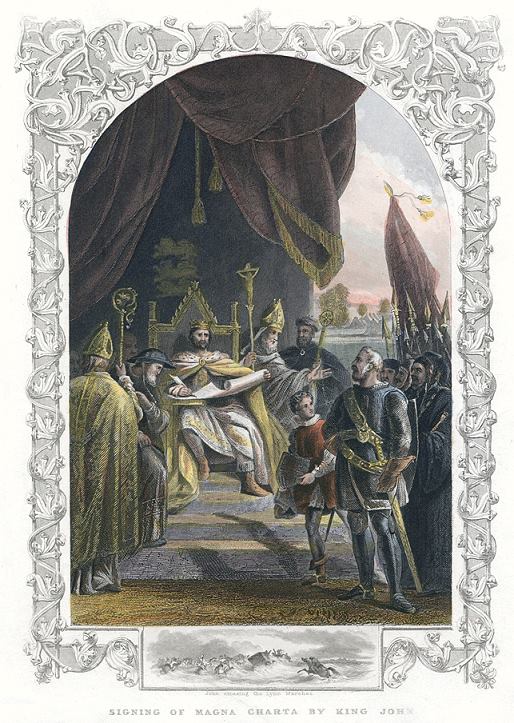
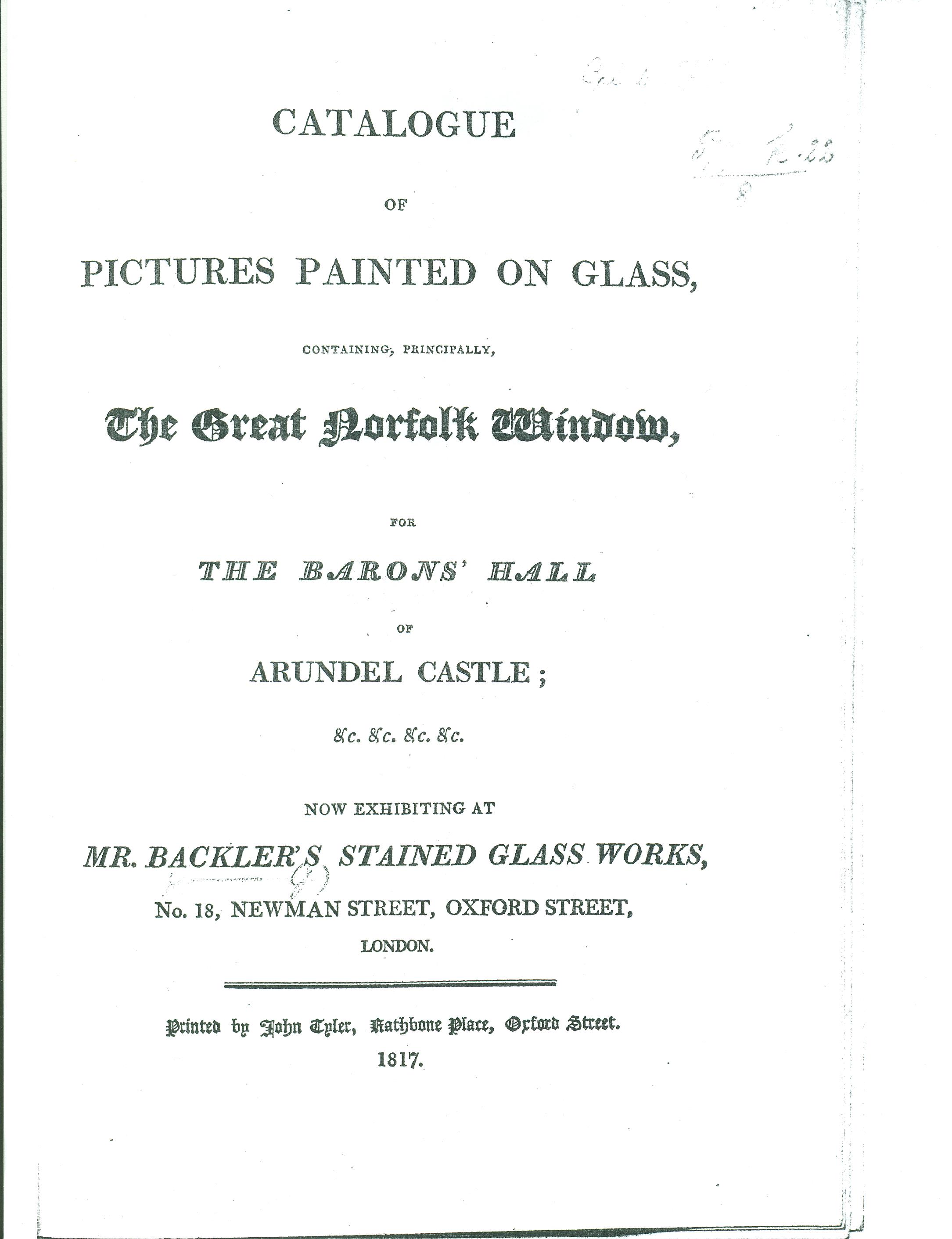
Praise indeed!  The catalogue for this exhibition listed a number of works, principally featuring the ‘Great Norfolk Window’ – King John signing Magna Carta – to be placed in the Baron’s Hall of Arundel Castle, commissioned by the Duke of Norfolk.  Alas, this along with most other Backler windows, no longer exists.

Magna Carta ancestryimages dot com

Newman street catalogue 2016-04-29 001

Some idea of the look of the window can be seen from the image on the right. (credit:ancestryimages.com).  It depicts ‘Signing of the Magna Carta by King John’, anonymous engraver after a picture by Lonsdale from a painting by Backler, published in James Barclay’s Complete and Universal Dictionary … about 1850.

On the left below is the cover of the catalogue for the 1817 exhibition, in which we find more detail about the art of glass painting, as opposed to stained glass:

The window for Arundel Castle was begun under the immediate direction and management of  his Grace the late DUKE OF NORFOLK, who delighted particularly in this effective and elegant Art.  It is presumed that the present Work may vie in all respects with most attempts, in modern days, toward the advancement of the art of Painting upon Glass, as the panes are considerably larger than perhaps in any Work of the same magnitude in Europe; and when it is seen that throughout the whole Window there is not a single piece of what is termed “pot metal glass”, that is, glass formed into one colour in its making, the difficulty of producing the brilliancy of tone apparent in this Picture will be duly appreciated…’ [Referring then to the ancient art of leaded stained glass, the catalogue goes on to say]:  The mosaic here spoken of was the mode pursued by all the ancient glass-painters, and consisted of pieces of coloured glass leaded together.  To form their draperies, &. they were unable, as in modern glass-painting, to execute a picture without the aid of lead-work and pot metal glass; nor had they, as some persons supposed, near so many colours on the palette as modern Artists of this Art are able to produce; consequently, ancient glass, though beautiful as to colour and effect, yet in respect to anything like picture and outline must leave the judicious observer much to regret, from a total disregard of drawing and perspective.’

Modestly [!], the catalogue concludes: ‘In giving publicity to this performance, Mr. BACKLER had no intention of indulging personal gratification: but several Artists of high talent, and others conversant in the Art itself, having earnestly recommended its exhibition; and his Grace THE DUKE OF NORFOLK having kindly acceded to the proposition; he has ventured to submit his effort to public candour and discernment.’  The cast of characters in this window features the Duke of Norfolk as King John, in addition to whom, the Catalogue tells us: ‘The resemblance of the Mayor of London to Harvey Christian Combe, Esq.; of Almeric, the Master of the Knights Templars, to Captain Morris; and of the Page, to the Son of Howard Molyneux, M.P. will be readily discovered.’

Joseph Backler’s other works – major and minor:  As early as March 1813, Backler was advertising his works at ‘Backler’s Gallery of painted and stained glass, 18, Newman Street’ (see for instance, The Times, 23 March 1813, which claimed: ‘Church windows of every description or architecture executed in a superior manner’).  Whether through word of mouth, adverts, self-promotion, family ties or other means, Backler subsequently executed and exhibited windows for, among others:

Limehouse Church (described in ‘The Examiner’, Sunday 19 December, 1813), like many others of Backler’s windows, based on a painting by Benjamin West, who lived near to Backler in Newman Street.

Woodford Church, Essex, 1819.  I suspect this was St Mary’s Woodford, for which an Act of Parliament was passed in 1816 for enlarging, improving and repairing.  If this was the case, the window most likely was destroyed in the fire of 9 February 1969. (http://www.stmaryswoodford.org.uk/history  – accessed 18 May 2016)

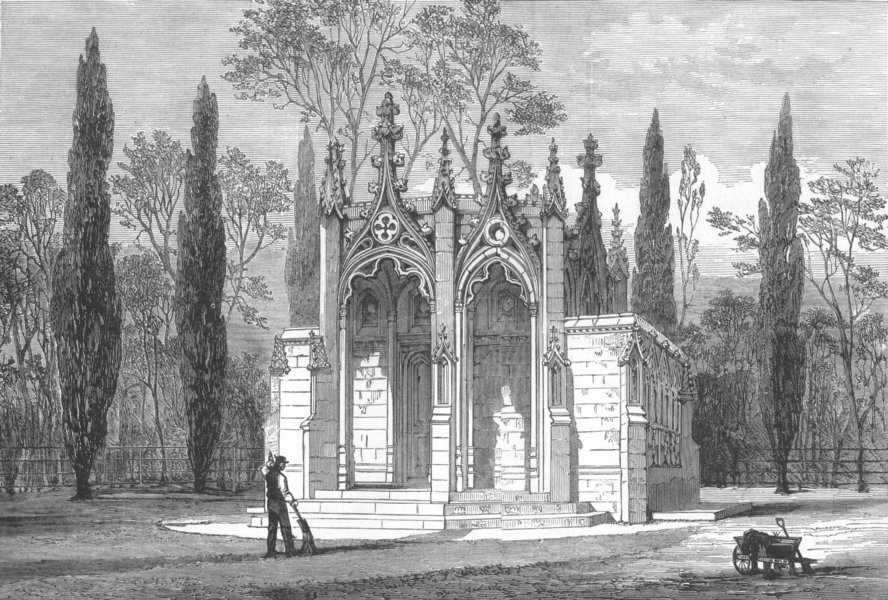
surrey-princess-charlotte-s-mausoleum-claremont-antique-print-1882-249264-pMausoleum, Claremont:  On 11 June 1818, The Times reported that His Royal Highness the Prince Leopold went ‘by appointment’ to Mr. Backler’s premises at 18 Newman Street, remaining for an hour, to ‘make suitable arrangements for the stained glass intended to be placed in the Mausoleum, which has been erected at Claremont, with much taste, in Gothic architecture, by Mr Hiort, under the immediate direction of his Royal Highness, to be devoted to the memory of our late much lamented Princess [Charlotte of Wales, 1796-1817, who died after giving birth to a stillborn son, leaving her husband distraught after fewer than two years of married life].  The whole of the windows are to be filled with the armorial bearings of Her Royal Highness, in conjunction with those of Prince Leopold’s.’  The windows were advertised for viewing in April 1819.  The image is of the Mausoleum, which was converted from a summer house, and demolished in the 1920s. On 24 April 1819, a report in The Times wrote of a private viewing, that Mr. Backler’s productions ‘unite the greatest riches and variety of ornament with great breadth and simplicity of effect.  The arms on the mausoleum windows are painted with exquisite richness and brilliancy…’   In July 1819, Prince Leopold and the Duke and Duchess of Kent visited Mr Backler’s studios to view the windows, which were also seen by the Duke and Duchess of York.  Perhaps somewhere, in some archives, there hides an image of these windows?

St Thomas’ Church, Dudley (1821, east window – this window has been seen by my distant Backler cousin from Australia, but I have not made the journey to see it – on my do-do list!); at this time Backler also advertised viewings for altar windows ‘for the churches of .. Southwell, and Macclesfield‘.  I have not been able to identify which churches these were for.

???Stansted Park Chapel, Stansted Park House, Sussex: The following extract is self explanatory. I have never seen a reference to this place in anything I have seen about Joseph Backler, leading me to think he was not the artist: International expert Mark Bambrough of specialist Scottish Glass studios carried out restoration work to the East Window, which had previously been repaired following bombing during WW2, but in recent years it became clear the repairs were failing. The glass was cleaned and fragments painstakingly re-assembled before being housed in protective panes and re-installed. It is painted, not stained, with a delicate enamel technique. The original artist is thought to have been either Joseph Backler or James Edwards, but no documentation survives. (http://www.hha.org.uk/DB/news/stansted-park-chapel-restored.html)

Hereford Cathedral: the ‘Grand painted window’ for the altar of Hereford Cathedral, viewed by the Duke of York on 15 June, 1823, and by ‘His Royal Highness the Duke of Sussex, Lady Elizabeth Murray and several other ladies of distinction’. I have a photo of this window supplied to me by Hereford Cathedral – I am happy to forward it to any enquirer. The window was relatively shortlived, being removed in the 1840s with the re-design of that part of the Cathedral.  Further information about this window was supplied to me by the archivist at Hereford Cathedral, as follows (and leaving open the fate of the window):

The east window, 40 feet high and 20 feet wide, representing the Lord’s Supper, is considered the largest in this branch of the art since its revival in England; the figures are 15 feet high, and beautifully painted by Mr. Backler, from West’s picture of the Lord’s Supper, at an expense of £2000, towards defraying which Dr. Cope, canon residentiary, bequeathed £500.  (From: ‘Henstridge – Herringby’, A Topographical Dictionary of England (1848), pp. 482-491. URL: http://www.british-history.ac.uk/report.aspx?compid=51026&strquery=backler  Date accessed: 23 October 2009.)

References in the Dean and Chapter Act Book of Hereford Cathedral indicated that there were difficulties in raising the funds to pay for the window. Could these difficulties be related to Backler’s change of fortunes in the mid-1820s, resulting in his giving up the lease on 18 Newman Street, and also filing for bankruptcy?  It is interesting that Backler’s mother-in-law, Jean Cowie (the mother of Jane Cowie, of both of whom little is known) had to join in a bond for the advance paid to Backler in 1822, a time when he was clearly in financial difficulties:

26 Feb 1822: Notice of a legacy of £500 0 0 from Dr Cope towards a painted glass window in the east end of the cathedral.  Mr Backler’s of London design taken from West’s Last Supper approved by the bishop with a subscription of £100 0 0; the dean and residentiaries to subscribe £100 0 0 each.  Although the estimate may amount to £100 0 0 more they flatter themselves there will be no necessity to apply to any but the members of the cathedral and such as derive emolument from it to contribute to this very desirable ornament to the church.  Proposed to have the window completed by the ensuing music meeting.  Letters to this effect to be sent to the various officials [pp. 189-190]

15 Oct 1822:  A further advance of £200 0 0 to Mr Backler provided his mother-in-law join in a bond for that amount and the the amount previously advanced [p. 199]

25 Feb 1823: Further advance of £50 0 0 if sufficient in the bank [p. 203].

10 Nov 1825: £235 4 6 still due to the bankers exclusive of interest.  New dignitaries to be approached for subscriptions [p. 230].

26 Nov 1825: The bank overdraft to be paid from the Shinfield fine by loan at 4% [p. 232]

3 Oct 1826: List of subscriptions amounting to £1792.15.0 recorded [p. 240]

8 Nov 1827: Dignitaries who have not subscribed to be approached [p. 256]

8 Dec 1845: Advertisement to be inserted in a London paper intimating that the dean and chapter will dispose of the painted window in the east end of the choir provided it be re-erected in a church [p. 53]

25 June 1846: The dean read letters from Mr Evans of Shrewsbury and the Rev Guthrie of …. as to the east window of the choir.  Ordered that it be advertised for sale [p. 77]

17 Oct 1846: Painted window offered to Leominster church as a gift if put in the east window there and the organ removed from that situation.  This was owing to the necessity of removing the window to effect the restoration ‘of that portion of the church to its original form.  The parishioners of Leominster being anxious to adorn their church.  Matters left in the hands of the dean to arrange [p. 81]

1 Sept 1849: Announcement that £150 0 0 had been placed in the hand of a London banker for a stained glass window at the east end of the choir [p. 176]

St James’s Piccadilly: This window never came to fruition, though a model was constructed for it, about which we will read in the next blog about Joseph Snr’s ill-fated son, Joseph Jnr. No doubt the inability to raise sufficient funds for the window’s execution contributed to Backler’s general ill-fortunes in the 1820s:

In 1810 several ‘respectable’ inhabitants suggested that the east window should be filled with painted or stained glass. The vestry did not object, provided it was paid for by voluntary subscription, but only sufficient funds to pay for the upper part of the window were promised. The subject chosen was the ‘whole History of the Transfiguration’, and in 1813 Joseph Backler agreed to execute the work and fix ground glass in the lower part of the window for a sum of not more than £1250, or to complete the whole window for £2000, subject to the satisfaction of Benjamin West and Thomas Hardwick.

Backler was given permission to solicit for subscriptions in 1819, and in 1821 the vestry also instructed one of the rate collectors to ask for subscriptions and issued a printed appeal. Promises of funds were so slow in coming, however, that it was not until 1845 that The Builder reported, accurately, a rumour that a Gothic stained-glass window was to be put up. (http://www.sjp.org.uk/buildinghistorya.html)

Here we will leave Joseph Backler Snr, tracing his later years in the next blog, which introduces his son Joseph Jnr.  I have found no reference to further works by Joseph Backler.  He just seems to have ground to a halt, and how he occupied his later years, in an artistic sense, until his death in 1848 remains a mystery.  However, any number of misfortunes were to befall him, including his separation from his wife, the bankruptcy of his brother Samuel Backler, and the death sentence, commuted to transportation, on his son Joseph.

19. Joseph BACKLER Sr. – a painter on glass at 18 Newman Street, London

In which I introduce the somewhat-famous Joseph Backler [Sr], who for a time was a well-known painter on glass, but who fell on hard times and died a rather inconspicuous death. In this blog I focus his family, his early career, and on the premises he used at the height of his reputation, at 18 Newman Street, near Oxford Street, London.

Searching old newspapers, as one does, on the name ‘Backler’, it is hard to avoid the name of Joseph Backler, active self-promoter and sometime well-known painter on glass, whose premises at 18 Newman Street, just off Oxford Street, featured in the many adverts for his work which he placed in The Times in the second and third decades of the 19th century.

Joseph Backler was christened at St Ann Blackfriars on 24 January 1788, son of Sotherton and Hannah (OSBORNE) BACKLER.

Marriage and children: Joseph (said in the Times notice to be an ‘enamel painter’) married on 1 February 1810 at St Mary’s Marylebone, to Jane COWIE, daughter of John Cowie, Refiner, and his wife Jean, of Falcon Square .  Witnesses were his father Sotherton Backler, Sotherton Backler Jr [to become Rev Sotherton Backler – see a future blog], and his sister Mary Backler (who would become the wife of John James Joseph Sudlow). Joseph and Jane Cowie Backler produced five known children:

  • Jane Cowie BACKLER, born 16 April 1811; married to John BROWN in Kilmarnock, Scotland in 1833, and died in Australia in 1855 (shown in the Victoria death index).  They had six children.
  • Joseph BACKLER,  9 November 1812 – 1895.  Well known Australian convict artist, whose story will feature in a future blog.
  • Mary Cowie BACKLER, 1814-1820. The Times on 20 March 1820 reported: Death on 16th, Mary Cowie, 2nd daughter of Mr Joseph Backler of Newman Street, aged 5 years and 9 months.
  • Hannah BACKLER, 1818 – ?1922 in Caulfield, Victoria Australia. Married on 28 October 1854 at St Peter’s Hill, Melbourne, to Henry George REGAN. They had three children, Daniel Joseph REGAN (1857-1942); William John REGAN (1860 – ); Sarah Jane Cowie REGAN (1855-1932, married to Herbert Henry COULSON, 1888; son Harry William Oliver COULSON, 1882-1944, married Florence Mabel MARSHALL, 1909).
  • Sarah Cowie Mitchell BACKLER, 1823-1824, who is buried at Bunhill Fields Burial Ground.

Early artistic career: The Glass Painters Journal (Vol VIII No. 1, 1959) suggests that Backler studied under Chas. [sic] MUSS (1779-1824), who was a well-known enamalist, and later a painter on glass.  Glass painting was distinguished from stained glass made of separately coloured leaded panes, and had something of a revival in England in the later 18th and early 19th centuries.

The London Gazette of 20 October 1812, reported that a partnership was dissolved on 22 September between Joseph Backler, of Newman-Street Oxford-Street, Painter and Stainer on Glass, and William Silk, of Newman-Street aforesaid, Painter and Stainer on Glass.  I cannot find out any further information about this partnership, or about William Silk.

Bankruptcy: We further learn from the London Gazette of 26 October 1819, that a Commission of Bankrupt had been awarded against Joseph Backler, stained glass, dealer, of Newman-Street. He was to present himself to the Commissioners at the Guildhall on specified dates in November and December, declaring his estate and effects.  Those indebted to him should declare this to Solicitors Messrs. Fisher and Sudlow, Thavies Inn, Holborn (Sudlow being Joseph’s brother-in-law).  Bankruptcies were not uncommon among artisans and traders.  While Joseph carried on his business, the bankruptcy proceedings apparently took place, as the London Gazette of 1 March 1823 reports that the Commissioners intended to meet on 22 March to make a final dividend to creditors.  This perhaps sealed Joseph’s fate, as we will see in the next blog that a proposed window for St James’s Piccadilly church never came to fruition, and perhaps his commissions dried up.  (In a later blog we will look in some detail at the bankruptcy in 1831 of Joseph’s brother Samuel.)

Premises at 18 Newman Street In what must have been Joseph Backler’s prime years, numerous adverts in The Times and other newspapers invited the public to view his works at his premises off Oxford Street, at 18 Newman Street.  In the next blog, I will look at many of his works, but as an example, see this early advert of 1813 in The Times of London:

Joseph Backler adverts 23 March 1813

18 Newman Street, Oxford Street:  Newman Street and nearby Berners Street (on which lived for a time Joseph’s brother and my 3x g. grandfather Samuel Backler, who will feature in a future blog) housed many well known artists, including Constable and Benjamin West.  In 2012,  inspired by the impending visit of a very distant Backler cousin (and descendant of Joseph Backler) fro18 Newman Street Google Street Viewm Australia, I decided to search out records of deeds at the London Metropolitan Archives for these premises, uncovering a series of documents (E/BN/16-34) in the papers of the sculptor John Bacon, about his property at 17 Newman Street, the rentaBackler letter Sep 1826 3 signaturel of  next-door 18 Newman Street to Joseph Backler, and Backler’s subsequent surrender of the lease in the mid-1820s when he fell on hard times. The papers were a fascinating collection of information about the Bacon family (father and son famous sculptors) and included drawings of the 17/18 Newman Street premises, which remain in their original configuration today. (Google Street View image, right above, shows the frontage of today – almost certainly dating from the mid-19th century, but perhaps in tune with the previous incarnation as Backler’s studio and showroom.)

Lease dated 9 August 1817 between Joseph Backler Glass Enameller and John Bacon Esquire both of Newman Street for the premises at 18 Newman Street: 

Consisting of two rooms the lower one measuring 19 feet and 9 inches more or less on the west side [fronting Newman Street]; and the upper room measuring 26 feet and 8 inches or thereabouts and exceeding the dimensions of the lower room in length from north to south as well on the east as on the south sides thereof fifteen feet or thereabouts and overhanging the premises of the said John Bacon to such extent and also all that narrow slip of ground lying on the east side of the said premises and running in a straight line from south to north on the west side thereof towards the Mews or Stable Yard in Newman Passage thirty five feet and eight inches or thereabouts and containing in breadth from west to east towards the said Mews on the north eight feet or thereabouts then running from north to south on the east side thereof thirty two feet eight inches or thereabouts and afterwards in an oblique line home to the east end of the said erection or building eight feet three inches or thereabouts of which slip of ground a carriage road or way is intended to be made from the same erection or building into the aforesaid Mews or Stable Yard all which premises are more particularly delineated and described in the plan or ground plot thereof drawn on the margin of these present together with all ways passages commodities and appurtenances to the said Ground, Erection and Premises or any part thereof belonging To hold unto the said Joseph Backler his heirs [etc] [for twenty five years and one quarter of another year from the date of this lease at an annual rent of £75, paid through equal and half yearly payments on the ninth day of February and the ninth day of August]  

The lease was carried out under the auspices of Joseph’s brother in law, John James Joseph Sudlow but sadly, the 25 years of the lease was nowhere near reached, as his letter to Bacon on 8August 1826 reveals:

Mr Bacon:  Sir  –  Herewith you will receive the key of the Premises lately occupied by me at the back of No 18 Newman Street I being now exonerated from any claim for Rent due therefrom and also from further liability to retain [?] the said premises – I am  Sir Ys … J Backler  Tuesday Aug 8 1826


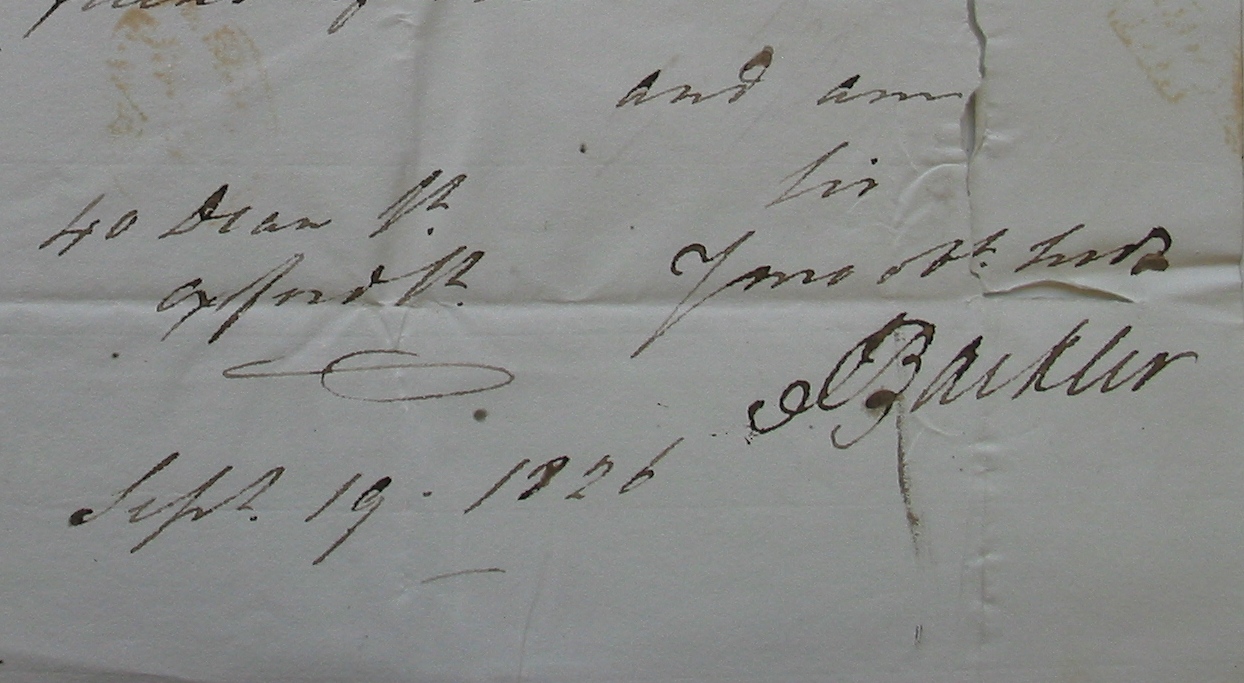
A letter of  19 September 1826 (Backler’s signature above) describes his difficulties in recovering a copy of the lease for the ‘back premises’ from a Mr Ives, having mislaid his own copy.  This letter gives an address for Backler of 40 Dean Street, this taking place perhaps after his wife and daughters had left him to return to her native Scotland, as he descended into penurious circumstances.

An Old Bailey trial on 18 September 1816 refers to the Backlers at Newman Street, and to Joseph’s links with the Duke of Norfolk, arising from his execution of the Great Norfolk Window for the Baron’s Hall at Arundel Castle – see the next blog:  WILLIAM ASHLIN was indicted for obtaining money on false pretences .

REBECCA MOORE. On the day in the indictment the prisoner came to the shop. I had known that he was the servant of Mr. Backler, the celebrated glass stainer, of Newman-street. He asked me if Mrs. Taylor was within. I told him she was, and he asked me to lend him eleven shillings for Mr. Backler, to pay the carriage of goods, lying at Wood-street, which had come from the Duke of Norfolk’s. I lent him eleven shillings upon that. Mrs. Backler was a customer of ours, and we knew her. He came again on Thursday the 25th of July, bringing with him a paper, apparently a bill for the carriage of goods. The amount was one pound nine shillings and a penny, and underneath was written in pencil, “received one pound,” and he asked me to lend him nine shillings and a penny, to pay for the carriage of goods lying at Wood-street, and I did so; fearing that it might not have been right, I wrote to Mrs. Backler, and she sent a verbal message. On Monday the 29th, the prisoner came to the house again, and asked for a one pound note for Mr. Backler, who, he said, was waiting in Gracechurch-street for it. I did not let him have it, but I gave an alarm, and he was laid hold of immediately.

JOSEPH BACKLER. The prisoner was formerly in my employment. I had no goods come to London from the Duke of Norfolk. I expected no such goods. I never authorised the prisoner to get this money.

GUILTY .  Confined six months , and fined 1s .  London jury, before Mr. Common Serjeant.

And with that bit of colour, we will leave Joseph for the moment, looking in the next blog at his heyday in producing painted glass windows.


18. Backler sisters at Geffrye’s Almshouses

Hannah and Sarah Ann Backler:
Half-sisters who lived in Sir Robert Geffrye’s Almshouses

Geffrye Feb 2012

The 1851 Census shows half-sisters Hannah [aka Anna] and Sarah Ann BACKLER living in Kingsland Road Ironmongers’ Almshouses. They were two unmarried daughters of the 14 children of Sotherton BACKLER (1746-1819), who had been Clerk to the Society of Apothecaries.

Hannah BACKLER, daughter of Sotherton BACKLER and Frances nee HARRIS: Hannah was christened on 11 June 1780 at St Ann’s Blackfriars, on the same day as her brother John (see previous blogs for his story and those of is children). Given the christening dates of the previous two children, Sotherton (1778-1786) and Frances (1779-1833) and the marriage date of Sotherton and his first wife Frances HARRIS on 11 February 1777, it seems likely that Hannah and John were twins.

Sotherton and Frances were married at St Mary’s Stoke Newington. Witnesses were Hannah HARRIS [mother? sister?], John FREEMAN (most likely husband to Sotherton’s sister Ann, who married a John FREEMAN in 1770), and Nathaniel JENNINGS. Frances (Harris) Backler presumably died around the time of, or just after Hannah and John’s christening date. I have not succeeded in finding anything about Frances’ origins, nor a date for her death or burial.  I also have no further information about the other two children of this marriage, Sotherton and Frances (who was buried at Bunhill Fields in 1833).

Sarah Ann BACKLER, daughter of Sotherton BACKLER and Hannah nee OSBORNE: Sotherton married his second wife, Hannah OSBORNE, in Bocking, Essex in 1782. (I have not seen the record itself, and so I do not know the name of Hannah’s father, which I suspect could be Thomas Osborne (July 1796 – November 1796) – the name of one of Sotherton and Hannah’s several short-lived children.) Together they had 9 children, the first-born being Sarah Ann, christened on 10 August 1783 at St Mary’s Stoke Newington, as was her next sibling, my 3x g. grandfather Samuel BACKLER, on 18 August 1784. All the subsequent children were christened at St Ann Blackfriars, neighbourhood church to the Society of Apothecaries.

Two daughters married:

  • Mary (1791- 1860) to John James Joseph SUDLOW, a lawyer. They had very many children and descendants and will feature in a future blog.
  • Jane Ozella  (1795 – 1830) to Daniel BURTON, who re-married after Jane’s death and the birth of their child, Sarah Ann BURTON (1828-1916). Their tree can be seen here:  Jane Ozella family tree

The Geffrye almshouses – for the elderly poor:  Sir Robert Geffrye was a prosperous merchant of humble origins. He was twice Master of the Ironmongers Company, and in 1685 became Lord Mayor of London. Among his many legacies to charitable causes, he bequeathed a substantial sum to the Ironmongers Company for the building and maintenance of almshouses. A plot was found on Kingsland Road, Shoreditch, where the buildings, finished in 1715, now stand as the Geffrye Museum. [1]

So what else is known of Hannah and Sarah Ann? Precious little! With luck there could be some information about them in the records of the Ironmongers’ Company, which I have not yet managed to access. Sarah Ann’s mother Hannah (Osborne) died in 1803, when Sarah would have been about 20 and Hannah just a bit older. Did these two young women (and their sister Frances, who died in 1833) remain at home with their father, in particular to look after their much younger siblings? (Their youngest brother Sotherton was born only in 1798 – much more about him in a future blog.)

Death of their father, Sotherton BACKLER: I have already described in a previous blog how, at the time of Lord Nelson’s funeral in January 1806, their father Sotherton had just been appointed Clerk to the Apothecaries, having been acting Clerk for some time. It is possible that he was on the Society’s barge in the funeral procession from Greenwich to Westminster, but in any case, the three young women would surely have viewed the funeral procession as it made its way to St Paul’s, as well as the procession of barges along the river.

Their father Sotherton died intestate in 1819. Administration was granted to his oldest surviving son, John Backler (as noted above, possibly Hannah’s twin), and on 26 October 1819 the Minutes of the Court of Assistants of the Society record a letter from Mr. John Backler, son of the late Sotherton, requesting that the sum of £50 be granted to Frances and Anna [sic] Backler, Sotherton’s daughters. This was duly agreed, and letters of thanks from the recipients were recorded at the Court of Assistants on 21 December 1819, after which there is no further mention of the daughters in the records of the Society. The oldest daughter Frances (who died in 1833) does not appear to have needed this extra sum.  I wonder why.

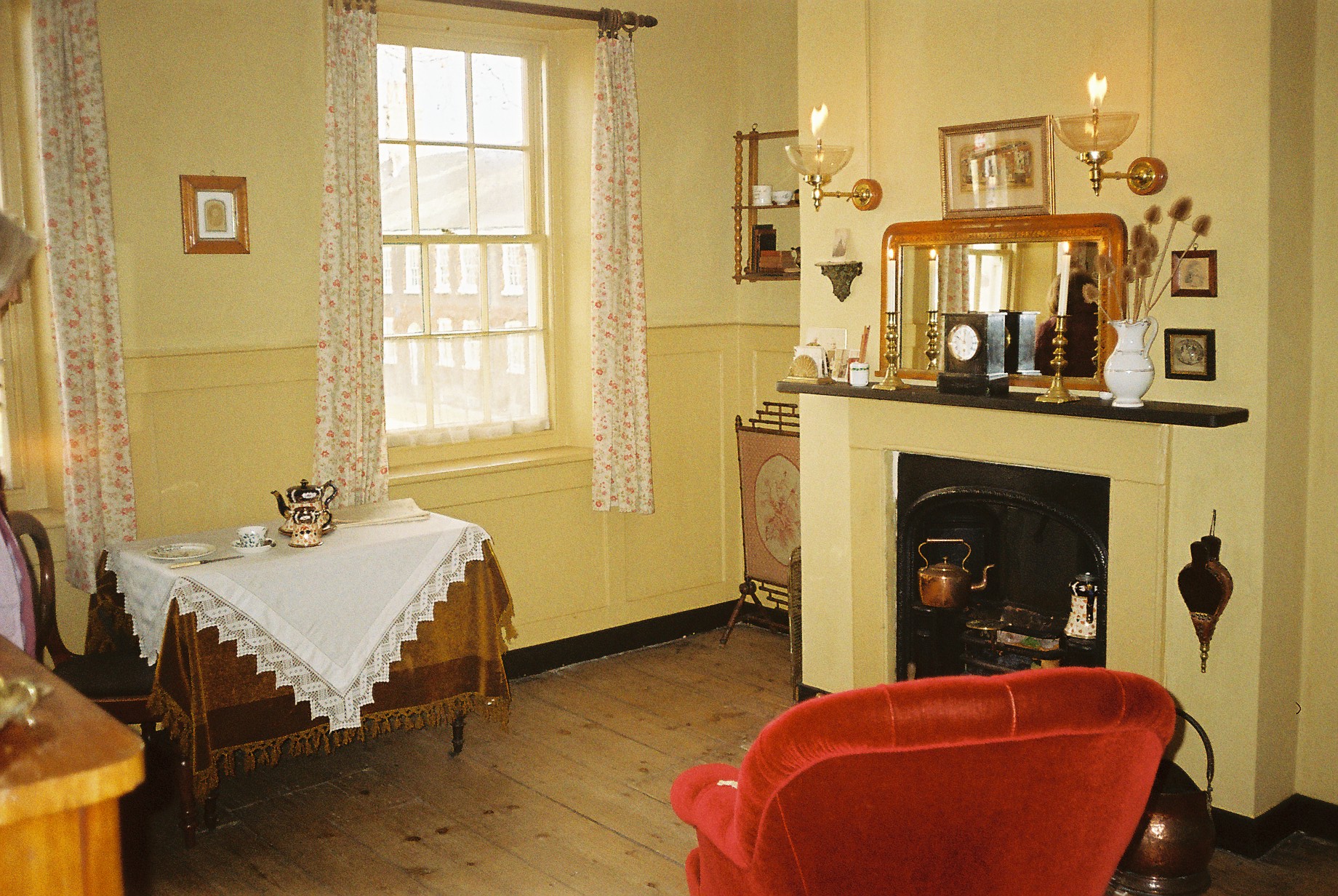
Census returns for Hannah and Sarah Ann: The 1841 Census shows that Hannah, age 60, was living at the Geffrye almshouses. I cannot find a record of Sarah Ann in 1841, but both are shown in residence in 1851 at Jeffries’ Alms [sic], both ‘Almswoman’, Sarah A, 67, at number 5, and Hannah, 71, at number 14, the house which has recently been restored to show how the residents might have lived, in the 1780s and 1880s. The picture here shows the interior as it could have been in the 1880s.

14 Geffrye 2 Hannah Backler 1851

Sarah Ann’s death was registered in 1857, but Anna [sic] Backler appears in the 1861 Census, aged 82, shown as ‘formerly Companion’. This time the house is not numbered on the census return, which helpfully indicates the former status of residents, many shown as ‘widow of …. [citing their late husband’s occupation]’. Hannah’s death was registered at the GRO in 1870, presumably while she was still resident.

Family connections with the Ironmongers – introducing the Pellatts: There was a family connection by marriage to the Worshipful Company of Ironmongers. Hannah’s half-brother, and Sarah Ann’s brother Samuel BACKLER married in 1810 to Mary PELLATT, oldest of the 15 children of Apsley PELLATT (1763-1826), a well-known glassmaker with his son, also Apsley, who later became a member of Parliament. Mary’s grandfather Apsley PELLATT (1735-1798) was Master to the Ironmongers in 1789; his son Apsley (Mary’s father) was a member of the Ironmongers, and another son Thomas was clerk to the Ironmongers. Whether this family connection had anything to do with Hannah and Sarah Ann ending their days in the Ironmonger’s almshouses remains to be discovered.

[1] For much more detail about the history of the Almshouses, see ‘A History of the Geffrye Almshouses’ by Kathy Haslam, published by the Geffrye Museum – no date.

17. Tragic daughters – Florence Sophia McLauchlan Backler and Laura Louisa McLauchlan Backler

It was something of a shock when my eyes landed on the Probate index book entry for Laura Louisa McLauchlan Backler of “Norland”, Champion Park, Denmark Hill in the County of Surrey Spinster: ‘died on the 8th day of September 1909 by drowning in a lake in Richmond Park in the said County’.

Laura was the younger of two daughters of Henry McLauchlan Backler, the successful gas company man whose life I described in two previous blogs. Laura’s older sister Florence Sophia McLauchlan Backler married, aged nearly 19 years, to William Griffin Davis in the Parish Church of St Giles, Camberwell, on 16 August 1866.  Witnesses included her parents and sister, as well as her father’s maternal uncle, Henry McLauchlan, and Sarah Davis.  William was an engineer, resident in Tipton, Stafford. His father John Griffin Davis was a Gentleman.  But the Davis’ do not feature long in our story, because alas, Florence died aged 21 and was buried on 11 June 1869 in Nunhead Cemetery, where William was buried in the same plot in October 1886. He had married Laura Louisa Potter in 1872, but by the time of the 1881 census, he was widowed again, having had a son, William Griffin Parkes Davis in around 1873.

Florence pre-deceased her parents by some years.

At the time of her sister’s death, Laura was aged 19.  Was it this event which led to this young woman devoting her life to piety and good works?

Poetess’ Tragic End:  The headline in the South London Press of Friday, September 17, 1909 read: ‘Poetess’ Tragic End. Camberwell Lady Wanders into a Pond and is Drowned.  Life and Work of Miss Backler’.  At Nunhead Cemetery, ‘the grave was surrounded by a crowd of poor women among whom the deceased was accustomed to work, and one of whom started the hymn “Safe in the Arms of Jesus”, which was taken up by all present and sung with wonderful pathos.’

The mystery of Laura’s death caused considerable concern among her friends and acquaintances, but the report of the inquest reveals undercurrents of mis-trust among her various supporters.  And her Will reveals an interesting relationship which remains unexplained.

The picture which can be drawn of Laura is of a young woman in a very prosperous family, who devoted her life to writing and good work.  As far as can be seen, her writings were of a pious nature, including ‘ “Issy” A Story of Trust and Triumph’[1], the title page of which cites other works by the author: ‘Light and Shadow’ and ‘Heart Musings’ etc.  The title page of ‘How I was turned inside out’[2] also cites her authorship of ‘The Cry for Christ’, while the text of this 14-page tract describes how one man saw the light and reformed his ways from being a bullying husband and father to becoming one who ruled his spirit and ‘came to Jesus’.

Her piety was combined with concern for those who were oppressed in a poem about the ‘sweating system’ quoted in the South London Press report of her death:

‘Marvels of cheapness! Look at the price!  Ah! look at it once again:

See it in sorrow, starvation, vice, And ruin of heart and brain.

See it in girlhood sunk in the mire, the terrible slough of sin;

And manhood checked in each right desire, Scarce able a crust to win.

‘Remember the solemn warning cry Of the prophet’s voice of old,

And refuse persistently to buy Where lives count less than gold.

Give to the labourer what is due, Pity the weak and poor,

Let the world behold Christ’s life in you, With no soul’s blood at your door.’

Both her piety and writing talents permeate the reports about Laura after her mysterious death.  She had invited the local vicar, the Rev John Robert Porte D.D., to lunch on Wednesday 8 September 1909, having only two days previously returned from a five week break with him and his family in Buckinghamshire.  The Rev Porte conducted the ceremony at the graveside, and had identified Laura’s body and given evidence at the inquest into her death, at which he noted ‘she has written beautiful poetry and books, which have been printed. She was a brilliant speaker on religious and social questions. Conversationally she was most delightful in every way…she was a most earnest and devoted Christian woman.’

The South London Press report says Miss Backler was ‘known throughout the Camberwell district for her benevolence, her untiring efforts to advance the moral and spiritual welfare of the poor, her zeal as a Churchwoman, and her power of producing poetry that sounded trumpet notes of earnest protest against wrong and evil’.

Body found at Dann’s Pond, Richmond Park: Some clues as to her behaviour on that day are seen in reports at her inquest and afterwards of her poor health, including among other things, diabetes, and previous instances when she had seemed to suffer from loss of memory.  Saying she was going to the bank in the morning, she had proceeded to Blackfriars Station and purchased a return ticket to Richmond. How had she reached the station from Camberwell?  And why had she purchased a ticket to Richmond?  And how had she then covered the distance to Dann’s Pond on the far side of Richmond Park, near to Kingston Gate?  None of those questions were answered in the subsequent inquiries into her death.  (The pond can be seen in the southwest corner of the park at this link: http://www.mappery.com/map-of/Richmond-Park-Map )

What did emerge was that James Harmsworth, of 5 New Road, Kingston, was crossing the Park near White Ash Lodge, passing Dann’s Pond at 6.30 in the morning, and ‘saw some clothes on the ground with an open sunshade over them. They were under a tree, and consisted of a jacket, hat, waterproof and boots, and spectacle case.’  He then saw the body of a woman in about eight feet of water, using ropes to bring the body ashore, and calling the police.  The report goes on to summarise the belongings on the body of the deceased: ‘a gold signet ring, gold dress ring set with pearls, another set with diamonds, and another set with sapphires and diamonds, 32s 3d silver, and 1s bronze, a silver chain purse, a return half of a railway ticket (Richmond to Blackfriars), black cloth purse bag, three lead pencils, and some memos, two bunches of keys, and one pair of steel-rimmed spectacles, a stone brooch and gold scarf pin’.

The Inquest – dispute over Will and the role of the Rev Porte: When Laura had not appeared for lunch on the Wednesday, she was reported missing by the Rev. Porte, and the next day he travelled to Richmond to identify the body. The inquest was held on the evening of Saturday, 11 September 1909.  A number of people known to Laura Backler were present, including the Rev. Porte and ‘Mr. Davidson, a relative’.  He was in fact Walter Davidson, the nephew of Laura’s mother, and during the inquest there was an atmosphere of mis-trust between him and the long-standing family solicitor, Mr. Cowland on the one hand, and the Rev. Porte and Mr Chester, another solicitor, on the other.  The first area of contention was over the Will.  Cowland solicitors had drawn up the wills of Laura’s father and mother: ‘The Coroner asked if anyone else wished to speak, and Mr. Cowland said that his firm acted for the family for last thirty years, and made a will for the deceased four years ago.  Mr. Chester interrupted and said that could not be correct, for he had acted for Miss Backler for the last six years and held her will.  The Coroner: ‘I am willing to give you all a hearing if you can help me.’  Neither gentleman, nor Mr. Williams, another trustee [of Laura’s Will, and Secretary to the European Gas Company],  however, could add anything to what had been said.

The second, rather more mysterious note of disagreement was as follows:

‘Mr Davidson, a relative: May I suggest you ask the witness…

The Coroner: Will you allow me to examine the witness in my own way? (To Dr. Porte): Was there anything wrong with her mind? – Several times she had a bad memory. She was rather ill two or three years ago, and there was no question she was wandering in her mind.

Would you say her mind was affected? – I would not say that but her brain was clouded…

…Mr Davidson was then asked if he had any questions, and said that Miss Backler had suffered a good deal with her head.

Dr. Porte said that he thought that in the last few years she had been better in that respect.  Some years ago she had suffered from headaches and loss of memory and that was due to a constitutional cause.

Mr. Davidson asked Dr. Porte to read a letter dated December 31st, 1908, in which the words occurred: “Not feeling very well.” He then asked witness to read another, but the Coroner said if he wanted the letters read he could go into the witness-box himself later on.

Mr. Chester: It was about seven years ago that Miss Backler did not enjoy good health.  She was perfectly able to transact business.

Mr. Cowland.  I think he has made a little mistake about Miss Backler’s health. (Mr. Davidson: Hear, hear.)

Mr. Chester: I am sorry to interrupt but the evidence may hereafter –

The Coroner: It is a matter of no importance to me what takes place hereafter. I am trying to find out the cause of the lady’s death.

Dr. Porte: Her doctor can give evidence on that. He is present.

The Coroner: Very well.

After this exchange, Louisa Baughem, the parlourmaid, said Miss Backler’s headaches were usually worse on Wednesdays, and it was unusual for her to go to the bank – she usually sent her companion.

Witnesses described instances when Laura had gone astray in previous years, once being found at her mother’s grave in Nunhead Cemetery, and once in a pond, rescuing a dog.  However, the general sentiment was that there was no obvious explanation for her behaviour at the pond, her doctor suggesting that she might have thought she was going to bed.  Summing up, the Coroner was reported as saying ‘that if the deceased lady had thought she was going to bed she would hardly have opened an umbrella and put it over her clothes. Had she been going to bed she would have probably taken off all her clothes. However, if the jury were in doubt as to her actions, and there was no direct evidence that she committed suicide, they could return an open verdict.’

‘The jury could not at first agree, and the foreman said nine were for a verdict of “Found drowned,” and the other six disagreed.

‘The Coroner: I must have twelve for one verdict. Surely there is no difficulty in agreeing.

‘The jury then retired, and after a short time the foreman returned and agreed on a verdict of “Found drowned”.’

Laura, her sister and parents are all interred in the ‘nature reserve’ section of Nunhead Cemetery.  But her story does not end there.

Laura’s Will – suspiciously favouring the Rev. Porte? Reading the comments about the Will at the inquest, and the comments there and at the graveside by her ‘intimate’ friend The Rev. John Robert Porte, one is led to speculate about his influence over Laura after the death of her mother in December 1903 – roughly the time at which the Laura’s ‘health’ problems were said to be at their worst.  The change of solicitors from the Cowlands to Chesters could have been influenced by Rev. Porte, and when one reads Laura’s Will, one can certainly see that the Porte family benefited handsomely from it.  This friendship, though, was not new.  The Rev. Porte was also an executor of Henry’s and Eliza’s Wills, along with William Williams, the Secretary to the European Gas Company.  But the size of the parents’ bequests was small compared to that which Laura left the Porte family, and Rev. Porte in particular.

Although she was said to have many charitable and benevolent interests, Laura made no such bequests in her will. Her first legacy from her £23,000 estate was for £8,000 to the Rev Porte, and if he should have died, to his wife. In addition there was £1,000 for the Rev. Porte’s wife, £4,000 to their daughter Leonie Sybil Edith Porte (Laura’s god-daughter); £2,000 each to Monica Vera Porte, another daughter, and to each of the four Porte sons; and small bequests to friends, servants and the other executor – the total of which seems to be more than the value of the estate!

Laura’s Bequest to Leslie George Panton – who was he? A sting in the tail for the Executors, however, was contained in fully two pages of the 3 page will.  Laura had inherited the leasehold of the large house ‘Norlands’ from her parents.  In her Will she bequeathed the leasehold premises to her Executors, first so they pay all covenants etc from the rents and proceeds from the leasehold, and secondly so they pay out of rents and profits the yearly sum of fifty pounds, clear of any deductions whatsoever, to a certain Leslie Panton, ‘at present [1906] residing with Mrs. Hanbrin of No 2 Paulet Road, Camberwell and of the age of seven years’ so long as he shall be under the age of seventeen and as long as he ‘shall conduct himself in every respect to the reasonable satisfaction of the said trustees’ in or towards his maintenance, clothing, education, advancement in life and general benefit, accumulating any residue of the said profits and benefits, making payments after age 17 as needed until the said Leslie Panton is age 25, and then after that the moneys to be held in trust for Leslie Panton absolutely, so long as he conducts himself in every respect to the reasonable satisfaction of the trustees!

Leslie George Panton was born on 15 June 1897 at 42 Chelmsford Road, Walthamstow to Jacobina Panton, with no father shown on his birth certificate.  In 1891, Jacobina Panton was a 22 year old dressmaker, living in Dalston with her father James and her siblings.  She is nowhere to be seen by the 1901 Census, when Leslie was living at the ‘Haven Home for Little Ones’ in Banstead, Surrey.

Haven of Hope: In 1893 Janet Ransome Wallis (1858 – 1928) had founded what was then known as the Haven of Hope (later called The Haven of Hope for Homeless Little Ones) in a small rented terraced house in 4 Shernall Street, Walthamstow, London E17.  Soon it had outgrown its premises and moved to Walton Heath, later becoming Christian Family Concern.

What had led Laura to bestow some of her wealth on young Leslie, who would have been about 11 at the time of her death?  Records show he went on to serve with the Army Service Corps in World War I, and to marry Ethel Watson in Tynemouth on 2 June 1923.  Did he continue to benefit from Laura’s generosity?  He died in Newcastle in 1984.

The South London Press Report of Friday, September 17, 1909 had listed some of the many organisations in which she had had an interest.  They included Mr. Fagan’s Home for Boys, Southwark; The British and Foreign Bible Society; The London City Missions; the Rescue Society’s Homes; Miss Steer’s work in Ratcliff; and, tellingly, Mrs. Ransome Wallis’ Babies Home.  Clearly this latter interest had led to Laura’s interest in Leslie George Panton, but what singled him out from all the others she might have supported? And, indeed, why was there no legacy in her will for any of these charities?

Rather tantalisingly, there was a short piece in the Law section of the Times of  9 December 1909, suggesting that the terms of the Will were in dispute.  Under Probate, Divorce and Admiralty Division, in Chancery Chambers, was to be heard before Master White for Master Burney, at 12.45 Re Backler (Williams v. Panton).  Alas, no record of what transpired has yet been found.

[1] “Issy” A Story of Trust and Triumph, by L.L. McL. Backler. S.W. Partridge and Co., 9 Paternoster Row, London. 1886

[2] How I was turned inside out by Laura L McL. Backler, Marshall Bros, 3 Amen Corner, Paternoster Road, London. 1887.  Price Twopence, 12s per 100.

16. Legacy of a gas man – the Wills of Henry McLauchlan Backler and his wife Eliza (nee Cole) Backler

In which we look at the Will of Henry McLauchlan Backler, with news of his siblings and wife, and preceding a look in my next blog at the fate of his two daughters.

In my previous blog, I described the life and times of Henry McLauchlan Backler, successful businessman in the 19th century municipal gas industry.

Henry’s Will

Henry’s Will was written on 13 February 1891, revealing helpful genealogical details.  Henry was of ‘Norlands’, Champions Park – now opposite Denmark Hill railway station, the houses having been destroyed.  He was also of No 11 Austin Friars, City of London (then the address of the European Gas Company, of which he was still Chair).  At the time of probate, his estate was valued in excess of £34,000.His Executors were to be:

‘my dear wife Eliza; my dear daughter Laura Louisa McLauchlan Backler, and my friends John Blacket Gill of the Stone House Caterham Esquire and William Williams of Number 11 Austin Friars, Secretary of the European Gas Company’.

John Blacket Gill was made a liveried member of the Guild of Merchant Tailors in 1867, later to become Master. In 1891, age 51, he was living on his own means with his 39 year old wife, three children and 4 servants in The Stone House, Caterham, Surrey.  Ten years before, he was shown as a coal factor, living in Croydon, Surrey, with a similar number of servants.  His occupation as ‘coal factor’ provides a link with Henry’s gas interests.  William Williams will also feature in Laura’s story.  He was the Secretary of the European Gas Company.

The Will provided for:

–  the leasehold home [Norlands, Champion Park, Denmark Hill] absolutely to my wife and all possessions.  Residue of estate to Trustees. After death of wife, £500 legacy to daughter and £200 to each remaining trustee.

The Trustees should sell property and invest the proceeds to pay:

  • -An annuity of £100 to wife’s sister Louisa Smith, now residing at Croydon House, Britannia Terrace, Upper Westbourne Park,widow, during her life;
  • ‘the same income’ to daughter Laura for her life – she shall not be able to dispose of it in anticipation thereof;

–  after Laura’s death the capital held in Trust for any children she will have; if no child, Henry bestowed legacies on a number of the many charitable pension funds and healthcare providers:

£100 each to Peckham and Kent Road Pension Society; Camberwell and Dulwich Pension Society; the Surgical Aid Society;  the Provident Surgical Appliance Society;

£500 to the Provident Clerks Association Benevolent Fund, 27 Moorgate Street, City of London;

  • to sister Susannah Maria Huxtable of Ashbourne, Lawrie Park Gardens, Sydenham, widow, £1000 (see my previous blog about this wealthy, multiply-married sibling);
  • to sister Sarah Knowles, widow of the Reverend William Knowles, of New Shoreham, Sussex, £1000;
    • Having worked as a domestic servant since returning to London from Paris, Sarah married at about age 50 to Christopher Knowles, schoolmaster of the Protestant Free Church.  After she was widowed, she appeared in 1891 and 1901 censuses living with her sister, Sophia Matilda Beaumont.  Sarah died in 1905.
  • to sister Sophia Matilda Beaumont of Hampton Villas Park Road Worthing, Widow, £1000;
    • No marriage is evident for Sophia and William Beaumont.  In later years, Sophia was to live with ‘daughter’ Eleanor Beaumont, born in Leeds in 1855.  Whether she was Sophia’s daughter is not yet known.  Sophia left £11,000 at the time of her death in 1913.
  • to Gertrude Baddeley daughter of my deceased friend Henry John Baddeley £500; to Annie Grace Perrier Wagstaff (my wife’s god-daughter) now a minor residing with her parents at Ashbury Cottage Forest Hill Kent, £500;  to Fred Hersee, eldest son of deceased friend Alfred Hersee £500, and to his sons Arthur and Stanley, £100, and to his widow Ellen, £500;  to Madeline, Dora and Ida, daughters of my friend Robert H Crowder now of the Larches, Newlands Park, Sydenham, £100 each, and to his son Albert £100; and to Maria Victoria Crowder now living with her mother at Rosedale, Cedar Road, Sutton, Surrey, £100.  All legacies to minors to be paid when they reach 21.
  • All the rest residue and remainder in trust for my niece Eleanor Beaumont, daughter of my said sister Sophia Matilda, for her heirs etc.
    • The fate of Eleanor Beaumont remains unkown…

Norlands:  And what about Norlands? Some flesh is put on the bones of this splendid home by the land valuation survey map and records at the National Archives.  The houses in this tract and others in the area were owned by, and owe the name of their area to, Sir Claude Champion de Crespigny, whose claims to fame were first that he was seriously rich, then a steeplechaser, hunter, and balloonist, and the owner of Champion Lodge in Essex.  Taking up ballooning in 1882, he was the first man to cross the north sea in a balloon in 1883.

The Land Valuation survey (IR 58/78070/2696) for 6 Champion Park puts the gross land value at £110, and that the leasehold owner was J.R. Porte D.D., with a superior interest held by De Crespigny [?name followed by a mark].  The occupier was responsible for rates and taxes and insurance, but it is not clear if Porte was actually resident there.  By the time of this survey, The Rev Porte would have taken on the lease after Laura’s death in 1910.

The description of the property is as follows:  Detached, double fronted, cement faced & painted. Bst. Servants Hall. Kitchen scullery w.c. & large domestic office.  Grd. 4 very fine rec rooms. conservatory w.c.  1st w.c. 5 very good bed. dressing room & Bath room.  Top 4 rooms.

The building and structures were given a market value of fee simple of £1090, and the whole property a gross value of £1910.  On the reverse page, under a date of 1909, the first name to appear is ‘Sir C.C. de Crespigny 87 years, 25/12/1842  £27.15

The second name is J.R. Porte, Occupier.  Further down this page we find that J.R. Porte was deceased on 1 October 1922, giving up his leasehold interest, and the freehold was taken by the Salvation Army, which now owns the whole site.  One of the houses is pictured in Camberwell records, but is not double-fronted, as Norlands was said to be.

Eliza Cole Backler:  I conclude this blog with details of Henry’s wife Eliza’s Will.  These details could equally be contained in the tale of their daughter Laura.  The Rev J R Porte comes to the fore here, first as Executor and then as beneficiary.  This might be the time when he began to assert himself as an influence in Laura’s life – or had he already done so for many years before?

The Will was dated 19 November 1902, with Codicils 11 February 1903 and 24 February 1903.  Eliza died on 19 December 1903, and was interred with her husband and daughter Florence Sophia McLauchlan Backler Davis in Nunhead Cemetery.  At the time of probate her estate was valued at nearly £32,000.  Executors: Laura Louisa McLauchlan Backler, spinster, daughter; the Rev John Robert Porte of St Matthews Vicarage Champion Hill; William Williams of Finsbury House, Blomfield St, City of London, Secretary.

  • £100 to male Executors.
  • Bronze statue of David and Goliath and pedestal to my friend and medical adviser Dr Bramley Taylor;
  • to William Williams the bronze group in my hall which was presented in 1872 to my late dear husband Henry McLauchlan Backler;
  • to John Robert Porte the silver service of three pieces for flowers and fruit which was also presented to my late husband – all subject to my daughter having use for her life.
  • To my friend Mrs Porte (wife of J R Porte) £100;
  • to Royal Hospital for Incurables at West Hill Putney £200;
  • leasehold dwelling house and appurtenances to daughter absolutely and all cash, household effects etc;
  • request her to distribute among ‘my and my husband’s relations and dearest friends such articles of jewellery and of personal or artistic value as she may not desire personally to retain’.
  • Desire Trustees during joint lives of my daughter and of my nephew Walter Davidson as they shall think proper and at their discretion to make allowance to the said Walter Davidson or his wife (if any) not exceeding £100 in any one year.
  • Trustees to pay interest of invested funds to daughter during her life and then each child of Walter Davidson gets £500; during his life he gets annuity of £200 per year unless the Trustees think there is reason not to pay it; the rest to be distributed as daughter from time to time says.

Witnesses J A Cowland Solr. 56 Ludgate Hill; Frances Ann Northern 58 Hogarth Road, South Kensington SW.

  • Codicil revokes £200 annuity to Walter Davidson and bequeaths him £500 only if he survives daughter;
  • further codicil Royal Hospital for Incurables now gets £100, and £100 to Surgical Aid Society.

Henry McLauchlan Backler and his wife had prospered, although they had lost their older daughter at a very young age.  They were not to know the fate of their other daughter, Luara, who although a wealthy woman, had a sad but pious end –  the subject of my next blog.

15. Henry McLauchlan Backler: advocate of municipal gas lighting

In which we consider the life and times of Henry McLauchlan Backler (1824-1892), born in Paris, died a rather wealthy man in London.  Strong advocate of municipal gas lighting and director and company secretary of many overseas gas lighting companies.

Henry McLauchlan Backler was born in Paris, where his father John Backler, apothecary and cupper, had fled in 1820 when under suspicion of fraudulent dealings in his partnership with Thomas Mapleson, cupper to the Prince Regent and then the King. Henry’s birth (12 February 1824), and those of his two sisters Sophia Matilda and Sarah, were registered in the non-conformist registers in Paris for the year 1834.

It is reasonable to assume that as the oldest son of a successful apothecary and cupper, Henry might have had an education in Paris similar to that of his father at St. Paul’s School in London.  However, no records of Henry’s early years have yet come to light.  His education was such as to equip him for a successful business career, as we shall see.

Henry’s father John Backler died in Paris in 1846.  Records show that John Backler’s wife and surviving children then returned to England, perhaps safe in the knowledge that they could not be pursued for his outstanding alleged legal infringement.  The 1851 Census separately records Henry, his mother and his widowed sister Susannah Maria Raoux.

Henry had married Eliza Cole on 3 January 1846, and before the 1851 Census, they had produced their two children:

Florence Sophia McLauchlan Backler, born 29 September 1847

Laura Louisa McLauchlan Backler, born 28 February 1849.

The family lived in Meadow Place, Lambeth in 1851, father Henry shown as ‘Secretary to a Gas Company’.    Meadow Place is a small road just south of Vauxhall Station.  Its location near to Waterloo Station and Bridge would have been convenient for Henry to access central London.  But each successive Census would show moves up-market to their eventual home in the wealthy area of Champion Park in Camberwell.

A career in gas:  My first sightings of Henry came through the Times and 19th century newspapers indexes in a trawl of the ‘Backler’ name through the 19th century.  I found information about the respective businesses of Samuel (apothecary) and Joseph (stained glass artist), mainly in adverts for Samuel’s lotions and potions, and exhibitions by Joseph at his showrooms on Newman Street, near Oxford Street – blogs about both are forthcoming.  But dated much later in the 19th century, I came across references to variations on the name of ‘H. McL Backler’; ‘Henry McL Backler’ and ‘H.M. Backler’.  I didn’t know who he was for quite some time, but the pieces began to fall into place when I uncovered the biographical information above in the nonconformist BMD Registers.

Gas as a whooping cough ‘cure’:  I was intrigued by a letter to The Times on 29 August 1864 in which Henry expounded as a cure for whooping cough ‘the practice of sending children to inhale the gas from newly-opened purifiers’, stating that ‘from information obtained at various works [in France], which I frequently visit, I may infer that the cure for whooping cough is perfect.’  Some 45 years previously, Henry’s  half-uncle Samuel Backler had advertised his own cure for whooping cough in The Times, inviting orders for pills of unspecified content which he assured readers would prove immediately effective![1]

For quite some time I had no idea what this letter referred to.  I decided to try to learn more about Henry’s career in the gas industry through a number of sources.  They included:

  • reports in various London newpapers of his different business interests, consisting of adverts convening meetings, or giving annual or half-yearly reports of the various companies with which he was associated.  From 1850 – 1892 he was auditor to, General Manager, Secretary, Director and/or Chair of at least the Continental Union Gas Company, the Oriental Gas Company (enabled by an Act on 13 February 1857 – see http://indiankanoon.org/doc/333275/), the Turkish Gas Company and the European Gas Company (which owned the majority of shares in Unions des Gaz in France). (Check out this website for a quick look at the gas industry in Europe: http://www.academia.edu/6391506/Gasworks_manufactured_gas_plants_in_Europe )
  • Board of Trade records of limited companies in the BT31 series at The National Archives
  • specialist journals, such as the Journal of Gas Lighting and Gas World, accessed through the auspices of the National Gas Archives in Warrington, Lancashire.

A plethora of municipal gas companies: Through these sources I could build a picture of Henry’s business activities, which were almost exclusively of overseas enterprises for municipal lighting, with dividends often as high as 10 per cent.

Here I copy just a pair of examples of the very many reports I have downloaded.  Careful scrutiny of all of them over a period of some 40 years reveals a lot about Henry’s business activities, the economic climate in which his businesses prospered (or not), and insight into the perceived threats to the industry by electricity.

An advert (a company report) from The Times of Wednesday 15 July 1891, late in Henry’s career, is typical of the type of report which appeared in the press over the years.  It reveals something of the costs the company incurs, principally through the price of coal.  It shows that the kind of contract the company could negotiate with the municipalities it supplied was absolutely key, and that the company was forced to reduce its prices in the interests of long-term sustainability.  It also shows the importance of the by-products of the industry, for instance coke and tar.  J. Blacket Gill, a new member of the Board, was a trustee to and beneficiary of, Henry’s Will.  When reading these adverts across the years, personnel of the different companies appear repeatedly.  I think Henry operated in a business world where a few people held a number of positions of power.  On Tuesday Feb 6, 1872 (p 7, issue 27292), a report in The Times ‘Money Market and City Intelligence’ commented on the incestuous nature of the various municipal gas companies which were being formed:

A prospectus has been issued of the Foreign and Colonial Gas Company, with a capital of 100,000l., in shares of 10l. (half to be first subscribed).  The first work proposed is the lighting of the city of Antequers, in Spain, under an exclusive concession for 58 years.  While the advantages of amalgamation are actively pointed out with regard to railway, telegraph, and other undertakings, it is difficult to see the expedience of pursuing an opposite principle in companies of the present description.  There is an Imperial Continental Gas Company, with a capital of 2,800,000l ; a European Gas Company, with a capital of 234,000l.; and a Continental Union Gas Company, with a capital of 8000,000l.; yet, to start some new works at an interior town of Spain which are not to cost more than 24,000l., a new Foreign and Colonial Gas Company is to be inaugurated with all the usual distinct administrative offices, such as a Board of Directors, auditors, solicitors, and clerks.  Another peculiar feature in the prospectus is that two of the Directors belong to Boards of other companies formed for the very same objects – one of them belonging to the European and the other to the Continental Union Gas Company.

Another article from much earlier in Henry’s career (The Times, 7 March 1856) shows Henry as auditor to the newly-developed Turkish Gas Company; he was already Secretary to the European Gas Company (which was a major holder of shares in the Unions des Gaz in France), and this illustrates some of the duplication in personnel reported above.  It also illustrates how much detail there is in pieces such as this about context of the businesses, for instance describing the extensive nightlife and many buildings which could be illuminated.

Metropolitan Steamboat Company:  All these Gas Company adverts taken together would allow analysis of the ebb and flow of British involvement in municipal gas lighting abroad.  In the midst of them appears a business interest of a different nature – an advert for the Metropolitan Steamboat Company (The Times, 7 March 1856), one of whose Directors was H McL Backler, Chairman of the Continental Union Gas Company.  Plans were for the company to build boats specifically designed for speed and comfort; for attention to refreshments; and for links with interchanges with railway companies. This company appeared to be an amalgamation of the London Steamboat Company and the Woolwich Steampacket Company. I haven’t been able to find anything else about this company, but it illustrates some of the diversity of Henry’s business interests.

 TNA – the BT31 series:  I decided to see what I could find out about Henry’s various companies at the National Archives.  Series BT 31 consists of files of dissolved companies of all kinds incorporated between 1856 and 1931 and dissolved before 1932; some files of companies incorporated between 1856 and 1900 and dissolved between 1933 and 1948; files of public and private non-exempt companies incorporated up to 1970 and dissolved between 1948 and 1971 with a one per cent sample of files of exempt private companies.  (Records of existing companies can be viewed at the search rooms of Companies House, although once a company is dissolved, its records are destroyed after 20 years unless part of the sample held at TNA.) Only a sample of dissolved companies had full returns preserved after many were destroyed after 1950, but I struck lucky with the European Gas Company.  The books begin with details of the incorporation after the 1856 Companies Act, with many images including H M Backler’s signature (see right, from TNA, BT31/35913/1604).

Eur gas co Ltd HMB sign BT31 35913 1604

Back to the cure for whooping cough:  When I first saw the letter about the whooping cough cure in the Times, I was mightily puzzled.  My idea of ‘gas’ is based on natural gas from the north sea, with only a dim memory of when ‘gas’ meant something derived from coal or some other product (such as whale oil).  Of course the gas Henry was involved with was coal gas, the production of which involved huge capital investment in equipment and technology.  Henry was a member of the Gas Institute, originally known as the British Association of Gas Managers.  He actively promoted the cause of gas over electricity, for instance in  ‘Remarks on The Electric Light,[2] which summarised his views on why it was highly unlikely that electricity could ever take precedence over gas for lighting, owing to high costs and the need to replace the ‘candles’ every half hour or so. During the 1880s, though, the pressures of  technological developments in electricity were reflected in his annual reports to the shareholders of the various companies with which he was involved, although even just before his death in 1892 he was reporting that he didn’t think electricity would be a threat to gas in the supply of fuel for municipal lighting.

The gas involved in the ‘cure’ for whooping cough was that of the gas purifiers. The use of gas as a cure was not confined to this country or Europe.  A contemporary article about whooping cough shows that this was used in America as well[3]:

‘Several stories from around the turn of the century described crowds of children gathered at factories belching pollution, which was thought to be an effective treatment for whooping cough. “Gas As A Medicine: Chicago Factories Are A Whooping Cough Cure,” was the headline for one 1898 story that appeared in the Chicago Daily Tribune. “One Place Last Year ‘Treated’ Three Thousand Children.” Another, appearing in the Chicago Daily Tribune in 1893, read “Children At Gas Tanks: They Come To Inhale The Fumes For The Care Of Whooping Cough.”’  Google searching on ‘gas as a cure for whooping cough’ shows that this approach was used up until the middle of the 20th century!

The National Gas Archive:  TNA’s BT31 papers, combined with the newspaper adverts I have described above, allow me to see the breadth of Henry’s involvement as a businessman across the gas industry, and to learn more about the fortunes of that industry over a period of 40 years.  However, they don’t give much insight into his personality.  This was to come through his obituary which appeared in the Gas Journal, and which was sent to me by the Archivist at the National Gas Archive in Warrington.  Even allowing for hyperbole in obituaries, it offers some insight into a man who was not only a good businessman, but also someone who was respected and liked. Alas I can’t figure out how to reproduce it here – so that will have to await another day.  Suffice to say that Henry died on 30 November 1892.  We will look at his Will, and the fate of his wife and two daughters in the next blog.

[1] The Times 12 April 1819, and other dates

[2] Henry McLauchlan Backler, FRGS, FRHS. Remarks on the electric light, revised edition. Printed for private circulation by Waterlow & Sons Limited, London Wall, London, 1878.  This publication is held in the British Library.

[3] Chicago Tribune, 6 January 2012: Our whooping cough story, and why medical reporting is so interesting |By Trine Tsouderos


14. Susannah Maria (nee Backler) Raoux/Gott/Huxtable – first-born well-married daughter of John Backler, cupper

In which we consider the fortunes of  the first-born child of John Backler, cupper, and his wife Susanna Maria (nee McLauchlan).  Of young Susannah’s early years in exile in Paris, we know nothing.  But from her marriage in 1841 to Charles Raoux in Paris, we can follow her fortunes for the next 60 years during which she appeared to do very well indeed!

Susannah Maria McLauchlan Backler, named after her mother, was born on 21 January 1822 and christened in Christchurch Southwark on 18 August 1822.  At that time her father was rather in disgrace in Paris, and it is not clear whether or not he attended her christening.

First Marriage –  to Charles RAOUX: Our next sighting of Susannah is the marriage of ‘Marie Suzaune’ Backler, daughter of John and ‘Marie Suzaune Auclan’ to Charles RAOUX in Paris on 11 December 1841.  I can find no information about Charles other than the names of his parents, Jean Raoux and Marie Henriette Delorme, and there is no online record of his death before 1851.  Susanna Maria’s father John died in Paris in 1846, and presumably her husband Charles died before 1851, since she appeared as a widow in the census of that year, in the home of her future husband, the wealthy merchant William GOTT of Leeds.

Second marriage (twice?) –  to wealthy merchant William GOTT.  http://en.wikipedia.org/wiki/File:KP-St-Marks-Church.jpgThe 1851 census was taken on 30 March 1851.  It shows William Gott, 53, widower, woollen cloth merchant, living at Denison Hall, Hanover Square, Leeds, with 5 of his children, and Susannah Maria Raoux, visitor, widow, 29, born France – and innumerable servants.  This was rather distinguished company for Susannah Maria, the Gott family being one of the most prominent families in Leeds.  Four months later, Susannah was married to William at St Mark’s Kennington (pictured right, see note 1) on 28 July 1851.  Her brother Henry McLauchlan Backler – of whom we will learn much more in a later blog – had married there in 1846.  It seems possible that the marriage there was linked to his residence nearby.  I rode my motor bike past this church every day for many years en route to work in central London. It is an imposing building near the Oval tube station.

For reasons which remain unclear, William and Susannah were married again in 1853.  I have a copy of the Kennington marriage, from the Ancestry London Metropolitan Archives collection.  Yet less than two years later, another wedding was announced, this time in Blatherwyke, Northamptonshire, where Susanna’s half uncle Rev Sotherton Backler was vicar and Rural Dean.  We will learn much more about him later.  There are entries for both marriages on the GRO marriage registers. The following report appeared in the Leeds Mercury – and many other papers – for the 1853 marriage:

Leeds Mercury, Sat April 9, 1853.  On Wednesday at Blatherwycke, Northamptonshire, by the Rector the Rev. S. Backler, M.A., rural dean, uncle to the bride, WILLIAM GOTT, Esquire, of Little Woodhouse, Leeds, to SUSANNAH MARIA, daughter of the late John Backler, Esq, MD, and widow of  Monsr C. Raoux, of Paris    

In 1861 we find Susannah at the Gott family home at Bay Fort in Torquay.  The census entry tells us:

Bay Fort (now Bay Fort Mansions) Torquay

Bay Fort (now Bay Fort Mansions) Torquay

Susannah M Gott, 39, Wife of Head, Cloth Merchant, Born Paris
[Her husband William Gott, 64, woollen merchant and manufacturer, was staying at Armley House, Leeds, with his brother John Gott, a Magistrate and woollen merchant and manufacturer, employing 650 men and women and 150 boys and girls]
Margaret Gott, 38; Ann Gott, 32; Harriet C Gott, 20; all ‘daughter’ [in reality, step daughter] born Leeds, Yorkshire.
Robert Nairne, Visiting son in law, M.D. Trinity College, Cambridge, born China, Macau. [Named as Executor in William Gott’s Will]
Elizabeth, daur, 35, born Yorkshire, Leeds
Ethel M, Annie B, Maud M Gott, granddaughters, 4, 2, 3 months. Born St George Hanover Square except Maud, born Surrey, Richmond. 

But two years later, William Gott, who was said to have been in poor health, died in Patterdale.  His many accomplishments and interests are summarised in an extract [ref. 2] from The National Archives Catalogue of holdings in Leeds University Library special collections:

The third son [of Benjamin Gott], William (1797-1863), of Wyther Grange, inherited his father’s taste for fine art. He also built up a magnificent collection of rare books, now, unfortunately,dispersed, which included several early editions of the Bible, liturgies, and Shakespeare’s works. His papers include over 100 letters from art dealers (Dominic Colnaghi, John Sheepshanks), booksellers (Boone, Pickering), and book-collectors (Francis Fry). William Gott was active in encouraging public building in Leeds. He was the Chairman of the Building Committee when the extension to the Philosophical Hall was built, in 1861-62. About 20 letters from him to T P Teale, the Leeds surgeon, concern the planning and building of the new Leeds Infirmary in 1862 -63. He married Margaret Ewart (1795 -1844), daughter of the Liverpool merchant, William Ewart the elder (1763 -1823).  Harriet Gott (1795 -1883), who endowed almshouses at Armley, was William Gott’s unmarried sister.

Armley Mill, LeedsArmley Mills Industrial Museum:  Benjamin Gott and his sons were proprietors of what was once the largest woollen mill in Europe – Armley Mills.  The building now houses the Leeds Industrial Museum [note 3].  William is buried in the lavish family vault in Armley Church, his extensive ‘Gott Collection’ now featuring until Spring 2015 at the Hepworth, Wakefield.

Susannah did rather well from the provisions of his Will.  Amidst very many pages of legalese, it is possible to discern that the leases of the properties at Bay Fort and in Wyther were to be left in Trust for her use and that of his unmarried daughters, for their natural lives or until they married.  Susannah was to have £500 at once, and the income from £12,000 to be invested by the Executors, this income to continue to be for her absolute use even if she married again.  His effects were said to be ‘under £140,000’ – by far the most of anyone mentioned, through marriage or any other means,  in my family tree!

Third marriage – to Anthony HUXTABLE, a wealthy Churchman and agriculturist: The 1871 Census finds widowed (again) Susannah living at Bay Fort with her step daughter Margaret Gott, 48; step grand-daughter Mabel Elizabeth Smyth, 9; and five servants.  Conveniently living next door, in ‘Hawthornden’, were Anthony Huxtable, Head, 63, Archdeacon and Rector in Dorset, with his 73 year old (very wealthy) wife Maria Sarah Huxtable, 73.  They were looked after by eleven servants.  Both houses sat on the cliff tops overlooking Torbay.

Maria Sarah Huxtable died in an accident involving the lift at Hawthornden, and was buried on 8 May 1874 at Sutton Waldron, Dorset, paving the way for Susannah’s next marriage to Anthony HUXTABLE on 2 November 1875 at St James’ Piccadilly.  The ceremony was conducted by John Gott, D.D., William Gott’s son; one of the witnesses was Robert Nairne, son-in-law and executor to William Gott’s will.  It seems highly possible that Susannah’s brother Henry McLauchlan Backler and his wife Eliza might have attended this wedding.

The 1881 Census finds the couple in retirement at 35 Warrior Square,  St Leonards on Sea, Sussex – just them with 4 servants plus a Butler and a Page.  The Warrior Square houses are some 5 stories high plus a basement. But their married life was relatively short-lived.  The Will of the Venerable Anthony Huxtable late of Sutton Waldron in the County of Dorset Clerk formerly Archdeacon who died 12 December 1883 at St Leonards on Sea in the County of Sussex was proved at the Principle Registry by Susannah Maria Huxtable Widow the Relict and the Reverend Samuel Penrose Downing Clerk, both of Sutton Waldron and Henry McLauchlan Backler of 11 Austin-Friars in the City of London. Effects £88,714 14s 1d.

Inscribed in the burial register of St Bartholomew Church, Sutton Waldron, Dorset is the following: ‘Anthony Huxtable was rector of this parish from 1834 to 1871 – was appointed Archdeacon of Dorset in 1862 but retained the office only one year. He married Miss Langston daughter of the late Mr Langston of Sarsden, Oxon in  1840.  The church of this Parish was built by them (the old one being very dilapidated) and was consecrated in 1848′.   As well as his church-building project, he was an agricultural pioneer and was said to have worked tirelessly to improve the lot of his parishioners.  He researched and tried to put into practice new uses for manure, devising systems for collecting and using the manure from his pigs.  His lecture on The Science and Application of Manure, in 1847, apparently went through many editions.  He was a member of the Chemical Committee of the Royal Agricultural Society.

The wealthy widow lives til 1901:  Susannah Maria did very well by the provisions of Anthony Huxtable’s Will.  In 1891 we find her living on her own at The Birches, Ashbourne, Lawrie Park Gardens, Sydenham, in southeast London, with 7 servants, including a butler and a page, a single young woman companion, and the coachman with his large family living next door in Ashbourne Stables.  This wasn’t all that far from her two sisters, Sarah Knowles and Sophia Beaumont, who were living in Winbledon at the time.  Yet, with the exception of the clear links with her brother Henry, there is no sign that she was in touch with them – or, indeed – favoured them with any spoils of her Will when she died in 1901!

The total value of her estate was in excess of £56,000. Generous legacies went to numerous church charities, includingSusannah Huxtable charitable legacies the Society for the Propagation of the Gospel in Foreign Lands and its Women’s Mission Association; St Augustine College Canterbury; the College of Women Workers at Blackheath [The great aim of the Greyladies’ College is to bring together lonely women working in isolation without a definite plan, and also women who are possibly daughters in a large family and find it difficult to separate themselves from social distraction in order to follow religious and philanthropic work. It becomes a great happiness to such to be associated with people who are trying to make the world better. Many women emerge through such association from a life of narrowness and emptiness into one of breadth and satisfaction. The college (founded in 1893) is described as a society of ladies living together for the purpose of helping in the work of the Church of England under the incumbents of the diocese. The bishop of the diocese has ultimate control over all its affairs. The Greyladies work in twenty-two parishes in South London. [See Note 4]]; other church charities and then locally, two local National Schools and the local Infirmary for Sick Children.

There were legacies to godchildren; to her late husband’s Huxtable relatives; to various friends and servants.  Of her blood relatives, the only mention was a legacy of £1,000 to her late brother’s wife Eliza [nee Cole] Backler.  No mention of her sisters, and no mention of more distant – and much less well off – Backler cousins and half cousins.  Which perhaps makes sense, since Susannah’s great wealth was entirely due to the inheritances she had received from her two very wealthy husbands.

There are no further generations of Backler cousins descended from Susannah, so we will leave swaldron1her interred next to her last husband, the Venerable Archdeacon Anthony Huxtable by the church which he had built using his first wife’s wealth, and said by Sir John Betjeman to be ‘one of the best and most lovely examples of Victorian architecture’ –  St Bartholomew’s Church, Sutton Waldron, Dorset [note 5].


1.  http://en.wikipedia.org/wiki/File:KP-St-Marks-Church.jpg

2. http://discovery.nationalarchives.gov.uk/details/rd/c8c11929-9c8d-47fb-a84d-2583f01d8a50. Gott papers.

3.  http://www.leeds.gov.uk/museumsandgalleries/Pages/armleymills.aspx

4. http://chestofbooks.com/food/household/Woman-Encyclopaedia-1/Religion-The-Greyladies-College-For-Women-Workers.html#.VK_nUyusWpA#ixzz3OKq54rqI

5.  http://www.wessexarch.co.uk/book/export/html/251


13. John Backler (1780-1846) – Apothecary, Cupper – and ‘outlaw’

In which we consider what is known about the life and career of Sotherton Backler and Frances Harris’ son John, a cupper, and his flight to Paris.  

The report of the hearing at the Court of Common Please was unequivocal.  ‘[John] Backler had .. been outlawed and was out of the country.’  John Backler’s father was the eminently respectable Sotherton Backler (1746-1819), an apothecary and Clerk to the Society of Apothecaries.  John was the fourth of Sotherton’s 13 children, the youngest of four children born before the [presumed] death of his first wife Frances Harris.  What circumstances had led to the hasty departure of John from England for Paris, where he died in 1846?

John and Hannah Backler christening 1780Thanks to their father’s close association with the Society of Apothecaries, most of his children were christened in nearby St Ann Blackfriars.  John was christened on the same day as his sister Hannah.  Sotherton and Frances had married in Stoke Newington on 11 February 1777.  Their oldest child Sotherton was christened on 5 January, 1778 (but died in December 1786), and his sister Frances on 23 May 1779.  This surely means the double christening on 11 June 1780 was of twins?

On 17 August 1790, John was enrolled at St Paul’s School, which was in St Paul’s Churchyard, just around the corner from his home at Apothecaries Hall.  No further information about his time at St Paul’s has been found.  His career at the Society of Apothecaries is more easily traceable in a fragile card index  which summarises all the mentions of its members through several centuries, compiled by Cecil Wall, a one-time clerk to the Society.  It shows that John was apprenticed to his father on 5 April 1796, and was admitted to the Yeomanry in 1803.  This meant that he was a member of the company, and having been apprenticed, he was probably admitted by ‘servitude’ rather than by patrimony.  There is no indication, though, that he was ever elected to the ‘Livery’ of the Company, the economic and social elite of the membership, who were entitled to wear the company’s ‘livery’.

I have found no details of John’s early life as an apothecary.  There was a thriving trade at Apothecaries Hall, where there was a laboratory for the manufacture of drugs, and a salesroom.  His father would have been occupied with his duties as Clerk, but John may have worked with his younger half-brother Samuel, some 4 years John’s junior,  who had been admitted to the Society by patrimony after the Master to whom he had been apprenticed had died.  An 1811 directory finds both John and his father Sotherton in residence at Apothecaries’ Hall (and Samuel at his premises in Bedford Street, Covent Garden).

A cupper: John’s practice as an apothecary centred on the ‘art’ of cupping, an ancient practice involving the placing of heated cups on the body at different points, to draw out the ‘humours’.  Cupping could be ‘dry’ (just using the heated cups), or ‘wet (involving scraping of the skin on which the cup was placed, to draw out blood).  This is sometimes known as blood-letting.  As the heated cups cooled, the vacuum they created drew up the skin, causing marks which remained when the cups were removed.  The hot cups could also cause burns.

Mapleson book on cuppingJohn entered into partnership with Thomas Mapleson, a well-known cupper to the Prince Regent and then King.  The premises of this partnership were in Golden Square, at the corner of St John Street, in the City of London.  Mapleson was the author of ‘A treatise on the art of cupping: in which the history of that operation is traced; the various diseases in which it is useful indicated and the most approved method of performing it described’.  This 80-page tract was first published by the author in 1813, and reissued in 1830.

Fraudulent dealings and flight: However, the partnership was not to last.  On 2 December, 1820, John married Susanna Maria McLauchlan in the safety of the port of Dover,  presumably on his way to Paris, shortly after his partnership with Mapleson  had been dissolved in October, 1820.  The rather sordid details of the alleged fraudulent dealing of bills of exchange between Backler and a man named Chartres (subsequently transported to Australia) can be seen in Chancery papers (C 13/283/17,  6 May 1822) and a lengthy report in the Morning Chronicle.  In ‘Wills v Mapleson’, heard in the Court of Common Pleas on 10 December 1823, Frances Wills was seeking recompense from Mapleson on account of a fraudulent bill issued in autumn 1820 by Backler in the name of the partnership.  Since Backler was ‘now outlawed in Paris’, Mapleson was being held to account, even though the partnership had been dissolved at around the same time as the exchange of the bill.   The upshot of the case was that the jury found for the plaintiff, and Mapleson had to pay £115.  The next year, Mapleson tried to produce new evidence to support his claim that he was not responsible for the Bill, but this attempt failed.

In his case to Chancery, Mapleson had reported:

The Times 1 September 1820

‘the said John Backler had shortly previous to the dissolution of the said partnership became embarrassed in his circumstances and had unknown to your Orator (as your Orator has lately discovered) published an Advertisement in the newspapers in the words following [see advert from The Times 1 September 1820] that is to say, “Money, the Advertiser wishes for the loan of Two hundred and fifty pounds for two years the most liberal terms will be offered the situation respectability and principles of the Advertiser will be no barrier, Address letters post paid with real name and address to X.X. Battys Coffee House behind the new church Strand” as by the said Advertisement will appear and your Orator sheweth that one George Chartres a man then in desperate circumstances answered the said advertisement …’  Chartres had in effect swindled Backler out of large sums of money, andthe fraudulent bills were passed to Frances Wills, who sought recompense from Mapleson.

By this time, John Backler was well away, having married Susanna Maria McLauchlan (born around 1890 at Landguard Fort in Essex).  Their first child, Susanna Maria was said to have been born in Paris in January 1822, but christened at Christ Church Southwark in August 1822.  Her father’s address was given as John Street West, but it is not clear whether at that time he was in England or not.  What seems fairly certain, however, is that after the above court case, he remained in Paris until his death in 1846.  There are various references to the ‘noted English cupper’ Mr. Backler.  For instance On 1 May 1832 The Times reported in its ‘French Papers’ section, from Galignoni’s Messenger’, in an article which discussed official returns for cholera, and the system of cupping:  ‘they have therefore had repeated recourse to the English cupper, Mr Backler, Hotel de la Marine, No 23: rue Gaillon, whose skill and experience have been constantly exercised with the best results.’

Successive editions of Gallignani’s ‘New Paris Guide’ show Backler in 1827 at 15, rue Trainee, St. Eustache; in 1830 at Hotel de la Marine, rue de Gaillon No. 23;  in 1839 at rue Neuve St. Roch, No. 49;  and in 1841 at rue Rameau, No. 7.

While carrying on his successful career as a cupper, Backler and his wife produced a number of children, whose christenings in Paris are recorded in nonconformist records.  Their son became a highly successful businessman,  whose two daughters had tragic ends.  The three daughters married (one very very well, and several times), while another son has yet to be traced after his birth in Paris.

12. Sotherton Backler (1746-1819) – the last years

In which we consider events at the Society of Apothecaries during Sotherton’s reign as Clerk, and record his demise in 1819.

Sotherton Backler was elected Clerk to the Worshipful Society of Apothecaries on 15 January 1806, just days after the funeral of Admiral Lord Nelson (see previous blog).  In this role he administered the workings of the Society, in particular recording proceedings in his immaculate hand in the Minute Books of the Court of Assistants.  His years as Clerk were to be of great importance for the Society.

The history of apothecaries as a trade or profession was long one of rivalry between different types of practitioner, ranging from physicians and surgeons to chemists and druggists, and from tradesmen to medical practitioners.  The rivalry with the Physicians was resolved at least in law by the case of apothecary William Rose in 1704. The House of Lords over-ruled his conviction for treating a butcher name Searle. This established the right of apothecaries to practice medicine, and changed the role of the Society from one of subservience to the physicians to a more complicated multi-purpose function of both professional and trade regulation, as well as trading in its own right.  This dual nature was to persist right through to the Apothecaries Act of 1815.

sotherton backler TIMES 1815 soc apothIn the period leading up to the passage of the Act, Sotherton, among others, was engaged in considerable negotiation and lobbying. The Society, initially reluctant to accept change, in the end took on the role of formalising a curriculum and overseeing examinations which, along with apprenticeship, attendance at lectures on such topics as anatomy and physiology, and other matters, led to the Licentiateship of the Society of Apothecaries, precursor to what we now know as General Practice.  (The extract right from The Times of 21 July 1815, announces the changes which the Act brought.) At the same time, chemists and druggists, who during the latter part of the 18th century had begun to usurp the dispensing role of apothecaries, began to formalise their own training and qualifications, resulting in the establishment of the Pharmaceutical Society of Great Britain in 1841.

Despite the formalising of apothecaries’ education and training, a sore point remained their inability to charge for medical advice or attendance – a hangover from earlier days of dispute with the physicians.  Apothecaries could only charge for medicines, until a court case in around 1830 ruled that they could also charge for visits and medical advice, thus reducing their previous tendency to over-prescribe medicines in order to cover their costs for practising, in effect, as general practitioners.

The Society’s records yield evidence that Sotherton Backler lived at Apothecaries Hall during at least part of his tenure as Clerk.  His wife Hannah had died in April 1803, leaving Sotherton with a large number of surviving children presumably still at home.  It seems likely that some of the older siblings would have taken charge of the household and care of the family.  On 20 March 1807 the Society was in receipt of a letter from the Secretary of the London Bridge Water Works, revealing the discovery by the Collector of the Water Rents that there might be a supply to Apothecaries’ Hall over and above that already known, ‘to the Dwelling House of Mr. Backler, for which he [the rent collector] has received an Annual Payment of £1-8-0…’  The letter asserted that additional water was now found to be supplied to ‘a large Back and two Cisterns’, estimated value of £10 a year.  The Board suggested a payment of £200 to cover arrears of water supply for an unknown period!  However, by May, it had been decided on further examination that there was no service of water other than to Mr Backler’s house, and there the matter rested, useful indeed in our ascertaining Sotherton Backler’s residence at least at that time.

And so his duties – and presumably residence – continued until 0n 23 August 1816, Sotherton Backler ‘resigned his situation as Clerk to the Society, but was requested by the Court to continue in it until a proper person is chosen in his room…’  By the 30th of October, this had been achieved, and ‘it was resolved that the Thanks of this Court be given to Mr Sotherton Backler, for his faithful and diligent discharge of the Duties of Clerk of this Society for many years past, and as a small testimony of their perfect approbation of his services, he be presented with a piece of Plate of the value of Fifty Guineas.’

rubbing 18 June 2012Hannah and Sotherton Backler and Mary SudlowIt is presumed that Sotherton then ceased residence at the Society.  On 7 January 1817, the Court Minutes noted a payment to S. Backler for coals, of £9 – 14s – 0d.

Sotherton died on 12 September 1819 in Kentish Town, and is buried with his wife Hannah and grand daughter Mary Sudlow at Bunhill Fields Burial Ground. The death duty registers show that he died intestate – unfortunately for family historians.  (Death Duty Register IR27. Register October 1819, p. 10 Ref: Vol 2, Folio 392.  IR27_28_018[1]) Administration was to his oldest son by his first marriage, about whom we will hear in later blogs: John Backler, 19 Golden Square, Westminster.

A touching endnote was the application by John to the Court of Assistants on the 26th of October 1819, ‘soliciting the Benevolence [of the Court] in favor of two daughters of the late Mr Backler and the same having been read and taken into consideration, Resolved that the sum of Fifty Pounds be given to Frances Backler [1779-1833] and Anna [Hannah] Backler [1780-1870], daughters of the late Mr. Sotherton Backler in equal shares between them.  On 21 December 1819, the Court Minutes note that letters of thanks were received from both daughters and John Backler.

And there ends the direct association of the Backler family with the Society of Apothecaries.  In subsequent blogs we will first trace the life and times of the two apothecary sons of Sotherton – the above-named John Backler, and his half-brother (my 3x great grandfather), Samuel Backler. We will then look at other descendants of Sotherton Backler.