In which we acquaint ourselves with the first Apsley Pellatt and his siblings, later noting his residence in London, his marriage to Mary Sheibell (Scheibel) in 1731 and his death in 1740/1, leaving two children and a third on the way.
Apprenticeships.
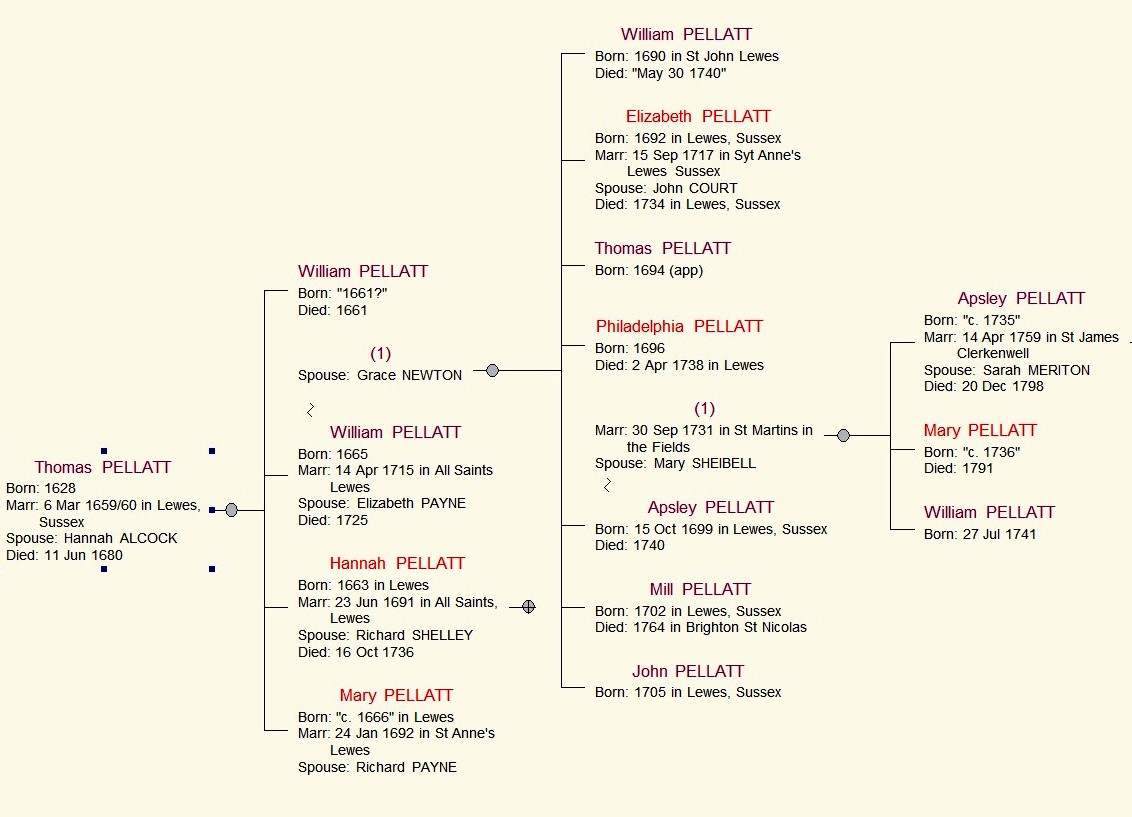
We have noted that Apsley Pellatt (1699-1740) was the son of William Pellatt (1665-1725) and Grace Newton (1664-1710). Grace died in 1710, and William was to marry for a second time to Mrs Elizabeth Taunton on 14 April 1715. I have found a Will for a William Pellatt of Lewes, Gent, written in 1719 and proved in 1725 by the sole Executrix, wife Elizabeth Pellatt. The Will is so brief as to make one wonder, simply leaving all estate, goods, chattels etc to loving wife Elizabeth. Is this ‘our’ William Pellatt? No mention of any children? It is puzzling. Had all the children been provided for at the time of the second marriage? There is no Will discovered for Grace, nor, for certain, for Elizabeth, although there is a possible one written in 1747 and proved in 1753, citing a son, ‘Thomas Tonton’ and daughter ‘Elizabeth’ as heirs. I have not researched this further.
William and Grace had seven known children, five boys of whom one, Thomas, died age 20, and the oldest, William, was presumably going to be the heir to his father. The three younger boys were put out to apprenticeships as shown in ‘Sussex Apprentices and Masters 1710-1752 ( https://www.sussexrecordsociety.org/wp-content/uploads/Digital_editions/SRS-Vol-28.pdf ), abstracted as follows:
PELLATT, Apsley, son of William P. of Lewes, Suss., esq.,to Francis Goater of Chichester, [Suss.], Apothecary; 7 yrs. from 24 June last’” [1715]; £60 – We consider below his progress to London and what is known of his later life. See https://practitioners.exeter.ac.uk/wp-content/uploads/2024/08/SUSSEX-MEDICS.pdf , p. 101, for information about Francis Goater, a prominent member of Chichester society.
PELLATT, John, son of William P. of Lewis, Suss. to Benjamin Powell of Lond, upholder; C. I. 7 yrs. ;£40; d. 7 inst. [Dec. 1720]; What happened to John? He was alive when his brother Mill wrote his Will in 1764 (see below). But I cannot reliably find him otherwise.
PELLATT, Mill, son of William P. of Lewis, Suss, gent.,to James Coulton of St Saviour’s, Southwark, [Surrey], hosier; C.I., 6yrs. ; £50; d. 9 inst. [May 1717]. Mill Pellatt’s (1702-1764) apprenticeship to James Coulton in 1717 was not to last, as James Coulton died in 1721. It does not seem that there was a London guild of hosiers then or now. I have found no evidence of what Mill did next, until we see his rather extraordinary last Will and Testament dated 14 April 1764 and proved on 30 May 1764. Mill had died and was buried in Brighthelmstone (Brighton), and his Will begins: “Dear Nephew Apsley Pellatt” – addressed to the son of his late brother, the first Apsley Pellatt, the principal person of interest in this post.
he asks Apsley Pellatt to be his sole Executor, and goes on ‘the 2 Lodgings Houses one Mine the other Mary Warners We agreed in the Court the longest liver Should Enjoy all the Goods in both houses I give to your Sister Mary Pellatt such as beding [sic] Linnen Plate China Glasses every thing that was Mine if Mary Warners will buy the goods as they stand if you think proper may sell them her I have a part of two Vessels One Capt Tho. Telson the other Capt Jno Butler those I bequeath to your sister Mary Pellatt the residue of my Effects I bequeath to you my Nephew Apsley Pellatt I have paid all my Debts so that you shall have no Demand on you except my Brother John Pellatt him I owe about a hundred pound I desire to be buried in this tow very private and frugal by daylight I believe you may Manage all this Business without the Charge of Administering this I Sign as my las Will and Testament this fourteenth Day of April One Thousand Seven Hundred and Sixty Four Witness my Hand – Mill Pellatt
To Mr. Apsley Pellatt this Will of Mill Pellatt I devise may be given him Apsley Pellatt the 30th Day of May 1764
On that day, Mr Thomas Meriton of the parish of St Mary Magdalen, Bermondsay (the nephew Apsley’s father-in-law. whom we will meet in future posts), Ironmonger, and Mr Apsley Brett of Lewes, Grocer (I think the son of Apsley Brett, Apothecary in Brighton, and apprenticed in 1756 to Will Brett in Lewes, Grocer) swore that they had long known Mill Pellatt and that the handwriting was his, so that Apsley Pellatt could duly prove the Will on that date. A Mary Warner, aged 72, was buried in Brighton on 26 December 1784, shown as from the Almshouse. Any fotrune she acquired from Mill Pellatt seems to have been exhausted.
Of the daughters of William Pellatt and Grace (Newton):
Elizabeth Pellatt (1692-1734) married John Court, who predeceased her. Her Will and three codicils left all her varied property, including The Friars in Lewes, and everything else, to her brother, the above-named Apsley Pellatt (1699-1740/1), subject to a provision by him of a yearly annuity payable to her brother William of £20 for his lifetime. It is not clear why William, the oldest sibling, should need this annuity. Even more unclear is why the Codicils should go into some detail about £500 and many goods, jewelry and other things to be left to her cousin George Nevill Newton (1696-1746), son of William Newton and his wife, Ann, possibly one of the many Paine’s I mentioned in my previous post. George lived in Brighton, as did Elizabeth in her last days, although both were buried in Lewes. Did he have some influence over Elizabeth?
Elizabeth’s sister Philadelphia (1696-1738) appears to have left little trace. She was not mentioned in her sister’s Will.
The first Apsley Pellatt in London: And so we move to our direct ancestor, Apsley Pellatt (1699-1740/1). Apprenticed in 1715 to apothecary Francis Goater in Chichester, we next find him living in central London, and appearing in the parish records of St Martin in the Fields, now a famous landmark opposite the National Gallery, in Trafalgar Square. Indeed, the present church was finished in 1726, replacing an earlier one built by Henry VIII, and so these Pellatt ancestors worshipped and were buried there. (There is no sign of them in the many memorial stones which pave the floors and walls of the present church.)
Once in London, he can be found as Apsley Pellatt, Apothecary, of Leicester Fields (now Leicester Square). The first substantive mention I have found about him concerns his appointment as Apothecary to the Parish of St Martin in the Fields, to succeed his father-in-law John Sheibell who died in 1734. Apsley Pellatt had married Sheibell’s daughter Mary in 1731. The Vestry Minutes of 15 April 1734 record the need for consideration of employing an Apothecary for the Service of the poor of the parish. The matter was referred to successive Vestries, but finally (what happened to the care of the poor in the interim?), on 16 June 1735, it was: ‘Ordered and agreed that Mr Pellatt Apothecary be recommended .. to be .. employed for the service of the Poor of this parish for the remainder of this present year’. (Westminster Archives, WAC F/2006/434). I have found no further mention of him and this role. He died at the tender age of about 41 in March 1740/1. (It is important here to use the old style Julian calendar to show the date, in which the new year (1741) would have started at the end of March, because of the birth of Apsley Pellatt’s third child, William, in summer of 1741. I had long thought this was too long after Apsley’s death in 1740, but realised that the death date of 1740 in fact referred to March 1741 under the new style which would come into force in 1752.)
As noted above, Apsley Pellatt had married Mary Sheibell (Scheibel)(1712-1758) at St Martin-in-the-Fields on 30 September 1731; he was of the parish of St James Westminster, which implies that he had a different residence prior to moving to Leicester Fields. By the time of his death in 1740/1, he and Mary had had three children. First-born was Apsley Pellatt (1735-1798); then Mary (1736-1791), and William (1741- ) (born posthumously).
Apsley Sr’s Will made provision for his very young children. His freeholds, hereditaments etc were left to his wife Mary in trust until his oldest child reached age 21, using the rents and profits for the maintenance and education of the children (including the one ‘in veintre sa mere’). Then the oldest child was to have these monies and make payments to the other offspring of interest and then, on their becoming 21, legacies of £400 each; and also an annual annuity to Mary of £25 per annum. Basically, Apsley the younger was to inherit the various properties in Sussex, including The Friars…but…he was just five years old when his father died. His mother was to re-marry to widower William Webb a year later. She would die in February 1758. We will learn more about her in my next post, when I trace what is known about the Scheibels, after which we will return to ‘Pellatt’ and review what happened to Apsley Pellatt St’s three children.
 backlers