Grace Newton (1664-1710)

48. Apsley Pellatt (1699-1740/1). Apothecary of St Martin in the Fields

In which we acquaint ourselves with the first Apsley Pellatt and his siblings, later noting his residence in London, his marriage to Mary Sheibell (Scheibel) in 1731 and his death in 1740/1, leaving two children and a third on the way.
Apprenticeships.

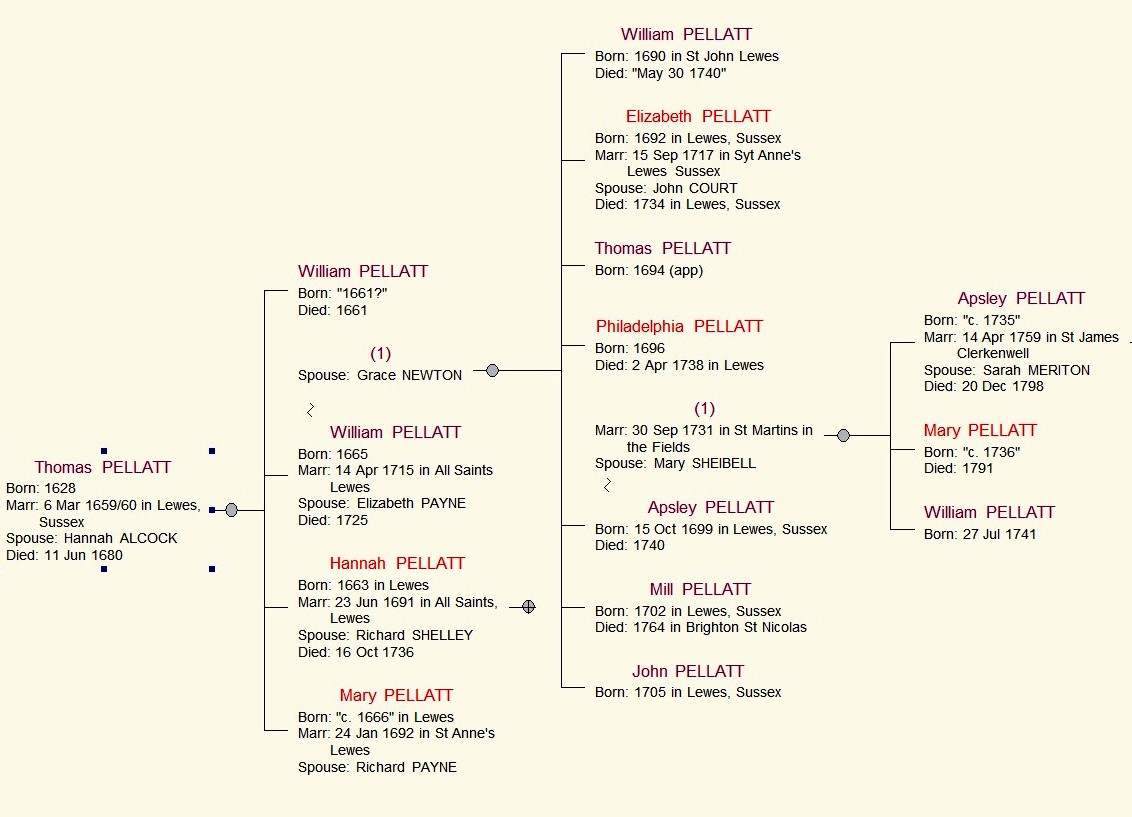
We have noted that Apsley Pellatt (1699-1740) was the son of William Pellatt (1665-1725) and Grace Newton (1664-1710). Grace died in 1710, and William was to marry for a second time to Mrs Elizabeth Taunton on 14 April 1715. I have found a Will for a William Pellatt of Lewes, Gent, written in 1719 and proved in 1725 by the sole Executrix, wife Elizabeth Pellatt. The Will is so brief as to make one wonder, simply leaving all estate, goods, chattels etc to loving wife Elizabeth. Is this ‘our’ William Pellatt? No mention of any children? It is puzzling. Had all the children been provided for at the time of the second marriage? There is no Will discovered for Grace, nor, for certain, for Elizabeth, although there is a possible one written in 1747 and proved in 1753, citing a son, ‘Thomas Tonton’ and daughter ‘Elizabeth’ as heirs. I have not researched this further.

William and Grace had seven known children, five boys of whom one, Thomas, died age 20, and the oldest, William, was presumably going to be the heir to his father. The three younger boys were put out to apprenticeships as shown in ‘Sussex Apprentices and Masters 1710-1752 ( https://www.sussexrecordsociety.org/wp-content/uploads/Digital_editions/SRS-Vol-28.pdf ), abstracted as follows:

PELLATT, Apsley, son of William P. of Lewes, Suss., esq.,to Francis Goater of Chichester, [Suss.], Apothecary; 7 yrs. from 24 June last’” [1715]; £60 – We consider below his progress to London and what is known of his later life. See https://practitioners.exeter.ac.uk/wp-content/uploads/2024/08/SUSSEX-MEDICS.pdf , p. 101, for information about Francis Goater, a prominent member of Chichester society.

PELLATT, John, son of William P. of Lewis, Suss. to Benjamin Powell of Lond, upholder; C. I. 7 yrs. ;£40; d. 7 inst. [Dec. 1720]; What happened to John? He was alive when his brother Mill wrote his Will in 1764 (see below). But I cannot reliably find him otherwise.

PELLATT, Mill, son of William P. of Lewis, Suss, gent.,to James Coulton of St Saviour’s, Southwark, [Surrey], hosier; C.I., 6yrs. ; £50; d. 9 inst. [May 1717]. Mill Pellatt’s (1702-1764) apprenticeship to James Coulton in 1717 was not to last, as James Coulton died in 1721. It does not seem that there was a London guild of hosiers then or now. I have found no evidence of what Mill did next, until we see his rather extraordinary last Will and Testament dated 14 April 1764 and proved on 30 May 1764. Mill had died and was buried in Brighthelmstone (Brighton), and his Will begins: “Dear Nephew Apsley Pellatt” – addressed to the son of his late brother, the first Apsley Pellatt, the principal person of interest in this post.

he asks Apsley Pellatt to be his sole Executor, and goes on ‘the 2 Lodgings Houses one Mine the other Mary Warners We agreed in the Court the longest liver Should Enjoy all the Goods in both houses I give to your Sister Mary Pellatt such as beding [sic] Linnen Plate China Glasses every thing that was Mine if Mary Warners will buy the goods as they stand if you think proper may sell them her I have a part of two Vessels One Capt Tho. Telson the other Capt Jno Butler those I bequeath to your sister Mary Pellatt the residue of my Effects I bequeath to you my Nephew Apsley Pellatt I have paid all my Debts so that you shall have no Demand on you except my Brother John Pellatt him I owe about a hundred pound I desire to be buried in this tow very private and frugal by daylight I believe you may Manage all this Business without the Charge of Administering this I Sign as my las Will and Testament this fourteenth Day of April One Thousand Seven Hundred and Sixty Four Witness my Hand – Mill Pellatt

To Mr. Apsley Pellatt this Will of Mill Pellatt I devise may be given him Apsley Pellatt the 30th Day of May 1764

On that day, Mr Thomas Meriton of the parish of St Mary Magdalen, Bermondsay (the nephew Apsley’s father-in-law. whom we will meet in future posts), Ironmonger, and Mr Apsley Brett of Lewes, Grocer (I think the son of Apsley Brett, Apothecary in Brighton, and apprenticed in 1756 to Will Brett in Lewes, Grocer) swore that they had long known Mill Pellatt and that the handwriting was his, so that Apsley Pellatt could duly prove the Will on that date. A Mary Warner, aged 72, was buried in Brighton on 26 December 1784, shown as from the Almshouse. Any fotrune she acquired from Mill Pellatt seems to have been exhausted.

Of the daughters of William Pellatt and Grace (Newton):

Elizabeth Pellatt (1692-1734) married John Court, who predeceased her. Her Will and three codicils left all her varied property, including The Friars in Lewes, and everything else, to her brother, the above-named Apsley Pellatt (1699-1740/1), subject to a provision by him of a yearly annuity payable to her brother William of £20 for his lifetime. It is not clear why William, the oldest sibling, should need this annuity. Even more unclear is why the Codicils should go into some detail about £500 and many goods, jewelry and other things to be left to her cousin George Nevill Newton (1696-1746), son of William Newton and his wife, Ann, possibly one of the many Paine’s I mentioned in my previous post. George lived in Brighton, as did Elizabeth in her last days, although both were buried in Lewes. Did he have some influence over Elizabeth?

Elizabeth’s sister Philadelphia (1696-1738) appears to have left little trace. She was not mentioned in her sister’s Will.

The first Apsley Pellatt in London: And so we move to our direct ancestor, Apsley Pellatt (1699-1740/1). Apprenticed in 1715 to apothecary Francis Goater in Chichester, we next find him living in central London, and appearing in the parish records of St Martin in the Fields, now a famous landmark opposite the National Gallery, in Trafalgar Square. Indeed, the present church was finished in 1726, replacing an earlier one built by Henry VIII, and so these Pellatt ancestors worshipped and were buried there. (There is no sign of them in the many memorial stones which pave the floors and walls of the present church.)

Once in London, he can be found as Apsley Pellatt, Apothecary, of Leicester Fields (now Leicester Square). The first substantive mention I have found about him concerns his appointment as Apothecary to the Parish of St Martin in the Fields, to succeed his father-in-law John Sheibell who died in 1734. Apsley Pellatt had married Sheibell’s daughter Mary in 1731. The Vestry Minutes of 15 April 1734 record the need for consideration of employing an Apothecary for the Service of the poor of the parish. The matter was referred to successive Vestries, but finally (what happened to the care of the poor in the interim?), on 16 June 1735, it was: ‘Ordered and agreed that Mr Pellatt Apothecary be recommended .. to be .. employed for the service of the Poor of this parish for the remainder of this present year’. (Westminster Archives, WAC F/2006/434). I have found no further mention of him and this role. He died at the tender age of about 41 in March 1740/1. (It is important here to use the old style Julian calendar to show the date, in which the new year (1741) would have started at the end of March, because of the birth of Apsley Pellatt’s third child, William, in summer of 1741. I had long thought this was too long after Apsley’s death in 1740, but realised that the death date of 1740 in fact referred to March 1741 under the new style which would come into force in 1752.)

As noted above, Apsley Pellatt had married Mary Sheibell (Scheibel)(1712-1758) at St Martin-in-the-Fields on 30 September 1731; he was of the parish of St James Westminster, which implies that he had a different residence prior to moving to Leicester Fields. By the time of his death in 1740/1, he and Mary had had three children. First-born was Apsley Pellatt (1735-1798); then Mary (1736-1791), and William (1741- ) (born posthumously).

Apsley Sr’s Will made provision for his very young children. His freeholds, hereditaments etc were left to his wife Mary in trust until his oldest child reached age 21, using the rents and profits for the maintenance and education of the children (including the one ‘in veintre sa mere’). Then the oldest child was to have these monies and make payments to the other offspring of interest and then, on their becoming 21, legacies of £400 each; and also an annual annuity to Mary of £25 per annum. Basically, Apsley the younger was to inherit the various properties in Sussex, including The Friars…but…he was just five years old when his father died. His mother was to re-marry to widower William Webb a year later. She would die in February 1758. We will learn more about her in my next post, when I trace what is known about the Scheibels, after which we will return to ‘Pellatt’ and review what happened to Apsley Pellatt St’s three children.
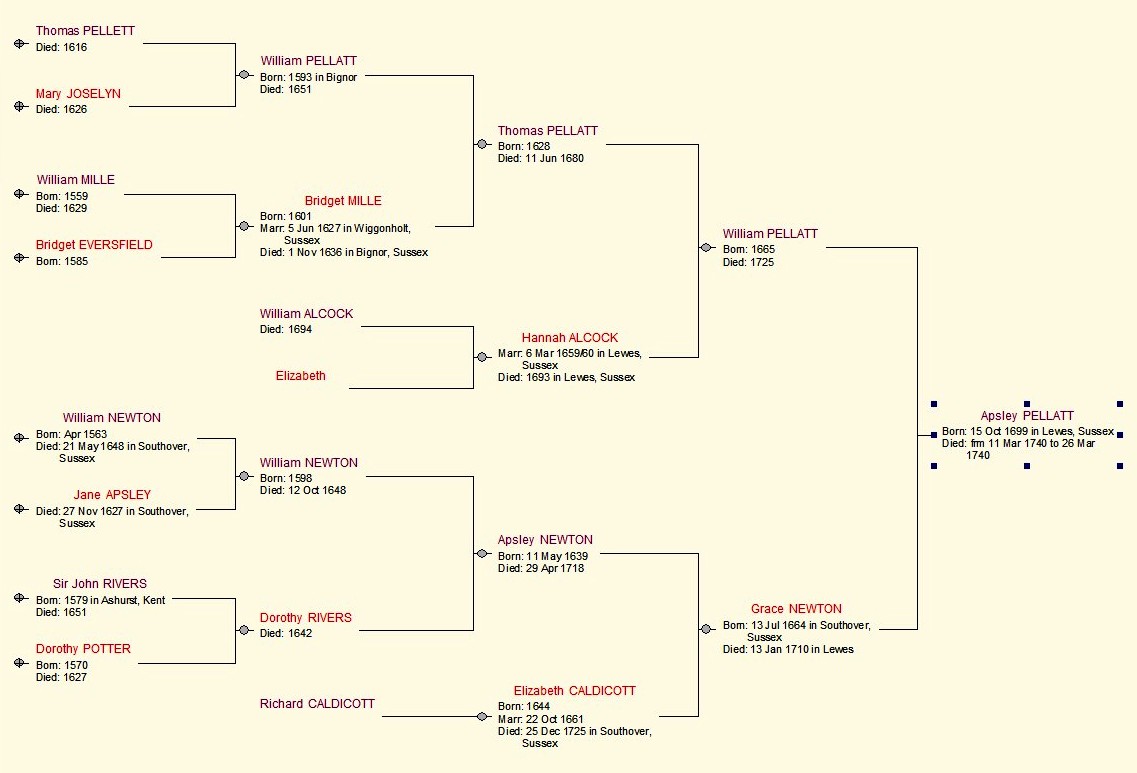
47. Starting the Pellatt line: looking back from Grace Newton (1664-1710) marrying William Pellatt (1665-1725).

In which we finally link the Newton/Rivers lines to the Pellatts, who will join the Backlers with Mary Pellatt marrying Samuel Backler in 1810. As with the Newton and Rivers lines, we find landowners and local worthies. As we move later on to London, we encounter more folk in different City of London livery companies, and in the case of the Pellatts we encounter, among other things, apothecaries, and glassmakers of the highest repute. But first things first – who were the Pellatts [or Pelletts]?

The tree above shows that the line back from William Pellatt, married to Grace Newton, starts with William (1655-1725) – then Thomas (1628-1680) – William (1593-1651) – Thomas ( – 1616). Above this last Thomas we find another William, of Charlton Court, Steyning (Sussex) (died before 1558) – Richard Pellet of Steyning (died before 1532) – William Pellett of Steyning (died before 1503).

You will note that the earliest Pellatts in this line date back to before the Dissolution of the Monasteries by Henry VIII in the late 1530s. Before this date, the lease of the Manor of Charlton in Sussex, once part of the Manor of Steyning, had been held by Syon Abbey in west London, and was granted to the William Pellett of Steyning listed above, who died around 1503. After the Dissolution of the Monasteries the title reverted to Henry VIII and the lease was then passed back to the Pellatts and held until Richard Pellett (died 1587) passed the lease to his son (Sir) Benjamin, who sold it on. Meanwhile, our line of the Pellatts had built a property at nearby Bignor Park, a few fragments of which stand today in the grounds of a much more recent stately home at which you can enjoy a very splendid wedding.

All of which is to say that the Pellatts were a locally landed, well connected family, at least two of whom were elected members of Parliament, and others of whom served in local positions of authority. They married into other landed and well connected families, and ‘our’ Pellatts ended up at the Friars in Lewes, Sussex, which was, alas, demolished in around 1848 to make way for Lewes’ first railway station, itself no longer in existence. A drawing of the Friars can be seen on this link: https://leweshistory.org.uk/2011/04/11/lewes-history-group-bulletin-9-7-april-2011/

Maberly Phillips (1838 – 1923), in his Pedigree and Genealogical Memoranda relating to the family of Pellatt describes “The Friars”: It was situated in the centre of the town, and comprised a family mansion, with gardens, orchards, fish pond, &c., the boundary walls enclosing an area of eighteen acres. (p. 124. For Part 1 of 2, see https://archaeologydataservice.ac.uk/archiveDS/archiveDownload?t=arch-285-1/dissemination/pdf/Vol_38_1892/SAC038_Phillips.pdf On page 15 of this document you can see the family tree of early Pellatts – I own an original paper copy of this tree.) Little did I know many decades ago when I enjoyed the delights of opera at the nearby Glyndebourne Festival, that I was walking on the lands of my Pellatt ancestors.

William Alcock ( – 1673) held the Friars at his death in 1672, when it passed to his daughter Hannah (1659/60 – 1693), wife of Thomas Pellatt of Bignor Park (1628-1680), and after her death in 1693 to their son William Pellatt (husband of Grace Newton), who died in 1725 and was succeeded by his second son Apsley Pellatt (1699-1740, diagram above, furthest right).  Apsley’s three grandsons (Mill, Apsley and Thomas) sold the property in 1803. We will learn much more about these latter Pellatts in future posts. 

But we get ahead of ourselves. The earliest lines are not shown in the tree above, but sufficient has been said about them for our purposes. Suffice to say we can trace them pretty far back, mainly thanks to Maberly Phillips. Early wives’ names are thin on the ground, and so the earliest I have found is that of Mary Joselyn (died 1626), wife of Thomas Pellett (died 1616). She was the daughter of Richard Joselyn of Hide Hall (in Essex), and his wife Anne Lucas of Bury St Edmonds (in Suffolk). Also we find Bridget Mille [Mill, Mylle] (1601-1636), the first wife of William Pellatt 1583-1651). She was the daughter of William Mille, M.P. (1569-1629; see https://www.historyofparliamentonline.org/volume/1604-1629/member/mill-william-1569-1629) and his wife Bridget Eversfield (1585- ) Many of these folk feature in an entertaining tome entitled A History of the Castles, Mansions and Manors of western Sussex by Dudley George Cary Elwes, London, Longman and Lewes, GP Bacon, 1876. A pdf can be downloaded from https://ia904707.us.archive.org/24/items/ahistorycastles00elwegoog/ahistorycastles00elwegoog.pdf It is well worth a look, and has an index of places at the beginning and surnames at its end. Among places of interest to our story are Greatham, Bignor, Steyning and Wiggonholt, while indexed surnames include Pellatt, Mill and Eversfield. I haven’t managed to find a similar volume related to East Sussex, which would feature Pellatts, Alcocks and Newtons among others.

I now turn to the parents of Grace Newton’s husband William Pellatt (1665-1725): Thomas Pellatt (1628-1680) and Hannah Alcock ( – 1693), daughter of William Alcock ( – 1673) and his wife Elizabeth. I have spent considerable hours trying to untangle cousin marriages among the Alcocks, Pellatts and Paynes (or Paines), since Hannah’s sister Elizabeth married a Richard Payne, and further down the line a Payne married a cousin Pellatt…but I have given that up. It is a tangled web of modest propertied families linking up with other propertied families to make ‘good marriages’, and since they don’t impact on our direct line, I am going to leave them to it.

I propose to end this post with some quotes about Thomas and Hannah and their children from the Parish Register of Lewes All Saints church, which I would very much like to visit, along with seeing the Newton manse in Southover. This parish register is part of an 823 page collection of parish records from Lewes, which can be seen on family search. This link https://www.familysearch.org/ark:/61903/3:1:S3HT-6PX3-4NX?i=495&cc=1465706 takes you to the burial record of Hannah [nee Alcock] Pellatt, which appears on image 496 of 823. From there you can navigate to others that I quote below. These entries feature much more detail than I am used to finding on parish records, which is why I give them an airing here.

[496 of 823] : Tuesday May 2nd 1693 was buried Mistris Hannah Pellatt of this parish widow. She lyeth at ye hithermost side of her seat within ye seat her husband lyeth in ye space just without ye seat with a large stone above him. She was aged 58 years wanting on [sic] month.

[465 of 823]: June 12th 1680 Then was buried Thomas Pellat of ye Ffriars who married Hannah ye daughter of William Alcock of this parish gent. He lieth before his seat which is in the North Aisle aged about 55. He died of ye small pox.

Moving down a generation, and scrolling forward through this large dataset, we find first records of births of the children of William Pellatt and Grace Newton, giving date and time of birth, and then their christenings. The interest here lies in the fact that the christenings show godparents, something I have not seen before in Anglican parish records. The first two children, William and Elizabeth, were baptised in Southover, having been born before the Friars passed to William through Hannah. So the first baptism we find in Lewes is that of Thomas Pellatt (1694-1714):

[507 of 823]: Thos Pellatt Sunday September 30 1694 Was baptized Thomas ye son of Mr William Pellatt of ye Fryers and Grace his wife. Godfathers Mr William Pellat of London [possibly William’s cousin] & Mr Richard Shelley [husband of William’s sister Hannah]. Godmistress Madam Springett widow [who appears to have died in 1695].

[508 of 823]: Philadelphia, bap 19 August 1696.

[509 of 823] My 6x great grandfather: Munday October ye 23th 1699 was baptized Apsley ye son of Mr William Pellat of ye Fryers in this parish and Mrs Grace his wife. Godfathers Mr. William Pellatt of London junior & Mr Apsley Newton of Southover Junior. Mrs Grace Butler Mistris Pellatt’s Aunt Godmother. Here we find the first of seven known Apsley Pellatts, three of whom come down my direct line.

[510 of 823] Here we look at the last in this short summary of register entries of All Saints, Lewes. It is the baptism of Mill Pellatt (1702-1764), the first in a series of so-named Pellatts, again, as with Apsley, adopting a surname as a first name. Baptised on 13 November 1702, this Mill’s Godfather was William Mill Esq of Greatham, and Godmother Madam Barbara Beard. The other Godfather Mr Apsley Newton Senior who stood for Mr Richard Hay of Horsted. In all these entries we can see various relatives standing in as Godparents.

And here, for the moment, we will leave the Pellatts. In the next post we will begin the journey of the first Apsley Pellatt from his roots in Lewes to the centre of London and his marriage to the daughter of German immigrants, with an unexpected link to Apothecaries Hall, which we considered in some detail way back at the beginnings of the Backler line.