Mary Sheibell 1712-1758

50. Apsley Pellatt II (1735-1798)

In which we meet Apsley Pellatt II (1735-1798). and his wife Sarah Meriton (c. 1738-1798), and their three children.  We are re-introduced to The Worshipful Society of Ironmongers,  with which Company successive generations of Pellatts would be associated for more than 100 years. 
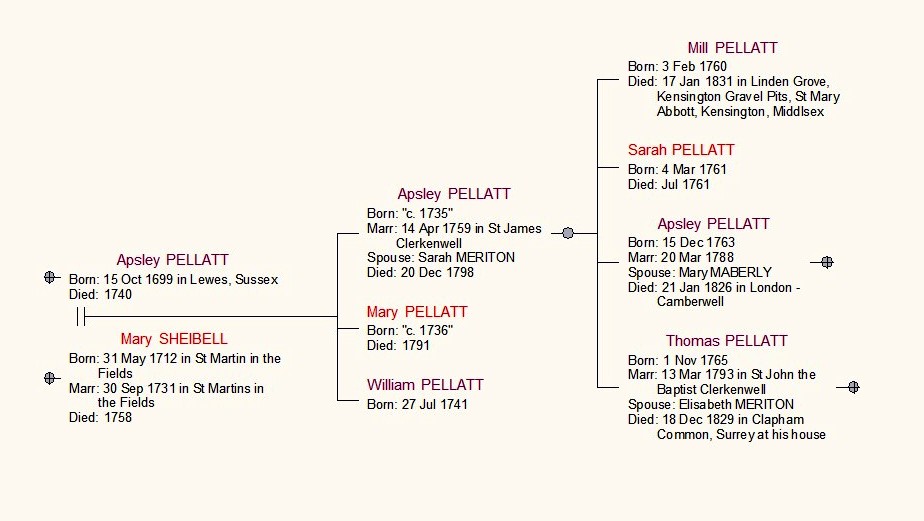
Apsley Pellatt II (1735-1798) was the oldest of three children born to Apsley Pellatt 1 (1699-1740) and Mary nee Sheibell (1712-1758).   We have seen in previous posts that Apsley Pellatt I died just five years after his oldest child’s birth.  Of the younger Apsley’s siblings, we can take a very brief look, since I can trace nothing about his sister Mary, other than that she died at Camden Street, Islington, in 1791, and in her will left many legacies to nieces and nephews, various charities, and the residue to her brother and executor, the above-name Apsley II.  Of William we know even less. His impending birth was mentioned in his father’s will.  I had long puzzled about his apparent birth date, more than a year after his father’s death, until I realised that these events took place before the change of the calendar from Julian to Gregorian in 1752.  Before this date, the first three months of what is now our calendar year were considered to be of the previous year – so that Apsley Sr died early in 1740/1, with William appearing a few months later.  Other than that – of William, there is nothing. I suspect he may have died in infancy, as he is not mentioned in the Will of his grandmother, Mary Sheibell, below.

So, back to young Apsley II.  He was to benefit from a number of legacies, for instance from his grandmother Mary (nee Houghton) Sheibell, both silver and a sum of money, payable upon his reaching the age of 21.  Before he reaches that age, the executors of the will are instructed to use the interest on these gifts ‘to put him apprentice to some genteel and reputable trade’.  And so, we renew acquaintance with the Worshipful Company of Ironmongers, whom we first met in Post 6c, John Freeman (1740-1803), Indigo Maker and Ironmonger.   To recap, John Freeman had married Ann Backler (1741-1820), who was sister to apothecary Sotherton Backler (1746-1819) and aunt to Sotherton’s son Samuel Backler (1784-1870), who in 1810 married Mary Pellatt (1789-1857), daughter of Apsley Pellatt III (1763-1826), to whom we will briefly be introduced later in this post.  The point of all this is to show that almost certainly there were long standing links between the Pellatts and the Backlers.

Apprentice: In 1750, on payment of the sum of £80, Apsley II was put apprentice to William Bliss: ‘I Apsly Pellat [sic] Apprentice to William Bliss do promise to be obedient to the Master and Wardens of the Worshipful Company of Ironmongers during my life and my said Master during my Apprenticeship. Witness my hand this 12 day of July 1750 Apsley Pellat [sic].’ (image on findmypast)

Apsley Pellatt served out his seven years as an apprentice, and was made free of the Ironmongers Company on 18 August 1757.  By this time, aged 21, he would also have come into his various inheritances, which undoubtedly gave him the resources to marry, and to set up in business as an Ironmonger, where he is to be found for many years at 13 St John Street, Clerkenwell.

Marriage to Sarah Meriton  This took place at St James Clerkenwell, Clerkenwell Green, on 14 April 1759.  Sarah was a minor, and married with the consent of her father Thomas Meriton ( – 1865).  Witnesses were Thos. Meriton (possibly/probably her father) and John Godfrey (not sure who he is).  We will learn more about the Meritons in a future  post, but here it is important to note that Thomas Meriton was an Ironmonger, albeit south of the river in Bermondsey, and not of the Ironmongers Company. It seems likely that the Pellatt/Meriton marriage resulted from the partnership between the families, as noted in the following item from The London Gazette, shortly before Thomas Meriton’s death in Bermondsey.  His marriage to Sarah Wilkinson in 1731 had taken place in Clerkenwell, so although he was located south of the river, she had links in Clerkenwell.  

London Gazette 1 January 1765: The Ironmongery Business carried on by Thomas Meriton of Dockhead, Southwark and Apsley Pellatt of Clerkenwell, was dissolved the 31st of December last, 1764. Witness our hand Thomas Meriton, Apsley Pellatt.  N.B. Thomas Meriton is to pay and receive what is Debtor and Creditor to that time.

And so, for some 30 years, Apsley Pellatt II carried on as Ironmonger of Clerkenwell.  In 1789 he was Master of the Ironmongers Company, elected to the post by the Court of Assistants.  His tenure lasted a year.

He and Sarah had four children, three sons and the sadly short-lived Sarah Pellatt (1861-1861).  Let’s look at the three sons.

Mill Pellatt (1760-1805): Was apprenticed to his father, of St John’s Street, St Sepulchre Without, on 27 July 1775.  He was duly made free of the Ironmongers Company by service to his father on 28 November 1782 (both images on findmypast).  In the 1796 Electoral Register for London, we find Mill Pellatt and Apsly Pellatt [sic] [II] as Ironmongers at St John Street.  And in 1831 we find the death of Mill Pellatt Esq on 17 January and his subsequent burial on 21 January 1831 at St Mary Abbotts Kensington.  His address was given as Linden Grove, which rang a bell – it was where Samuel Backler and Mary [nee Pellatt] Backler were living when their daughter Esther Maria Backler was born in 1830.  See Post 26!  Mary was Mill’s niece.  The Backlers were about to embark on a rather turbulent year, featuring Samuel’s bankruptcy proceedings, among other things.  

Mill Pellatt had profited handsomely from his father’s Will in 1799, but apparently became ill or somehow dependent, because his brother Apsley III’s Will in 1826 [which complicated document we will peruse at a later date] made provision for funds to be invested to produce ‘the yearly sum of eighty pounds and to pay the sum of eighty pounds yearly and every year unto and for or towards the support of my dear brother Mill Pellatt for his life’.   Presumably this care was being provided by Mill’s niece Mary Backler and her husband.

Apsley Pellatt III ( 1763-1826) we will leave until a subsequent post.

Thomas Pellatt (1765-1829) further complicates this complicated family, and I have come to the conclusion that he needs a post of his own.  In short, he was apprenticed Clerk to Attorney William Leeson on 4 October 1780, and  was made free of the Ironmongers Company in 1757 by Patrimony.  He was later to have a significant role with the Ironmongers, and in wider civic life, which is why he merits a post on his own.  For the purposes of this post, suffice to say that he married his cousin Elizabeth Meriton, daughter of Henry Meriton (Thomas Meriton’s brother) in 1795.  Their son Henry Pellatt would marry Mary Backler, daughter of Mary Pellatt (daughter of Apsley Pellatt III) and Samuel Backler. Are you staying with this?  We will leave that for the moment and just focus on the latter years of Apsley Pellatt II. 

There is plenty of evidence that Apsley Pellatt II traded at St John’s Street, but perhaps none so colourful as the events described in the following newspaper clipping:
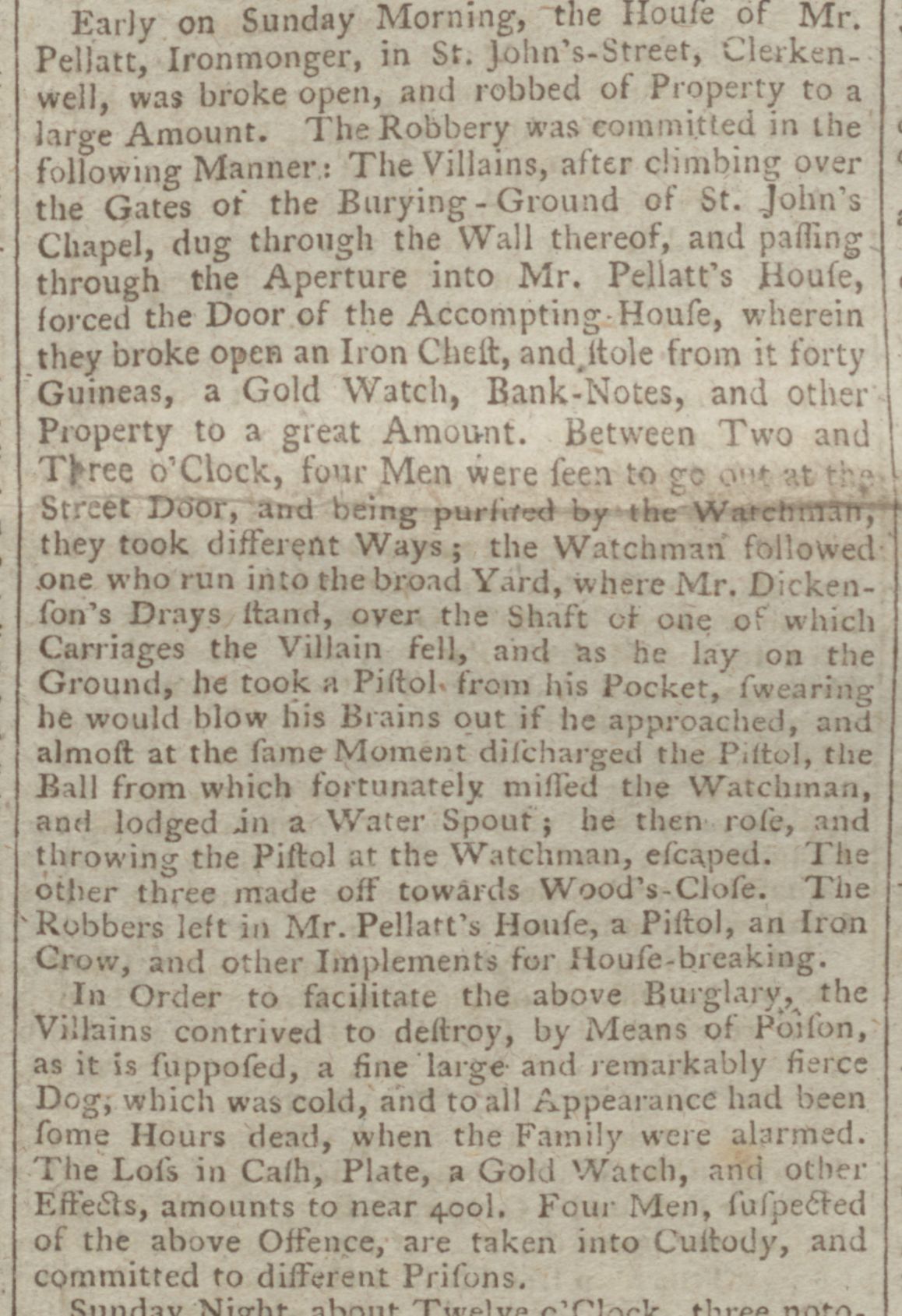
Northampton Mercury 25 October 1784. Image reproduced from British Newspapers collection by kind permission of Findmypast

This clipping tells us a lot about Apsley Pellatt at the time. His home was adjacent to St John’s Chapel and the burying ground, both on the western side of St John’s Street as it heads north towards Islington. Not far away is St James Clerkenwell, where Apsley Pellatt II married Sarah Meriton. The value of stolen goods was some £400 – around £60-80,000 today, depending on which website you peruse. They owned a dog! I have not managed to find court reports about the suspected thieves.

More context of Apsley Pellatt’s working life is given in the advert seen below, not long before his death in 1798. Here we see the types of goods an ironmonger would stock – iron, steel, brass – plus household furniture and effects. Presumably the Pellatts were moving from St John’s Street to Islington, where they died within days of each other at the end of 1798.
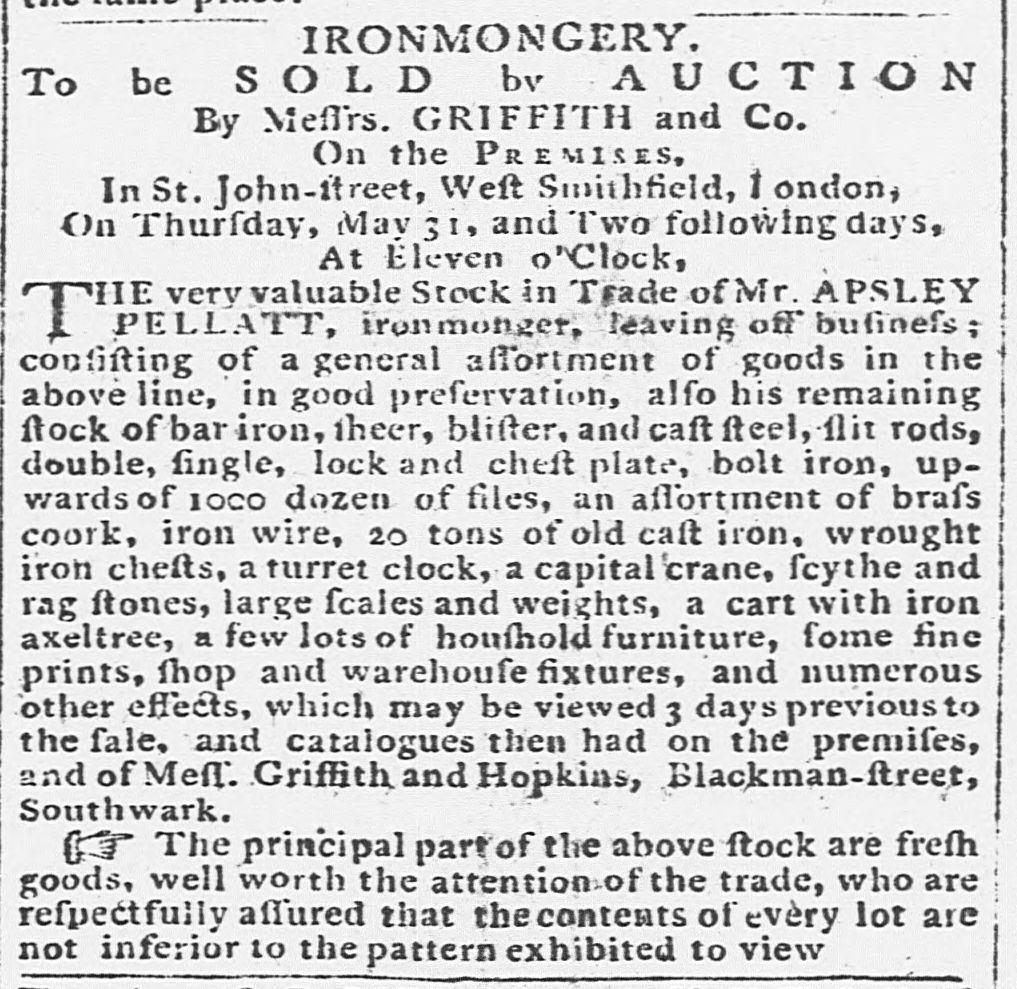
Ipswich Journal, 28 May 1798. Image used by kind permission of Findmypast, British Newspaper Collection.

Apsley Pellatt II – death and Will: The following text is taken from the online record of ‘Deeds of 9 Friars Walk, Lewes’ (ESX 21359) on the Sussex Record Office website   https://www.thekeep.info/collections/getrecord/GB179_AMS6346_1-32

On 4 & 5 Apr 1759 the Friars Estate was settled on the marriage of Apsley Pellatt and Sarah, daughter of Thomas Meriton; they mortgaged it for £2000 to Elizabeth Macie on 5 & 6 Jan 1776, who assigned it to James Louis Macie on 12 & 13 Apr 1786. Sarah Pellatt died on 16 Dec 1798 and Apsley Pellatt on the 20th leaving Mill Pellatt, Apsley Pellatt and Thomas Pellatt his surviving children; Apsley and Thomas proved their father’s will in PCC on 5 Jan 1799. The estate was auctioned on 19 Aug 1803; lot 2, a capital messuage called The Friars occupied by Sir F[erdinando] Poole at a rent of £90 and 2a 1r 28p of land, was sold to George Verrall for £2400 and £93 18s 6d for the timber. The conveyance was executed on 28 & 29 Mar 1804 by Mill Pellatt of Edgware Road in Mx, gent, Apsley Pellatt of St Pauls Churchyard, glass manufacturer and Thomas Pellatt of Ironmongers Hall, gent, to George Verrall of Lewes, gent (and his trustees John Godlee of Cliffe, merchant, Thomas Shank of Fenchurch Street, London, wine and brandy merchant and George Nelson of Palsgrave Place, Temple). Of the purchase money, £2000 was owed to Macie the mortgagee.

Given that Sarah predeceased her husband by a few days, the provisions in his Will for her were not applicable, so basically everything went to the three brothers, with Mill seeming to get a bit more than the two younger siblings. Of interest to us is that eldest grand daughter Mary Pellatt (1789-1857) was to receive £100 when reaching age 21 or day of marriage, a nice little sum for her when she married Samuel Backler (1784-1870) in 1810. In the next post we will catch up with Thomas Pellatt, then we will peruse the Meritons, and finally will move on to Apsley Pellatt III. Lots to look forward to!

49. Introducing the Scheibel/Sheibell line – an early twig from Germany

In which we meet the rather complicated Scheibel/Sheibell line, apothecaries from Friedburg, Wettaravia, Germany, naturalised as British citizens in the late 17th and early 18th centuries … but… they are not properly disentangled!

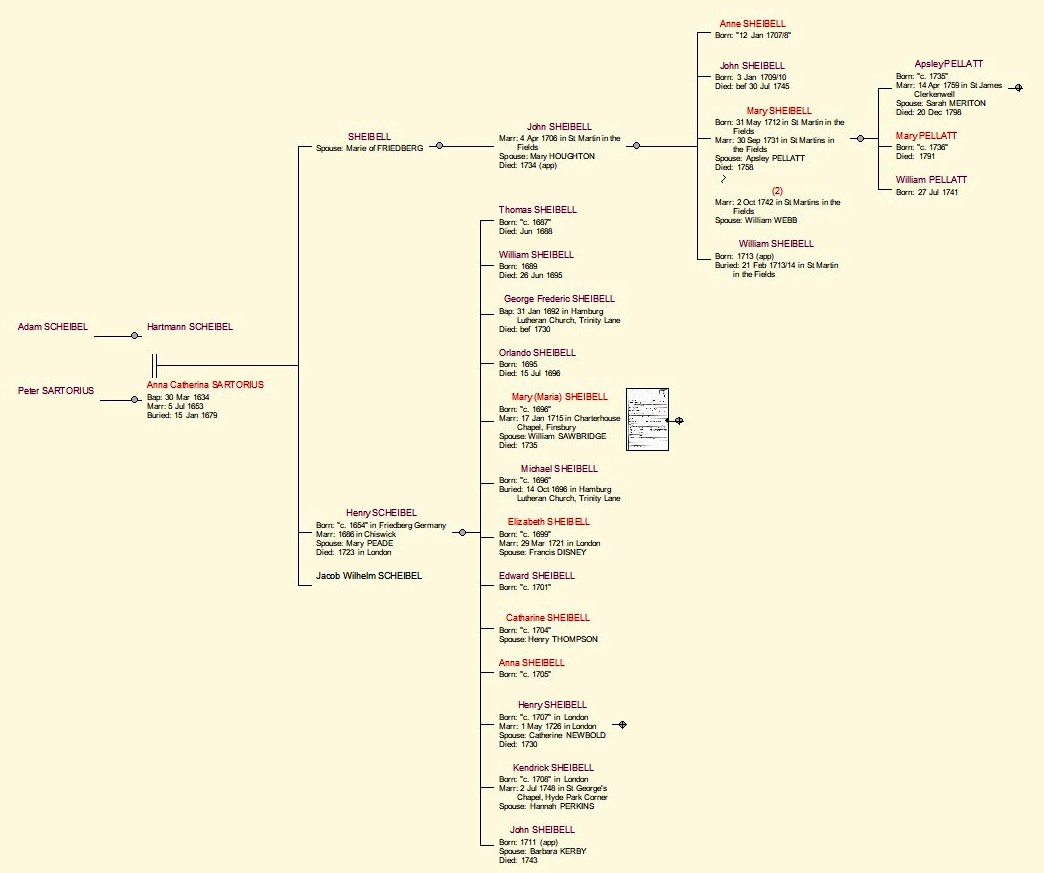
Two trees below show some pretty well known information, and some more speculative, derived from a variety of sources. The main person of interest for our purposes is Mary Sheibell (1712-1758), who married Apsley Pellatt (1699-1740/1). We are secure in the knowledge that Mary Sheibell was the daughter of John Sheibell ( – 1734) and Mary Houghton/Haughton ( – 1745). They married at St Martin in the Fields on 4 April 1706, and their four children’s baptisms are to be found in the parish registers of that church. Shown on the first tree below, they are Anne, born on 12 January 1707/8 and baptised on the 15th; a child Anne Sheibel [sic] was buried there on 5 February 1707/8, who could have been this Anne, or, feasibly, her cousin Anne Sheibell, daughter of Henry Sheibell and his wife Mary, who was born in November 1705. These Scheibells can be quite confusing. Next up for John Sheibell and Mary Houghton was John Sheibell, born 3 January 1709/10, and who died before 1745. He appears to have been somewhat troubelsome, as we will see when we look at his parents’ Wills. He had a daughter Mary by an unknown spouse. Then we come to Mary Sheibell, whose dates we have seen above, followed by the short-lived William Sheibell, who I believe was born and died in 1713.

Who was John Sheibell?

Looking at the trees below, we see that some sources show that Hartmann Scheibel, Apothecary, of Friedburg in Germany was the father of Henry Sheibell, Apothecary, and grandfather of John Scheibel, Apothecary, both of St Martin in the Fields. The naturalisation record for Henry Scheibel in 1693 clearly shows: ‘Henry Sheibell Son of Hartman Sheibell [1654-1723] and Katherine his wife born at Ffriedberg in Wetteravia in Germany’. After a certain amount of disagreement with the Worshipful Society of Apothecaries, whom we have met many times before in our Backler stories, Henry was made free of the Society in 1691. He married Mary Peade, and a ‘tentative’ pedigree for him and a line for ‘our’ John Sheibell can be seen in Miscellanea Genealogica et Heraldica, London 1912, which can be viewed online at https://archive.org/details/miscellaneagenea4191bann/page/n39/mode/2up pages 8-10.

So far, so good, for Henry, but what about our John? The Pedigree shows him as Henry’s nephew, naturalised by Act of Parliament No. 94, 4 and 5 Anne (1706), as son of Mary Scheibel, father’s name not given. However, I have combed through the very many names of naturalised folk in this Act, and the one I find is ‘John Phillip Sheibell son of John Sheibell by his wife Mary born at Ffriedberg in Germany’. Is this ‘our’ John? I have reason to believe that it is, since John Phillip Sheibell was buried in 1734 at the Savoy Lutheran Chapel, and ‘our’ John (no Phillip in the name) died in that year, stating in his Will that he wished to be buried there. If this is so, and the Naturalisation parentage is accurate, ‘our’ John was indeed the nephew of Henry and the grandson of Hartmann. The trees below do not show his father as ‘John’, which I now believe to be the case.

The rather fuzzy tree below shows the very extensive family of Henry Sheibell, Apothecary. His children were ‘our’ John Sheibell’s cousins, and detailed examination shows them featuring in various ways in each others’ lives – which I do not propose to set out in any detail.

Let’s see what else we know about our direct ancestor, John (Phillip) Sheibell ( – 1734).

Some years ago I explored the Vestry Minutes of St Martin in the Fields seeking information about John Sheibell and his son-in-law Apsley Pellatt.  I am not sure how John Sheibell became a ‘Citizen and Apothecary’, but the Vestry Minutes consider in some detail the payments to John Sheibell in his role as apothecary to the poor of the parish, and later on, in his services to the workhouse:

‘This Board takeing into consideration an Apothecary to be employed this year by the Overseers of the poor for the relief of the poor, Doe recomend [sic] Mr John Sheibell, Apothecary to be employed by the Overseers of the Poor as Apothecary & Surgeon So as his Bills do not exceed Sixty pounds for & during all this year…’[1]

This recommendation was repeated in the following two years, but in 1720 the following entry appears:

‘John Sheibell Apothecary petitioned this Board complaining of the great Costs and Charges he yearly sustains by reason of his paying a Surgeon out of his Sallary of 60 £ y And, this Board taking the same in Consideration Ordered that the said John Sheibell’s Sallary be advanced to 80 £ y And during such time as the two Outwards shall remain part of this parish’[2]

The relationship of John Sheibell and the Vestry did not always run smooth. Cost-cutting is not just a modern phenomenon: at the Vestry of 13 September 1722, the Board apparently reviewed the salary and services, and decided that £60 a year should be sufficient to serve the Poor in Medicines and Surgery. If John Sheibell was not willing to accept these terms, then another should be elected ‘in his room’.  But by Easter Monday 1723, his salary was £80, and in 1724, ‘A Memorial of Mr John Sheibell Apothecary for providing Medicines for the poor of this parish was produced for this Board and ordered to be referred to the next Vestry’ [although no mention of it is made at the next vestry]. 

More was to follow. In May 1725, on opening of the Workhouse, the Vestry

‘ordered and agreed that an Advertisement be put into the Daily Courant that if any sober, skilful Apothecary is willing to Settle at the Workhouse and to attend the poor of this parish He be desired to wait on Sr Jno Colbatch Knt at Bartram’s Coffee House in Church Court any Day between One and two in the afternoon to treat about the same’[3]

The upshot of this appeared to be that a Mr Kitchen was to be ‘imployed as Apothecary for the poor of this parish And to have 40 £ pa And Sallary for the same …’. This was followed by months of procrastination when the orders re Mr Sheibell and Mr Kitchen were referred over and over again to ‘the next Vestry’.  Apparently John Sheibell wasn’t going to give up his position without a fight, and indeed, on Easter Monday 1726, John Sheibell was confirmed as Apothecary to the poor ‘provided his Bills exceed not 60 £ p. ann.’[4]

Following John Sheibell’s death in 1734, the Vestry Minutes of 15 April 1734 record the need for consideration of employing an Apothecary for the Service of the poor of the parish. Once again the matter was referred to successive Vestries, but finally (what happened to the care of the poor in the interim?), on 16 June 1735, it was:

‘Ordered and agreed that Mr Pellatt Apothecary be recommended .. to be .. employed for the service of the Poor of this parish for the remainder of this present year’.[5]

As we already know, Apsley Pellatt was John Sheibell’s son-in-law, having married Mary Sheibell in 1731.  No further mention is made of Apsley Pellatt as Apothecary (nor indeed of anyone else).  He died in 1740, and his wife married William Webb, who later became Churchwarden and Overseer.

Wills – a good source of information

We turn now to another key source of info for this Sheibell clan. The first Will of interest is that of Mary (nee Peade) Sheibell, wife of the above-cited apothecary, Henry Sheibell. He had died in 1723, but I have not located a Will for him. His wife, on the other hand, wrote her Will in 1730, and it was proved in 1732. She scattered any number of diamond rings and monetary legacies among her many children and grandchildren, but one item clarifies the relationship between her (and her late husband) and ‘our’ John Sheibell:

Item I give to my Nephew John Sheibell and to his wife Mary ten pounds apiece for Mourning and twenty shillings apiece more for a Mourning ring and to each of their children John and Mary I give ffive pounds for Mourning and twenty shillings apiece for a Mourning ring and I do further give and bequeath to my said Nephew John Sheibell a Legacy of one hundred pounds and in case he shall depart this life before my decease then I give the said one hundred pounds to his daughter Mary Sheibell and not otherwise

The Mary Sheibell in question, of course, is ‘our’ Mary who in 1731 would marry Apsley Pellatt.

We next move to the Will of John (Phillip) Sheibell, written in April 1732, and proved in April 1734. At the time of writing his daughter Mary will have married Apsley Pellatt, in 1731; the other surviving child is John, who is mentioned with some reservations in the Will, as follows:

I give and bequeath unto my only Son Twenty pounds and six Silver Spoons And in case my said Wife shall at any time after my death find and be satisfyed that my said Son John is reformed and become discreet and sober I recommend it to her to give to my said Son John the further sum of One hundred and Thirty pounds out of my Estate and Effects Also I give and bequeath to my Son in Law Apsley Pellett and to my dear daughter Mary his Wife Twenty pounds a peice [sic] and no more for Mourning I having given her a Portion upon her Marriage with the said Mr Pellet

After one or two other legacies, and specifying his wish to be ‘interred in the Vault or in the Church Yard of the Lutheran Church within the precinct of the Savoy with as little Ceremony and Expense as may be…’, he leaves everything else in the care of his wife, who he is sure will ensure it is used for the benefit of their children.

However, soon after – too soon, really – we come to the Will of Apsley Pellatt (1699-1740). Written on 11 March 1740 and proved on the 16th of the same month, he leaves all his property in Sussex to his wife Mary, the proceeds of which should be used for the maintenance and education of all their children, including the one ‘in ventre sa mere’ – not yet born (this is William Pellatt, born 1740/41, not sure what happened to him). Basically everything is left to his wife. She would re-marry after Apsley’s death, to William Webb, but I cannot find a Will of hers in 1758, when she died. However, we do have the Will of Mary (nee Houghton) Sheibell, her mother, and grandmother to the Apsley Pellatt children. Written in July 1745, and proved in August, she requests that she should be buried near her late son-in-law Apsley Pellat [sic], at St Martin in the Fields. Her wayward son John having died, she makes the following provision for his daughter Mary [mother’s name not known]:

‘I give and bequeath unto my grand daughter Mary Sheibell the only child of my son John Sheibell deceased the sum of two hundred and fifty pounds in satisfaction of a legacy of one hundred and thirty pounds which my late husband desired me to give to my said son John if I found him prudent and careful which said sum of two hundred and fifty pounds I direct to be paid my said granddaughter when she shall attain the age of one and twenty years or be married also I give and bequeath to my said granddaughter Mary Sheibell an old fashioned two handle silver cup and a gold ring set with ten diamonds one pair of silver salts six silver teaspoons and a strainer’

Apsley Pellatt’s children, Apsley (1735-1798) and Mary (1736-1791) were also given legacies:

I give and bequeath unto my grandson Apsley Pellat the sum of one hundred and fifty pounds also I give and bequeath unto the said Apsley Pellat a ribbed silver salver also I give and bequeath unto my granddaughter Mary Pellat one hundred pounds and a silver tea pot and I direct that the said legacies to my grandson Apsley Pellat and my granddaughter Mary Pellat shall be paid to them when and as they severally attain their respective ages of one and twenty years or be married…

Additionally to these legacies, however, came provision for her nephew John Stockwell (son of her sister Elizabeth and her husband John Stockwell), and apothecary Charles Carlisle to invest the sums left to the grandchildren and use the income to support their education and to put young Apsley Pellatt ‘apprentice to some genteel and reputable trade’. (See next post!) She left the rest and residue of her estate to her daughter Mary (Houghton Pellatt) Webb, for her sole use, which makes it puzzling that no Will can be found for her in 1758. Her husband William Webb died in 1771. He left most legacies to his daughters by his first marriage, but made son-in-law Apsley Pellatt (1735-1798) one of his Executors, and left £200 to be divided among Pellatt’s children when they reached age 21.

This rounds off our rather limited acquaintance with the Sheibells. Through Uncle Henry, there were any number of Sheibell descendants, but on ‘our’ John’s side there were only a few, one, Mary Sheibell (unknown mother), daughter of the wayward John, and ‘our’ Mary, mother of the second of very many Apsley Pellatts to follow. In the next post we will see this young Apsley Pellatt begin his association with the Worshipful Company of Ironmongers, with which the Pellatts would have a long association.


All notes from Westminster Archives Centre: [1] WAC F/2006/4 Easter Monday 1717 [2] WAC F/2006/37 April 15th 1720 [3] WAC F/2006/183  May 3 1725 [4] WAC F/2006/224 [5] WAC F/2006/434