In which we finally link the Newton/Rivers lines to the Pellatts, who will join the Backlers with Mary Pellatt marrying Samuel Backler in 1810. As with the Newton and Rivers lines, we find landowners and local worthies. As we move later on to London, we encounter more folk in different City of London livery companies, and in the case of the Pellatts we encounter, among other things, apothecaries, and glassmakers of the highest repute. But first things first – who were the Pellatts [or Pelletts]?
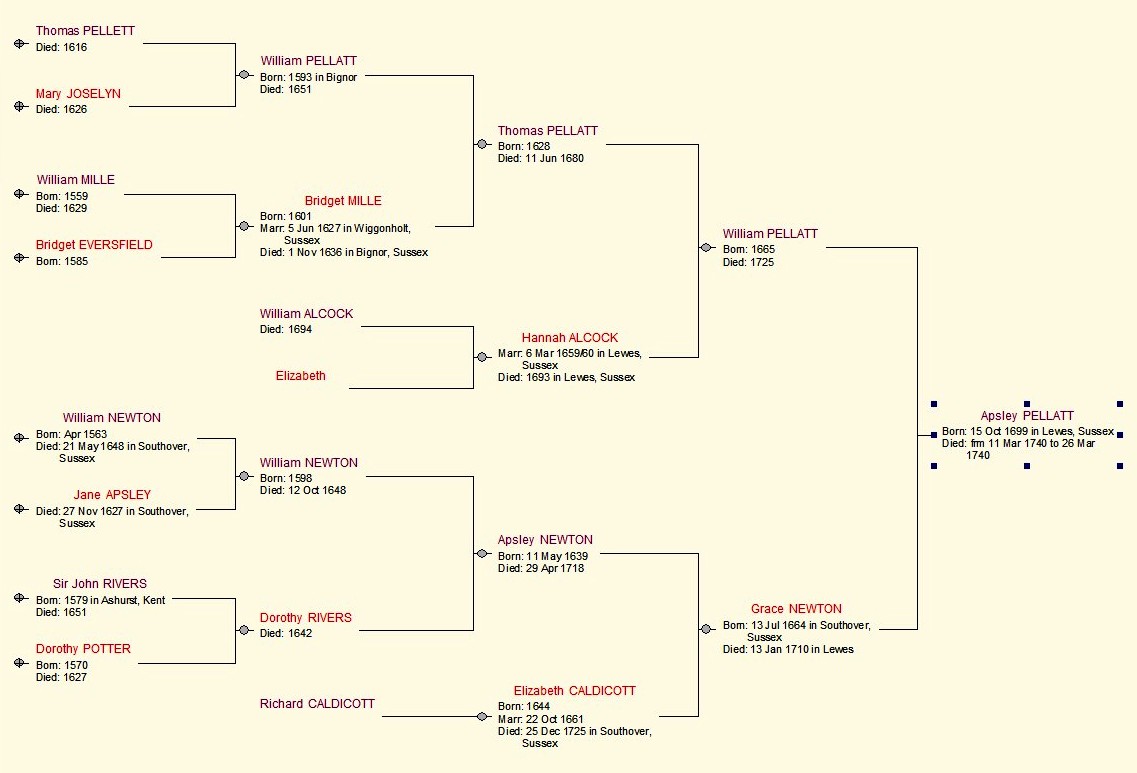
The tree above shows that the line back from William Pellatt, married to Grace Newton, starts with William (1655-1725) – then Thomas (1628-1680) – William (1593-1651) – Thomas ( – 1616). Above this last Thomas we find another William, of Charlton Court, Steyning (Sussex) (died before 1558) – Richard Pellet of Steyning (died before 1532) – William Pellett of Steyning (died before 1503).
You will note that the earliest Pellatts in this line date back to before the Dissolution of the Monasteries by Henry VIII in the late 1530s. Before this date, the lease of the Manor of Charlton in Sussex, once part of the Manor of Steyning, had been held by Syon Abbey in west London, and was granted to the William Pellett of Steyning listed above, who died around 1503. After the Dissolution of the Monasteries the title reverted to Henry VIII and the lease was then passed back to the Pellatts and held until Richard Pellett (died 1587) passed the lease to his son (Sir) Benjamin, who sold it on. Meanwhile, our line of the Pellatts had built a property at nearby Bignor Park, a few fragments of which stand today in the grounds of a much more recent stately home at which you can enjoy a very splendid wedding.
All of which is to say that the Pellatts were a locally landed, well connected family, at least two of whom were elected members of Parliament, and others of whom served in local positions of authority. They married into other landed and well connected families, and ‘our’ Pellatts ended up at the Friars in Lewes, Sussex, which was, alas, demolished in around 1848 to make way for Lewes’ first railway station, itself no longer in existence. A drawing of the Friars can be seen on this link: https://leweshistory.org.uk/2011/04/11/lewes-history-group-bulletin-9-7-april-2011/
Maberly Phillips (1838 – 1923), in his Pedigree and Genealogical Memoranda relating to the family of Pellatt describes “The Friars”: It was situated in the centre of the town, and comprised a family mansion, with gardens, orchards, fish pond, &c., the boundary walls enclosing an area of eighteen acres. (p. 124. For Part 1 of 2, see https://archaeologydataservice.ac.uk/archiveDS/archiveDownload?t=arch-285-1/dissemination/pdf/Vol_38_1892/SAC038_Phillips.pdf On page 15 of this document you can see the family tree of early Pellatts – I own an original paper copy of this tree.) Little did I know many decades ago when I enjoyed the delights of opera at the nearby Glyndebourne Festival, that I was walking on the lands of my Pellatt ancestors.
William Alcock ( – 1673) held the Friars at his death in 1672, when it passed to his daughter Hannah (1659/60 – 1693), wife of Thomas Pellatt of Bignor Park (1628-1680), and after her death in 1693 to their son William Pellatt (husband of Grace Newton), who died in 1725 and was succeeded by his second son Apsley Pellatt (1699-1740, diagram above, furthest right). Apsley’s three grandsons (Mill, Apsley and Thomas) sold the property in 1803. We will learn much more about these latter Pellatts in future posts.
But we get ahead of ourselves. The earliest lines are not shown in the tree above, but sufficient has been said about them for our purposes. Suffice to say we can trace them pretty far back, mainly thanks to Maberly Phillips. Early wives’ names are thin on the ground, and so the earliest I have found is that of Mary Joselyn (died 1626), wife of Thomas Pellett (died 1616). She was the daughter of Richard Joselyn of Hide Hall (in Essex), and his wife Anne Lucas of Bury St Edmonds (in Suffolk). Also we find Bridget Mille [Mill, Mylle] (1601-1636), the first wife of William Pellatt 1583-1651). She was the daughter of William Mille, M.P. (1569-1629; see https://www.historyofparliamentonline.org/volume/1604-1629/member/mill-william-1569-1629) and his wife Bridget Eversfield (1585- ) Many of these folk feature in an entertaining tome entitled A History of the Castles, Mansions and Manors of western Sussex by Dudley George Cary Elwes, London, Longman and Lewes, GP Bacon, 1876. A pdf can be downloaded from https://ia904707.us.archive.org/24/items/ahistorycastles00elwegoog/ahistorycastles00elwegoog.pdf It is well worth a look, and has an index of places at the beginning and surnames at its end. Among places of interest to our story are Greatham, Bignor, Steyning and Wiggonholt, while indexed surnames include Pellatt, Mill and Eversfield. I haven’t managed to find a similar volume related to East Sussex, which would feature Pellatts, Alcocks and Newtons among others.
I now turn to the parents of Grace Newton’s husband William Pellatt (1665-1725): Thomas Pellatt (1628-1680) and Hannah Alcock ( – 1693), daughter of William Alcock ( – 1673) and his wife Elizabeth. I have spent considerable hours trying to untangle cousin marriages among the Alcocks, Pellatts and Paynes (or Paines), since Hannah’s sister Elizabeth married a Richard Payne, and further down the line a Payne married a cousin Pellatt…but I have given that up. It is a tangled web of modest propertied families linking up with other propertied families to make ‘good marriages’, and since they don’t impact on our direct line, I am going to leave them to it.
I propose to end this post with some quotes about Thomas and Hannah and their children from the Parish Register of Lewes All Saints church, which I would very much like to visit, along with seeing the Newton manse in Southover. This parish register is part of an 823 page collection of parish records from Lewes, which can be seen on family search. This link https://www.familysearch.org/ark:/61903/3:1:S3HT-6PX3-4NX?i=495&cc=1465706 takes you to the burial record of Hannah [nee Alcock] Pellatt, which appears on image 496 of 823. From there you can navigate to others that I quote below. These entries feature much more detail than I am used to finding on parish records, which is why I give them an airing here.
[496 of 823] : Tuesday May 2nd 1693 was buried Mistris Hannah Pellatt of this parish widow. She lyeth at ye hithermost side of her seat within ye seat her husband lyeth in ye space just without ye seat with a large stone above him. She was aged 58 years wanting on [sic] month.
[465 of 823]: June 12th 1680 Then was buried Thomas Pellat of ye Ffriars who married Hannah ye daughter of William Alcock of this parish gent. He lieth before his seat which is in the North Aisle aged about 55. He died of ye small pox.
Moving down a generation, and scrolling forward through this large dataset, we find first records of births of the children of William Pellatt and Grace Newton, giving date and time of birth, and then their christenings. The interest here lies in the fact that the christenings show godparents, something I have not seen before in Anglican parish records. The first two children, William and Elizabeth, were baptised in Southover, having been born before the Friars passed to William through Hannah. So the first baptism we find in Lewes is that of Thomas Pellatt (1694-1714):
[507 of 823]: Thos Pellatt Sunday September 30 1694 Was baptized Thomas ye son of Mr William Pellatt of ye Fryers and Grace his wife. Godfathers Mr William Pellat of London [possibly William’s cousin] & Mr Richard Shelley [husband of William’s sister Hannah]. Godmistress Madam Springett widow [who appears to have died in 1695].
[508 of 823]: Philadelphia, bap 19 August 1696.
[509 of 823] My 6x great grandfather: Munday October ye 23th 1699 was baptized Apsley ye son of Mr William Pellat of ye Fryers in this parish and Mrs Grace his wife. Godfathers Mr. William Pellatt of London junior & Mr Apsley Newton of Southover Junior. Mrs Grace Butler Mistris Pellatt’s Aunt Godmother. Here we find the first of seven known Apsley Pellatts, three of whom come down my direct line.
[510 of 823] Here we look at the last in this short summary of register entries of All Saints, Lewes. It is the baptism of Mill Pellatt (1702-1764), the first in a series of so-named Pellatts, again, as with Apsley, adopting a surname as a first name. Baptised on 13 November 1702, this Mill’s Godfather was William Mill Esq of Greatham, and Godmother Madam Barbara Beard. The other Godfather Mr Apsley Newton Senior who stood for Mr Richard Hay of Horsted. In all these entries we can see various relatives standing in as Godparents.
And here, for the moment, we will leave the Pellatts. In the next post we will begin the journey of the first Apsley Pellatt from his roots in Lewes to the centre of London and his marriage to the daughter of German immigrants, with an unexpected link to Apothecaries Hall, which we considered in some detail way back at the beginnings of the Backler line.
 backlers