Ann Backler (1741-1820)

50. Apsley Pellatt II (1735-1798)

In which we meet Apsley Pellatt II (1735-1798). and his wife Sarah Meriton (c. 1738-1798), and their three children.  We are re-introduced to The Worshipful Society of Ironmongers,  with which Company successive generations of Pellatts would be associated for more than 100 years. 
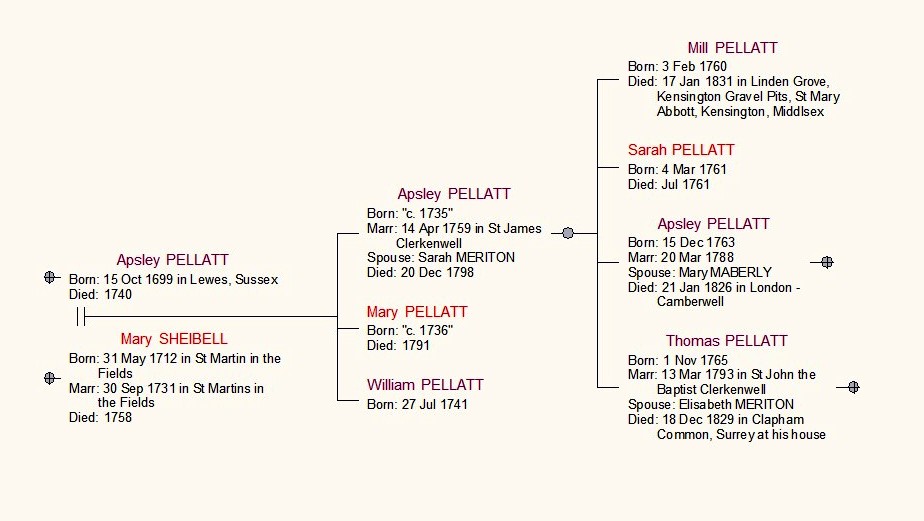
Apsley Pellatt II (1735-1798) was the oldest of three children born to Apsley Pellatt 1 (1699-1740) and Mary nee Sheibell (1712-1758).   We have seen in previous posts that Apsley Pellatt I died just five years after his oldest child’s birth.  Of the younger Apsley’s siblings, we can take a very brief look, since I can trace nothing about his sister Mary, other than that she died at Camden Street, Islington, in 1791, and in her will left many legacies to nieces and nephews, various charities, and the residue to her brother and executor, the above-name Apsley II.  Of William we know even less. His impending birth was mentioned in his father’s will.  I had long puzzled about his apparent birth date, more than a year after his father’s death, until I realised that these events took place before the change of the calendar from Julian to Gregorian in 1752.  Before this date, the first three months of what is now our calendar year were considered to be of the previous year – so that Apsley Sr died early in 1740/1, with William appearing a few months later.  Other than that – of William, there is nothing. I suspect he may have died in infancy, as he is not mentioned in the Will of his grandmother, Mary Sheibell, below.

So, back to young Apsley II.  He was to benefit from a number of legacies, for instance from his grandmother Mary (nee Houghton) Sheibell, both silver and a sum of money, payable upon his reaching the age of 21.  Before he reaches that age, the executors of the will are instructed to use the interest on these gifts ‘to put him apprentice to some genteel and reputable trade’.  And so, we renew acquaintance with the Worshipful Company of Ironmongers, whom we first met in Post 6c, John Freeman (1740-1803), Indigo Maker and Ironmonger.   To recap, John Freeman had married Ann Backler (1741-1820), who was sister to apothecary Sotherton Backler (1746-1819) and aunt to Sotherton’s son Samuel Backler (1784-1870), who in 1810 married Mary Pellatt (1789-1857), daughter of Apsley Pellatt III (1763-1826), to whom we will briefly be introduced later in this post.  The point of all this is to show that almost certainly there were long standing links between the Pellatts and the Backlers.

Apprentice: In 1750, on payment of the sum of £80, Apsley II was put apprentice to William Bliss: ‘I Apsly Pellat [sic] Apprentice to William Bliss do promise to be obedient to the Master and Wardens of the Worshipful Company of Ironmongers during my life and my said Master during my Apprenticeship. Witness my hand this 12 day of July 1750 Apsley Pellat [sic].’ (image on findmypast)

Apsley Pellatt served out his seven years as an apprentice, and was made free of the Ironmongers Company on 18 August 1757.  By this time, aged 21, he would also have come into his various inheritances, which undoubtedly gave him the resources to marry, and to set up in business as an Ironmonger, where he is to be found for many years at 13 St John Street, Clerkenwell.

Marriage to Sarah Meriton  This took place at St James Clerkenwell, Clerkenwell Green, on 14 April 1759.  Sarah was a minor, and married with the consent of her father Thomas Meriton ( – 1865).  Witnesses were Thos. Meriton (possibly/probably her father) and John Godfrey (not sure who he is).  We will learn more about the Meritons in a future  post, but here it is important to note that Thomas Meriton was an Ironmonger, albeit south of the river in Bermondsey, and not of the Ironmongers Company. It seems likely that the Pellatt/Meriton marriage resulted from the partnership between the families, as noted in the following item from The London Gazette, shortly before Thomas Meriton’s death in Bermondsey.  His marriage to Sarah Wilkinson in 1731 had taken place in Clerkenwell, so although he was located south of the river, she had links in Clerkenwell.  

London Gazette 1 January 1765: The Ironmongery Business carried on by Thomas Meriton of Dockhead, Southwark and Apsley Pellatt of Clerkenwell, was dissolved the 31st of December last, 1764. Witness our hand Thomas Meriton, Apsley Pellatt.  N.B. Thomas Meriton is to pay and receive what is Debtor and Creditor to that time.

And so, for some 30 years, Apsley Pellatt II carried on as Ironmonger of Clerkenwell.  In 1789 he was Master of the Ironmongers Company, elected to the post by the Court of Assistants.  His tenure lasted a year.

He and Sarah had four children, three sons and the sadly short-lived Sarah Pellatt (1861-1861).  Let’s look at the three sons.

Mill Pellatt (1760-1805): Was apprenticed to his father, of St John’s Street, St Sepulchre Without, on 27 July 1775.  He was duly made free of the Ironmongers Company by service to his father on 28 November 1782 (both images on findmypast).  In the 1796 Electoral Register for London, we find Mill Pellatt and Apsly Pellatt [sic] [II] as Ironmongers at St John Street.  And in 1831 we find the death of Mill Pellatt Esq on 17 January and his subsequent burial on 21 January 1831 at St Mary Abbotts Kensington.  His address was given as Linden Grove, which rang a bell – it was where Samuel Backler and Mary [nee Pellatt] Backler were living when their daughter Esther Maria Backler was born in 1830.  See Post 26!  Mary was Mill’s niece.  The Backlers were about to embark on a rather turbulent year, featuring Samuel’s bankruptcy proceedings, among other things.  

Mill Pellatt had profited handsomely from his father’s Will in 1799, but apparently became ill or somehow dependent, because his brother Apsley III’s Will in 1826 [which complicated document we will peruse at a later date] made provision for funds to be invested to produce ‘the yearly sum of eighty pounds and to pay the sum of eighty pounds yearly and every year unto and for or towards the support of my dear brother Mill Pellatt for his life’.   Presumably this care was being provided by Mill’s niece Mary Backler and her husband.

Apsley Pellatt III ( 1763-1826) we will leave until a subsequent post.

Thomas Pellatt (1765-1829) further complicates this complicated family, and I have come to the conclusion that he needs a post of his own.  In short, he was apprenticed Clerk to Attorney William Leeson on 4 October 1780, and  was made free of the Ironmongers Company in 1757 by Patrimony.  He was later to have a significant role with the Ironmongers, and in wider civic life, which is why he merits a post on his own.  For the purposes of this post, suffice to say that he married his cousin Elizabeth Meriton, daughter of Henry Meriton (Thomas Meriton’s brother) in 1795.  Their son Henry Pellatt would marry Mary Backler, daughter of Mary Pellatt (daughter of Apsley Pellatt III) and Samuel Backler. Are you staying with this?  We will leave that for the moment and just focus on the latter years of Apsley Pellatt II. 

There is plenty of evidence that Apsley Pellatt II traded at St John’s Street, but perhaps none so colourful as the events described in the following newspaper clipping:
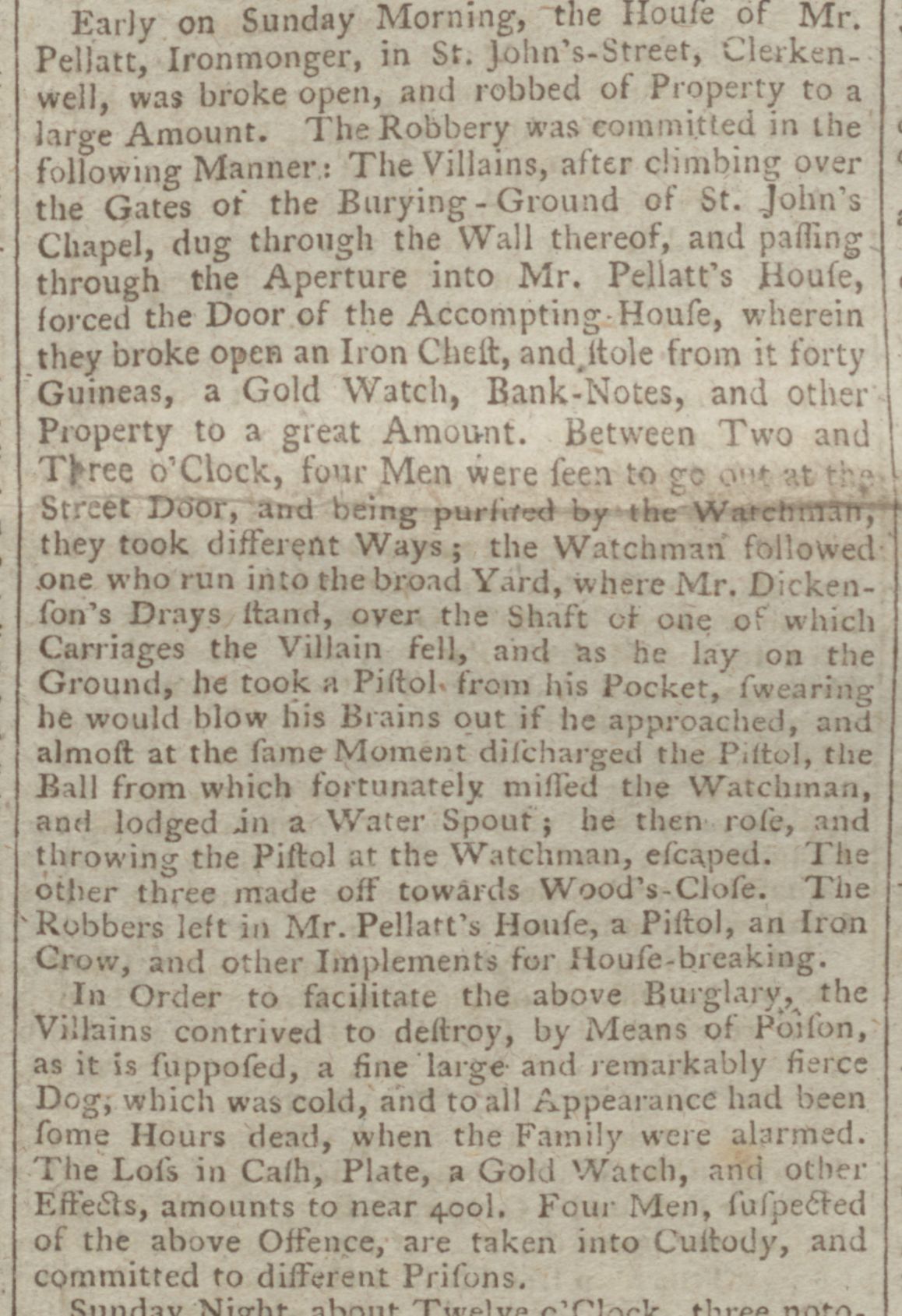
Northampton Mercury 25 October 1784. Image reproduced from British Newspapers collection by kind permission of Findmypast

This clipping tells us a lot about Apsley Pellatt at the time. His home was adjacent to St John’s Chapel and the burying ground, both on the western side of St John’s Street as it heads north towards Islington. Not far away is St James Clerkenwell, where Apsley Pellatt II married Sarah Meriton. The value of stolen goods was some £400 – around £60-80,000 today, depending on which website you peruse. They owned a dog! I have not managed to find court reports about the suspected thieves.

More context of Apsley Pellatt’s working life is given in the advert seen below, not long before his death in 1798. Here we see the types of goods an ironmonger would stock – iron, steel, brass – plus household furniture and effects. Presumably the Pellatts were moving from St John’s Street to Islington, where they died within days of each other at the end of 1798.
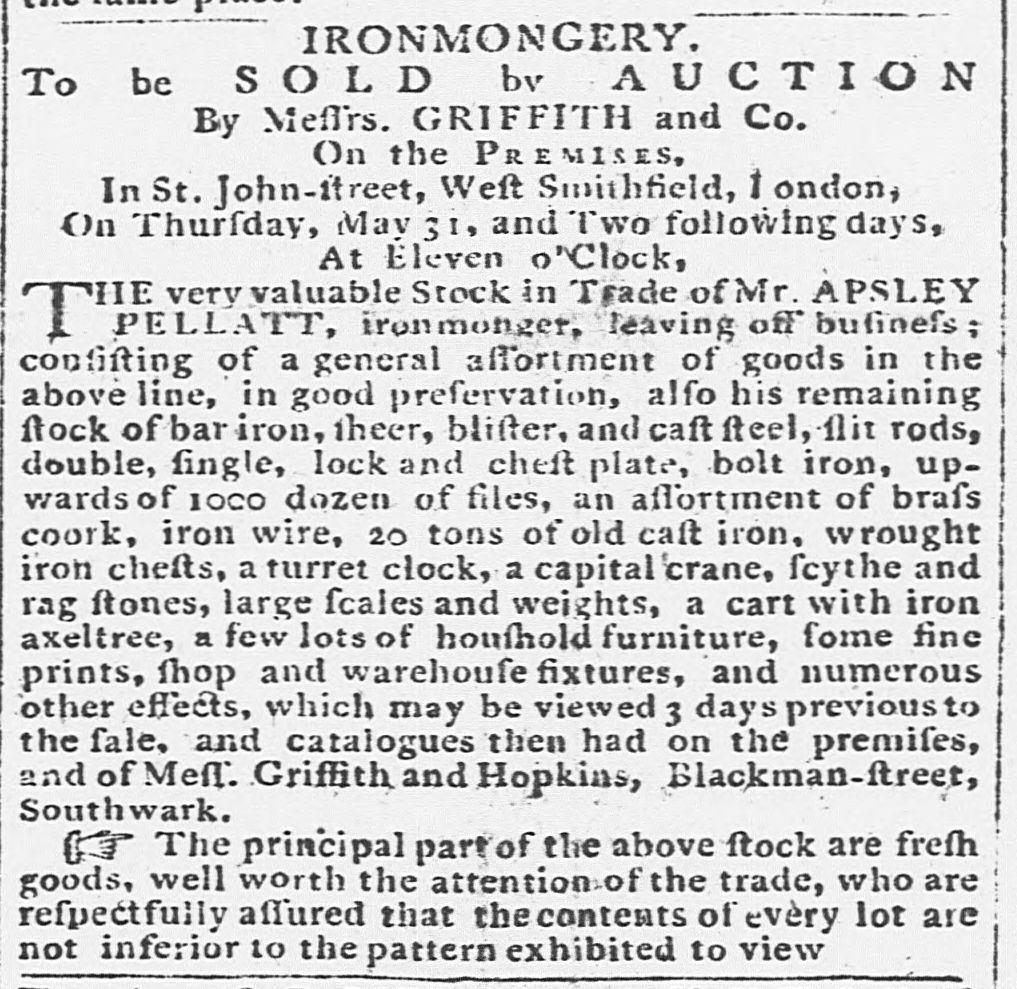
Ipswich Journal, 28 May 1798. Image used by kind permission of Findmypast, British Newspaper Collection.

Apsley Pellatt II – death and Will: The following text is taken from the online record of ‘Deeds of 9 Friars Walk, Lewes’ (ESX 21359) on the Sussex Record Office website   https://www.thekeep.info/collections/getrecord/GB179_AMS6346_1-32

On 4 & 5 Apr 1759 the Friars Estate was settled on the marriage of Apsley Pellatt and Sarah, daughter of Thomas Meriton; they mortgaged it for £2000 to Elizabeth Macie on 5 & 6 Jan 1776, who assigned it to James Louis Macie on 12 & 13 Apr 1786. Sarah Pellatt died on 16 Dec 1798 and Apsley Pellatt on the 20th leaving Mill Pellatt, Apsley Pellatt and Thomas Pellatt his surviving children; Apsley and Thomas proved their father’s will in PCC on 5 Jan 1799. The estate was auctioned on 19 Aug 1803; lot 2, a capital messuage called The Friars occupied by Sir F[erdinando] Poole at a rent of £90 and 2a 1r 28p of land, was sold to George Verrall for £2400 and £93 18s 6d for the timber. The conveyance was executed on 28 & 29 Mar 1804 by Mill Pellatt of Edgware Road in Mx, gent, Apsley Pellatt of St Pauls Churchyard, glass manufacturer and Thomas Pellatt of Ironmongers Hall, gent, to George Verrall of Lewes, gent (and his trustees John Godlee of Cliffe, merchant, Thomas Shank of Fenchurch Street, London, wine and brandy merchant and George Nelson of Palsgrave Place, Temple). Of the purchase money, £2000 was owed to Macie the mortgagee.

Given that Sarah predeceased her husband by a few days, the provisions in his Will for her were not applicable, so basically everything went to the three brothers, with Mill seeming to get a bit more than the two younger siblings. Of interest to us is that eldest grand daughter Mary Pellatt (1789-1857) was to receive £100 when reaching age 21 or day of marriage, a nice little sum for her when she married Samuel Backler (1784-1870) in 1810. In the next post we will catch up with Thomas Pellatt, then we will peruse the Meritons, and finally will move on to Apsley Pellatt III. Lots to look forward to!

6h. Descendants of Ann Backler and John Freeman: Pack, Grant, Grant-Ives, de Clanay Rennick, Grasby, Shore, Clarke, Hurle, Robinson…

In which we finally reach the last offspring of Mary Freeman and Richard Pack, and, with them, the end of this lengthy exploration of the Ann Backler/John Freeman line.This post rather variably, and somewhat arbitrarily, explores only fragments of later generations, particularly of the Shore line.There are simply too many of them, and I have run out of steam!

On reflection, before I tackle yet another large, extended couple of families, I note how very different the Ann Backler line is from that of her brother Sotherton Backler (1746-1819) of the Society of Apothecaries. I have not managed definitively to identify the fate of Ann’s other surviving sibling, Elizabeth Backler (1748/9 – ). As described in earlier posts, Ann’s husband John Freeman (1740-1803) had come to London from Northamptonshire, where he had been part of a very large and tangled web of families. Ann and John’s children and grandchildren inhabited a world of universities, military, clergy, the law and landed proprietors, very different from the artisans, artists and, for females, low-key lives of her brother’s family back in London. Apart from the youngest Sotherton-child, Rev Sotherton Backler (1798-1875), there seems little to link these two branches of this mid-18th century Backler line. And so, this series of posts has been a journey into modest and perhaps more grand stately homes, offspring of clergy marrying clergy, and pages of Burke’s Family Records (Shore, Cooke-Hurle and more) on Ancestry’s website. This post exemplifies all those trends. It seems a world away from ‘my’ Backler line descended from Ann’s nephew Samuel Backler (1784-1870) and his siblings.

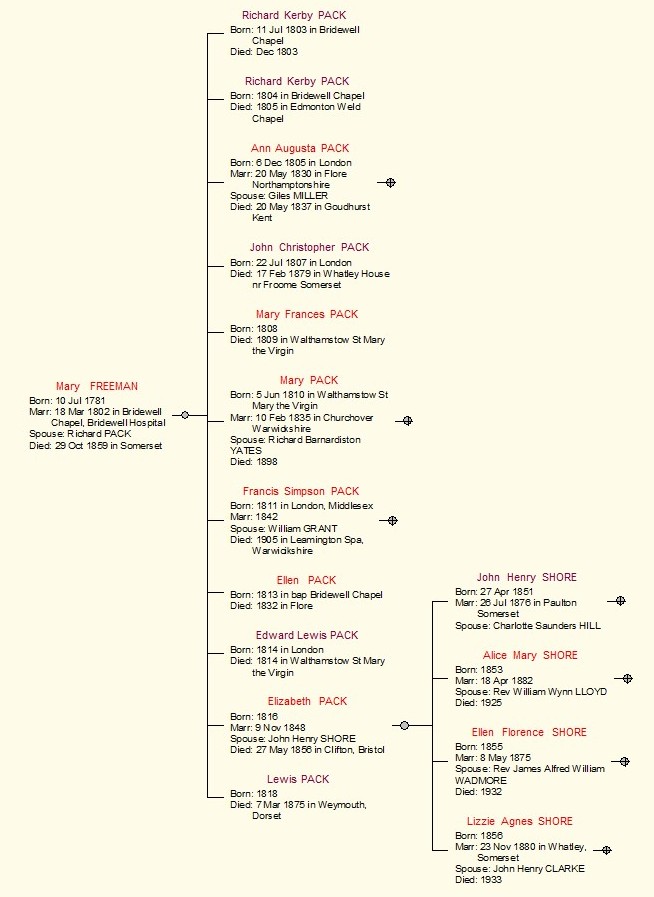
In the previous post we looked at two branches descended from Mary Freeman and Richard Pack. Here we look at two more lines, but we also note in the tree below that Mary and Richard had several more children who died in infancy or at a young age. I have just identified these in updating my data for this post, so this diagram differs from that in the previous post. Thus does family history continually evolve. First- and second-born infants both named Richard Kerby Pack died soon after birth. And later on, Ellen Pack (1813-1832) died at Flore aged 18, and Edward Lewis Pack was born and died in 1814. Clearly this otherwise prosperous family did not always have an easy time.

Moving on from where we left off in the last post, we meet Frances Simpson Pack (1811-1905) who married Barrister William Grant (1806-1868) at St George’s Hanover Square in 1842. By the time of the 1851 Census the family were living in Litchborough, Northamptonshire, where he was a land owner of 200 acres. Noting that his sons were said to be of ‘Litchborough Hall’, I found an English Heritage listing of that property, noting that it had been extensively renovated for William Grant in 1838, just a few years before his marriage to Frances. In 1861 he was described as a Magistrate and Barrister – not in practice. He died aged just 42, and by 1871, Frances was still living in Litchborough, but now with son Arthur W Grant, MA, Barrister and graduate of Brasenose College, as Head, and also with daughter Edith and youngest child, Charles E., an undergraduate at King’s College, Cambridge. By 1901 Frances was living on her own in Leamington Priors, Warwickshire and at her death in 1905, she left some £17,000 in the care of her three surviving sons, executors, her daughter Edith Frances having pre-deceased her by a year.

Some of the Grant family acquired the name of Grant-Ives, following the death of their relative Elizabeth Ives, spinster sister of Cornelius Ives, the Rector of Bradden. Use of the Ives surname and title to Bradden House, was granted by her in 1888 to Wilfred Dryden Grant, whose older brother was already lord at Litchborough Hall. On Wilfred’s death in 1919, the name passed by Royal licence to his brother Charles Eustace, as shown in the London Gazette, below. A search on ‘Grant-Ives’ brings up images of the various coats of arms adopted by different branches of the family. 

London Gazette 21 November 1919 Whitehall, August 23, 1919. The KING has been pleased to grant unto Charles Eustace Grant, of Bradden House, in the parish of Bradden, in the county of Northampton, Gentleman, Master of Arts of the University of Cambridge, and a Fellow of King’s College in the said University, His Royal Licence and Authority that he and his issue may, in compliance with a clause contained in the last will and testament of Elizabeth Ives, late of Bradden House aforesaid, Spinster, deceased, take and henceforth use the surname of Ives in addition and after that of Grant, and that he, and they may bear the arms of Ives quarterly with those of his and their own family, the said arms being first duly exemplified according to the Laws of Arms, and recorded in the College of Arms, otherwise the said Royal Licence.and Permission to be void and of none effect: And to command that the said Royal concession and declaration be recorded in His Majesty’s said College of Arms.

Of Frances’ first two children, Arthur William Grant (1842-1878) and Edith Frances Grant (1844-1904) there is little to say. Oldest surviving son, Edward Grant (1848-1910) of Lichborough (sometimes with a ‘t’) Hall and his wife Edith Helen Hulton (1859-1926) (daughter of the Rev Hulton), had three daughters, two of whom married, one to the exotically named Alexander de Clanay Rennick (1878-1949) (a Lt-Col in the Indian Army, later of Litchborough Hall). When their son was an adult he was styled Capt Richard de Clanay Grant-Rennick (1923-2004), perhaps acquiring the Grant name to preserve that Coat of Arms and the Litchborough title. These families are all easily traceable online and I will take them no further.

As noted above, Wilfred Dryden Grant-Ives (1854-1919) was diverted from his occupation of educator and tutor when he became the Lord of the Manor of Bradden in 1888. He devoted his life to public service, serving as JP and on various councils, as well as being a noted agriculturist and hunter. A rather harrowing report in the Northampton Mercury on 14 March 1919 of the inquest into his death reports that following a serious motor accident involving himself and his wife in 1918, he had become ‘not himself’ and very reclusive. His family had become very concerned about his welfare and had requested the attendance of health personnel, but on perceiving this, Wilfred had climbed out of his bedroom window onto the roof, from which he fell, his injuries resulting in his death, which was deemed accidental. A sad tale, indeed.

Wilfred and his wife Fanny Louisa Millington (1860-1951) had six daughters. An announcement of the engagement of the oldest daughter, Winifred Frances Grant-Ives (1883-1972) to Mr Gerard Arthur Kennaway, son of the Rev Kennaway in nearby Towcester, appeared in The Morning Post on 14 July 1906. However, no marriage record is in evidence, and she next appears in public records returning to England from Spain in 1916, apparently the wife of someone completely different, Charles Egbert Reynolds Sams (1877-1968), a mining engineer, with three children. The next public record is of their marriage in 1925. It’s not clear what all that means! 

Winifred’s youngest sister, Kathleen Beatrice Grant-Ives (1896-1976) married William Wright Grasby (1864-1939), veterinary surgeon (his second wife) in 1922. They had 7 sons before his death in 1939, and then a daughter was born named Diana Kathleen Grasby (1941-2005) in May 1941, two years after William’s death – it’s not clear who the father was. Interestingly, both Kathleen and Diana then became very well known for breeding ponies, including many who performed in pantomimes and at the Royal Opera House, Covent Garden!

Charles Eustace Grant (1851-1930), later Grant-Ives, as above, succeeded his brother Wilfred as Lord of the Manor. He married Madeline Isabel Whitting (1863-1949), daughter of a solicitor and niece of the Bursar of King’s College Cambridge, a post which her husband would later hold until his retirement to Bradden. They had five children. Charles and his son John Charles Grant-Ives (1889-1959) were ‘of Bradden House, Bradden Northamptonshire’. In 1933 John Charles was granted a divorce from his wife Amy (Whiteside Shaw) – I cannot see a marriage for them, possibly it was in Scotland – and custody of their three children, John Edward, Elizabeth M and Joy. She immediately married the co-respondent, Frank Boughton, and in 1948 John Charles married Dorothy M Hemsted, or Chance. 

Isabel Frances Grant-Ives (1891-1976) married Colin Fish (1888 – 1969) in 1921 and their daughter Joan H Fish was born in 1922. Ursula Grant-Ives (1892-1984), twin to Agnes below, was single all her life and died in Wilmslow, Cheshire, leaving some £76,800. She was buried in Bradden with other members of the family. Her twin, Agnes Grant-Ives (1892-1943) married geologist George M Davies (1885-1973) in 1922, his second wife.

There are plenty more Grant-Ives descendants of the above folk, but I will leave them there, and move on to the last of Mary Pack’s children with descendants, Elizabeth Pack (1816-1856) and her husband John Henry Shore – another tree is needed!

Finally, we have the children of Elizabeth Pack (1816-1856) and her landed-proprietor husband John Henry Shore (1819-1878) of Whatley in Somerset. Astute readers will note that this diagram has only their four children, in light of the resulting some 28 grandchildren, which really is a step too far! Elizabeth’s husband came from a long-established family of Shores, chronicled in Burke’s Family Records on Ancestry. His father, John Albin Shore (1775-1835), had married Mary Ann Hurle, so that when John Henry Shore Jr’s (1851- 1932) second child, Bertha Josephine Agnes Shore (1872-1958), married Captain William Armitage Cooke-Hurle, R.N. (1875-1920), they were probably related in some way I haven’t got the energy to pursue. John Henry Jr and his wife Charlotte Saunders Hill (-1900) had three daughters and eight sons, seven of whom survived to adulthood. I have found an online post which summarises some of the sons’ histories and military exploits at https://grandadswar.co.uk/capt-j-l-shore/ I have traced the outlines of their lives for my own database, but will not undertake to write them up here. I would be happy to discuss further if any reader so desires. I think John Henry Jr married twice more.

Alice Mary Shore (1853-1925) married Rev William Wynn Lloyd (1844 – 1925), they producing five daughters, three of whom did not marry, and one son, Meredydd Wynn Lloyd (1887-1967), who served in the Australian Army in WW1 and later married a French woman in Egypt. 

Ellen Florence Shore (1855-1932) married Rev James Alfred William Wadmore (1851-1918), they having two sons and three daughters.

Lizzie Agnes Shore (1856-1933) married solicitor Charles Henry Clarke (1841-1914), the son of a solicitor and his wife, Mary Hurle Clarke, the Hurle name appearing again in this family. One son, Arthur Henry Gilbert Clarke (1891-May 1916) died at High Wood in France. His early death contrasted with the career of his older brother, Major Dr Richard Christopher Clarke, RAMC, OBE whose death in 1957 in Bristol was attended by some 300 mourners, including many from the various families mentioned above, and remembering, among other things, his role as Honorary Curator of Bristol Zoo. He had served in WW1 as a medical officer. It seems youngest brother Aubrey Martin Clarke (1889-1957) also served in WW1, but then spent at least a number of years in Ceylon with his wife Evelyn Robinson (1890-1962), first cousin of Foster Gotch Robinson (1880-1967), noted cricketer, horse trainer and paper manufacturer (see his entry in wikipedia), who married in 1908 Aubrey’s sister, Marguerite Victoria Mary Robinson (1887-1963). The Robinson family were noted philanthropists in Bristol.

The very last child of Mary Freeman and Richard Pack was the unmarried son, Lewis Pack (1818-1875). Educated at Balliol College, Oxford, he is designated simply as Landowner in the 1861 Census at Southfield House, Whatley, Somerset, the home of his brother-in-law Richard Barnardiston Yates. Similarly, in the 1871 Census he is again a Landowner at the rather grand Whatley House, again in Whatley, Somerset, the home of his brother-in-law John Henry Shore. He died in 1875 and is buried in Whatley.

And so endeth the tale of the Freeman/Backler line, admittedly very selective and incomplete in this post. I had no idea when I embarked on this line some 18 months ago that it would be so enormous, albeit always interesting. It feels good to have explored it, however genetically distant from me is the resulting cast of characters. When all is said and done, they are my Backler cousins!

With some relief, I will in due course revert to the Pellatt/Rivers/Newton line!

6E. Backler descendants of Ann Backler and John Freeman (1): MORGAN/MORTON/BINSTEED/WILLIAMS/SNOOKE

In which we see that Ann Backler and John Freeman had six children in all, three of whom married and had children. This post looks at the MORGAN descendants, from the marriage of Sarah Freeman (1774-1856) to Rev Thomas MORGAN (1771-1851). We meet, among others, the delightfully-named Rev Hargood Bettesworth Snooke…

Sarah Freeman (1774-1856) was pre-deceased by two older siblings, Elizabeth Ann Freeman (1772-1789) and John Freeman (1773-1773). Also pre-deceasing Sarah was her younger sibling John Sotherton Freeman (1777-1777).

Sarah Freeman (1774-1856) married Rev Thomas MORGAN (1770-1851) on 4 November 1806 at All Saints Edmonton. Among the witnesses were his brother-in-law Richard PACK, of whom much more in a subsequent post. Thomas was born in Devinnock, Brecknock, and educated at Wadham and Jesus Colleges, Oxford. As well as holding several curacies, he was made a chaplain in the Royal Navy, latterly chaplain of the Royal Dockyard in Portsmouth. There is a portrait of him at the National Maritime Museum, described at https://www.rmg.co.uk/collections/objects/rmgc-object-14343 – with further biographical details. The family moved around a lot, as shown in baptismal and census records. According to the Dictionary of Welsh Biography, Thomas sold his lands in Brecknock when his only son died in 1844 ( https://www.rmg.co.uk/collections/objects/rmgc-object-14343 ). At his death in 1851 he lived at North End Lodge, Milton, Hampshire.

Sarah and Thomas had five children, as follows:

  • Elizabeth Morgan (1808, Goudhurst, Kent – 1885) married Rev David MORTON (1799-1884) on 1 October 1835 in her hometown of Portsea, Hampshire. This marriage re-kindled (or maintained) the Freeman family links with Northamptonshire. Witnesses included, among others, her Northamptonshire-based uncle by marriage Richard Pack, who had also witnessed her parents’ marriage. The couple moved back to Northants, the Rev Morton being Rector of the Parish of Harleston. England censuses from 1841 to 1871 show them living in the Rectory – in 1851 with a Housekeeper, Footman and Servant; in 1861 Cook & Housekeeper, Housemaid, Footman and occasional servant – washerwoman; and three servants in 1871, when David Morton was aged 71. In 1881 the couple are found at 2 Carisbrooke House, Ventnor, Isle of Wight. He is designated as Rector of Harlestone – aged 81. Were they just visiting? David Morton’s Probate record in 1884 shows he died in Southampton, but he is buried in Harlestone. In 1885 Elizabeth died in Sussex but is also buried in Harlestone.
  • Philadelphia Sarah Morgan (1814, Goudhurst, Kent – 1852) married Charles Henry BINSTEED (1813 – 1891), Solicitor, on 14 August 1845 at St Thomas Parish Church, Portsmouth. Alas, the names of witnesses are illegible. After her death, her husband re-married in 1860 and had three children – about whom we will not concern ourselves! (That’s a relief, you say…)
  • Anne Morgan (1816 – 1877) married on 3 February 1842 at Portsea, to Captain Woodford John WILLIAMS, R.N (1809-1892), who would become Admiral. The ceremony was taken by her brother-in-law Rev David Morton, and witnesses included her sister Philadelphia Morton and father Thomas Morgan D.D. The couple had onc child:
    • Annie Philadelphia Williams (1843-1914) married Richard Fielden TAYLOR on 6 June 1873 in Southend-on-sea, Essex. Richard was in early censuses a Professor of Music; later on he was described as living on own means. According to the 1911 Census in Torquay, the couple had had 9 children, of whom 5 were still living. Their house had 10 rooms. This family, with the exception of the youngest known child Richard Benjamin Taylor, is an example of a large family with no known descendants – this branch of the family line ends here. Some children were born and died between censuses; known children, identified with the help of online family trees, and confirmed by finding baptismal and death records, were:
      • Annie Gwendolyn Taylor (1874-1966). She died in Torquay, left about £12,000, and showed no known occupation in successive censuses. In the 1921 Census, she, her sister Winifred and their father, aged 82, were living at Abbeyfield, Bridge Road, Torquay. Search on this and you will find an elegant house built in 1860, now a rather attractive-looking B & B! This was her address when she died in 1966.
      • Dorothy Morgan Fielden-Taylor (1875 -1959), aka Angel Lorraine Dorothy Morgan, according to her probate notice. She, too, showed no occupation in censuses. She lived in Somerset in 1939, and died there.
      • Maurice Charles Woodford Taylor (1877-1877, baptised in Chelsea in April and buried at Brompton Cemetery in October.
      • Winifred Elizabeth Taylor (1878-1937), No known occupation, living with her father and sister in 1921 in Torquay. on 19 February 1937 the Torquay Times and South Devon Advertiser reported her funeral, noting that she had lived with her sister Gwendolyn (as above) for about 25 years and was an ardent church-goer and church worker with Tor Church and the Tor Missionary Association. A long list is given of friends and family who attended the funeral and sent wreaths.
      • Diana Margaret Taylor (twin: 1879-1880), buried at St Mary Wandsworth.
      • Rev Canon Thomas Fielden-Taylor (twin: 1879-1937, Wellington NZ). After qualifying in law, went to NZ for health reasons and was ordained. Chaplain to NZ army in the 1st WW, served in and wounded in Dardanelles, then to France, then invalided back to NZ. Married Eleanor Sophia Mules (1873-1950), daughter of Bishop Mules in 1911. After the War, according to NZ dictionary of Biography, he was a missioner at St. Peter’s Mission, Wellington. https://teara.govt.nz/en/biographies/3t11/taylor-thomas-fielden This link takes you to a longer biography, celebrating his work with youngsters, but also chronicling unproved charges of abuse against him. There were no children of this marriage.
      • Gladys Frances Taylor (1881-1886). Baptised at St Mary’s, Putney; buried in Heene in Sussex.
      • Christine Marie Taylor (1882-1886) Baptised in Putney 2 February 1882, Father now a ‘Gentleman’, as opposed to ‘Professor of Music’ in previous baptisms. Died in Worthing, buried at Heene on 31 May 1886.An inquest was reported in a syndicated article appearing in many newspapers between the end of May and the beginning of June, for instance the Edinburgh Evening News on 31 May. Three children had been suddenly taking ill with vomiting and other symptoms very early one morning, having gone to bed well. One aged 4 (Christine) died later that morning and another (Gladys) in the afternoon. A third child recovered. No obvious evidence of cause, for instance poisoning, was found, and after an adjourned inquest, further work was to be done on the stomach contents at Guy’s Hospital. No further report appears in the British Newspaper Archive.
      • Richard Benjamin Taylor (1883 – ) appears in the 1891 Census with his parents and surviving siblings. In 1901 he was at school in Horsham, Sussex. The Portsmouth Evening News 23 January 1903 reports that at the Gosport Petty Sessions Richard Benjamin Fielding Taylor was fined 2s 6d for riding a bicycle on the footpath of the Fareham Road! He has proved difficult to trace after that.
  • Thomas Charles Morgan (1818 Portsea, Hants – 1844 Secundarabad, India). Lincolnshire Chronicle 29 November 1844: ‘Death of a Promising Young Officer: Died, at Secundarabad in the East Indies, on the 11th of September last, in the 26th year of his age, after a few days’ attack of a violent, irruptive fever, which terminated in pulmonary apoplexy, Lieutenant Thomas Charles Morgan, acting adjutant for nearly four years in the 4th Foot (or King’s Own), the dear and only son of the Rev. Doctor Morgan, Chaplain of Portsmouth Dockyard. He was of an affectionate disposition and generous nature, amiable and a most promising officer…he was beloved in his regiment…
  • Mary Morgan (1820-1880). Married widower Rev Hargood Bettesworth SNOOKE (1807-1875) on 11 October 1853 in Portsea. He was perpetual curate in Portsea, and in 1867 became Chaplain of St Malo and Dinard. He died in Jersey. He had three children by his first marriage, and two daughters with Mary Morgan, who were::
    • Mary Elizabeth Snooke aka Hargood (1855-1912). She never married, appeared with her sister in the 1911 Census at 2 Pemberton Terrace, Cambridge, and died there in 1912, address The Tiled House, Panton Street, Cambridge, citing her sister (below) as executor of her will. Nothing else known.
    • Rosa Mary Morgan Snooke (1857-1929) lived at various addresses in London, always of ‘Private Means’. In 1901 shw is found at the elegant Ladies’ Residential Club at 52 Lower Sloane Street, and as noted above, in 1911 she was living with her sister in Cambridge. The 1921 Census shows her as Rosa Mary Morgan Hargood, 64, living at 34 Panton Street, Cambridge. Her Probate index record shows that she died at Heigham Hall in Norwich, Norfolk in 1929, effects approx £7800.

And thus endeth the roll of descendants of Sarah Freeman and the Rev Thomas Morgan. It appears there are no possible living descendants of this line.

6d. Children of Thomas Freeman and Dennis Gare

In which we quickly consider the descendants of Thomas Freeman and Dennis Gare – excepting those of John Freeman and Ann Backler. We trace links between families, and back to Northamptonshire for those who were in London.

Of eldest child Thomas Freeman (bap 1738 Weedon Bec – ), we know little, other than, as noted in the previous post (6c), that he was a cordwainer in Bedford, with a son Thomas Freeman (approx 1764 – ), who was briefly apprenticed to John Freeman in London before being turned over to John Grant, Citizen and Glover, in 1779. A reference in Bedford Archives catalogue in ‘An Account of the indentures of apprentice bound out by the Bedford Charity’ (X109/1/70) cites ‘John Covington 8 May [1799] to Thomas Freeman of Kingsthorp – shoe maker’. But who knows? End of known story!

Of John Freeman and Ann Backler, we will turn to them in the next post. Their children are direct Backler descendants, while those further mentioned in this post are Backler cousins by marriage.

Of Anne Freeman (bap 23 July 1742 Weedon Bec – ), we know even less than about Thomas. Did she marry? Not sure. And we have no Wills of her parents to see if she is mentioned there. She is not mentioned in her siblings’ Wills so far identified.

Of William Freeman (1745 Weedon Bec -1795), we know more. We have seen in the previous post that he went to London sometime in the 1760s or 70s, and was made free of the Ironmongers in 1787 through his brother John’s recommendation. The record of William’s marriage to Judith T(h)ompson (1756-1785) is one of those felicitous finds that brings some strands together. Taking place at Northampton St Sepulchre on 4 July 1776, it helpfully stipulates that William Freeman is ‘of Cripplegate in the City of London’. The marriage was conducted by C[harles] Tompson, Rector of Mulsoe in the County of Buckinghamshire. who turns out to be Judith’s brother. Witnesses as shown on an ancestry parish record image signed as Geo:Tompson, in a rather large, shaky hand which could be

that of her father, and a very familiar signature for the Backlers.com blog – that of S[otherton] Backler [1746-1819], with its distinctive wavy flourishes seen in many documents of the Society of Apothecaries. This is Ann’s brother, who would eventually become Clerk to the Society. It is surely likely that John Freeman was at his brother’s wedding as well?

George T(h)ompson, Judith’s father, was a Grocer in Northampton, also designated as Alderman in Judith’s baptismal record and Mayor in the baptismal record of his daughter Mary in 1754. His lengthy Will probated in 1787, also the year of his son the Rev Charles Tompson’s death, is long and leaves much property and wealth to innumerable children, including £1,500 in stocks and securities to his son-in-law William Freeman. His daughter Judith also features many times in the Will, but I confess to lack of inclination to decipher it all. The Will was written in 1781, and Judith predeceased her father in 1785, so her legacy would be shared by her surviving children.

William Freeman and Judith Tompson had five children as far as is known. Judith died in 1785, and William in 1795, after which date the surviving youngsters were orphans:

  • Susannah (1777-1778)
  • William (1779 -), married first Mary Hawling, and second Ann Randall, with whom he had two sons, William (1803) and George (1808). We saw in the previous post that William was apprenticed first to his father and then to his uncle John of the Ironmongers. Mention in his brother George’s Will in 1849 would indicate that William was alive then, but I cannot find a suitable death record or Will.
  • George (1780-1854), was also apprenticed to his father, and then turned over to his uncle George Tompson, Judith’s brother, in 1796 after his father’s death. In the 1851 Census he is shown as a 70-year-old retired Grocer, lodging at Radcliffe Terrace, Finsbury, the address given in his brief Will written two years before and proved by his Executor and Nephew John Downes in August 1854, and to whom the rest and residue is bequeathed after £10 and his clothes and linen are left to George’s brother William (see bullet above).
  • Judith Freeman (1781-1854) married John Downes (1781-1849), a wholesale tea dealer. They had at least five children. Their final address was 6 Bedford Place, Russell Square. Judith’s Will written 8 October 1850 would be a delightful read if it were more legible. It specifies exactly what is to go to each child, such as which volumes and editions of books, which silver spoons, which articles of furniture. But life is too short

Of Thomas and Dennis’ last child we can note just John Freeman (bap Sep 1784 St Giles Cripplegate – buried Mar 1785 St Giles Cripplegate, cause of death convulsions).

And so endeth the account of Backler-cousins-by-Freeman-marriage. In the next post we will look at the very many descendants of John Freeman and Anne Backler.

6c. John Freeman (1740-1803) Indigo Maker and Ironmonger from Northamptonshire

In which we look a little more closely at John Freeman (1740-1803), who married Ann Backler (1741-1820), speculating that the woad industry of Northamptonshire prompted his move to London to improve his fortunes in the related industry of indigo making. Also considering his links with the Ironmongers Company and his certain acquaintance (or more?) with the Pellatts, who played a prominent role therein and whose heritage we will examine in future posts.

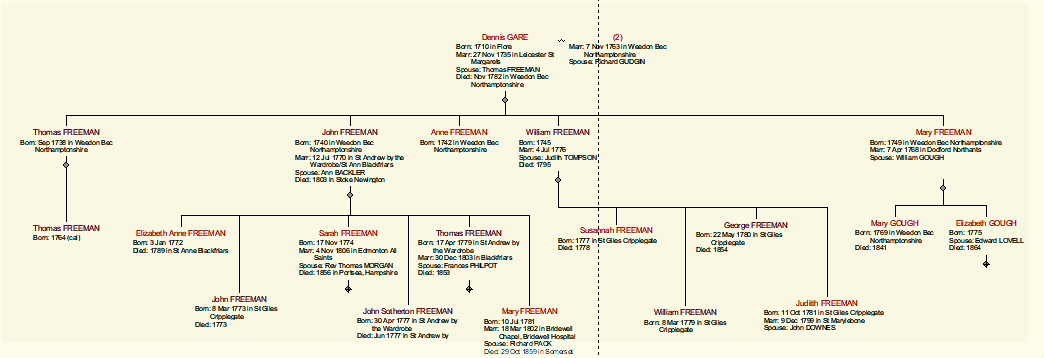
The tree above will form the basis of this and the next post (or two). It shows two generations of descendants of Thomas FREEMAN (1684-1761) and his wife Dennis GARE (1710-1782). Of particular relevance to this post are John Freeman, who we know married Ann Backler in London, and John’s brother William Freeman (1745-1795), also to be found in London.

From his Will and other sources (see below) we know that John was an Indigo Maker. Without direct evidence, it is possible to speculate that this occupation was related to John’s and brother William’s migration from Northamptonshire to London from an area in Northamptonshire actively involved in the production of dye from woad, a crop widely grown in the area. A post on the Whilton history website describes this industry in some detail. (https://whiltonlhs.org/whilton-history/f/woad-in-whilton ). The post describes the itinerant nature of woad workers, the necessity for communities to separate themselves from the dreadful stink of woad processing (and from the workers who carried this stink with them), and the gains to be made by landowners in letting out fields for growing the biennial crop. Every four years or so, the workers moved on to other sites. One place of residence was in the now-defunct village of Glassthorpe, almost certainly the location cited in entries in the Flore Parish Register, which also indicate that family groups were involved in the woad industry:

. 1732 Apr 9. James son of William & Martha Phipps (Woading-Labourers at Clastrop) was baptized.

1732 July 14. William son of Edward & Mary Phipps (Woaders at Clastrop) was Buried. Affadavit Dated, July 20.

1740 June 22. Elizabeth daughter of Thomas & Elizabeth Neal (Woad-Folks) was Baptized.

1740 July 12. James son of Peter & Elizabeth Neal (Woad-folks) was Baptized.

1740 July 20, James son of Peter & Elizabeth Neal was buried. Affid: Dated, July 25.

Woad was the native-grown plant which produced blue dye, but a richer, darker dye could be got from Indigo, which from the start of the 18th century was increasingly being imported from Asia and the Americas, produced largely through the work of slave or indentured labour. (See, for instance:Blue in Eighteenth Century England: Pigments and Usages. Zoriana Lotut. https://journals.openedition.org/1718/1214?lang=e )

From Northamptonshire to London: At some point, probably in the 1760s, William and John – together or separately? – went to London. The first record we find is that of John, being made free by redemption of the Ironmongers Company, on 24 July 1769. The transcribed record on findmypast shows him as a ‘Blue merchant’, son of Thomas Freeman, gentleman. Proposed by W. Price. In 1787, William Freeman (1745-1795), Indigo Maker, becomes free by redemption, proposed by J Freeman, his older brother (nepotism abounds in the City Livery Companies). Further family links appear in Ironmongers’ records over the next decade:

  • Thomas Freeman is apprenticed to John Freeman, 20 March 1779. This Thomas, said to be aged 15 years, is said in the record to be the son of Thomas Freeman (1738/9 – ), Cordwainer, of Bedford. As mentioned in John Freeman’s Will of 1803, the father is John’s older brother Thomas, baptised in Weedon Bec in 1738/9 and frustratingly elusive after that. Young Thomas, apprenticed first to his uncle John, was shortly after, on 17 June 1779, turned over to John Grant, Citizen and Glover, of the Glovers’ Company. No more is known about Thomas Snr or Jnr. Records from Bedfordshire are not very evident online.
  • Thomas Freeman, this time son of John Freeman (1740-1803), was apprenticed to his father, John Freeman, Indigo Maker of St Giles Cripplegate, on 30 April, 1793, for no consideration. This apprenticeship would see out its full time, with Thomas being made Free by service to his father John, on 30 April 1800. We will return to this Thomas (1779-1853) in a future post.
  • William Freeman (1779 – ), son of William Freeman (1745-1795), who we have seen above, became free of the Ironmongers by redemption, was on 29 August 1793 bound apprentice to his father William Freeman, Little Aldermanbury, Indigo Maker. However, William Snr’s dates as above show that he died in 1795, so on 25 November 1795, young William was ‘turned over’ to his uncle John Freeman, Citizen and Ironmonger, for the duration of his apprenticeship. I have not found a record of William being made free of the Ironmongers.
  • George Freeman (1780-1854) also son of William Snr, on 27 November 1794 was also bound apprentice to his father. After William Snr’s death in 1795, on 19 March 1796, George was turned over to George Tompson (see next bullet point), Citizen and Ironmonger, to serve out his apprenticeship. I have not found a further record of George’s apprenticeship, but we will return to him in future posts.
  • George T(h)ompson (as in the previous bullet point) was made Free by Redemption of the Ironmongers on 24 June 1788, son of George Thompson, Gent (of Northamptonshire). George Jnr was a tea dealer, and was the brother of Judith T(h)ompson ( – 1785), late wife of William Freeman Snr. George was proposed for his freedom by … John Freeman! (Are you keeping up? – nepotism, indeed.) We will return to this family in a later post.

The Aldermanbury Postern address, hard by the city walls in St Giles Cripplegate, was the site of the indigo makers variably named as Grace and Freeman (appearing in London directories between 1781 and 1794), later Freeman John & Son (by 1803), then Freeman and North (1817). William Freeman (died 1795) and Henry Grace (died 1798), and John Freeman, were in partnership, with John taking over for the brief period after their deaths until his own in 1803, the original partnership having been dissolved in 1795, just before William’s death, as recorded in the London Gazette as follows:

June 24, 1795. The partnership subsisting between Henry Grace, John Freeman and William Freeman, in the Business carried on under the firm of Grace and Freemans of Aldermanbury Postern, London, Indigo Blue Manufacturers, is this Day, by mutual Consent, dissolved, the Share of the said Henry Grace being made over to the remaining partners, the said John Freeman and William Freeman, who undertake to settle all Matters relating to the said Copartnership. Henry Grace. Wm. Freeman. John Freeman. The London Gazette Issue 13790. 23 June 1795. p. 663

I am not sure who took over after John Freeman died in 1803. Could the ‘and Son’ have been his son Thomas, who had served his apprenticeship under John and then been made free of the Ironmongers? Suffice to say that at his death in Brighton in 1853, as a ‘Merchant’ he was evidently a very wealthy man. The source of his fortune is unknown. We will meet this family again.

This post has aimed at locating John Freeman and his brother William in London from their Northamptonshire origins. A review of their families in future posts will very partially uncover the tangled roots of the Freeman and related families.

6a. Ann Backler and John Freeman: exploring a newly-discovered (and extensive) Backler line

In which we unveil some details about Ann Backler (1741-1820) and her husband John Freeman, Indigo Maker (1740 – 1803), spurred on by contact to this blog by a very distant cousin descended from this partnership. In this and some subsequent posts we will briefly look at the Freeman family, and then (again, briefly) follow the many descendants, featuring some great wealth, and lots of clergy and military folk. We will move on from the report in Blogpost 6, ‘The Family of Sotherton Backler, Apothecary, and his wife Ann Ashley’ https://wordpress.com/post/backlers.com/50 which stated as follows:

Ann 1741 –       m. John Freeman 12 July 1770 at St Andrew by the Wardrobe/St Ann Blackfriars, witnessed by S Backler and Sarah Rowley. Nothing more is known about Ann and John. [But, now, read on…]

John Freeman, of the Parish of St Ann Blackfriars, Bachelor, and Ann Backler, of the Parish of St Dunstan in the West, Spinster, were married by Licence at St Andrew by the Wardrobe on 7 July 1770. Witnesses were S Backler [her brother Sotherton Backler (1746-1819)], Sarah Rowley [not sure who she is] and Elizabeth Backler [almost certainly Ann’s sister, born 1748/9, whose fate I have not managed to trace. The tree below shows the married couple and their six children (of whom more in succeeding blogposts). The baptism records of some of the children show that John was an Indigo Maker.

John FREEMAN (1740-1803) was born in Weedon Bec, Northamptonshire, son of Thomas FREEMAN (1684-1761) and Dennis [sic] GARE (1710-1782). I spent many engaging hours in the summer of 2022 working with distant cousin Chris to disentangle the various lineages originating in Northamptonshire and linked in many different ways to Ann Backler and John Freeman. My challenge is to get them into some kind of order for the purposes of my Backler blog! The very many descendants of John Freeman and Ann Backler are cousins of one sort or another with me and the other Backler descendants chronicled on this site – all sharing in some degree as grandparents, Sotherton Backler (1704 – 1763) and Ann Ashley (c.1714-1768).

For some time I had linked the name of Ann Backler with that of John Freeman, but it wasn’t until his death date of 1803 was suggested to me that I identified the correct John Freeman, among many possibilities, and found his Will, clearly citing his brother-in-law Sotherton Backler as an executor. The Will was one of those very helpful ones, citing lots of clearly-labelled relations. It showed that John Freeman was resident in Newington Green, Middlesex, hard by Islington and Stoke Newington, the places of residence of many of our Backler and, later on, Boulding and Pellatt ancestors. However, John wished to be buried at St Ann Blackfriars, right by the Society of Apothecaries and the site of many Backler baptisms and burials.

By the time of drafting his Will, just one of John and Ann’s children had married, three having pre-deceased them. Mary, the youngest, had in 1802 married to soon-to-become very-wealthy Richard Pack, cited as an executor in John’s Will. (More about them anon.) Son Thomas would marry soon after his father’s death, and daughter Sarah would follow a couple of years later. She is left a handsome legacy, with provision after John’s wife Ann’s death for both daughters and their children. Also mentioned are John’s niece, Mary Gough (which, in sorting out various Freeman families in Northants helps to confirm John’s family), and John’s brother Thomas, of Bedford – a mysterious soul, indeed. The Will shows that John owned a house in Fore Street, Cripplegate, where the Sotherton Backlers also had lived – could this house have come to him on his marriage to Ann?

John Freeman was the great grandson of Richard FREEMAN [1] ( – 1694) and Mary GODFREY [sometimes GODFREE] of Brockhall (1622-1691). Brockhall was one centre of residence for the Freemans, Godfreys and others prominent in John Freeman’s family tree. Adjacent parishes include Dodford, Norton, Whilton and Flore, all places of births, marriages and burials of various kin.

Richard Freeman [1] was a Bonesetter, a largely un-formally-trained version of an osteopath, chiropractor and physiotherapist. Such was his fortune, however acquired, that in 1644 he purchased the Manor of Whilton. His and Mary’s son Richard FREEMAN [2] (1646-1684, note he died ten years before his father, so Richard [1’s] grandson inherited) married his cousin Elizabeth GODFREY. ‘Our’ John FREEMAN was the youngest son of Richard FREEMAN [2].

A number of features marked Whilton in this period. First, and perhaps relevant to the bonesetting, was the Civil War. Northamptonshire supported the Parliamentarians, but battles took place all around the area, including in Whilton and Flore, and notably at nearby Naseby.

Not having found any contextual information for that period, there is later evidence found by my Freeman-sleuthing partner: reference to Mr Freeman, Bonesetter in Memoires of the Verney Family, Vol IV, downloaded from https://archive.org/details/memoirsofverneyf04verniala/page/394/mode/2up

Young Edmund Verney, a student at Oxford from 1685-8, has had an accident, and damaged his elbow. On 6 April 1687, his father wrote to Dr Thomas Sykes: ‘ This day about noone yr Messenger Brought me the ill newse of my Sonnes unlucky accident last Munday. I am very sorry for it : But am extremely joyfull to under- stand by you that the worst is past with this and that He is in so fayre a way of amendment soe I Hope There is noe Danger in a dislocation of an Elbow, where such excellent Chirurgions and Bone setters are at Hand, and Physitians if occasion Be : I Guesse This was done at wrestling…’ However, the arm continued to prove troublesome, and by May young Edmund still did not have proper use of it. On 14 May 1687, his tutor wrote to the lad’s father, also Edmund: ‘His arme is free from paine, but he hath not yet the right use of it, And upon that Account as soon as I was fearfull that all was not right, I would have had him gone home to you in order to his consulting some very skilfull Chirurgion, and particularly advised him to one Mr. Freeman who lives near Daventry in Northamptonshire, and is every market Day Here at the Wheatsheaf. This man here is look’d upon by Physitians and others as the most skilfull Bone setter in all England, And therefore I had a desire that your Sonn should have his opinion ;‘ On 22 May 1687, young Edmund’s father wrote: ‘The famous Bone setter Mr. ffreeman Lookt upon the arm and ffelt it, and sayd it is right sett, and nothing out, but That the sinues are shrunk wch makes Him That Hee cannot Hold his Arme streight : But Mr. ffreeman sayes his Arme will Do well : and Be as streight as ever, if Hee Doth use it and exercise it with care : and ffollow his directions and prescriptions.

An entry in the Parish Register of Brockhall does record one impact of the Civil War: ‘May 4th 1653. Brockhall Parsonage was by Mr. James Cranford resigned to the Present Rector thereof Mr. William Borlee, who by Reason of the Warrs between the Royalist [sic] and Parliamentarians not being Constant Resident until February 2nd 1646 noe Just Account could be taken of the Severall Baptizeings Marriages and Burrials.

Whether the above hiatus also afftected a delay in baptising of Richard Freeman [2] from his birth in 1646 to his Baptism in 1650 is not known. What is known is that he and Elizabeth Godfrey had five children, of whom the oldest, Richard [3] (1677-1749) and the youngest, Thomas Freeman (1684, the year of his father’s death – 1761) are most relevant to our story.

First off, Richard [3] (1677-1749) had two wives, Mary CORPSON (1680-1707) – 6 children, most of whom were short-lived except for the Rev. John Freeman (1703-1786), educated at Pembroke College Oxford and then Rector of Louth in Lincolnshire. His half-siblings were the children of Richard FREEMAN [3] and his second wife, Elizabeth LANGTON (1688-1761), whose first son the Rev Langton Freeman (1710-1784) inherited Whilton Manor. Langton was the oldest of ten children, and an avowed eccentric. His and his siblings’ stories are interwoven throughout the vicinity, including Daventry, Northampton, and into Warwickshire. Much too numerous to delineate here, and anyway, they aren’t Backler descendants! His Will, however, made unusual provision for his interment:

first, his body to lie in the Bed in which he dies for four or five days until it becomes offensive; then to be moved in the Bed to the summerhouse in the garden, ‘and to be wrapped in a strong double winding sheet, and in all other respects to be interred as near as may be to the description we receive in Holy Scripture of Our Saviours Burial. The doors and windows to be locked up or bolted and to be kept as near and in the same manner and state as they shall be at the time of my Decease. And I desire that the Building or Summer House may be planted around with evergreen plants and fenced off with Iron or Oak pales and painted of a blue colour. For carrying this out, he gives Whilton to his nephew Thomas Freeman (1746-1801), son of Langton’s brother Thomas (1715-1777) and his second wife Anne Adams ( – 1781). Nephew Thomas died in 1802, and the estate passed to his daughter Marianne (1788-1866), who had married Dr Charles Rattray ( – 1836). The estate was then sold.

This takes us to the branch, founded by Richard FREEMAN [2] and Elizabeth GODFREY, and of direct interest to the Backler story: that of Thomas FREEMAN and his wife Dennis GARE. BUT, to develop this story in bitesized chunks, I will leave this family to the next post! Hopefully there won’t be too much of a gap before it appears.