In which we finally reach the last offspring of Mary Freeman and Richard Pack, and, with them, the end of this lengthy exploration of the Ann Backler/John Freeman line. This post rather variably, and somewhat arbitrarily, explores only fragments of later generations, particularly of the Shore line. There are simply too many of them, and I have run out of steam!
On reflection, before I tackle yet another large, extended couple of families, I note how very different the Ann Backler line is from that of her brother Sotherton Backler (1746-1819) of the Society of Apothecaries. I have not managed definitively to identify the fate of Ann’s other surviving sibling, Elizabeth Backler (1748/9 – ). As described in earlier posts, Ann’s husband John Freeman (1740-1803) had come to London from Northamptonshire, where he had been part of a very large and tangled web of families. Ann and John’s children and grandchildren inhabited a world of universities, military, clergy, the law and landed proprietors, very different from the artisans, artists and, for females, low-key lives of her brother’s family back in London. Apart from the youngest Sotherton-child, Rev Sotherton Backler (1798-1875), there seems little to link these two branches of this mid-18th century Backler line. And so, this series of posts has been a journey into modest and perhaps more grand stately homes, offspring of clergy marrying clergy, and pages of Burke’s Family Records (Shore, Cooke-Hurle and more) on Ancestry’s website. This post exemplifies all those trends. It seems a world away from ‘my’ Backler line descended from Ann’s nephew Samuel Backler (1784-1870) and his siblings.
In the previous post we looked at two branches descended from Mary Freeman and Richard Pack. Here we look at two more lines, but we also note in the tree below that Mary and Richard had several more children who died in infancy or at a young age. I have just identified these in updating my data for this post, so this diagram differs from that in the previous post. Thus does family history continually evolve. First- and second-born infants both named Richard Kerby Pack died soon after birth. And later on, Ellen Pack (1813-1832) died at Flore aged 18, and Edward Lewis Pack was born and died in 1814. Clearly this otherwise prosperous family did not always have an easy time.

Moving on from where we left off in the last post, we meet Frances Simpson Pack (1811-1905) who married Barrister William Grant (1806-1868) at St George’s Hanover Square in 1842. By the time of the 1851 Census the family were living in Litchborough, Northamptonshire, where he was a land owner of 200 acres. Noting that his sons were said to be of ‘Litchborough Hall’, I found an English Heritage listing of that property, noting that it had been extensively renovated for William Grant in 1838, just a few years before his marriage to Frances. In 1861 he was described as a Magistrate and Barrister – not in practice. He died aged just 42, and by 1871, Frances was still living in Litchborough, but now with son Arthur W Grant, MA, Barrister and graduate of Brasenose College, as Head, and also with daughter Edith and youngest child, Charles E., an undergraduate at King’s College, Cambridge. By 1901 Frances was living on her own in Leamington Priors, Warwickshire and at her death in 1905, she left some £17,000 in the care of her three surviving sons, executors, her daughter Edith Frances having pre-deceased her by a year.
Some of the Grant family acquired the name of Grant-Ives, following the death of their relative Elizabeth Ives, spinster sister of Cornelius Ives, the Rector of Bradden. Use of the Ives surname and title to Bradden House, was granted by her in 1888 to Wilfred Dryden Grant, whose older brother was already lord at Litchborough Hall. On Wilfred’s death in 1919, the name passed by Royal licence to his brother Charles Eustace, as shown in the London Gazette, below. A search on ‘Grant-Ives’ brings up images of the various coats of arms adopted by different branches of the family.
London Gazette 21 November 1919 Whitehall, August 23, 1919. The KING has been pleased to grant unto Charles Eustace Grant, of Bradden House, in the parish of Bradden, in the county of Northampton, Gentleman, Master of Arts of the University of Cambridge, and a Fellow of King’s College in the said University, His Royal Licence and Authority that he and his issue may, in compliance with a clause contained in the last will and testament of Elizabeth Ives, late of Bradden House aforesaid, Spinster, deceased, take and henceforth use the surname of Ives in addition and after that of Grant, and that he, and they may bear the arms of Ives quarterly with those of his and their own family, the said arms being first duly exemplified according to the Laws of Arms, and recorded in the College of Arms, otherwise the said Royal Licence.and Permission to be void and of none effect: And to command that the said Royal concession and declaration be recorded in His Majesty’s said College of Arms.
Of Frances’ first two children, Arthur William Grant (1842-1878) and Edith Frances Grant (1844-1904) there is little to say. Oldest surviving son, Edward Grant (1848-1910) of Lichborough (sometimes with a ‘t’) Hall and his wife Edith Helen Hulton (1859-1926) (daughter of the Rev Hulton), had three daughters, two of whom married, one to the exotically named Alexander de Clanay Rennick (1878-1949) (a Lt-Col in the Indian Army, later of Litchborough Hall). When their son was an adult he was styled Capt Richard de Clanay Grant-Rennick (1923-2004), perhaps acquiring the Grant name to preserve that Coat of Arms and the Litchborough title. These families are all easily traceable online and I will take them no further.
As noted above, Wilfred Dryden Grant-Ives (1854-1919) was diverted from his occupation of educator and tutor when he became the Lord of the Manor of Bradden in 1888. He devoted his life to public service, serving as JP and on various councils, as well as being a noted agriculturist and hunter. A rather harrowing report in the Northampton Mercury on 14 March 1919 of the inquest into his death reports that following a serious motor accident involving himself and his wife in 1918, he had become ‘not himself’ and very reclusive. His family had become very concerned about his welfare and had requested the attendance of health personnel, but on perceiving this, Wilfred had climbed out of his bedroom window onto the roof, from which he fell, his injuries resulting in his death, which was deemed accidental. A sad tale, indeed.
Wilfred and his wife Fanny Louisa Millington (1860-1951) had six daughters. An announcement of the engagement of the oldest daughter, Winifred Frances Grant-Ives (1883-1972) to Mr Gerard Arthur Kennaway, son of the Rev Kennaway in nearby Towcester, appeared in The Morning Post on 14 July 1906. However, no marriage record is in evidence, and she next appears in public records returning to England from Spain in 1916, apparently the wife of someone completely different, Charles Egbert Reynolds Sams (1877-1968), a mining engineer, with three children. The next public record is of their marriage in 1925. It’s not clear what all that means!
Winifred’s youngest sister, Kathleen Beatrice Grant-Ives (1896-1976) married William Wright Grasby (1864-1939), veterinary surgeon (his second wife) in 1922. They had 7 sons before his death in 1939, and then a daughter was born named Diana Kathleen Grasby (1941-2005) in May 1941, two years after William’s death – it’s not clear who the father was. Interestingly, both Kathleen and Diana then became very well known for breeding ponies, including many who performed in pantomimes and at the Royal Opera House, Covent Garden!
Charles Eustace Grant (1851-1930), later Grant-Ives, as above, succeeded his brother Wilfred as Lord of the Manor. He married Madeline Isabel Whitting (1863-1949), daughter of a solicitor and niece of the Bursar of King’s College Cambridge, a post which her husband would later hold until his retirement to Bradden. They had five children. Charles and his son John Charles Grant-Ives (1889-1959) were ‘of Bradden House, Bradden Northamptonshire’. In 1933 John Charles was granted a divorce from his wife Amy (Whiteside Shaw) – I cannot see a marriage for them, possibly it was in Scotland – and custody of their three children, John Edward, Elizabeth M and Joy. She immediately married the co-respondent, Frank Boughton, and in 1948 John Charles married Dorothy M Hemsted, or Chance.
Isabel Frances Grant-Ives (1891-1976) married Colin Fish (1888 – 1969) in 1921 and their daughter Joan H Fish was born in 1922. Ursula Grant-Ives (1892-1984), twin to Agnes below, was single all her life and died in Wilmslow, Cheshire, leaving some £76,800. She was buried in Bradden with other members of the family. Her twin, Agnes Grant-Ives (1892-1943) married geologist George M Davies (1885-1973) in 1922, his second wife.
There are plenty more Grant-Ives descendants of the above folk, but I will leave them there, and move on to the last of Mary Pack’s children with descendants, Elizabeth Pack (1816-1856) and her husband John Henry Shore – another tree is needed!
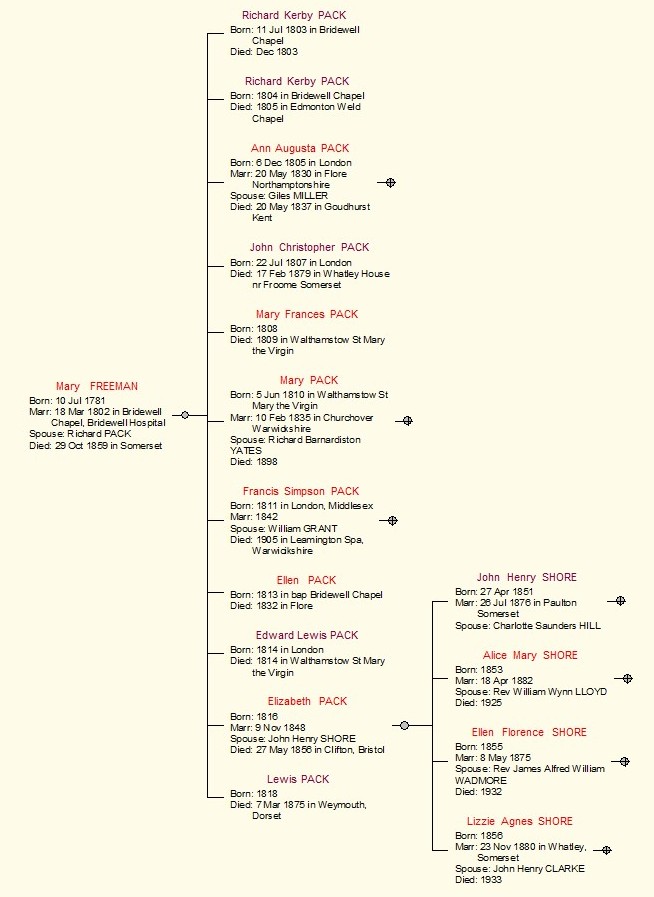
Finally, we have the children of Elizabeth Pack (1816-1856) and her landed-proprietor husband John Henry Shore (1819-1878) of Whatley in Somerset. Astute readers will note that this diagram has only their four children, in light of the resulting some 28 grandchildren, which really is a step too far! Elizabeth’s husband came from a long-established family of Shores, chronicled in Burke’s Family Records on Ancestry. His father, John Albin Shore (1775-1835), had married Mary Ann Hurle, so that when John Henry Shore Jr’s (1851- 1932) second child, Bertha Josephine Agnes Shore (1872-1958), married Captain William Armitage Cooke-Hurle, R.N. (1875-1920), they were probably related in some way I haven’t got the energy to pursue. John Henry Jr and his wife Charlotte Saunders Hill ( -1900) had three daughters and eight sons, seven of whom survived to adulthood. I have found an online post which summarises some of the sons’ histories and military exploits at https://grandadswar.co.uk/capt-j-l-shore/ I have traced the outlines of their lives for my own database, but will not undertake to write them up here. I would be happy to discuss further if any reader so desires. I think John Henry Jr married twice more.
Alice Mary Shore (1853-1925) married Rev William Wynn Lloyd (1844 – 1925), they producing five daughters, three of whom did not marry, and one son, Meredydd Wynn Lloyd (1887-1967), who served in the Australian Army in WW1 and later married a French woman in Egypt.
Ellen Florence Shore (1855-1932) married Rev James Alfred William Wadmore (1851-1918), they having two sons and three daughters.
Lizzie Agnes Shore (1856-1933) married solicitor Charles Henry Clarke (1841-1914), the son of a solicitor and his wife, Mary Hurle Clarke, the Hurle name appearing again in this family. One son, Arthur Henry Gilbert Clarke (1891-May 1916) died at High Wood in France. His early death contrasted with the career of his older brother, Major Dr Richard Christopher Clarke, RAMC, OBE whose death in 1957 in Bristol was attended by some 300 mourners, including many from the various families mentioned above, and remembering, among other things, his role as Honorary Curator of Bristol Zoo. He had served in WW1 as a medical officer. It seems youngest brother Aubrey Martin Clarke (1889-1957) also served in WW1, but then spent at least a number of years in Ceylon with his wife Evelyn Robinson (1890-1962), first cousin of Foster Gotch Robinson (1880-1967), noted cricketer, horse trainer and paper manufacturer (see his entry in wikipedia), who married in 1908 Aubrey’s sister, Marguerite Victoria Mary Robinson (1887-1963). The Robinson family were noted philanthropists in Bristol.
The very last child of Mary Freeman and Richard Pack was the unmarried son, Lewis Pack (1818-1875). Educated at Balliol College, Oxford, he is designated simply as Landowner in the 1861 Census at Southfield House, Whatley, Somerset, the home of his brother-in-law Richard Barnardiston Yates. Similarly, in the 1871 Census he is again a Landowner at the rather grand Whatley House, again in Whatley, Somerset, the home of his brother-in-law John Henry Shore. He died in 1875 and is buried in Whatley.
And so endeth the tale of the Freeman/Backler line, admittedly very selective and incomplete in this post. I had no idea when I embarked on this line some 18 months ago that it would be so enormous, albeit always interesting. It feels good to have explored it, however genetically distant from me is the resulting cast of characters. When all is said and done, they are my Backler cousins!
With some relief, I will in due course revert to the Pellatt/Rivers/Newton line!


 backlers