Mary Pellatt (1789-1857)

52. Thomas Meriton ( -1765) and Sarah Wilkinson ( -1784) of Bermondsey – and Root: the power of Wills

In which we meet the parents of Sarah Meriton (1739-1798), wife of Apsley Pellatt (1735-1798). Six-times great grandparents Thomas Meriton ( -1765) and Sarah Wilkinson ( -1784) had eight known children whose fates we will briefly consider in our next post. But firs,t a quick look at some of the quite complicated relationships, including that of Sarah’s short-lived sister and brother-in-law, and their three children.

On the left of the tree we find Thomas Meriton ( – 1765) and his wife Sarah Wilkinson (- 1784). More about them in a minute. Of interest in the next generation down are, of course, oldest child Sarah Meriton (1739-1798), wife of Apsley Pellatt II (1735-1798) , and mother of Apsley Pellatt III (1763-1826). He in turn, with wife Mary Maberly (1768-1822), was father of 15 children – too many to show here! – including their oldest child, Mary Pellatt (1789-1857), who married Samuel Backler (1784-1870) – the Backlers being the starting point of this whole blog! Stay with this, because there are some cousin relationships coming up. (See https://backlers.com/2017/03/21/samuel-backler-1784-1870-family-thefts-and-a-changing-career/ )

Sarah nee Meriton and Apsley Pellatt II are also parents of Thomas Pellatt (1765-1829), who married Elizabeth Meriton ( – 1804), the daughter of Sarah’s younger brother Henry Meriton ( – 1826). Thomas Pellatt and Elizabeth were parents of, among others, Henry Pellatt (1797-1860), who married Mary Backler (1813-1882), daughter of Mary Pellatt and Samuel Backler. (See:https://backlers.com/2025/08/27/51-thomas-pellatt-1765-1829-clerk-to-the-ironmongers/ ) (See also https://backlers.com/2014/11/06/thomas-meriton-pellatt-or-sargeant-who-is-the-father/ )

Meanwhile, as I was making final preparations for this post, I reflected with some frustration that I had little information about Sarah Wilkinson’s origins. So I decided to try once more to find parents, using as a starting point the name of her brother, George Wilkinson Meriton -= surely named after his grandfather? And yes, so it proved. The story below of variously interconnected families is largely drawn from the Wills of the key players.

Thomas Meriton ( – 1765). Origins? Here I have found pretty much of a dead end. Various online trees show a christening at St Sepulchre London on 27 May 1710 of a Thomas Meriton, father Thomas, Mother, Elizabeth. Another possibility is the christening of a Thomas Merriton [sic] at Greenwich St Alfege, on 2 December 1696 to Henery Merriton and Johannah. Thomas and Sarah’s first son was named Henry. But I cannot find a Will or other evidence which would confirm either of these. So Thomas’ origins remain doubtful for the moment.

Rather more satisfying – at least one generation back – is the find of George Wilkinson ( – 1762) of Clerkenwell. As noted above, a search on Wills for George Wilkinson threw up one in Clerkenwell, where at St John the Baptist, Sarah Wilkinson ‘of this parish’ had married Thomas Meriton ‘of St Olave’s Southwark’ on 5 February 1731. This George Wilkinson Will was incredibly obliging. Written on 28 November 1759, it tells us that George was an Ironmonger of St James, otherwise St John, Clerkenwell. After certain bequests (see below), all the rest, residue, real and personal estate etc etc are left to ‘my Son in Law Thomas Meriton‘, sole executor of the Will. Rather handily, and just to make sure of our family connections, two of the three witnesses were Apsley Pellatt [II] and Sarah [nee Meriton] Pellatt. How satisfying! [The bold typeface throughout this post indicates my direct ancestors.]

Root: George Wilkinson‘s Will began with a bequest which aroused my curiosity. The very first Item reads: ‘I give to my Grand Son Samuel Root and to my two Grand Daughters Elizabeth Root and Ann Wilkinson Root the sum of One hundred pounds each’, when married or they reach age 21…and Thomas Meriton is appointed their Guardian. So, in 1759 when the Will was written, there were three children of a daughter of George Wilkinson, who seemed to be orphaned. Here is how it works: George Wilkinson had two daughters, Sarah (who married Thomas Meriton in 1731) and Elizabeth, who married widowed Mason Samuel Root in St Benet, Paul’s Wharf in 1748. Guessing back from their marriage dates, I infer that Sarah was born around 1711, and Elizabeth perhaps much later – perhaps with a different mother than Sarah? Their father George Wilkinson was widowed when he married widow Sarah Bart, also at St Benet Paul’s Wharf in 1731. (This historic Wren church is just north of the River Thames, opposite Southwark and Bermondsey. I am not sure why these marriages took place there.) I have not found an earlier marriage for George, nor have I found a baptism for either daughter.

But, back to the sad Root story. There are baptism records for Elizabeth (1750-1763), Samuel (1751-1764) and Ann Wilkinson Root (1752 -). Sadly, we find a Will for their father Samuel Root of the Parish of St Mary Magdalen Bermondsey, Citizen and Mason of London, written just five years after his marriage to Elizabeth, on 4 October 1753, and proved on 15 October 1753. Samuel appoints three executors – ‘my honoured father Roger Root of the Parish of St John [Horsleydown] in Southwark Carpenter, my father in law George Wilkinson of the Parish of St James Clerkenwell Ironmonger and my brother in law Thomas Meriton of the said parish of St Mary Magdalen…Ironmonger to be joint executors’…; After debts etc, everything is left to loving wife Elizabeth Root, the three children, ‘and such other child or children as my said wife is now pregnant with…’ The usual provisions are made for education and maintenance of the children.

So, one of the Executors was George Wilkinson, whom we have seen died in 1762. What about wife Elizabeth (nee Wilkinson) and the other grandfather, Roger Root? Well, he died in 1755, when only one son proved his Will as executor, since the other Executor, son Samuel, had already died. And Elizabeth? By the time of George Wilkinson’s Will, written in 1759, she is not mentioned. Nor is there a fourth child. I wonder if she died in child birth. This leaves just one Executorand Guardian.

Thomas Meriton’s Will: And so we turn to Thomas Meriton. His Will was written on 28 January 1764 and proved by the sole Executrix, his wife Sarah nee Wilkinson Meriton on 6 November 1765. It makes no mention of the Root children, who are still minors. Why? Well, I think Elizabeth died in 1763 – there is a burial in Bermondsey for a 13-year-old Elizabeth Root. I think Samuel was buried in May 1764 in Bermondsey, brought from St John Horsleydown, in nearby Southwark, where there were Root relatives. But I am not sure about Ann Wilkinson Root, who was baptised on 12 November 1752 in Bermondsey. Presumably she was with some family member.

I think I will leave the rest of Thomas’ Will, and that of his wife in 1784, until my next post, where both Wills will introduce us to their many children. The Meritons were a prosperous family, he seeming to have been a successful Ironmonger, and she, perhaps, having inherited property and other things from her father, George Wilkinson. Considerable sums of money and jewels, and much property, feature in the Wills, as well as something of a mystery surrounding a child named Bart Meriton.
50. Apsley Pellatt II (1735-1798)

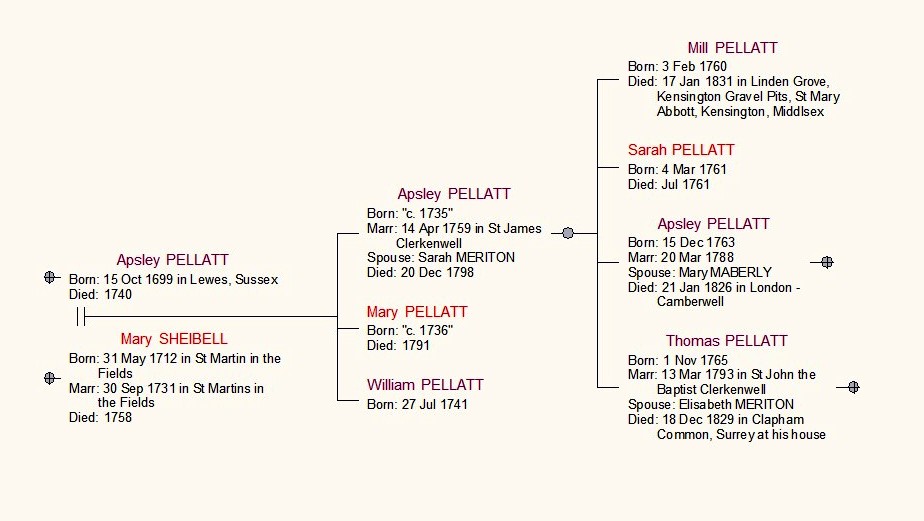
In which we meet Apsley Pellatt II (1735-1798). and his wife Sarah Meriton (c. 1738-1798), and their three children.  We are re-introduced to The Worshipful Society of Ironmongers,  with which Company successive generations of Pellatts would be associated for more than 100 years. 

Apsley Pellatt II (1735-1798) was the oldest of three children born to Apsley Pellatt 1 (1699-1740) and Mary nee Sheibell (1712-1758).   We have seen in previous posts that Apsley Pellatt I died just five years after his oldest child’s birth.  Of the younger Apsley’s siblings, we can take a very brief look, since I can trace nothing about his sister Mary, other than that she died at Camden Street, Islington, in 1791, and in her will left many legacies to nieces and nephews, various charities, and the residue to her brother and executor, the above-name Apsley II.  Of William we know even less. His impending birth was mentioned in his father’s will.  I had long puzzled about his apparent birth date, more than a year after his father’s death, until I realised that these events took place before the change of the calendar from Julian to Gregorian in 1752.  Before this date, the first three months of what is now our calendar year were considered to be of the previous year – so that Apsley Sr died early in 1740/1, with William appearing a few months later.  Other than that – of William, there is nothing. I suspect he may have died in infancy, as he is not mentioned in the Will of his grandmother, Mary Sheibell, below.

So, back to young Apsley II.  He was to benefit from a number of legacies, for instance from his grandmother Mary (nee Houghton) Sheibell, both silver and a sum of money, payable upon his reaching the age of 21.  Before he reaches that age, the executors of the will are instructed to use the interest on these gifts ‘to put him apprentice to some genteel and reputable trade’.  And so, we renew acquaintance with the Worshipful Company of Ironmongers, whom we first met in Post 6c, John Freeman (1740-1803), Indigo Maker and Ironmonger.   To recap, John Freeman had married Ann Backler (1741-1820), who was sister to apothecary Sotherton Backler (1746-1819) and aunt to Sotherton’s son Samuel Backler (1784-1870), who in 1810 married Mary Pellatt (1789-1857), daughter of Apsley Pellatt III (1763-1826), to whom we will briefly be introduced later in this post.  The point of all this is to show that almost certainly there were long standing links between the Pellatts and the Backlers.

Apprentice: In 1750, on payment of the sum of £80, Apsley II was put apprentice to William Bliss: ‘I Apsly Pellat [sic] Apprentice to William Bliss do promise to be obedient to the Master and Wardens of the Worshipful Company of Ironmongers during my life and my said Master during my Apprenticeship. Witness my hand this 12 day of July 1750 Apsley Pellat [sic].’ (image on findmypast)

Apsley Pellatt served out his seven years as an apprentice, and was made free of the Ironmongers Company on 18 August 1757.  By this time, aged 21, he would also have come into his various inheritances, which undoubtedly gave him the resources to marry, and to set up in business as an Ironmonger, where he is to be found for many years at 13 St John Street, Clerkenwell.

Marriage to Sarah Meriton  This took place at St James Clerkenwell, Clerkenwell Green, on 14 April 1759.  Sarah was a minor, and married with the consent of her father Thomas Meriton ( – 1865).  Witnesses were Thos. Meriton (possibly/probably her father) and John Godfrey (not sure who he is).  We will learn more about the Meritons in a future  post, but here it is important to note that Thomas Meriton was an Ironmonger, albeit south of the river in Bermondsey, and not of the Ironmongers Company. It seems likely that the Pellatt/Meriton marriage resulted from the partnership between the families, as noted in the following item from The London Gazette, shortly before Thomas Meriton’s death in Bermondsey.  His marriage to Sarah Wilkinson in 1731 had taken place in Clerkenwell, so although he was located south of the river, she had links in Clerkenwell.  

London Gazette 1 January 1765: The Ironmongery Business carried on by Thomas Meriton of Dockhead, Southwark and Apsley Pellatt of Clerkenwell, was dissolved the 31st of December last, 1764. Witness our hand Thomas Meriton, Apsley Pellatt.  N.B. Thomas Meriton is to pay and receive what is Debtor and Creditor to that time.

And so, for some 30 years, Apsley Pellatt II carried on as Ironmonger of Clerkenwell.  In 1789 he was Master of the Ironmongers Company, elected to the post by the Court of Assistants.  His tenure lasted a year.

He and Sarah had four children, three sons and the sadly short-lived Sarah Pellatt (1861-1861).  Let’s look at the three sons.

Mill Pellatt (1760-1805): Was apprenticed to his father, of St John’s Street, St Sepulchre Without, on 27 July 1775.  He was duly made free of the Ironmongers Company by service to his father on 28 November 1782 (both images on findmypast).  In the 1796 Electoral Register for London, we find Mill Pellatt and Apsly Pellatt [sic] [II] as Ironmongers at St John Street.  And in 1831 we find the death of Mill Pellatt Esq on 17 January and his subsequent burial on 21 January 1831 at St Mary Abbotts Kensington.  His address was given as Linden Grove, which rang a bell – it was where Samuel Backler and Mary [nee Pellatt] Backler were living when their daughter Esther Maria Backler was born in 1830.  See Post 26!  Mary was Mill’s niece.  The Backlers were about to embark on a rather turbulent year, featuring Samuel’s bankruptcy proceedings, among other things.  

Mill Pellatt had profited handsomely from his father’s Will in 1799, but apparently became ill or somehow dependent, because his brother Apsley III’s Will in 1826 [which complicated document we will peruse at a later date] made provision for funds to be invested to produce ‘the yearly sum of eighty pounds and to pay the sum of eighty pounds yearly and every year unto and for or towards the support of my dear brother Mill Pellatt for his life’.   Presumably this care was being provided by Mill’s niece Mary Backler and her husband.

Apsley Pellatt III ( 1763-1826) we will leave until a subsequent post.

Thomas Pellatt (1765-1829) further complicates this complicated family, and I have come to the conclusion that he needs a post of his own.  In short, he was apprenticed Clerk to Attorney William Leeson on 4 October 1780, and  was made free of the Ironmongers Company in 1757 by Patrimony.  He was later to have a significant role with the Ironmongers, and in wider civic life, which is why he merits a post on his own.  For the purposes of this post, suffice to say that he married his cousin Elizabeth Meriton, daughter of Henry Meriton (Thomas Meriton’s brother) in 1795.  Their son Henry Pellatt would marry Mary Backler, daughter of Mary Pellatt (daughter of Apsley Pellatt III) and Samuel Backler. Are you staying with this?  We will leave that for the moment and just focus on the latter years of Apsley Pellatt II. 

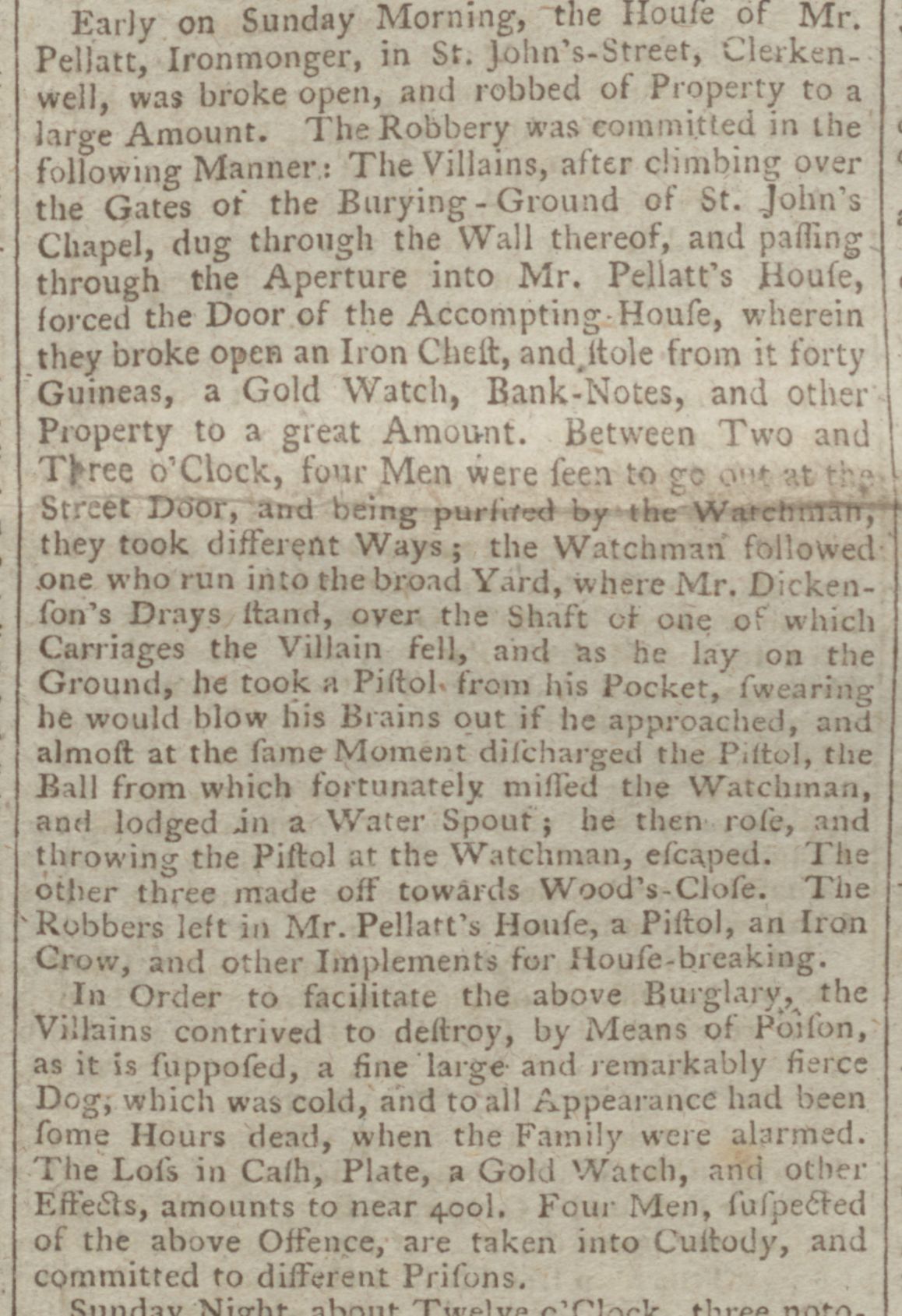
There is plenty of evidence that Apsley Pellatt II traded at St John’s Street, but perhaps none so colourful as the events described in the following newspaper clipping:

Northampton Mercury 25 October 1784. Image reproduced from British Newspapers collection by kind permission of Findmypast

This clipping tells us a lot about Apsley Pellatt at the time. His home was adjacent to St John’s Chapel and the burying ground, both on the western side of St John’s Street as it heads north towards Islington. Not far away is St James Clerkenwell, where Apsley Pellatt II married Sarah Meriton. The value of stolen goods was some £400 – around £60-80,000 today, depending on which website you peruse. They owned a dog! I have not managed to find court reports about the suspected thieves.

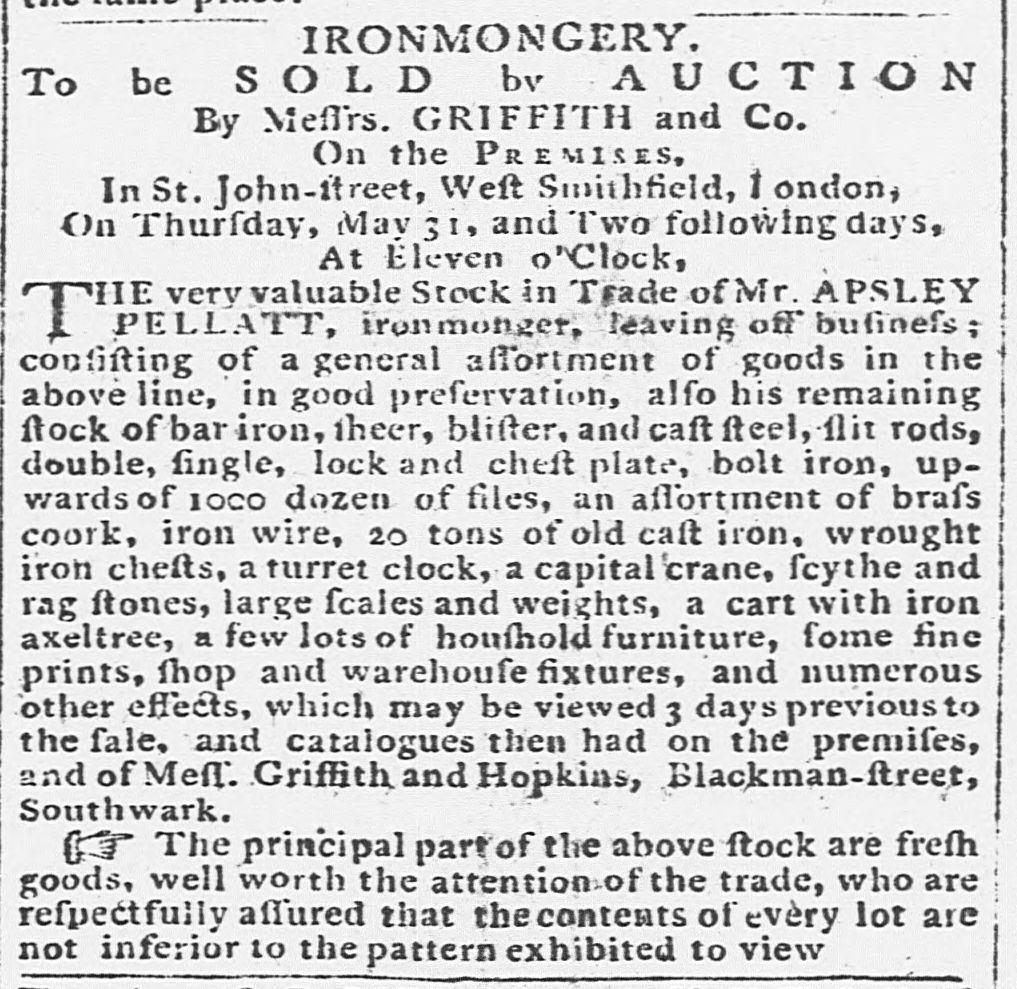
More context of Apsley Pellatt’s working life is given in the advert seen below, not long before his death in 1798. Here we see the types of goods an ironmonger would stock – iron, steel, brass – plus household furniture and effects. Presumably the Pellatts were moving from St John’s Street to Islington, where they died within days of each other at the end of 1798.

Ipswich Journal, 28 May 1798. Image used by kind permission of Findmypast, British Newspaper Collection.

Apsley Pellatt II – death and Will: The following text is taken from the online record of ‘Deeds of 9 Friars Walk, Lewes’ (ESX 21359) on the Sussex Record Office website   https://www.thekeep.info/collections/getrecord/GB179_AMS6346_1-32

On 4 & 5 Apr 1759 the Friars Estate was settled on the marriage of Apsley Pellatt and Sarah, daughter of Thomas Meriton; they mortgaged it for £2000 to Elizabeth Macie on 5 & 6 Jan 1776, who assigned it to James Louis Macie on 12 & 13 Apr 1786. Sarah Pellatt died on 16 Dec 1798 and Apsley Pellatt on the 20th leaving Mill Pellatt, Apsley Pellatt and Thomas Pellatt his surviving children; Apsley and Thomas proved their father’s will in PCC on 5 Jan 1799. The estate was auctioned on 19 Aug 1803; lot 2, a capital messuage called The Friars occupied by Sir F[erdinando] Poole at a rent of £90 and 2a 1r 28p of land, was sold to George Verrall for £2400 and £93 18s 6d for the timber. The conveyance was executed on 28 & 29 Mar 1804 by Mill Pellatt of Edgware Road in Mx, gent, Apsley Pellatt of St Pauls Churchyard, glass manufacturer and Thomas Pellatt of Ironmongers Hall, gent, to George Verrall of Lewes, gent (and his trustees John Godlee of Cliffe, merchant, Thomas Shank of Fenchurch Street, London, wine and brandy merchant and George Nelson of Palsgrave Place, Temple). Of the purchase money, £2000 was owed to Macie the mortgagee.

Given that Sarah predeceased her husband by a few days, the provisions in his Will for her were not applicable, so basically everything went to the three brothers, with Mill seeming to get a bit more than the two younger siblings. Of interest to us is that eldest grand daughter Mary Pellatt (1789-1857) was to receive £100 when reaching age 21 or day of marriage, a nice little sum for her when she married Samuel Backler (1784-1870) in 1810. In the next post we will catch up with Thomas Pellatt, then we will peruse the Meritons, and finally will move on to Apsley Pellatt III. Lots to look forward to!

45. Humphrey Newton 1495/6 – descendants to Apsley and Grace Newton: adding the Pellatt name

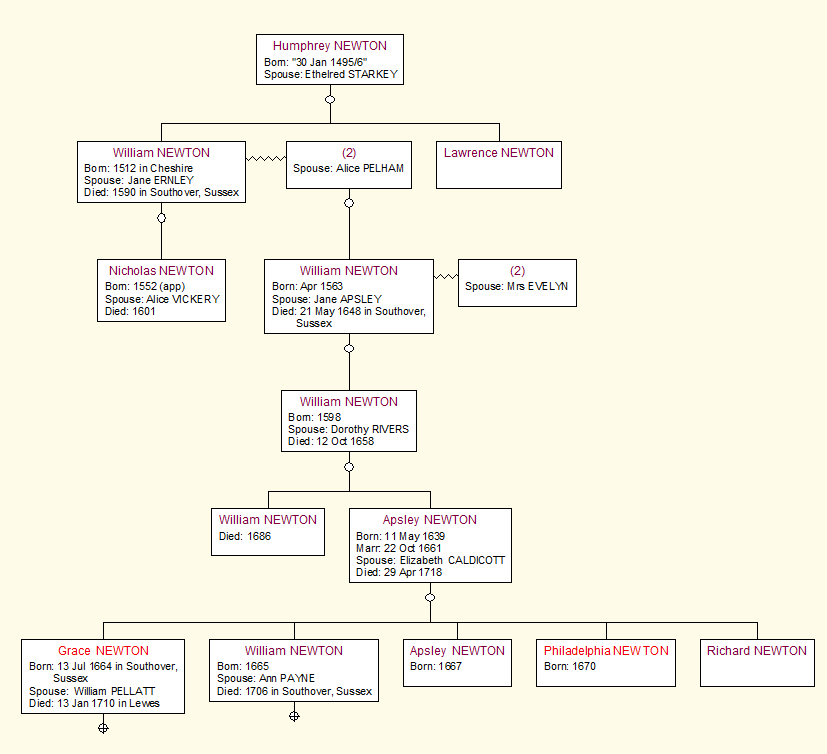
In which we hurry down the generations from Humphrey Newton the younger to join our Pellatt line (Grace Newton married William Pellatt, of whom more in a future post) , noting a few bits and pieces along the way, and ending up in the County of Sussex, in the South of England, where we leave our few northern ancestors behind. And bearing in mind that this line is not technically ‘Backlers’ – but is now tracing back through ‘Pellatt’, as Mary Pellatt (1789-1857) married Samuel Backler (1784-1870) – see, eg. posts 26-29, and 42.

Humphrey Newton the younger (1495/6 – ?) and his wife Ethelred Starkey start a line of three men named William Newton, who would take us down the generations to Apsley Newton and his daughter Grace. Ethelred Starkey was daughter and heiress of Lawrence Starkey, most probably Member of Parliament for Lancaster, and a local Lancaster worthy and property owner. See the discussion at: http://www.histparl.ac.uk/volume/1509-1558/member/starkey-lawrence-1474-1532 A fascinating account of Starkey and court cases related to his properties and other matters can be seen at Lancaster Jottings at: https://www.hslc.org.uk/wp-content/uploads/2017/06/73-10-Lancaster-jottings.pdf

Most of the following text of this blogpost, and the photograph, is a shameless replication of the Wikipedia entry about the Newton family of Southover Grange, in Sussex. I would like one day to venture there. See https://en.wikipedia.org/wiki/Southover_Grange. Text below in italics is lifted directly from the Wikipedia entry. I have not included references cited there. Names highlighted by me in bold are my direct ancestors.

William Newton (1512–1590) built Southover Grange in 1572. He was born in 1512 in Cheshire and was the second son of Humphrey Newton of Fulshaw and grandson of the notable Humphrey Newton (1466–1536) of Pownall. His mother was Ethelred Starkey an heiress of her father Lawrence Starkey and brought into the family extensive properties in York, Lancashire, Chester and Stafford.

In 1544 William and his younger brother Lawrence moved to Lewes. He lived at Lewes Priory in Southover which he leased from the then owner Anne of Cleves. In about 1550 he married Jane Ernley who was the daughter and heiress of William Ernley, owner of the Manor of Eryles. The couple had one son Nicholas Newton who was born in about 1552…. Jane died in about 1560 and several years later William married Alice Pelham and they had one son, William, born in 1564 and two daughters.

In 1572 William [Sr} built Southover Grange with stones from Lewes Priory having obtained permission by the owner Thomas Sackville, 1st Earl of Dorset, who employed him as his steward. William died in 1590 and his wife Alice died in 1600. He left Southover Grange to his second son William Newton (1564–1648).

William Newton (1564–1648) was a lawyer. He was married twice. His first wife was Jane Apsley daughter of John Apsley of Thakeham. As part of a marriage settlement he gained the manor of Storrington. They had six children, two sons and daughters. Jane died in 1627 and William married Jane, the widow of John Stansfield who was the grandfather of the famous diarist John Evelyn. The newly married Jane Newton was very fond of her grandson John Evelyn and offered to care for him so that he could go to the free-school at Southover. His father wanted him to go to Eton but John accepted his grandmother’s offer and spent most of his childhood at Southover Grange.

William Newton died in 1648 and his second wife Jane [Apsley] died in 1650. William’s son by his first wife William Newton (1598–1658) inherited the property. He was born in 1598 in Lewes and in 1637 he married Dorothy, daughter of Sir John Rivers 1st Baronet[See a forthcoming post.]

He died in 1658 and his second son Apsley Newton (1639–1718) became the owner of Southover Grange. It then passed to his grandson William Newton (1691–1775) because his son had predeceased him. When he died in 1775 Southover Grange was inherited by his great nephew Colonel William Newton.[8] 

And here, our Newton line moves to the female side, with the marriage of Apsley Newton’s daughter Grace Newton (1664-1710) to William Pellatt (1665-1725). This starts the ‘Pellatt’ line which extends into the middle of the 19th century, and which will begin in the next post. The name ‘Apsley’ also appears in a long line of ‘Apsley Pellatt’s – often mis-transcribed, but a helpful name when conducting online searches. And here I will leave this post. In the next one I will explore the Rivers line, taking us to London in the time of Henry VIII. Admittedly this is pretty far back as far as our share of DNA goes, but historically I find it fascinating! Hopefully there won’t be quite such a long gap in time before the next post appears.

40. Backler/Boulding: Susannah Mary Boulding and Apsley Samuel Boulding emigrate to America

In which we summarise what is known about the migration of my g.g. grandmother Susannah Mary Boulding and her younger brother Apsley Samuel Boulding to the United States.  This summary reveals a few questions. It also introduces the surnames of Spence and Hampson  to the list of Backler-descendants. 

As we have seen in the two previous posts, my g.g. grandmother Susannah (nee Backler) Boulding, then Cross, re-married after the disappearance of her first husband James Boulding, and was found in 1861 living with her second husband Edwin J Cross, and the unfortunate surviving offspring of this marriage, Edwin J F Cross.  But what of Susannah’s two surviving children of her first marriage?  Was it just part of normal circumstances of the day, or had these two been forced to flee the nest after the appearance of their new step-father and step-siblings?  Susannah’s mother Mary (nee Pellatt) Backler had died in 1857, the family having survived bankruptcy in the 1830s and, despite her wealthy Pellatt/Maberly origins, seeming to have fallen on rather straitened times.

1861 Census
And so, Susannah Mary Boulding, aged 16, was found in 1861 as a nurse to the large and growing family of wealthy surgeon Mitchell Henry, whose biography can be seen at https://en.wikipedia.org/wiki/Mitchell_Henry . With the death of his father in Manchester in 1862, Mitchell Henry gave up his career as a surgeon and – presumably – his home in Wimpole Street, and removed to Manchester and the home of the family business.  He later became a politician, and built Kylemore Lodge, now a convent, in Connemara, Ireland.  Question:  did young Susannah stay in service with this family, or seek another post in London, or move back to be with her mother? 

Even younger, Apsley Samuel Boulding, unlike his many Pellatt and Backler ancestors, does not seem to have been apprenticed out, but was in 1861 a warehouse boy in Tooley Street, Southwark, just south of the river Thames.  Question: what happened to young Apsley after the great fire of 1861 almost certainly destroyed the warehouses where he worked?

Next sightings: USA: Susannah Boulding – marriage to William Spence in 1870
I am fairly certain that the Susan Boulding shown on the ship’s list for the Steamer Scotia, arriving in New York from Liverpool on 1 May 1866, is our g. grandmother.  She appears as a Servant, aged 23, listed

under the names of [difficult to read, but possibly] A W Crawford, a merchant said to be of Germany, and ‘Marie’, listed as a male but almost certainly his wife.  Above Susan’s name are two other servants, both of Great Britain:  Robt Taylor, 30; and Hy [?] Wickham, 27.  I have tried searching all these people in the 1870 US Census, without success.  I have not found Susannah in that census either, but what we do have is the record of her marriage to William Spence in October 1870.  They were married in St John’s Church, Staten Island, by the Rev John C Eccleston, Rector.  Witnesses were Thomas Solomon and Edith Eccleston.  Rev Eccleston was Rector off and on for about 50 years.  In the 1870 Census, Thomas Solomon was a 40 year old Sexton, born in Ireland.  Had he known William Spence prior to the marriage, or was he a witness of convenience?  The marriage took place a year before the consecration of the new church, which was heavily financed by Cornelius Vanderbilt.

How had William and Susannah met?  We do not know whom she was working for when she arrived in America.  However, we know that William was already working for the employer he would serve until his death – Theodore Kane Gibbs, or his family.  In the 1870 Census, William Spence was to be found at the Gibbs family home in fashionable Newport, Rhode Island, where the family spent their summers.  He was said to be aged 40, born in England [sic], and a domestic servant.  In all records after this, he is a Coachman, and in my next post I will give much more detail about him and the Gibbs family.

We have never found when William came to the USA, nor is his age accurately known.  In the 1870 Census he was said to be 40,  presumably a guess by whoever filled in the census return.  At his marriage, also in 1870, he gave his age as 34, giving a birth year of 1836.  Elsewhere, family lore says he was born in Stewartstown, Northern Ireland, in around 1832.  Suffice to say that we don’t actually know!   Helpfully, but so far bringing us no closer to information about William’s ancestry, are the names of his parents – William Spence and Mary Hutton – given on the marriage certificate. This is an ongoing search.

For the moment, we will leave Susannah and William, and summarise what we know of her brother, Apsley Samuel Boulding.

USA: Apsley Samuel Boulding and Francine Hampson
There are two records of immigration for Apsley Boulding.  The first is on 4 April 1870, aboard the Aleppo, into Boston.  Apsley Boulding is said to be a Farmer, aged 22.   In theory, Apsley should appear on the US Federal Census, taken on 1 June 1870, but I cannot find him (nor, as stated above, his sister).

But…there is a second possibility: In his US Naturalisation declaration in 1888, he states that he arrived in March 1873, which is corroborated – sort of – by a Canadian immigration record showing the arrival on 17 June 1873 of A S Boulding, aged 25, a Labourer destined for Montreal, on The Peruvian from Liverpool.  Was this Apsley?  There is no record of a border crossing into the USA.  As shown in our post about Apsley’s half brother, Edwin J F Cross, hospital records indicated that Edwin’s brother was in Canada.  Question: Did Apsley travel twice across the Atlantic, first to Boston, then presumably returning to England and subsequently voyaging to Canada, from which he went to New York City?

Whenever and wherever he arrived, we know the broad details of his life until his death in 1925.  He married Francine [aka Francena or Francenie] Hampson (c. 1861 – 1937) in 1880.  She was descended from hatmakers in Stockport, England.  In his 1888 naturalisation declaration, he was a ‘Waiter’, but by the 1900 Census they are found in Newark NJ, where he is a Superintendent – Club.  In 1910, Apsley is a Steward in a country club in Lancaster PA.  Living with them is her 14 year old niece, Ethel Telford.  By the 1925 New York Census, the couple are living on East 92nd Street in New York City, with no occupation.  This was just before Apsley’s death on 12 February 1926, followed by Francenie’s death ion January 1937.  There were no known children of this marriage.

In my next post, I will try to summarise what I know about the Newport and New York City lives of The Spence/Boulding marriage.  This will bring us into recent memory.  In future posts I may digress, to describe the Pellatt/Maberly/Meriton lines.


38. Backler/Boulding/Cross: the denoument of my g.g. grandmother Susannah (1817 – 1883)

In which we trace the last years of my g.g. grandmother, Susannah [nee Backler] Boulding/Cross, rounding off the fates of her and the three children born to her second marriage, before following her two surviving Boulding children across the Atlantic.

In previous posts, we have seen that my g.g. grandfather James Boulding appears to have deserted his young family in or after 1848, after the birth of his and Susannah’s third child Apsley Samuel Boulding, and following the death on the same day of their second child, Lucilla Charlotte Boulding.  The first intimation of this supposed desertion comes with the 1851 census, showing Susannah and her two surviving children living with her parents in Islington.  She is ‘married’, but in this census year there is no James Boulding to be found in the British Isles.  It seems possible he had gone to Australia.

1851 England Census.  2 Old Paradise Row.  St Mary, Islington
Samuel Backler, Head, married, 66. Clerk [sic], Born Middlesex Stoke Newington
Mary Backler [nee Pellatt], Wife, married, 60. Born Middlesex Holborn
Esther Maria Backler, daughter, unmarried, 21.  Born Middlesex Bayswater
Susanna Boulding, daughter, married, 34. Born Middlesex Oxford Street.
Susanna Mary Boulding, grand daughter, 5. Scholar at home. Born Middlesex Islington
Apsley Samuel Boulding, grand son, 3. Born London Fleet Street.

We have seen in previous posts that Samuel Backler would live on for another 20 years, apparently tended by his youngest child, Esther Maria.  The status of Susanna, however, would change with her marriage on 28 October 1855, seven years after the disappearance of her husband James.  I am not exactly sure of the legal basis, but there

seems to have been an accepted rule that if someone had disappeared for seven consecutive years, with no news that they were alive, they could be presumed dead.  Hence Susanna’s status at the time of her second marriage as ‘widow’.

The marriage to Edwin John Cross, bachelor (and some 17 years Susannah’s junior), described as ‘Clerk’, took place just four months before the birth of their first child, Edwin John Frederick Cross, born on 24 February 1856, and christened at Christ Church St Marylebone on 30 March 1856, at which time his parents’ address was given as 13 Park Street.  Much more about him in a blogpost to follow.

Two years later another birth followed: Lucilla Beatrice Cross (another try for a little girl named ‘Lucilla’ – I have not found a precedent for Susanna’s use of this name).  Born on 1 June 1858, little Lucilla Beatrice was buried in Camden on 28 March 1861.  Thus the 1861 Census, taken shortly after this sad event, records just Edwin senior, Susannah and son Edwin jr.

1861 England Census. 
St Pancras, Camden Town.  3 Pratt Street (see photo right)
Edwin Cross, Head, Married, 27, China Dealer. Born Middx Marylebone
Susanna Cross, Wife, Married, 44. Born Middx Marylebone [sic]
Edwin Cross, Son, 5. Born Middx Marylebone
Susan Day, Lodger, Widow. Annuitant. Born Essex Harlow.

On 31 August 1862, Maberly Pellatt Cross was born to Edwin (china dealer) and Susannah Cross.  He was christened in September of that year at All Saints Church Camden Town, with the surnames of his mother’s maternal grandparents.  Alas, little Maberly was buried in Camden on 10 April 1863.  Older brother Edwin J F Cross was now about 6 years old, and had witnessed the deaths of two younger siblings.  Could this have affected him later in life?

Two Boulding children – soon to cross the Atlantic
Meanwhile, in 1861, young Edwin’s two half siblings appear to have been farmed out from the new Cross family.  Could this have been due to the influence of their new step-father?  We will take them across the Atlantic in a future blogpost, but suffice to say at the moment that in 1861 we find them as follows:

At number 5 Harley Street (now and then renowned as the location for private health care), in the home of Consulting Surgeon Mitchell Henry, 34, and his wife and 4 children, plus Governess, Butler, Footman, Cook, two Housemaids, Kitchen Maid, and two nursemaids, one of whom was my Great Grandmother Susan [sic] Boulding, unmarried, 16, born Middx Islington.

In the same Census, at 193 Tooley Street, in the home of Charles Bell, a Pawnbroker, we find her brother, 13 year old Apsley Boulding, Warehouse Boy, born Middlesex Strand.  He probably would not have been here long, as shortly after this Census was taken most of Tooley Street was destroyed in the great fire of 1861 (just search Tooley Street fire 1861 for details of this cataclysmic event).

How much these youngsters saw of their mother, step-father and half-siblings, is not known, though we will see that there was at least some correspondence with them after they left for America.

Back to the Cross family.
In 1871, we find Edwin, Susannah and 15 year old Edwin J F Cross at 130 High Street, Camden Town.
In 1881 Edwin and Susannah are at 58a Chalk Farm Road, a bit north of Camden Town (see left).

In this Census, sadly, we find the first intimation that things might not go too well for their only surviving child, Edwin John Frederick Cross.  As I will describe in more detail in a later post, we find in 1881 the following:

E J F C, age 24, Shorthand Writer, Patient, Lunatic, in the Middlesex County Lunatic Asylum, in Banstead Surrey, just up the hill from where I lived for many years.

On 9 February 1883, my G.G. Grandmother Susannah [nee Backler] [Boulding] Cross  died aged 66. She had congestion of the lungs, 7 days.  Her death was registered by her husband, E J Cross, of 156 High Street, Camden Town.

By the June quarter of 1884, Edwin had married widow Frances Anne [nee Lusty] Hilliard, mother of two children, and by the autumn of that year, Edwin had written his Will, leaving everything to his new wife and Executrix.  No mention at all of his son Edwin J F Cross.  Edwin Sr died in 1889, then living in Ramsgate Kent, and his Will was proved by his wife in January 1890.  At some point she emigrated to America, where she was to be found in Herrick Street, Boston in the 1900 US Census, living with her two sons Herbert H Hilliard and Walter J H Hilliard.   Frances died on 3 March 1902 and was buried in Evergreen Cemetery, Brighton MA.  Her son Herbert H Hilliard perished on The Titanic, while her son Walter J H Hilliard died in 1926 and is also interred in Evergreen Cemetery.

Meanwhile, their step-son and step-sibling Edwin J F Cross was living out what was a rather sad and lonely life in England – the subject of my next post.


27. Samuel Backler (1784-1870), Bankrupt Tobacconist

In which we face the sad task of reporting the complicated affairs of Samuel Backler and his wife Mary (nee Pellatt), as they faced bankruptcy and the loss of money and possessions, while looking after daughters Mary and Susannah Mary, and newborn Esther Maria.  We glean most of the story from papers held at The National Archives in B/3/695: In the matter of Samuel Backler of St James Street, Piccadilly, Middlesex, tobacconist, bankrupt. Date of commission of bankruptcy: 1831 February 21

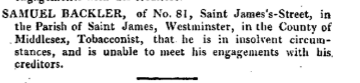
Our tale begins with a notice in The London Gazette dated 15 February 1831, to the effect that Samuel Backler, tobacconist of 81 St James’s Street, is unable to meet his financial obligations (https://www.thegazette.co.uk/London/issue/18776/page/302) Screenshot (116)

An insolvent debtor who was also a trader could declare himself bankrupt.  An individual who was not a trader could be kept in a debtor’s prison, a fate which Samuel seems to have avoided.

Here began a process which stretched across the entire year, in which a parade of creditors (including close family) laid out their claims on Samuel’s assets, his wife Mary had to forego part of her inheritance from her grandfather Stephen Maberly, and at least some of the family’s furniture was sold.  The date of 1831 was significant, as the process of administering bankruptcy was changing from Commissioners of Bankruptcy (which I believe was the process under which Samuel was treated) to a Court of Bankruptcy.  I do not claim to be expert!

Information copied at TNA 26 September 2009.  B/3/695.  The information is mainly extracted.  Where verbatim, it is in quotes.  I have poor quality photos of further lists of creditors than are reported in this account – they are not usable, and so I have left them out.  The total in debts was over £1,000, while money due to Samuel Backler was in the low £100s.  The outcome of it all was that creditors were to receive £2 and 5s in the pound.

__________________________________________________

22 February 1831.  Samuel Backler Tobacconist.  Burwood Rooms   George Maberly, Welbeck Street, Cavendish Square Middx. Coachmaker.  Against Samuel Backler of St James’ Street Piccadilly in the County of Middx tobacconist.  £104 – 17 – 4d lent between 1 January 1830 and 1 February 1831: ‘no security or satisfaction whatsoever’ except promissory notes and Bill of exchange.

Note: George Maberly was some sort of cousin to Samuel’s wife Mary Pellatt, though given the number of Maberly families in London at the time, I am not exactly sure of his relationship.  George is probably the George Maberly who eventually became a partner in the famous firm of Thrupp and Maberly.
___________________________________________________________________

23 February 1830 [sic –  is this 1831?].  George Cross of 3 Poole Street, Hoxton, Gentleman. Has known Samuel Backler four years, during which time he carried on trade, buying and selling tobacco, snuff, cigars and other commodities of a like nature.  He said Samuel Backler was in insolvent circumstances and unable to meet claims of debtors.  On Monday 14 February inst Samuel Backler came to Hoxton and asked for a bed because he was afraid of being arrested by his creditors for debt if he remained at his own house of residence.  Samuel Backler stayed there until the present, having not returned to ‘his own house or place of business’.
_____________________________________________________________________________

22 February 1831.  Provisional Assignment of Estate to William Burwood of Southampton Buildings Chancery Lane Gentleman. John Beauclerk, Jefferies Spranger and John Dyneley Esquires, the major part of Commissioners named and authorised in and by a Commission of Bankrupt – awarded and issued and now in Prosecution against  Samuel Backler of St James’ Street Piccadilly in the County of Middlesex tobacconist.  S.B. declared bankrupt at Burwood Rooms, 22 February 1831.
________________________________________________________________________________

22 February 1831 p. 350. London Gazette   Giving notice of the following dates: 25 February, disclosure; 8 March – Assignees; 5 April – finish examination of creditors, agree certification.  On this day Samuel Backler was reported as not at present prepared to make full disclosure and discovery of his Estate and Effects, praying further time until the next day.  25 February:  Still not full disclosure.
______________________________________________________________________________

8 March 1831. List of Creditors:

  • Gilbert Selioke Edwards, Newman Street, Oxford Street, Coachmaker. Late of Pall Mall.  Executor Thomas Chamberlayne. Had loaned £25 10s
  • Samuel Ward, Piccadilly, tobacconist. £100 – 10 – 10 for goods sold and delivered to Samuel Backler
  •  Henry Pellatt of Ironmongers Hall, Gentleman.  £104 – 8 – 6 money lent and advanced on 25 May 1829, 25 January 1825, 7 May 1828.  [on 18 March 1831, while these proceedings were going on, Henry had married his cousin Mary Backler, Samuel and Mary’s oldest daughter!  They feature in several posts (and one forthcoming).]
  • George Maberly, Welbeck Street, Cavendish Square,  Coachmaker.  £104 – 17 – 4
    George Maberly and Henry Pellatt chosen as assignees

On this date, the solicitor’s bill of £40-8-2 to be paid from the first monies raised.  Also the Messenger’s Bill, £14-4-8d
________________________________________________________________________________

5 April 1831.  More creditors:

  • Richard Vandome, Leadenhall Street, City of London, Scalemaker.  £59 – 5s
  • John Bale [Bask?] Derby Place, Bayswater in the County of Middlesex, Coal Merchant.  Goods sold and delivered £14 – 16
    _____________________________________________________________________

8 July 1831.  London Gazette. P. 1382:  ‘The Commissioners in a Commission of Bankrupt, bearing date of 21st February 1831, awarded and issued forth against Samuel Backler … intend to meet on the 29th of July instant at Eleven in the Forenoon, at the Court of Commissioners of Bankrupts at Basinghall-Street in the City of London in order to Audit the Accounts of the Assignees of the estate and effects of the said Bankrupt under the said Commission, pursuant to an Act of Parliament, made and passed in the sixth year of the reign of his late Majesty King George Fourth intituled “An Act to amend the laws related to Bankrupts.”

An untimely death:  On 3 June 1831, Mary [Pellatt] Backler’s grandfather Stephen Maberly died in Reading.  The timing of this death was rather unfortunate for Mary, in light of her husband’s bankruptcy proceedings!  Stephen Maberly had made specific provision for his grandchildren in his Will, which was proved on 5 July 1831, with quite a few Codicils relevant to the Backler bankruptcy.  Having initially left £4000 in trust for the benefit of ‘all and every the child of my late daughter Mary Pellatt’ [Samuel’s  mother-in-law], this sum was reduced to £2500 in a codicil, which excepted Mrs Mary Backler.  In an earlier Codicil, dated 12 August 1826, there was to be deducted £250 from ‘Mrs Backler’s share of the property I have left to her, having lately advanced that sum for her husband’ but that Codicil was revoked on 26 April 1827 in favour of the following:

£400 on trust – interest, proceeds etc – to Mary Backler into her own hands for her sole and separate use exclusively of her present and any future husband and without being liable to his debts or arrangements.  On her death, proceeds to go to every her child and children when they become 21, or when the daughters marry.

This inheritance results in a notice on August 22:  The Law Advertiser, Vol. 9:  Special meeting of creditors of bankrupts:

‘Backler, Samuel, St. James’s-st., Piccadilly, Middlesex, tobacconist; Sept 21, at 12 precisely, C.C.B., as to assignees compromising their claim to a legacy of 200l, bequeathed by Stephen Maberley, deceased, to the bankrupt’s wife, by accepting half of such legacy, and permitting the remainder to be settled on bankrupt’s wife for her separate use; and on other special affairs.’

Some confusion?  I am not sure how the legacy of £200 was determined.  In his Will Stephen Maberly had declared the legacy of £400 to be free from any debt of her husband.  Was this £200 Mary’s share of the £2500 left to all the children of Mary [Maberly] and Apsley Pellatt?  I don’t fully understand, as I thought she had been exempted from this.  Apparently not (see below).  Perhaps the £400 would remain at the disposal of Mary.

At the Court of Commissioners of Bankrupts, Basinghall Street London 21st day of September 1831:  Memorandum – At a Meeting of the Creditors and Assignees of Samuel Backler of St James’s Street Piccadilly in the County of Middlesex Tobacconist Dealer and Chapman a Bankrupt held on the day and year and at the place above written pursuant to a notice in the London Gazette of the thirtieth day of August last in order to [sic] the said Creditors to assent to or dissent from the said Assignees compounding their claim to a Legacy of £200 bequeathed by the Will of Stephen Maberly late of Reading in the County of Berks Esquire deceased to the Bankrupt’s Wife by receiving one half of the said Legacy and allowing the other half to be retained by the Trustees or Executors under the said Will for the purpose of Settlement on the said Wife of the Bankrupt for her separate use according to the decisions in Equity in like Cases And further to assent to or dissent from the assignees paying to a party to be named at the meeting the amount of certain premiums paid by him on a policy of Insurance in the London Life Association effected on the life of the said Bankrupt for the sum of £500 with a view to the Assignees obtaining possession of the said Policy And also to assent to or dissent from the said assignees selling and disposing of the said Policy and of any other the Estate and effects of the said Bankrupt either by public auction or private contract and for such terms and prices as they shall think fit And also to assent to or dissent from whatsoever the said Assignees hitherto done or at the said Meeting shall propose to do in reference to the said Bankrupt’s Estate.

The following is a copy of a letter from Mr Apsley Pellatt [Mary Backler’s brother] to the assignees produced and read at the Meeting –

“Mr Apsley Pellatt presents respects to the Assignees of Samuel Backler and acquaints them that he is willing to surrender to the use of the Creditors the Policy of Insurance of His (Mr B’s) life of £500 in the London Life Assurance Office on payment of the premium (he has paid) amounting to £27.13.10  Mr Apsley Pellatt begs also to say that he has no doubt on the Creditors assenting to accept £100 in full satisfaction of the Legacy of 1/11th of £2500 left by Will by the late Stephen Maberly Esquire to Mrs Backler that the Executrix will forthwith pay the same into the hands of the Assignees”.  Falcon Glass Works.  17 Sept 1831

Present the undersigned Creditors

It was resolved and agreed that the said assignees be authorized to pay to Mr Apsley Pellatt the Sum of £27. 13. 10 the amount of the premiums paid by him on the above mentioned Policy   And that they be at liberty to dispose of the said Policy  either by Surrender to the London Assurance Office or by Public Sale or private contract and at such price and on such terms as to the said Assignees may seem meet

Secondly – It being stated at the meeting that the Legacy in question being to the Bankrupts Wife and that the Court of Chancery thro’ which alone such Legacy could be recovered always makes a provision for the Wife out of it, and generally to the extent of one half of the Legacy, It was resolved and agreed that the said Assignees be also authorized and empowered to receive the sum of £100 in full satisfaction of their claim of the Legacy of 1/11th of £2500 left by the Will of the late Stephen Maberly Esquire to Mrs Backler the Wife of the Bankrupt and that they also be authorized to give and sign full and sufficient receipts and discharges for the same

Thirdly – and resolved and agreed that the undersigned do approve of the sale of the Bankrupts Furniture as made by the assignees, and ratify the same accordingly.

Henry Pellatt.  Richard Vandome.  Sam Ward
________________________________________________________________________________

22 November 1831.  London Gazette. P. 2442.  Notice of the following event: The Commissioners ‘intend to meet on the 23rd day of December next, at Ten of the Clock in the Forenoon … in order to make a Dividend of the estate and effects of the said Bankrupt; when and where the Creditors, who have not already proved their debts, are to come prepared to prove the same, or they will be excluded the benefit of the Dividend. And all claims not then proved will be disallowed.

Account: Cash realised:

Sale of bankrupt’s furniture                                           £20/3
Cash in compromise of Stephen Maberly legacy        £100/ –
Deposit on sale of policy per Mr Shuttleworth           £24/-
Balance from the purchases [?]                                       £96/–

£240/3-

Paid:

30 Sep Solicitor’s bill re choice of assignees                £40 – 8 – 2
Mr Pellatt’s claim re life policy                                       £27-13-10
Mr Shuttleworth’s charge on sale of policy                  £6 – 0 – 0
Messenger bills                                                                   £20-14-8
Auctioneer charges sale of furniture                             £4 – 14 – 0
Solicitor dividend                                                               £49-13-10
Claim of shopman in full                                                     £5 – 10
Claim of maidservant in full                                              £3 – 0 – 0
Balance to be divided                                                           £82-8-6

£240 – 8 – 0

____________________________________________________________________________

23 December 1831: More debts!

  • Richard Cater, deceased.  17 September 1827                     £23-8-4
  • William Deighton 71 St James’s Street Tailor.  Goods
    sold and delivered. Work and labour done as a tailor       £22 – 1 – 6
  • Maria Palmer 8 Kensington Terrace, Kensington
    Gravel Pits late servant to the Bankrupt. Wages due.
    Her X.                                                                                            £3 – 0 – 0
  • John Martin, 82 St James’s Street, tailor.  Goods sold
    and delivered.                                                                             £6 – 19
  • William Cousins, 45 Duke Street, St James’s. Carpenter
    Carpentry work                                                                         £6 – 12 – 5
  • James Davies, 106 New Bond Street, late shopman to
    The Bankrupt.  For wages                                                       £5 – 10 – 0
  • John Collier, Carey Street, Lincolns Inn, Gent.
    By judgement HM Court Kings Bench, Easter term
    11th year King George IVth for £500 debt and 65
    shillings costs. Indenture re William Nokes [Noke?]           £203

________________________________________________________________________________

23 December 1831.  Creditors to get £2s 5d to the £

_______________________________________________________________________________

What to make of all this? Little more is heard of Samuel Backler before his death in 1870, other than his presence in the 1851 and 1861 Censuses and the marriage of his second daughter Susannah Mary Backler to James Boulding in 1844.  We do not know what happened to Samuel and Mary after the traumatic events of Samuel’s bankruptcy in 1831, other than to assume that it did little in terms of good family relationships!  Clearly Samuel was a poor businessman.  Was he reckless, or just unfortunate?    We may never know.


25. Samuel Backler (1784-1870). A question of Bark

sam-backler-1784-baptismIn which we consider the life and early career of my 3x great grandfather, Samuel Backler, having reviewed the varied fortunes of his four half-siblings and nine siblings in previous posts.  We follow Samuel as he embarked on a career as an apothecary, like his father, grandfather and half brother John before him.  We see his fortuitous marriage to the eldest child of noted glassmaker Apsley Pellatt, and after what seems to have been an abortive apprenticeship, we witness Samuel setting up in business, perhaps armed with inside knowledge of the market for Peruvian Bark from his and his father’s association with the Society of Apothecaries.   

IMG_3340 (2)Early years: an apothecary apprentice and laboratory worker.  Samuel Backler was the second child and oldest son of Sotherton Backler (1746-1819) and his wife Hannah Osborne (approx 1763-1803).  He was born in Stoke Newington, and baptised at St Mary’s Church there. (The church, left, is ‘the old church’, no longer consecrated.)

No evidence as to Samuel’s education has come to light.  His older half brother John (c.1780 – 1846), and youngest sibling Sotherton (1798-1875), were educated at St Paul’s School, but there is no record of Samuel having been there, nor of him attending university. When he was just two years old the family faced sorrow.  Infant Thomas Backler, aged 8 months, was buried at St Andrew by the Wardrobe on 16 December 1786, followed just two weeks later on the 30th by Samuel’s 9 year old half brother Sotherton.  On 14 May 1791, Samuel’s 2 year old sister Elizabeth was also interred in the church, and to cap it all, his mother Hannah was buried in April 1803 at Bunhill Fields, aged about 40.

Samuel’s older brother John was apprenticed to their father, Sotherton Backler.  Samuel, however, was apprenticed in 1800 to Thomas Hall, but on Hall’s death in 1802, Samuel was released from his indentures and in 1805 gained the freedom of the Society by Patrimony.  The records show that he was in the service of the Laboratory Stock, established many years previously to oversee and control the quality of the manufacture of chemical and plant-based medicines. In 1843, he withdrew from the Society.  He had never fully qualified as an apothecary, though he was surely well trained in aspects of the art through his tenure in the laboratory. We will see that his subsequent career was to have many twists and turns.

Fortuitous marriage: Apothecaries’ Hall was located on Water Lane, very near to St Paul’s Cathedral, whose churchyard housed, among other residents and enterprises, the firm of Pellatt and Green, known as glassmakers to the King.  Here the names of Pellatt and Maberley enter my family tree, with the marriage in 1810 of our Samuel to Mary Pellatt, eldest child of Apsley Pellatt (1763-1826) (the third of six with that name) and his wife Mary Maberly.  The marriage linked two families prominent in their respective Livery Companies.  Apsley Pellatt had been Master of the Ironmongers Company.

screenshot-90Bedford Street Laboratory:  Following his marriage, Samuel set up his lab at Covent Garden’s Bedford Street.  Here he marketed a range of interesting lotions and potions, such as this one for Asthmatic Strontium Tobacco (The Morning Post, 10 October 1811).  Backler was in the forefront of the use of stramonium, derived from the common thorn-apple, in treating asthma.  The history of the use of smoking in treating asthma is fascinating, and can be explored through the following link: https://www.ncbi.nlm.nih.gov/pmc/articles/PMC2844275/

A matter of Bark:  I speculate that another of Samuel’s treatments, Peruvian Bark, might well have been linked to activities at the Society of Apothecaries’ labs, which I was able to learn more about through some sessions a few years back in the Society’s Archives.

By the early 19th century, Peruvian Bark (Jesuits’ Bark; cascarilla; le remede anglais) – or the various forms of cinchona – had become key elements in the maintenance of health in the far-flung British Empire.  First recorded as being used for fever in South America in the 17th century, and thought to have been brought to Europe by the Jesuits, it had become an important trade item.  Historians continue to debate the origins of the name cinchona, once said to have been because of a cure of a fever in the Countess of Chinchon.  Its use in England dates from as early as 1658, when the ague had become endemic in the south-east.  However, its first use at that time resulted in the death of the Alderman of the City of London – not a good start![1]   A decade or so later, however, Robert Talbor (or Tabor) began to use a remedy which included the Jesuits’ powder.  He went on to use this cure across Europe and in the Court of Charles II.  It took some time for understanding to develop that Peruvian Bark was not effective for all fevers – only those of an intermittent nature, like malaria. And it was not until 1820 that Pelletier and Cavenout isolated the alkaloids quinine and cinchonine.[2]

It stands to reason that with such an important product, the Society would be involved in its preparation and sale as part of its trading activities.  The Laboratory Stock and Navy Stock companies had been engaged in trade throughout the 18th century, and in 1810, during the Peninsular Wars, an approach from the Army Medical Board opened the prospect of providing the Army’s medical supplies.

Questions of quantity and quality: The Archives show that a special meeting of the Court of Assistants was convened on 8 October 1810, to consider a letter from the Army Medical Board of 26 September in which the Society was informed of the Army’s intent to obtain its supplies from the Society – subject to the answers to a series of questions.  These included whether the Society could at short notice ensure a sufficient quantity of medicines ready packed to be immediately available, and whether the Society would consider having Depots at Plymouth, Portsmouth, Falmouth and elsewhere. The Army also wanted to know if supplies could be returned to the Society if they were not wanted.

The Society indicated that they would certainly be able to supply medicines for an Army of 30,000 men – at ten days notice. and every medicine to be delivered in a ‘most perfect state’ – but not from Depots, which would be removed from the Society’s methods of quality control.  There would be no question of receiving returned unwanted goods!

By Spring 1811, a further letter from the Army Medical Board raised questions about the quality of drugs imported from abroad, suggesting that it was said to be the custom of the druggists ‘after purchasing them in their original state from the Merchants, to assort and mix the different qualities previously to offering them for sale, so that it is difficult, if not impossible, to procure any of the genuine.’  They asked how the Company could ‘obviate this nefarious and dangerous practice’ with respect to Bark: ‘It is understood that the only species of Peruvian Bark which of late years have been imported of distinct fine quality are the Crown Bark and grey silver coated Bark in small quills, but that these are afterwards mixed by the Dealers with others.’  They wanted ‘to be informed whether all the Drugs that are used in a state of Powder are bought by the Company in the gross, and powdered under their own inspection, such as Ipecaccuanha and Jalap, as well as Bark.’

On 13 March 1811 came the reply (no doubt drafted by the Clerk to the Society, Samuel Backler’s father Sotherton Backler):

‘…They [Master and Wardens of this Society] beg to observe that their mode of dealing does not expose them to any of these Inconveniences, as the Drugs sent to them for purchase are (in the language of the Druggists, garbled, that is picked, before they receive them) that they buy by competition, and by sample, without knowing of whom ‘till the purchase is made and without Reference to price or anything but the perfection of the Article to be bought; … On the subject of Bark … [there are] three sorts, corresponding with the directions given them by the College of Physicians’.  These were Yellow Bark (cinchona cordifolia Cortex), quilled or pale Bark (the Crown Bark – cinchona lancifolia cortex), and Red Bark (cinchona oblongifolia Cortex)…The Bark sent by them [Master and Wardens] when simply the Term Bark is employed, is the Cinchona lancifolia or Crown Bark, which is considered as the best Bark in the market…they never purchase any Article used in Medicine in powder…every article of the Materia Medica is bought in the Gross, and powdered at their Mill in the Premises under the Inspection of their very confidential Servants.’

A speedy reply (or rebuke?) on 14 March 1811 suggested that the Army didn’t want to know about the three types of bark – but wanted to know how the Society got the best quality of each type.  Furthermore, the Society had said that when ‘Bark’ is used, it referred only to Crown Bark. But, a sample was purchased  ‘at your Hall in which a proportion of 3 in 16 of the small quilled Bark, a sort considered inferior, was found mixed with the best Crown Bark, the whole being sold as an article of the best quality.’

On the 16th of March the Society replied that when any article was wanted, notice is posted so interested parties, druggists, merchants in the City, will want to produce proper samples.  Re the Bark bought at the Hall, ‘they think it proper to observe that the most eminent Druggists in London are not as yet perfectly decided on every identical piece of the Crown Bark, but at all events, the Committee can only purchase the best Article submitted to them’.  Pharmacists had to judge the quality of cinchona bark, as it arrived at London Docks, by colour and taste. The relationship between commercial barks and botanical species was unclear, and there was no assay to measure the active components.

This episode clearly hit at the heart of the Society’s reputation as provider of pure and high quality substances, and the doubts raised must have resonated throughout the Society and its laboratories.

One historian noted: ‘A further problem was that harvesting the bark of cinchona trees often led to their death. As the trees grew wild, regeneration was not sufficient to maintain supplies. By the beginning of the 19th century, as Spain’s American colonies gained independence, there was serious concern in Europe over the quality, quantity and price of exports of bark. Cinchona was taking on an increasingly important role in the occupation and safe administration of tropical colonies in Asia (India, Indonesia) and Africa.’[3]

At the same time as this spat with the Army Medical Board, Samuel Backler, Sotherton’s son, was trading on his links with the Society to market his own preparation of Peruvian Bark.  In a Times advert of 10 January 1811, we find S. Backler, ‘from Apothecaries’ Hall’, marketing a preparation of Peruvian Bark in the form of an oval tablet equal to one teaspoonful of powdered bark.  The advert modestly states that ‘S.B. confidently assures the faculty and the public that, having studied more than eight years in the chemical department at Apothecaries’ Hall, he is enabled to prepare all sorts of medicines agreeable to the plan pursued there…’

This, along with the advert for asthma preparations discussed above, and several others, such as the one below for whooping cough (BCWG, 16 May 1822 – alas my notes don’t say what ‘BCWG’ stands for, and I cannot find it online!), whooping-cough-bcwg-thu-16-may-1822-p1d1suggest that for a while, at least, Samuel, adept at trading on the name of Apothecaries’ Hall,  pursued a successful career marketing medicines from his laboratory in Covent Garden and later from his home in Berners Street.  To modern eyes, his claims of quality and efficacy make interesting reading indeed!

In the next post, I will follow his life and times as a parent, ‘tobacconist’ and ‘bankrupt’; ‘clerk’ in the 1851 Census; and ‘formerly dispensing chemist’ (his death certificate).  The records show that Samuel  ‘withdrew’ from the Society in 1843, and my feeling about him is that he was first, a poor businessman, and second, that he suffered by not having completed his apprenticeship, therefore not able to make claims to be an apothecary after the Apothecaries’ Act of 1815, which regularised and strengthened the role of apothecaries, forerunners to today’s general practitioners.

[1] ‘A cure for the ague: the contribution of Robert Talbor (1642-81)’. T.W. Keeble J R Soc Med 1997; 90:285-290.

[2] For a very interesting discussion of the uses of Peruvian Bark in the battle against malaria (or ‘fever’, or ‘ague’), see M.R.Lee, ‘Plants against Malaria. Part I: Cinchona or the Peruvian Bark’, J R Coll Physicians Edinb 2002: 32: 189-196

[3] A short history of Cinchona (Kew) http://www.kew.org/collections/ecbot/collections/topic/cinchona/a-short-history-of-cinchona/index.html