In which we briefly review some thoughts about Thomasd Meriton’s (1710-1765) somehow cousin Thomas Fowell (1705-1768) (discussed in some detail in Post 54), whose very interesting and famous descendant, Thomas Fowell Buxton, I would be very proud to have as an ultra-distant cousin many times removed. We also consider the relatively uncomplicated, and sadly short, lives of Elisabeth Meriton (1749-1767) and Ann Meriton (1760-1781).
An interesting – if very distant – cousin? Thomas Fowell Buxton (1786-1845) In post 54 we looked at Thomas and Bart Meriton, about both of whom there is precious little information except that they were apprenticed in 1852, sons of Thomas Meriton, ironmonger of Bermondsey, to his ‘cousin’ Thomas Fowell (or ffowell). Both Thomas Meriton and Thomas Fowell (1705-1768, sob o Joseph Fowell) refer to the other as ‘my cousin’ in their wills. I still have not managed to find out where the cousinship derives from, but, in exploring the ‘net for clues, I have come across a very significant Fowell descendant, who – if he and Thomas Meriton really were blood-related cousins – would be a very very very distant cousin of mine!
Thomas Fowell’s daughter Sarah married Isaac Buxton (1733-1782) on 5 March 1755 at St,. Stephen, Coleman Street, City of London. The witnesses were Thomas Fowell, presumably her father, and Charles Buxton, probably Isaac’s father and descended from a very well established family in Coggeshall, Essex. . . They had three children, mentioned in Thomas Fowell’s Will, the births of whom were all registered in the non-conformist Dr Williams’ Library Registry: Thomas Fowell Buxton (6 September 1757), Sarah Buxton (3 October 1758), and Charles Buxton (5 September 1760). Both Isaac Buxton and his wife Sarah (nee Fowell) are interred at Bunhill Fields Burial ground in London, as are some of my many Backler and Pellatt ancestors.
Of particular interest, Thomas Fowell Buxton (1757- 1793 ) married Hannah Hanbury and their son, also Thomas Fowell Buxton (1786-1845), was a prominent abolitionist and social reformer. He was married to Hannah Gurney, sister of Elizabeth, who would become Elizabeth Fry, noted prison and social reformer. The Gurneys were prominent Quakers. Although his early years after university were spent in business, he became increasingly involved in politics and social reform He was M.P. for Weymouth from 1818-1837, was active in social and prison reform, and very active in the anti-slavery movement, particularly succeeding Charles Wilberforce. His fascinating and hitherto unknown (to me) achievement are summarised in ever-useful wikipedia https://en.wikipedia.org/wiki/Fowell_Buxton. Ancestry subscribers can see his lengthy entry in the Dictionary of National Biography at https://www.ancestry.co.uk/imageviewer/collections/1981/images/31205_Vol3-00576?usePUB=true&usePUBJs=true&pId=10012693
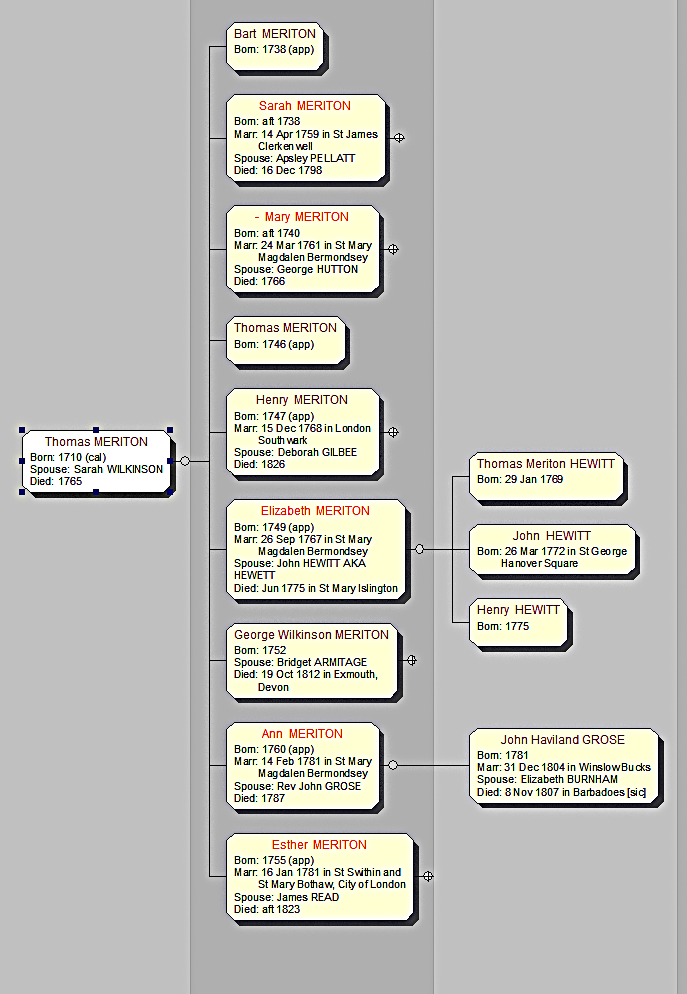
.Turning now back to Meritons – Elizabeth Meriton (1749-1775) first appears in the records on 26 September 1767, marrying as a minor with the consent of her mother Sarah, to John Hewitt, ‘Upholder’ of St George Hanover Square, in London. The marriage was at St Mary Magdalen, Bermondsey. The website of the Worshipful Company of Upholders explains the Company’s origins:
‘THE WORSHIPFUL COMPANY OF UPHOLDERS of the City of London can trace its history back to the early days of the Craft Guilds in which were fostered the high quality of goods and the high standards of workmanship that have always been the pride of English industry.
‘The craftsman in Upholstery was known by a name that varied from Upheldere to Uphouldesterr, but mainly as an Upholder and it is under this latter name that the Company came into existence “On the Saturday after the Feast of St. Matthias in the 35th year of the reign of Edward III” (i.e. the 1st March 1360, Old Style).’ https://upholders.co.uk/history/
Thomas Meriton Hewitt was baptised at St George, Hanover Square, on 8 February 1769. John Hewitt was baptised on 9 April 1772 at the Scotch Church, Swallow Street, London. And Henry Hewitt was baptised 10 February 1775 at Islington Independent. Tragically for this family, Elizabeth was buried four months later on 16 June 1775 ‘in Mr Meriton’s vault’ at St Mary Magdalen, Bermondsey.
What happened to the family after that? We know from City of London guilds Freedom Papers that sons Thomas and John also became free of the Upholders, while son Henry was apprenticed to Elizabeth’s brother-in-law, Apsley Pellatt at the Ironmongers on 30 July 1789 and was made Free on 27 April 1804.. But I have failed to identify them after that. One would suspect that John Hewitt would have married again – but I have not found a suitable possibility.
Another shortlived offspring was Ann Meriton (1760-1787). She married the Rev John Grose (1758-1821) on 20 February 1781 at St Mary Magdalene, Bermondsey. Both were of the parish, and witnesses were her brother, G W Wilkinson (see a forthcoming post), and Elizabeth Ridout. An extract from the Dictionary of National Biography summarises Grose’s career at https://en.wikisource.org/wiki/Dictionary_of_National_Biography,_1885-1900/Grose,_John_(1758-1821) Their son .John Haviland Grose was born in 1781and apprenticed in 1796 in Winslow, Buckinghamshire to Josh Turner, Surgeon. He evidently joined the military later on, since his resignation as Surgeon Mate Royal Artillery is dated 28 September 1804. His marriage to Elizabeth Burnham was announced in the London Courier and Evening Gazette on 2 January 1805. Tragically, however, the Kentish Gazette of 8 March 1808 reports the death on 8 November 1807 of the Surgeon of the Frigate Blonde, in Barbadoes [sic]. No further details are given.
The Rev John Grose married again and had two further children, whose fates we will not follow here.
And that completes the summary of these pretty small (by Meriton standards) descendant families of Thomas and Sarah Meriton. The next post will be much more complicated!

