Thomas Meriton ( – 1765)

52. Thomas Meriton ( -1765) and Sarah Wilkinson ( -1784) of Bermondsey – and Root: the power of Wills

In which we meet the parents of Sarah Meriton (1739-1798), wife of Apsley Pellatt (1735-1798). Six-times great grandparents Thomas Meriton ( -1765) and Sarah Wilkinson ( -1784) had eight known children whose fates we will briefly consider in our next post. But firs,t a quick look at some of the quite complicated relationships, including that of Sarah’s short-lived sister and brother-in-law, and their three children.

On the left of the tree we find Thomas Meriton ( – 1765) and his wife Sarah Wilkinson (- 1784). More about them in a minute. Of interest in the next generation down are, of course, oldest child Sarah Meriton (1739-1798), wife of Apsley Pellatt II (1735-1798) , and mother of Apsley Pellatt III (1763-1826). He in turn, with wife Mary Maberly (1768-1822), was father of 15 children – too many to show here! – including their oldest child, Mary Pellatt (1789-1857), who married Samuel Backler (1784-1870) – the Backlers being the starting point of this whole blog! Stay with this, because there are some cousin relationships coming up. (See https://backlers.com/2017/03/21/samuel-backler-1784-1870-family-thefts-and-a-changing-career/ )

Sarah nee Meriton and Apsley Pellatt II are also parents of Thomas Pellatt (1765-1829), who married Elizabeth Meriton ( – 1804), the daughter of Sarah’s younger brother Henry Meriton ( – 1826). Thomas Pellatt and Elizabeth were parents of, among others, Henry Pellatt (1797-1860), who married Mary Backler (1813-1882), daughter of Mary Pellatt and Samuel Backler. (See:https://backlers.com/2025/08/27/51-thomas-pellatt-1765-1829-clerk-to-the-ironmongers/ ) (See also https://backlers.com/2014/11/06/thomas-meriton-pellatt-or-sargeant-who-is-the-father/ )

Meanwhile, as I was making final preparations for this post, I reflected with some frustration that I had little information about Sarah Wilkinson’s origins. So I decided to try once more to find parents, using as a starting point the name of her brother, George Wilkinson Meriton -= surely named after his grandfather? And yes, so it proved. The story below of variously interconnected families is largely drawn from the Wills of the key players.

Thomas Meriton ( – 1765). Origins? Here I have found pretty much of a dead end. Various online trees show a christening at St Sepulchre London on 27 May 1710 of a Thomas Meriton, father Thomas, Mother, Elizabeth. Another possibility is the christening of a Thomas Merriton [sic] at Greenwich St Alfege, on 2 December 1696 to Henery Merriton and Johannah. Thomas and Sarah’s first son was named Henry. But I cannot find a Will or other evidence which would confirm either of these. So Thomas’ origins remain doubtful for the moment.

Rather more satisfying – at least one generation back – is the find of George Wilkinson ( – 1762) of Clerkenwell. As noted above, a search on Wills for George Wilkinson threw up one in Clerkenwell, where at St John the Baptist, Sarah Wilkinson ‘of this parish’ had married Thomas Meriton ‘of St Olave’s Southwark’ on 5 February 1731. This George Wilkinson Will was incredibly obliging. Written on 28 November 1759, it tells us that George was an Ironmonger of St James, otherwise St John, Clerkenwell. After certain bequests (see below), all the rest, residue, real and personal estate etc etc are left to ‘my Son in Law Thomas Meriton‘, sole executor of the Will. Rather handily, and just to make sure of our family connections, two of the three witnesses were Apsley Pellatt [II] and Sarah [nee Meriton] Pellatt. How satisfying! [The bold typeface throughout this post indicates my direct ancestors.]

Root: George Wilkinson‘s Will began with a bequest which aroused my curiosity. The very first Item reads: ‘I give to my Grand Son Samuel Root and to my two Grand Daughters Elizabeth Root and Ann Wilkinson Root the sum of One hundred pounds each’, when married or they reach age 21…and Thomas Meriton is appointed their Guardian. So, in 1759 when the Will was written, there were three children of a daughter of George Wilkinson, who seemed to be orphaned. Here is how it works: George Wilkinson had two daughters, Sarah (who married Thomas Meriton in 1731) and Elizabeth, who married widowed Mason Samuel Root in St Benet, Paul’s Wharf in 1748. Guessing back from their marriage dates, I infer that Sarah was born around 1711, and Elizabeth perhaps much later – perhaps with a different mother than Sarah? Their father George Wilkinson was widowed when he married widow Sarah Bart, also at St Benet Paul’s Wharf in 1731. (This historic Wren church is just north of the River Thames, opposite Southwark and Bermondsey. I am not sure why these marriages took place there.) I have not found an earlier marriage for George, nor have I found a baptism for either daughter.

But, back to the sad Root story. There are baptism records for Elizabeth (1750-1763), Samuel (1751-1764) and Ann Wilkinson Root (1752 -). Sadly, we find a Will for their father Samuel Root of the Parish of St Mary Magdalen Bermondsey, Citizen and Mason of London, written just five years after his marriage to Elizabeth, on 4 October 1753, and proved on 15 October 1753. Samuel appoints three executors – ‘my honoured father Roger Root of the Parish of St John [Horsleydown] in Southwark Carpenter, my father in law George Wilkinson of the Parish of St James Clerkenwell Ironmonger and my brother in law Thomas Meriton of the said parish of St Mary Magdalen…Ironmonger to be joint executors’…; After debts etc, everything is left to loving wife Elizabeth Root, the three children, ‘and such other child or children as my said wife is now pregnant with…’ The usual provisions are made for education and maintenance of the children.

So, one of the Executors was George Wilkinson, whom we have seen died in 1762. What about wife Elizabeth (nee Wilkinson) and the other grandfather, Roger Root? Well, he died in 1755, when only one son proved his Will as executor, since the other Executor, son Samuel, had already died. And Elizabeth? By the time of George Wilkinson’s Will, written in 1759, she is not mentioned. Nor is there a fourth child. I wonder if she died in child birth. This leaves just one Executorand Guardian.

Thomas Meriton’s Will: And so we turn to Thomas Meriton. His Will was written on 28 January 1764 and proved by the sole Executrix, his wife Sarah nee Wilkinson Meriton on 6 November 1765. It makes no mention of the Root children, who are still minors. Why? Well, I think Elizabeth died in 1763 – there is a burial in Bermondsey for a 13-year-old Elizabeth Root. I think Samuel was buried in May 1764 in Bermondsey, brought from St John Horsleydown, in nearby Southwark, where there were Root relatives. But I am not sure about Ann Wilkinson Root, who was baptised on 12 November 1752 in Bermondsey. Presumably she was with some family member.

I think I will leave the rest of Thomas’ Will, and that of his wife in 1784, until my next post, where both Wills will introduce us to their many children. The Meritons were a prosperous family, he seeming to have been a successful Ironmonger, and she, perhaps, having inherited property and other things from her father, George Wilkinson. Considerable sums of money and jewels, and much property, feature in the Wills, as well as something of a mystery surrounding a child named Bart Meriton.
50. Apsley Pellatt II (1735-1798)

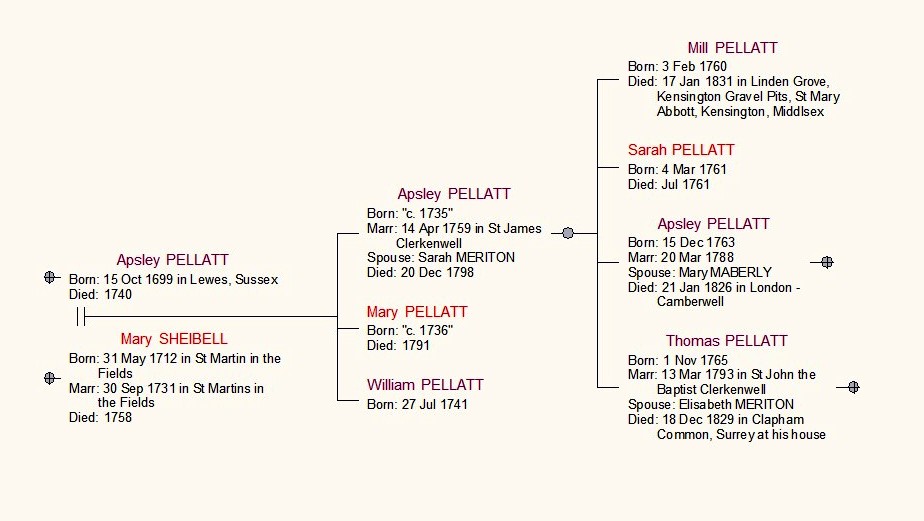
In which we meet Apsley Pellatt II (1735-1798). and his wife Sarah Meriton (c. 1738-1798), and their three children.  We are re-introduced to The Worshipful Society of Ironmongers,  with which Company successive generations of Pellatts would be associated for more than 100 years. 

Apsley Pellatt II (1735-1798) was the oldest of three children born to Apsley Pellatt 1 (1699-1740) and Mary nee Sheibell (1712-1758).   We have seen in previous posts that Apsley Pellatt I died just five years after his oldest child’s birth.  Of the younger Apsley’s siblings, we can take a very brief look, since I can trace nothing about his sister Mary, other than that she died at Camden Street, Islington, in 1791, and in her will left many legacies to nieces and nephews, various charities, and the residue to her brother and executor, the above-name Apsley II.  Of William we know even less. His impending birth was mentioned in his father’s will.  I had long puzzled about his apparent birth date, more than a year after his father’s death, until I realised that these events took place before the change of the calendar from Julian to Gregorian in 1752.  Before this date, the first three months of what is now our calendar year were considered to be of the previous year – so that Apsley Sr died early in 1740/1, with William appearing a few months later.  Other than that – of William, there is nothing. I suspect he may have died in infancy, as he is not mentioned in the Will of his grandmother, Mary Sheibell, below.

So, back to young Apsley II.  He was to benefit from a number of legacies, for instance from his grandmother Mary (nee Houghton) Sheibell, both silver and a sum of money, payable upon his reaching the age of 21.  Before he reaches that age, the executors of the will are instructed to use the interest on these gifts ‘to put him apprentice to some genteel and reputable trade’.  And so, we renew acquaintance with the Worshipful Company of Ironmongers, whom we first met in Post 6c, John Freeman (1740-1803), Indigo Maker and Ironmonger.   To recap, John Freeman had married Ann Backler (1741-1820), who was sister to apothecary Sotherton Backler (1746-1819) and aunt to Sotherton’s son Samuel Backler (1784-1870), who in 1810 married Mary Pellatt (1789-1857), daughter of Apsley Pellatt III (1763-1826), to whom we will briefly be introduced later in this post.  The point of all this is to show that almost certainly there were long standing links between the Pellatts and the Backlers.

Apprentice: In 1750, on payment of the sum of £80, Apsley II was put apprentice to William Bliss: ‘I Apsly Pellat [sic] Apprentice to William Bliss do promise to be obedient to the Master and Wardens of the Worshipful Company of Ironmongers during my life and my said Master during my Apprenticeship. Witness my hand this 12 day of July 1750 Apsley Pellat [sic].’ (image on findmypast)

Apsley Pellatt served out his seven years as an apprentice, and was made free of the Ironmongers Company on 18 August 1757.  By this time, aged 21, he would also have come into his various inheritances, which undoubtedly gave him the resources to marry, and to set up in business as an Ironmonger, where he is to be found for many years at 13 St John Street, Clerkenwell.

Marriage to Sarah Meriton  This took place at St James Clerkenwell, Clerkenwell Green, on 14 April 1759.  Sarah was a minor, and married with the consent of her father Thomas Meriton ( – 1865).  Witnesses were Thos. Meriton (possibly/probably her father) and John Godfrey (not sure who he is).  We will learn more about the Meritons in a future  post, but here it is important to note that Thomas Meriton was an Ironmonger, albeit south of the river in Bermondsey, and not of the Ironmongers Company. It seems likely that the Pellatt/Meriton marriage resulted from the partnership between the families, as noted in the following item from The London Gazette, shortly before Thomas Meriton’s death in Bermondsey.  His marriage to Sarah Wilkinson in 1731 had taken place in Clerkenwell, so although he was located south of the river, she had links in Clerkenwell.  

London Gazette 1 January 1765: The Ironmongery Business carried on by Thomas Meriton of Dockhead, Southwark and Apsley Pellatt of Clerkenwell, was dissolved the 31st of December last, 1764. Witness our hand Thomas Meriton, Apsley Pellatt.  N.B. Thomas Meriton is to pay and receive what is Debtor and Creditor to that time.

And so, for some 30 years, Apsley Pellatt II carried on as Ironmonger of Clerkenwell.  In 1789 he was Master of the Ironmongers Company, elected to the post by the Court of Assistants.  His tenure lasted a year.

He and Sarah had four children, three sons and the sadly short-lived Sarah Pellatt (1861-1861).  Let’s look at the three sons.

Mill Pellatt (1760-1805): Was apprenticed to his father, of St John’s Street, St Sepulchre Without, on 27 July 1775.  He was duly made free of the Ironmongers Company by service to his father on 28 November 1782 (both images on findmypast).  In the 1796 Electoral Register for London, we find Mill Pellatt and Apsly Pellatt [sic] [II] as Ironmongers at St John Street.  And in 1831 we find the death of Mill Pellatt Esq on 17 January and his subsequent burial on 21 January 1831 at St Mary Abbotts Kensington.  His address was given as Linden Grove, which rang a bell – it was where Samuel Backler and Mary [nee Pellatt] Backler were living when their daughter Esther Maria Backler was born in 1830.  See Post 26!  Mary was Mill’s niece.  The Backlers were about to embark on a rather turbulent year, featuring Samuel’s bankruptcy proceedings, among other things.  

Mill Pellatt had profited handsomely from his father’s Will in 1799, but apparently became ill or somehow dependent, because his brother Apsley III’s Will in 1826 [which complicated document we will peruse at a later date] made provision for funds to be invested to produce ‘the yearly sum of eighty pounds and to pay the sum of eighty pounds yearly and every year unto and for or towards the support of my dear brother Mill Pellatt for his life’.   Presumably this care was being provided by Mill’s niece Mary Backler and her husband.

Apsley Pellatt III ( 1763-1826) we will leave until a subsequent post.

Thomas Pellatt (1765-1829) further complicates this complicated family, and I have come to the conclusion that he needs a post of his own.  In short, he was apprenticed Clerk to Attorney William Leeson on 4 October 1780, and  was made free of the Ironmongers Company in 1757 by Patrimony.  He was later to have a significant role with the Ironmongers, and in wider civic life, which is why he merits a post on his own.  For the purposes of this post, suffice to say that he married his cousin Elizabeth Meriton, daughter of Henry Meriton (Thomas Meriton’s brother) in 1795.  Their son Henry Pellatt would marry Mary Backler, daughter of Mary Pellatt (daughter of Apsley Pellatt III) and Samuel Backler. Are you staying with this?  We will leave that for the moment and just focus on the latter years of Apsley Pellatt II. 

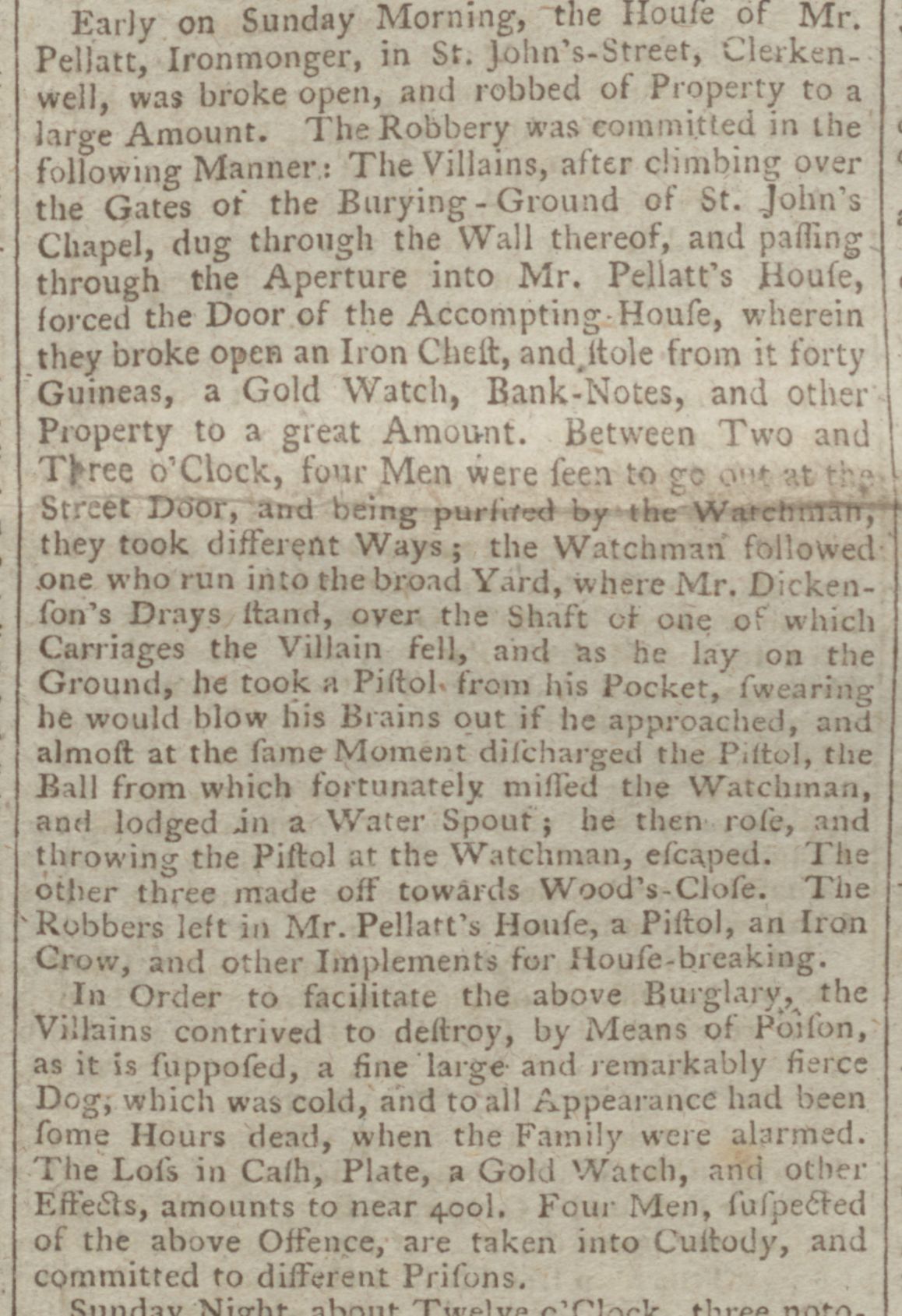
There is plenty of evidence that Apsley Pellatt II traded at St John’s Street, but perhaps none so colourful as the events described in the following newspaper clipping:

Northampton Mercury 25 October 1784. Image reproduced from British Newspapers collection by kind permission of Findmypast

This clipping tells us a lot about Apsley Pellatt at the time. His home was adjacent to St John’s Chapel and the burying ground, both on the western side of St John’s Street as it heads north towards Islington. Not far away is St James Clerkenwell, where Apsley Pellatt II married Sarah Meriton. The value of stolen goods was some £400 – around £60-80,000 today, depending on which website you peruse. They owned a dog! I have not managed to find court reports about the suspected thieves.

More context of Apsley Pellatt’s working life is given in the advert seen below, not long before his death in 1798. Here we see the types of goods an ironmonger would stock – iron, steel, brass – plus household furniture and effects. Presumably the Pellatts were moving from St John’s Street to Islington, where they died within days of each other at the end of 1798.

Ipswich Journal, 28 May 1798. Image used by kind permission of Findmypast, British Newspaper Collection.

Apsley Pellatt II – death and Will: The following text is taken from the online record of ‘Deeds of 9 Friars Walk, Lewes’ (ESX 21359) on the Sussex Record Office website   https://www.thekeep.info/collections/getrecord/GB179_AMS6346_1-32

On 4 & 5 Apr 1759 the Friars Estate was settled on the marriage of Apsley Pellatt and Sarah, daughter of Thomas Meriton; they mortgaged it for £2000 to Elizabeth Macie on 5 & 6 Jan 1776, who assigned it to James Louis Macie on 12 & 13 Apr 1786. Sarah Pellatt died on 16 Dec 1798 and Apsley Pellatt on the 20th leaving Mill Pellatt, Apsley Pellatt and Thomas Pellatt his surviving children; Apsley and Thomas proved their father’s will in PCC on 5 Jan 1799. The estate was auctioned on 19 Aug 1803; lot 2, a capital messuage called The Friars occupied by Sir F[erdinando] Poole at a rent of £90 and 2a 1r 28p of land, was sold to George Verrall for £2400 and £93 18s 6d for the timber. The conveyance was executed on 28 & 29 Mar 1804 by Mill Pellatt of Edgware Road in Mx, gent, Apsley Pellatt of St Pauls Churchyard, glass manufacturer and Thomas Pellatt of Ironmongers Hall, gent, to George Verrall of Lewes, gent (and his trustees John Godlee of Cliffe, merchant, Thomas Shank of Fenchurch Street, London, wine and brandy merchant and George Nelson of Palsgrave Place, Temple). Of the purchase money, £2000 was owed to Macie the mortgagee.

Given that Sarah predeceased her husband by a few days, the provisions in his Will for her were not applicable, so basically everything went to the three brothers, with Mill seeming to get a bit more than the two younger siblings. Of interest to us is that eldest grand daughter Mary Pellatt (1789-1857) was to receive £100 when reaching age 21 or day of marriage, a nice little sum for her when she married Samuel Backler (1784-1870) in 1810. In the next post we will catch up with Thomas Pellatt, then we will peruse the Meritons, and finally will move on to Apsley Pellatt III. Lots to look forward to!