Samuel BACKLER (1784-1870)

52. Thomas Meriton ( -1765) and Sarah Wilkinson ( -1784) of Bermondsey – and Root: the power of Wills

In which we meet the parents of Sarah Meriton (1739-1798), wife of Apsley Pellatt (1735-1798). Six-times great grandparents Thomas Meriton ( -1765) and Sarah Wilkinson ( -1784) had eight known children whose fates we will briefly consider in our next post. But firs,t a quick look at some of the quite complicated relationships, including that of Sarah’s short-lived sister and brother-in-law, and their three children.

On the left of the tree we find Thomas Meriton ( – 1765) and his wife Sarah Wilkinson (- 1784). More about them in a minute. Of interest in the next generation down are, of course, oldest child Sarah Meriton (1739-1798), wife of Apsley Pellatt II (1735-1798) , and mother of Apsley Pellatt III (1763-1826). He in turn, with wife Mary Maberly (1768-1822), was father of 15 children – too many to show here! – including their oldest child, Mary Pellatt (1789-1857), who married Samuel Backler (1784-1870) – the Backlers being the starting point of this whole blog! Stay with this, because there are some cousin relationships coming up. (See https://backlers.com/2017/03/21/samuel-backler-1784-1870-family-thefts-and-a-changing-career/ )

Sarah nee Meriton and Apsley Pellatt II are also parents of Thomas Pellatt (1765-1829), who married Elizabeth Meriton ( – 1804), the daughter of Sarah’s younger brother Henry Meriton ( – 1826). Thomas Pellatt and Elizabeth were parents of, among others, Henry Pellatt (1797-1860), who married Mary Backler (1813-1882), daughter of Mary Pellatt and Samuel Backler. (See:https://backlers.com/2025/08/27/51-thomas-pellatt-1765-1829-clerk-to-the-ironmongers/ ) (See also https://backlers.com/2014/11/06/thomas-meriton-pellatt-or-sargeant-who-is-the-father/ )

Meanwhile, as I was making final preparations for this post, I reflected with some frustration that I had little information about Sarah Wilkinson’s origins. So I decided to try once more to find parents, using as a starting point the name of her brother, George Wilkinson Meriton -= surely named after his grandfather? And yes, so it proved. The story below of variously interconnected families is largely drawn from the Wills of the key players.

Thomas Meriton ( – 1765). Origins? Here I have found pretty much of a dead end. Various online trees show a christening at St Sepulchre London on 27 May 1710 of a Thomas Meriton, father Thomas, Mother, Elizabeth. Another possibility is the christening of a Thomas Merriton [sic] at Greenwich St Alfege, on 2 December 1696 to Henery Merriton and Johannah. Thomas and Sarah’s first son was named Henry. But I cannot find a Will or other evidence which would confirm either of these. So Thomas’ origins remain doubtful for the moment.

Rather more satisfying – at least one generation back – is the find of George Wilkinson ( – 1762) of Clerkenwell. As noted above, a search on Wills for George Wilkinson threw up one in Clerkenwell, where at St John the Baptist, Sarah Wilkinson ‘of this parish’ had married Thomas Meriton ‘of St Olave’s Southwark’ on 5 February 1731. This George Wilkinson Will was incredibly obliging. Written on 28 November 1759, it tells us that George was an Ironmonger of St James, otherwise St John, Clerkenwell. After certain bequests (see below), all the rest, residue, real and personal estate etc etc are left to ‘my Son in Law Thomas Meriton‘, sole executor of the Will. Rather handily, and just to make sure of our family connections, two of the three witnesses were Apsley Pellatt [II] and Sarah [nee Meriton] Pellatt. How satisfying! [The bold typeface throughout this post indicates my direct ancestors.]

Root: George Wilkinson‘s Will began with a bequest which aroused my curiosity. The very first Item reads: ‘I give to my Grand Son Samuel Root and to my two Grand Daughters Elizabeth Root and Ann Wilkinson Root the sum of One hundred pounds each’, when married or they reach age 21…and Thomas Meriton is appointed their Guardian. So, in 1759 when the Will was written, there were three children of a daughter of George Wilkinson, who seemed to be orphaned. Here is how it works: George Wilkinson had two daughters, Sarah (who married Thomas Meriton in 1731) and Elizabeth, who married widowed Mason Samuel Root in St Benet, Paul’s Wharf in 1748. Guessing back from their marriage dates, I infer that Sarah was born around 1711, and Elizabeth perhaps much later – perhaps with a different mother than Sarah? Their father George Wilkinson was widowed when he married widow Sarah Bart, also at St Benet Paul’s Wharf in 1731. (This historic Wren church is just north of the River Thames, opposite Southwark and Bermondsey. I am not sure why these marriages took place there.) I have not found an earlier marriage for George, nor have I found a baptism for either daughter.

But, back to the sad Root story. There are baptism records for Elizabeth (1750-1763), Samuel (1751-1764) and Ann Wilkinson Root (1752 -). Sadly, we find a Will for their father Samuel Root of the Parish of St Mary Magdalen Bermondsey, Citizen and Mason of London, written just five years after his marriage to Elizabeth, on 4 October 1753, and proved on 15 October 1753. Samuel appoints three executors – ‘my honoured father Roger Root of the Parish of St John [Horsleydown] in Southwark Carpenter, my father in law George Wilkinson of the Parish of St James Clerkenwell Ironmonger and my brother in law Thomas Meriton of the said parish of St Mary Magdalen…Ironmonger to be joint executors’…; After debts etc, everything is left to loving wife Elizabeth Root, the three children, ‘and such other child or children as my said wife is now pregnant with…’ The usual provisions are made for education and maintenance of the children.

So, one of the Executors was George Wilkinson, whom we have seen died in 1762. What about wife Elizabeth (nee Wilkinson) and the other grandfather, Roger Root? Well, he died in 1755, when only one son proved his Will as executor, since the other Executor, son Samuel, had already died. And Elizabeth? By the time of George Wilkinson’s Will, written in 1759, she is not mentioned. Nor is there a fourth child. I wonder if she died in child birth. This leaves just one Executorand Guardian.

Thomas Meriton’s Will: And so we turn to Thomas Meriton. His Will was written on 28 January 1764 and proved by the sole Executrix, his wife Sarah nee Wilkinson Meriton on 6 November 1765. It makes no mention of the Root children, who are still minors. Why? Well, I think Elizabeth died in 1763 – there is a burial in Bermondsey for a 13-year-old Elizabeth Root. I think Samuel was buried in May 1764 in Bermondsey, brought from St John Horsleydown, in nearby Southwark, where there were Root relatives. But I am not sure about Ann Wilkinson Root, who was baptised on 12 November 1752 in Bermondsey. Presumably she was with some family member.

I think I will leave the rest of Thomas’ Will, and that of his wife in 1784, until my next post, where both Wills will introduce us to their many children. The Meritons were a prosperous family, he seeming to have been a successful Ironmonger, and she, perhaps, having inherited property and other things from her father, George Wilkinson. Considerable sums of money and jewels, and much property, feature in the Wills, as well as something of a mystery surrounding a child named Bart Meriton.

50. Apsley Pellatt II (1735-1798)

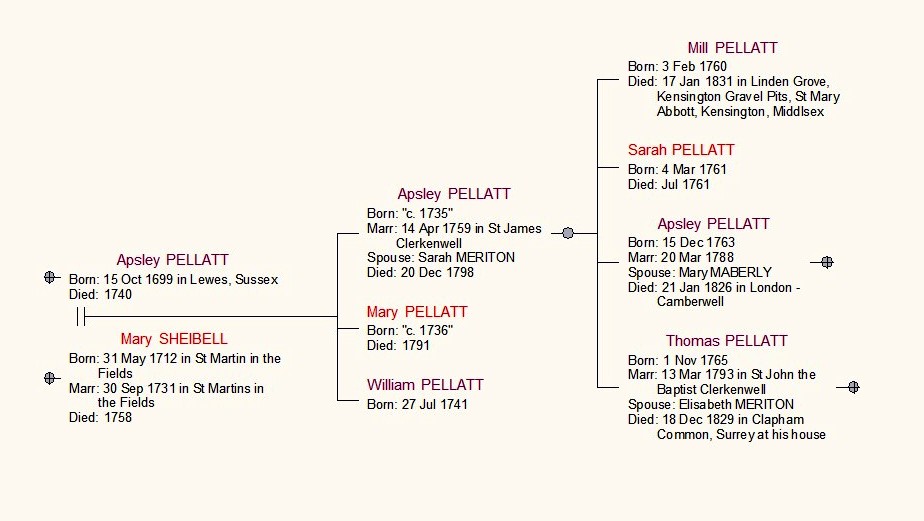
In which we meet Apsley Pellatt II (1735-1798). and his wife Sarah Meriton (c. 1738-1798), and their three children.  We are re-introduced to The Worshipful Society of Ironmongers,  with which Company successive generations of Pellatts would be associated for more than 100 years. 

Apsley Pellatt II (1735-1798) was the oldest of three children born to Apsley Pellatt 1 (1699-1740) and Mary nee Sheibell (1712-1758).   We have seen in previous posts that Apsley Pellatt I died just five years after his oldest child’s birth.  Of the younger Apsley’s siblings, we can take a very brief look, since I can trace nothing about his sister Mary, other than that she died at Camden Street, Islington, in 1791, and in her will left many legacies to nieces and nephews, various charities, and the residue to her brother and executor, the above-name Apsley II.  Of William we know even less. His impending birth was mentioned in his father’s will.  I had long puzzled about his apparent birth date, more than a year after his father’s death, until I realised that these events took place before the change of the calendar from Julian to Gregorian in 1752.  Before this date, the first three months of what is now our calendar year were considered to be of the previous year – so that Apsley Sr died early in 1740/1, with William appearing a few months later.  Other than that – of William, there is nothing. I suspect he may have died in infancy, as he is not mentioned in the Will of his grandmother, Mary Sheibell, below.

So, back to young Apsley II.  He was to benefit from a number of legacies, for instance from his grandmother Mary (nee Houghton) Sheibell, both silver and a sum of money, payable upon his reaching the age of 21.  Before he reaches that age, the executors of the will are instructed to use the interest on these gifts ‘to put him apprentice to some genteel and reputable trade’.  And so, we renew acquaintance with the Worshipful Company of Ironmongers, whom we first met in Post 6c, John Freeman (1740-1803), Indigo Maker and Ironmonger.   To recap, John Freeman had married Ann Backler (1741-1820), who was sister to apothecary Sotherton Backler (1746-1819) and aunt to Sotherton’s son Samuel Backler (1784-1870), who in 1810 married Mary Pellatt (1789-1857), daughter of Apsley Pellatt III (1763-1826), to whom we will briefly be introduced later in this post.  The point of all this is to show that almost certainly there were long standing links between the Pellatts and the Backlers.

Apprentice: In 1750, on payment of the sum of £80, Apsley II was put apprentice to William Bliss: ‘I Apsly Pellat [sic] Apprentice to William Bliss do promise to be obedient to the Master and Wardens of the Worshipful Company of Ironmongers during my life and my said Master during my Apprenticeship. Witness my hand this 12 day of July 1750 Apsley Pellat [sic].’ (image on findmypast)

Apsley Pellatt served out his seven years as an apprentice, and was made free of the Ironmongers Company on 18 August 1757.  By this time, aged 21, he would also have come into his various inheritances, which undoubtedly gave him the resources to marry, and to set up in business as an Ironmonger, where he is to be found for many years at 13 St John Street, Clerkenwell.

Marriage to Sarah Meriton  This took place at St James Clerkenwell, Clerkenwell Green, on 14 April 1759.  Sarah was a minor, and married with the consent of her father Thomas Meriton ( – 1865).  Witnesses were Thos. Meriton (possibly/probably her father) and John Godfrey (not sure who he is).  We will learn more about the Meritons in a future  post, but here it is important to note that Thomas Meriton was an Ironmonger, albeit south of the river in Bermondsey, and not of the Ironmongers Company. It seems likely that the Pellatt/Meriton marriage resulted from the partnership between the families, as noted in the following item from The London Gazette, shortly before Thomas Meriton’s death in Bermondsey.  His marriage to Sarah Wilkinson in 1731 had taken place in Clerkenwell, so although he was located south of the river, she had links in Clerkenwell.  

London Gazette 1 January 1765: The Ironmongery Business carried on by Thomas Meriton of Dockhead, Southwark and Apsley Pellatt of Clerkenwell, was dissolved the 31st of December last, 1764. Witness our hand Thomas Meriton, Apsley Pellatt.  N.B. Thomas Meriton is to pay and receive what is Debtor and Creditor to that time.

And so, for some 30 years, Apsley Pellatt II carried on as Ironmonger of Clerkenwell.  In 1789 he was Master of the Ironmongers Company, elected to the post by the Court of Assistants.  His tenure lasted a year.

He and Sarah had four children, three sons and the sadly short-lived Sarah Pellatt (1861-1861).  Let’s look at the three sons.

Mill Pellatt (1760-1805): Was apprenticed to his father, of St John’s Street, St Sepulchre Without, on 27 July 1775.  He was duly made free of the Ironmongers Company by service to his father on 28 November 1782 (both images on findmypast).  In the 1796 Electoral Register for London, we find Mill Pellatt and Apsly Pellatt [sic] [II] as Ironmongers at St John Street.  And in 1831 we find the death of Mill Pellatt Esq on 17 January and his subsequent burial on 21 January 1831 at St Mary Abbotts Kensington.  His address was given as Linden Grove, which rang a bell – it was where Samuel Backler and Mary [nee Pellatt] Backler were living when their daughter Esther Maria Backler was born in 1830.  See Post 26!  Mary was Mill’s niece.  The Backlers were about to embark on a rather turbulent year, featuring Samuel’s bankruptcy proceedings, among other things.  

Mill Pellatt had profited handsomely from his father’s Will in 1799, but apparently became ill or somehow dependent, because his brother Apsley III’s Will in 1826 [which complicated document we will peruse at a later date] made provision for funds to be invested to produce ‘the yearly sum of eighty pounds and to pay the sum of eighty pounds yearly and every year unto and for or towards the support of my dear brother Mill Pellatt for his life’.   Presumably this care was being provided by Mill’s niece Mary Backler and her husband.

Apsley Pellatt III ( 1763-1826) we will leave until a subsequent post.

Thomas Pellatt (1765-1829) further complicates this complicated family, and I have come to the conclusion that he needs a post of his own.  In short, he was apprenticed Clerk to Attorney William Leeson on 4 October 1780, and  was made free of the Ironmongers Company in 1757 by Patrimony.  He was later to have a significant role with the Ironmongers, and in wider civic life, which is why he merits a post on his own.  For the purposes of this post, suffice to say that he married his cousin Elizabeth Meriton, daughter of Henry Meriton (Thomas Meriton’s brother) in 1795.  Their son Henry Pellatt would marry Mary Backler, daughter of Mary Pellatt (daughter of Apsley Pellatt III) and Samuel Backler. Are you staying with this?  We will leave that for the moment and just focus on the latter years of Apsley Pellatt II. 

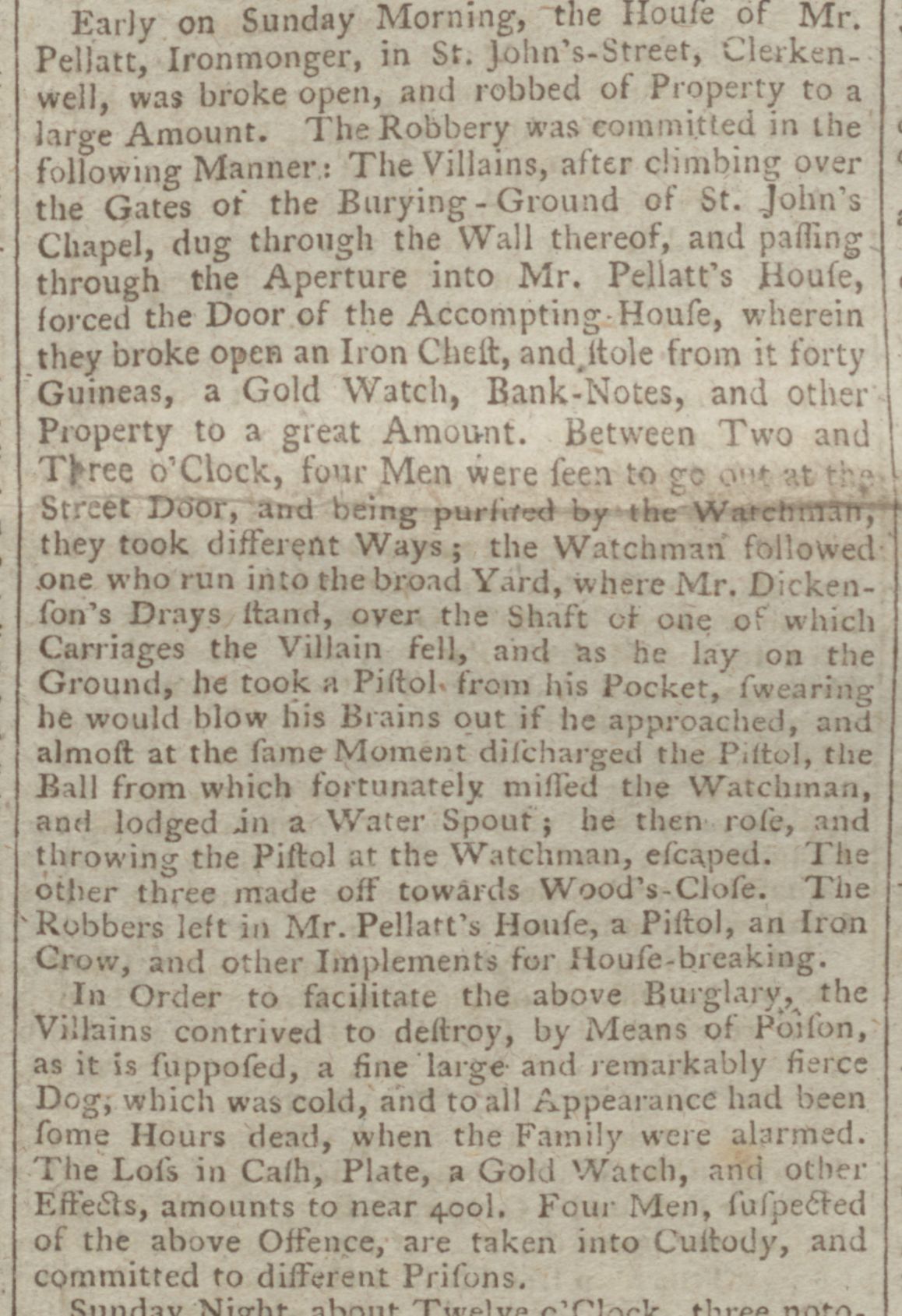
There is plenty of evidence that Apsley Pellatt II traded at St John’s Street, but perhaps none so colourful as the events described in the following newspaper clipping:

Northampton Mercury 25 October 1784. Image reproduced from British Newspapers collection by kind permission of Findmypast

This clipping tells us a lot about Apsley Pellatt at the time. His home was adjacent to St John’s Chapel and the burying ground, both on the western side of St John’s Street as it heads north towards Islington. Not far away is St James Clerkenwell, where Apsley Pellatt II married Sarah Meriton. The value of stolen goods was some £400 – around £60-80,000 today, depending on which website you peruse. They owned a dog! I have not managed to find court reports about the suspected thieves.

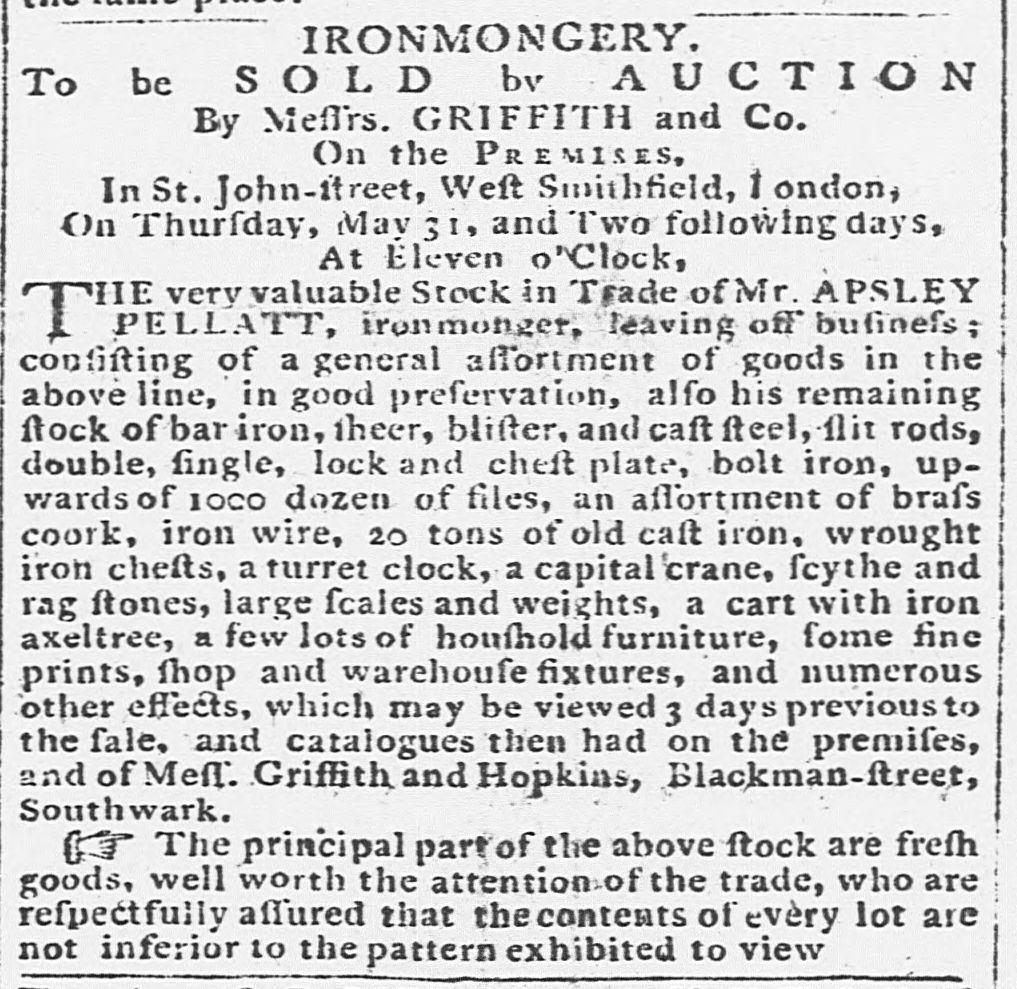
More context of Apsley Pellatt’s working life is given in the advert seen below, not long before his death in 1798. Here we see the types of goods an ironmonger would stock – iron, steel, brass – plus household furniture and effects. Presumably the Pellatts were moving from St John’s Street to Islington, where they died within days of each other at the end of 1798.

Ipswich Journal, 28 May 1798. Image used by kind permission of Findmypast, British Newspaper Collection.

Apsley Pellatt II – death and Will: The following text is taken from the online record of ‘Deeds of 9 Friars Walk, Lewes’ (ESX 21359) on the Sussex Record Office website   https://www.thekeep.info/collections/getrecord/GB179_AMS6346_1-32

On 4 & 5 Apr 1759 the Friars Estate was settled on the marriage of Apsley Pellatt and Sarah, daughter of Thomas Meriton; they mortgaged it for £2000 to Elizabeth Macie on 5 & 6 Jan 1776, who assigned it to James Louis Macie on 12 & 13 Apr 1786. Sarah Pellatt died on 16 Dec 1798 and Apsley Pellatt on the 20th leaving Mill Pellatt, Apsley Pellatt and Thomas Pellatt his surviving children; Apsley and Thomas proved their father’s will in PCC on 5 Jan 1799. The estate was auctioned on 19 Aug 1803; lot 2, a capital messuage called The Friars occupied by Sir F[erdinando] Poole at a rent of £90 and 2a 1r 28p of land, was sold to George Verrall for £2400 and £93 18s 6d for the timber. The conveyance was executed on 28 & 29 Mar 1804 by Mill Pellatt of Edgware Road in Mx, gent, Apsley Pellatt of St Pauls Churchyard, glass manufacturer and Thomas Pellatt of Ironmongers Hall, gent, to George Verrall of Lewes, gent (and his trustees John Godlee of Cliffe, merchant, Thomas Shank of Fenchurch Street, London, wine and brandy merchant and George Nelson of Palsgrave Place, Temple). Of the purchase money, £2000 was owed to Macie the mortgagee.

Given that Sarah predeceased her husband by a few days, the provisions in his Will for her were not applicable, so basically everything went to the three brothers, with Mill seeming to get a bit more than the two younger siblings. Of interest to us is that eldest grand daughter Mary Pellatt (1789-1857) was to receive £100 when reaching age 21 or day of marriage, a nice little sum for her when she married Samuel Backler (1784-1870) in 1810. In the next post we will catch up with Thomas Pellatt, then we will peruse the Meritons, and finally will move on to Apsley Pellatt III. Lots to look forward to!

6h. Descendants of Ann Backler and John Freeman: Pack, Grant, Grant-Ives, de Clanay Rennick, Grasby, Shore, Clarke, Hurle, Robinson…

In which we finally reach the last offspring of Mary Freeman and Richard Pack, and, with them, the end of this lengthy exploration of the Ann Backler/John Freeman line.This post rather variably, and somewhat arbitrarily, explores only fragments of later generations, particularly of the Shore line.There are simply too many of them, and I have run out of steam!

On reflection, before I tackle yet another large, extended couple of families, I note how very different the Ann Backler line is from that of her brother Sotherton Backler (1746-1819) of the Society of Apothecaries. I have not managed definitively to identify the fate of Ann’s other surviving sibling, Elizabeth Backler (1748/9 – ). As described in earlier posts, Ann’s husband John Freeman (1740-1803) had come to London from Northamptonshire, where he had been part of a very large and tangled web of families. Ann and John’s children and grandchildren inhabited a world of universities, military, clergy, the law and landed proprietors, very different from the artisans, artists and, for females, low-key lives of her brother’s family back in London. Apart from the youngest Sotherton-child, Rev Sotherton Backler (1798-1875), there seems little to link these two branches of this mid-18th century Backler line. And so, this series of posts has been a journey into modest and perhaps more grand stately homes, offspring of clergy marrying clergy, and pages of Burke’s Family Records (Shore, Cooke-Hurle and more) on Ancestry’s website. This post exemplifies all those trends. It seems a world away from ‘my’ Backler line descended from Ann’s nephew Samuel Backler (1784-1870) and his siblings.

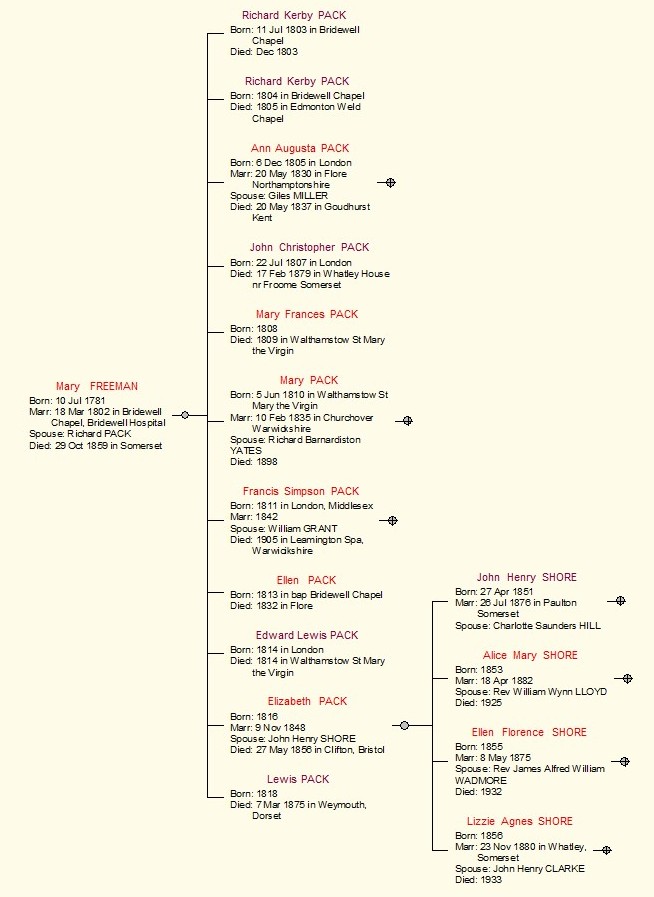
In the previous post we looked at two branches descended from Mary Freeman and Richard Pack. Here we look at two more lines, but we also note in the tree below that Mary and Richard had several more children who died in infancy or at a young age. I have just identified these in updating my data for this post, so this diagram differs from that in the previous post. Thus does family history continually evolve. First- and second-born infants both named Richard Kerby Pack died soon after birth. And later on, Ellen Pack (1813-1832) died at Flore aged 18, and Edward Lewis Pack was born and died in 1814. Clearly this otherwise prosperous family did not always have an easy time.

Moving on from where we left off in the last post, we meet Frances Simpson Pack (1811-1905) who married Barrister William Grant (1806-1868) at St George’s Hanover Square in 1842. By the time of the 1851 Census the family were living in Litchborough, Northamptonshire, where he was a land owner of 200 acres. Noting that his sons were said to be of ‘Litchborough Hall’, I found an English Heritage listing of that property, noting that it had been extensively renovated for William Grant in 1838, just a few years before his marriage to Frances. In 1861 he was described as a Magistrate and Barrister – not in practice. He died aged just 42, and by 1871, Frances was still living in Litchborough, but now with son Arthur W Grant, MA, Barrister and graduate of Brasenose College, as Head, and also with daughter Edith and youngest child, Charles E., an undergraduate at King’s College, Cambridge. By 1901 Frances was living on her own in Leamington Priors, Warwickshire and at her death in 1905, she left some £17,000 in the care of her three surviving sons, executors, her daughter Edith Frances having pre-deceased her by a year.

Some of the Grant family acquired the name of Grant-Ives, following the death of their relative Elizabeth Ives, spinster sister of Cornelius Ives, the Rector of Bradden. Use of the Ives surname and title to Bradden House, was granted by her in 1888 to Wilfred Dryden Grant, whose older brother was already lord at Litchborough Hall. On Wilfred’s death in 1919, the name passed by Royal licence to his brother Charles Eustace, as shown in the London Gazette, below. A search on ‘Grant-Ives’ brings up images of the various coats of arms adopted by different branches of the family. 

London Gazette 21 November 1919 Whitehall, August 23, 1919. The KING has been pleased to grant unto Charles Eustace Grant, of Bradden House, in the parish of Bradden, in the county of Northampton, Gentleman, Master of Arts of the University of Cambridge, and a Fellow of King’s College in the said University, His Royal Licence and Authority that he and his issue may, in compliance with a clause contained in the last will and testament of Elizabeth Ives, late of Bradden House aforesaid, Spinster, deceased, take and henceforth use the surname of Ives in addition and after that of Grant, and that he, and they may bear the arms of Ives quarterly with those of his and their own family, the said arms being first duly exemplified according to the Laws of Arms, and recorded in the College of Arms, otherwise the said Royal Licence.and Permission to be void and of none effect: And to command that the said Royal concession and declaration be recorded in His Majesty’s said College of Arms.

Of Frances’ first two children, Arthur William Grant (1842-1878) and Edith Frances Grant (1844-1904) there is little to say. Oldest surviving son, Edward Grant (1848-1910) of Lichborough (sometimes with a ‘t’) Hall and his wife Edith Helen Hulton (1859-1926) (daughter of the Rev Hulton), had three daughters, two of whom married, one to the exotically named Alexander de Clanay Rennick (1878-1949) (a Lt-Col in the Indian Army, later of Litchborough Hall). When their son was an adult he was styled Capt Richard de Clanay Grant-Rennick (1923-2004), perhaps acquiring the Grant name to preserve that Coat of Arms and the Litchborough title. These families are all easily traceable online and I will take them no further.

As noted above, Wilfred Dryden Grant-Ives (1854-1919) was diverted from his occupation of educator and tutor when he became the Lord of the Manor of Bradden in 1888. He devoted his life to public service, serving as JP and on various councils, as well as being a noted agriculturist and hunter. A rather harrowing report in the Northampton Mercury on 14 March 1919 of the inquest into his death reports that following a serious motor accident involving himself and his wife in 1918, he had become ‘not himself’ and very reclusive. His family had become very concerned about his welfare and had requested the attendance of health personnel, but on perceiving this, Wilfred had climbed out of his bedroom window onto the roof, from which he fell, his injuries resulting in his death, which was deemed accidental. A sad tale, indeed.

Wilfred and his wife Fanny Louisa Millington (1860-1951) had six daughters. An announcement of the engagement of the oldest daughter, Winifred Frances Grant-Ives (1883-1972) to Mr Gerard Arthur Kennaway, son of the Rev Kennaway in nearby Towcester, appeared in The Morning Post on 14 July 1906. However, no marriage record is in evidence, and she next appears in public records returning to England from Spain in 1916, apparently the wife of someone completely different, Charles Egbert Reynolds Sams (1877-1968), a mining engineer, with three children. The next public record is of their marriage in 1925. It’s not clear what all that means! 

Winifred’s youngest sister, Kathleen Beatrice Grant-Ives (1896-1976) married William Wright Grasby (1864-1939), veterinary surgeon (his second wife) in 1922. They had 7 sons before his death in 1939, and then a daughter was born named Diana Kathleen Grasby (1941-2005) in May 1941, two years after William’s death – it’s not clear who the father was. Interestingly, both Kathleen and Diana then became very well known for breeding ponies, including many who performed in pantomimes and at the Royal Opera House, Covent Garden!

Charles Eustace Grant (1851-1930), later Grant-Ives, as above, succeeded his brother Wilfred as Lord of the Manor. He married Madeline Isabel Whitting (1863-1949), daughter of a solicitor and niece of the Bursar of King’s College Cambridge, a post which her husband would later hold until his retirement to Bradden. They had five children. Charles and his son John Charles Grant-Ives (1889-1959) were ‘of Bradden House, Bradden Northamptonshire’. In 1933 John Charles was granted a divorce from his wife Amy (Whiteside Shaw) – I cannot see a marriage for them, possibly it was in Scotland – and custody of their three children, John Edward, Elizabeth M and Joy. She immediately married the co-respondent, Frank Boughton, and in 1948 John Charles married Dorothy M Hemsted, or Chance. 

Isabel Frances Grant-Ives (1891-1976) married Colin Fish (1888 – 1969) in 1921 and their daughter Joan H Fish was born in 1922. Ursula Grant-Ives (1892-1984), twin to Agnes below, was single all her life and died in Wilmslow, Cheshire, leaving some £76,800. She was buried in Bradden with other members of the family. Her twin, Agnes Grant-Ives (1892-1943) married geologist George M Davies (1885-1973) in 1922, his second wife.

There are plenty more Grant-Ives descendants of the above folk, but I will leave them there, and move on to the last of Mary Pack’s children with descendants, Elizabeth Pack (1816-1856) and her husband John Henry Shore – another tree is needed!

Finally, we have the children of Elizabeth Pack (1816-1856) and her landed-proprietor husband John Henry Shore (1819-1878) of Whatley in Somerset. Astute readers will note that this diagram has only their four children, in light of the resulting some 28 grandchildren, which really is a step too far! Elizabeth’s husband came from a long-established family of Shores, chronicled in Burke’s Family Records on Ancestry. His father, John Albin Shore (1775-1835), had married Mary Ann Hurle, so that when John Henry Shore Jr’s (1851- 1932) second child, Bertha Josephine Agnes Shore (1872-1958), married Captain William Armitage Cooke-Hurle, R.N. (1875-1920), they were probably related in some way I haven’t got the energy to pursue. John Henry Jr and his wife Charlotte Saunders Hill (-1900) had three daughters and eight sons, seven of whom survived to adulthood. I have found an online post which summarises some of the sons’ histories and military exploits at https://grandadswar.co.uk/capt-j-l-shore/ I have traced the outlines of their lives for my own database, but will not undertake to write them up here. I would be happy to discuss further if any reader so desires. I think John Henry Jr married twice more.

Alice Mary Shore (1853-1925) married Rev William Wynn Lloyd (1844 – 1925), they producing five daughters, three of whom did not marry, and one son, Meredydd Wynn Lloyd (1887-1967), who served in the Australian Army in WW1 and later married a French woman in Egypt. 

Ellen Florence Shore (1855-1932) married Rev James Alfred William Wadmore (1851-1918), they having two sons and three daughters.

Lizzie Agnes Shore (1856-1933) married solicitor Charles Henry Clarke (1841-1914), the son of a solicitor and his wife, Mary Hurle Clarke, the Hurle name appearing again in this family. One son, Arthur Henry Gilbert Clarke (1891-May 1916) died at High Wood in France. His early death contrasted with the career of his older brother, Major Dr Richard Christopher Clarke, RAMC, OBE whose death in 1957 in Bristol was attended by some 300 mourners, including many from the various families mentioned above, and remembering, among other things, his role as Honorary Curator of Bristol Zoo. He had served in WW1 as a medical officer. It seems youngest brother Aubrey Martin Clarke (1889-1957) also served in WW1, but then spent at least a number of years in Ceylon with his wife Evelyn Robinson (1890-1962), first cousin of Foster Gotch Robinson (1880-1967), noted cricketer, horse trainer and paper manufacturer (see his entry in wikipedia), who married in 1908 Aubrey’s sister, Marguerite Victoria Mary Robinson (1887-1963). The Robinson family were noted philanthropists in Bristol.

The very last child of Mary Freeman and Richard Pack was the unmarried son, Lewis Pack (1818-1875). Educated at Balliol College, Oxford, he is designated simply as Landowner in the 1861 Census at Southfield House, Whatley, Somerset, the home of his brother-in-law Richard Barnardiston Yates. Similarly, in the 1871 Census he is again a Landowner at the rather grand Whatley House, again in Whatley, Somerset, the home of his brother-in-law John Henry Shore. He died in 1875 and is buried in Whatley.

And so endeth the tale of the Freeman/Backler line, admittedly very selective and incomplete in this post. I had no idea when I embarked on this line some 18 months ago that it would be so enormous, albeit always interesting. It feels good to have explored it, however genetically distant from me is the resulting cast of characters. When all is said and done, they are my Backler cousins!

With some relief, I will in due course revert to the Pellatt/Rivers/Newton line!

45. Humphrey Newton 1495/6 – descendants to Apsley and Grace Newton: adding the Pellatt name

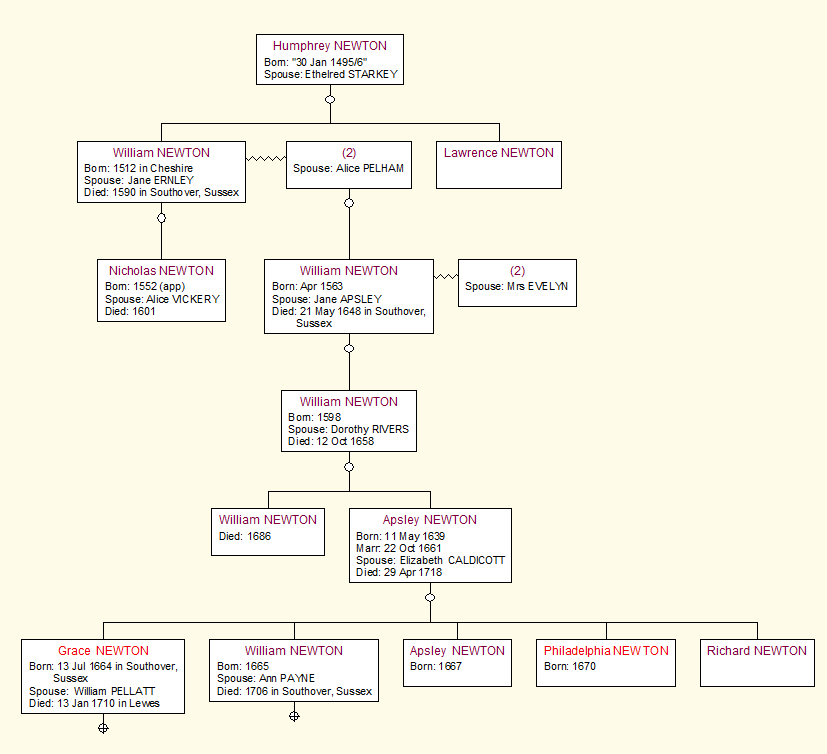
In which we hurry down the generations from Humphrey Newton the younger to join our Pellatt line (Grace Newton married William Pellatt, of whom more in a future post) , noting a few bits and pieces along the way, and ending up in the County of Sussex, in the South of England, where we leave our few northern ancestors behind. And bearing in mind that this line is not technically ‘Backlers’ – but is now tracing back through ‘Pellatt’, as Mary Pellatt (1789-1857) married Samuel Backler (1784-1870) – see, eg. posts 26-29, and 42.

Humphrey Newton the younger (1495/6 – ?) and his wife Ethelred Starkey start a line of three men named William Newton, who would take us down the generations to Apsley Newton and his daughter Grace. Ethelred Starkey was daughter and heiress of Lawrence Starkey, most probably Member of Parliament for Lancaster, and a local Lancaster worthy and property owner. See the discussion at: http://www.histparl.ac.uk/volume/1509-1558/member/starkey-lawrence-1474-1532 A fascinating account of Starkey and court cases related to his properties and other matters can be seen at Lancaster Jottings at: https://www.hslc.org.uk/wp-content/uploads/2017/06/73-10-Lancaster-jottings.pdf

Most of the following text of this blogpost, and the photograph, is a shameless replication of the Wikipedia entry about the Newton family of Southover Grange, in Sussex. I would like one day to venture there. See https://en.wikipedia.org/wiki/Southover_Grange. Text below in italics is lifted directly from the Wikipedia entry. I have not included references cited there. Names highlighted by me in bold are my direct ancestors.

William Newton (1512–1590) built Southover Grange in 1572. He was born in 1512 in Cheshire and was the second son of Humphrey Newton of Fulshaw and grandson of the notable Humphrey Newton (1466–1536) of Pownall. His mother was Ethelred Starkey an heiress of her father Lawrence Starkey and brought into the family extensive properties in York, Lancashire, Chester and Stafford.

In 1544 William and his younger brother Lawrence moved to Lewes. He lived at Lewes Priory in Southover which he leased from the then owner Anne of Cleves. In about 1550 he married Jane Ernley who was the daughter and heiress of William Ernley, owner of the Manor of Eryles. The couple had one son Nicholas Newton who was born in about 1552…. Jane died in about 1560 and several years later William married Alice Pelham and they had one son, William, born in 1564 and two daughters.

In 1572 William [Sr} built Southover Grange with stones from Lewes Priory having obtained permission by the owner Thomas Sackville, 1st Earl of Dorset, who employed him as his steward. William died in 1590 and his wife Alice died in 1600. He left Southover Grange to his second son William Newton (1564–1648).

William Newton (1564–1648) was a lawyer. He was married twice. His first wife was Jane Apsley daughter of John Apsley of Thakeham. As part of a marriage settlement he gained the manor of Storrington. They had six children, two sons and daughters. Jane died in 1627 and William married Jane, the widow of John Stansfield who was the grandfather of the famous diarist John Evelyn. The newly married Jane Newton was very fond of her grandson John Evelyn and offered to care for him so that he could go to the free-school at Southover. His father wanted him to go to Eton but John accepted his grandmother’s offer and spent most of his childhood at Southover Grange.

William Newton died in 1648 and his second wife Jane [Apsley] died in 1650. William’s son by his first wife William Newton (1598–1658) inherited the property. He was born in 1598 in Lewes and in 1637 he married Dorothy, daughter of Sir John Rivers 1st Baronet[See a forthcoming post.]

He died in 1658 and his second son Apsley Newton (1639–1718) became the owner of Southover Grange. It then passed to his grandson William Newton (1691–1775) because his son had predeceased him. When he died in 1775 Southover Grange was inherited by his great nephew Colonel William Newton.[8] 

And here, our Newton line moves to the female side, with the marriage of Apsley Newton’s daughter Grace Newton (1664-1710) to William Pellatt (1665-1725). This starts the ‘Pellatt’ line which extends into the middle of the 19th century, and which will begin in the next post. The name ‘Apsley’ also appears in a long line of ‘Apsley Pellatt’s – often mis-transcribed, but a helpful name when conducting online searches. And here I will leave this post. In the next one I will explore the Rivers line, taking us to London in the time of Henry VIII. Admittedly this is pretty far back as far as our share of DNA goes, but historically I find it fascinating! Hopefully there won’t be quite such a long gap in time before the next post appears.

42. Backlers Looking Back: the Pellatt/Newton line, leading to Humphrey Newton (1466-1536)

In which we begin a new approach to backlers.com by delving into the past through the line of Mary Pellatt (1789-1857), oldest child of Apsley Pellatt (1763-1826) and Mary Maberly (1768-1822).  Mary Pellatt married Samuel Backler (1784-1870)  in 1810.  It follows that in tracing Mary Pellatt’s diverse ancestral lines, the ‘Backler’ relevance will be only to her and Samuel’s descendants.  As far as is known, these are the descendants of Mary Backler (1813-1882) and her cousin/husband Henry Pellatt (1797-1860); Susannah Backler (1817-1883) and her husbands James Boulding (1823-1892) and Edwin John Cross (1834-1889); and Esther Maria Backler (1830-1918) and her husband Magnus Christian Abelin (1826 – 1890).  Posts 25 and most of those following trace these lines.

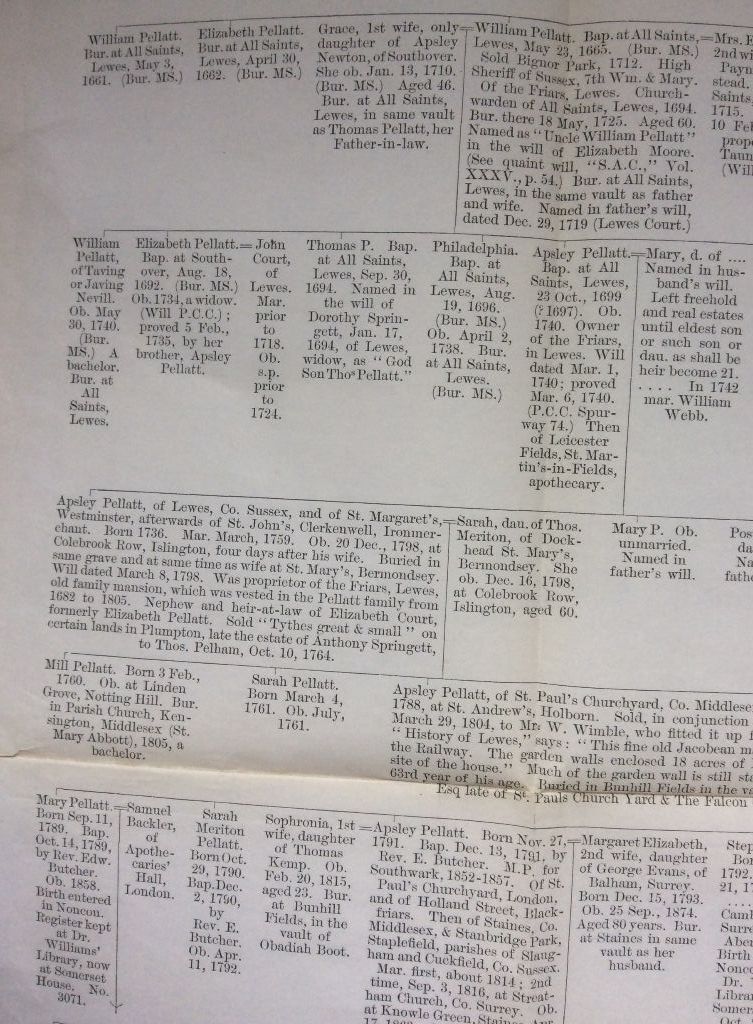
The first post in this new series of random ancestral trails stretches far into the past.  It arises from the entry in my precious Pedigree of Pellatt showing that William Pellatt (1665-1725), the son of Thomas Pellatt (1628-1680) and Hannah Alcock ( – 1693) was first married to:

Grace, only daughter of Apsley Newton [my emphasis], of Southover.  She ob. Jan 13, 1710. Aged 46. Bur. at All Saints Lewes, in same vault as Thomas Pellatt, her father-in-law.’

This line then descends through the first Apsley Pellatt (c.1699-1740) and his wife Mary Sheibell (or Scheibel), and their son Apsley Pellatt (1736-1798) and his wife Sarah Meriton ( – 1798) to the above-mentioned Mary Pellatt, the oldest of their 15 children.

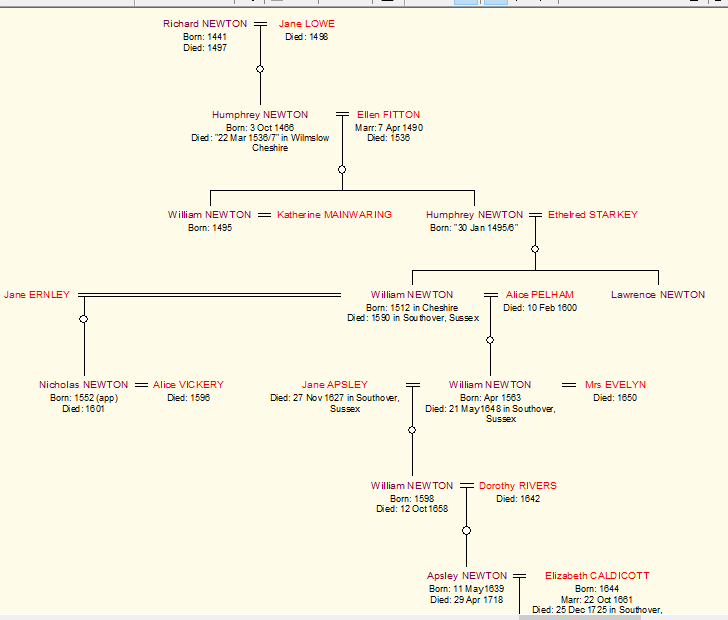
The descent back through time from Mary to Grace can be seen in the above diagram from my Family Historian database.

We can then trace further back in the Newton line, to my 14x Gt. Grandfather, Humphrey Newton (1466-1536).  This diagram introduces us to the name of ‘Apsley’, first seen with Apsley Newton (1639-1718), and further back as the surname of Jane Apsley ( – 1627), who was married to William Newton (1563-1648), they being my 11x Gt. Grandparents. The name Apsley distinguishes successive generations of Apsley Pellatts.  (When this name is correctly transcribed, it makes searching this line relatively easy.)

The line of descent also introduces a new region of England – Cheshire and surrounding areas. My Backler blog to date has focussed on East Anglia and the London area, and migrations away from there.  Other of my ancestors originated in South Wales.  I had no idea that lurking in the distant past were ancestors whose lives and times took place just a few miles away from my current home in Manchester, England.  And, once I started searching for this line, I came across a BOOK all about my said ancestor Humphrey Newton.  (Humphrey Newton (1466-1536) An Early Tudor Gentleman by Deborah Young.  2008. The Boydell Press, Woodbridge)

In my next blog I will attempt to summarise some of the findings in this book, and then will start to trace the various lines of descent to Mary Pellatt.  This should help to while away the wintery Covid days and nights.

38. Backler/Boulding/Cross: the denoument of my g.g. grandmother Susannah (1817 – 1883)

In which we trace the last years of my g.g. grandmother, Susannah [nee Backler] Boulding/Cross, rounding off the fates of her and the three children born to her second marriage, before following her two surviving Boulding children across the Atlantic.

In previous posts, we have seen that my g.g. grandfather James Boulding appears to have deserted his young family in or after 1848, after the birth of his and Susannah’s third child Apsley Samuel Boulding, and following the death on the same day of their second child, Lucilla Charlotte Boulding.  The first intimation of this supposed desertion comes with the 1851 census, showing Susannah and her two surviving children living with her parents in Islington.  She is ‘married’, but in this census year there is no James Boulding to be found in the British Isles.  It seems possible he had gone to Australia.

1851 England Census.  2 Old Paradise Row.  St Mary, Islington
Samuel Backler, Head, married, 66. Clerk [sic], Born Middlesex Stoke Newington
Mary Backler [nee Pellatt], Wife, married, 60. Born Middlesex Holborn
Esther Maria Backler, daughter, unmarried, 21.  Born Middlesex Bayswater
Susanna Boulding, daughter, married, 34. Born Middlesex Oxford Street.
Susanna Mary Boulding, grand daughter, 5. Scholar at home. Born Middlesex Islington
Apsley Samuel Boulding, grand son, 3. Born London Fleet Street.

We have seen in previous posts that Samuel Backler would live on for another 20 years, apparently tended by his youngest child, Esther Maria.  The status of Susanna, however, would change with her marriage on 28 October 1855, seven years after the disappearance of her husband James.  I am not exactly sure of the legal basis, but there

seems to have been an accepted rule that if someone had disappeared for seven consecutive years, with no news that they were alive, they could be presumed dead.  Hence Susanna’s status at the time of her second marriage as ‘widow’.

The marriage to Edwin John Cross, bachelor (and some 17 years Susannah’s junior), described as ‘Clerk’, took place just four months before the birth of their first child, Edwin John Frederick Cross, born on 24 February 1856, and christened at Christ Church St Marylebone on 30 March 1856, at which time his parents’ address was given as 13 Park Street.  Much more about him in a blogpost to follow.

Two years later another birth followed: Lucilla Beatrice Cross (another try for a little girl named ‘Lucilla’ – I have not found a precedent for Susanna’s use of this name).  Born on 1 June 1858, little Lucilla Beatrice was buried in Camden on 28 March 1861.  Thus the 1861 Census, taken shortly after this sad event, records just Edwin senior, Susannah and son Edwin jr.

1861 England Census. 
St Pancras, Camden Town.  3 Pratt Street (see photo right)
Edwin Cross, Head, Married, 27, China Dealer. Born Middx Marylebone
Susanna Cross, Wife, Married, 44. Born Middx Marylebone [sic]
Edwin Cross, Son, 5. Born Middx Marylebone
Susan Day, Lodger, Widow. Annuitant. Born Essex Harlow.

On 31 August 1862, Maberly Pellatt Cross was born to Edwin (china dealer) and Susannah Cross.  He was christened in September of that year at All Saints Church Camden Town, with the surnames of his mother’s maternal grandparents.  Alas, little Maberly was buried in Camden on 10 April 1863.  Older brother Edwin J F Cross was now about 6 years old, and had witnessed the deaths of two younger siblings.  Could this have affected him later in life?

Two Boulding children – soon to cross the Atlantic
Meanwhile, in 1861, young Edwin’s two half siblings appear to have been farmed out from the new Cross family.  Could this have been due to the influence of their new step-father?  We will take them across the Atlantic in a future blogpost, but suffice to say at the moment that in 1861 we find them as follows:

At number 5 Harley Street (now and then renowned as the location for private health care), in the home of Consulting Surgeon Mitchell Henry, 34, and his wife and 4 children, plus Governess, Butler, Footman, Cook, two Housemaids, Kitchen Maid, and two nursemaids, one of whom was my Great Grandmother Susan [sic] Boulding, unmarried, 16, born Middx Islington.

In the same Census, at 193 Tooley Street, in the home of Charles Bell, a Pawnbroker, we find her brother, 13 year old Apsley Boulding, Warehouse Boy, born Middlesex Strand.  He probably would not have been here long, as shortly after this Census was taken most of Tooley Street was destroyed in the great fire of 1861 (just search Tooley Street fire 1861 for details of this cataclysmic event).

How much these youngsters saw of their mother, step-father and half-siblings, is not known, though we will see that there was at least some correspondence with them after they left for America.

Back to the Cross family.
In 1871, we find Edwin, Susannah and 15 year old Edwin J F Cross at 130 High Street, Camden Town.
In 1881 Edwin and Susannah are at 58a Chalk Farm Road, a bit north of Camden Town (see left).

In this Census, sadly, we find the first intimation that things might not go too well for their only surviving child, Edwin John Frederick Cross.  As I will describe in more detail in a later post, we find in 1881 the following:

E J F C, age 24, Shorthand Writer, Patient, Lunatic, in the Middlesex County Lunatic Asylum, in Banstead Surrey, just up the hill from where I lived for many years.

On 9 February 1883, my G.G. Grandmother Susannah [nee Backler] [Boulding] Cross  died aged 66. She had congestion of the lungs, 7 days.  Her death was registered by her husband, E J Cross, of 156 High Street, Camden Town.

By the June quarter of 1884, Edwin had married widow Frances Anne [nee Lusty] Hilliard, mother of two children, and by the autumn of that year, Edwin had written his Will, leaving everything to his new wife and Executrix.  No mention at all of his son Edwin J F Cross.  Edwin Sr died in 1889, then living in Ramsgate Kent, and his Will was proved by his wife in January 1890.  At some point she emigrated to America, where she was to be found in Herrick Street, Boston in the 1900 US Census, living with her two sons Herbert H Hilliard and Walter J H Hilliard.   Frances died on 3 March 1902 and was buried in Evergreen Cemetery, Brighton MA.  Her son Herbert H Hilliard perished on The Titanic, while her son Walter J H Hilliard died in 1926 and is also interred in Evergreen Cemetery.

Meanwhile, their step-son and step-sibling Edwin J F Cross was living out what was a rather sad and lonely life in England – the subject of my next post.


33. Burton/Backler: the family of Jane Ozella Backler (c.1795-1830) and Daniel Burton (1790-1876)

In which we take a final look at the offspring of Sotherton Backler and Hannah Osborne, reviewing the family and descendants of their seventh child and youngest daughter, Jane Ozella Backler.  We find folk who stayed ‘local’ to their English roots; a famous acting family; and scandal, divorce and flight to Canada. There are quite a few unfinished stories in this post, with several folks’ destinies proving untraceable 

Jane Ozella Backler was christened on 17 February 1795 at St Ann Blackfriars, near to Apothecaries’ Hall, where her father Sotherton Backler was soon to become Clerk to the Society of Apothecaries. Children in previous generations of this family had also been given the name of Ozella – I am not sure why. Two siblings had died before her birth: Thomas (1786-1786) and Elizabeth (1789-1791).  I have never found any further information about brother Benjamin, christened in 1793.  Her three surviving half siblings were about 15 years old when Jane Ozella was born, and she had four surviving older full siblings.  Her birth was to be followed by that of Thomas Osborne Backler (1796-1796), whose name perhaps indicates the name of Hannah Osborne’s father (not confirmed), and Sotherton Backler (1798-1875), whose life as a vicar in Northamptonshire we have reviewed in a previous post.  Jane Ozella’s mother Hannah Osborne would die when she was about 8 years old, leaving her most likely in the care of her older siblings while their father became Clerk to the Apothecaries.

Marriage to Daniel Burton:  Jane Ozella Backler married Daniel Burton at St Clement Danes Church on 9 October 1827.  He was a widower, of that parish, while she was of the parish of St Mary Islington, where in a previous post we have seen her sister Mary [nee Backler] Sudlow lived at about that time.  Possibly Jane Ozella was living with the Sudlows?  Witnesses were Mary Ann Burton and a Burton whose name I can’t read, and Sam’l Backler (Jane Ozella’s older brother and my 3x G Grandfather, reviewed in many previous posts).  Daniel Burton  was a Publisher, born in 1790 in Hounsditch, and previously married and widowed.

Jane Ozella’s early death:  Daniel’s marriage with Jane Ozella was to be sadly short-lived, as she would die in 1830, perhaps in childbirth.  Jane Ozella Burton was buried on 20 November 1830 at Bunhill Fields Burial Ground, where her parents had been interred before her.

On 7 December 1835, the twice-widowed Daniel Burton would marry again, to Juliana Maria Willats (1785-1869).  I can identify no children from this marriage. He died in 1876.


Descendants of Jane Ozella Backler and Daniel Burton (see chart above)(please note: there is one missing person from this chart, a sibling at bottom right to John Q Mayes.  This person may still be living – I have found no trace after the mid 1950s):
Jane Ozella Backler and Daniel Burton  had one child: Sarah Ann Burton, born 1 September 1828 and baptised at Fetter Lane Independent Chapel on 10 October 1828, the family being of the parish of St Andrews Holborn.  Sarah Ann Burton, or Sarah Ann Mayes as she would become, obligingly appears in every English census from 1851 to 1911. Frustratingly, I cannot locate her in the 1841 census, when her father appears with his new wife, but not with his daughter who would have appeared as aged 12 in that census.

Sarah Ann Burton marriage to John Mayes, 1853:  By 1851, Sarah Ann Burton  is to be found in Olney, Buckinghamshire as a teacher in a Ladies’ Seminary, said to have been born in Holloway, London.  It is here that two years later we find a record of a marriage registration with John Mayes (JUN quarter Newport Pagnell, 3a 564).  This short-lived marriage was to produce two children, before John Mayes died in 1857 – at least I deduce that fact from the two deaths of ‘John Mayes’ registered in that year, one in Newport Pagnell Union in Sep quarter (03A 319, age 42) and one in Bedford in Dec quarter of 1857 (03B 21, age 61).  Could these be father and son?  Hard to tell, since we don’t know how old John Mayes was when he married Sarah Ann, although I think it may be safe to assume that he was the 36 year old John Mayes, Tailor, living on High Street, Olney, Bucks, in the 1851 census, born in Olney, and therefore about 42 by the year of the deaths noted above in 1857.

1861 and 1871: The widowed Sarah Ann Mayes was living in Bedford by the time of the 1861 Census, where she appears as a schoolmistress. widow, with her two young children.  In 1871 she is living at 13 Western Street in Bedford, as the Proprietor of a Ladies’ School.  As well as a number of pupils in residence, we find her 80 year old father Daniel Burton, a retired publisher.  In 1871, daughter Mary Ann Mayes is found as a pupil in Hanwell, Middx, but I cannot find John Burton Mayes in this census.

1881 – 1916: Still on Western Street in 1881, Sarah Ann has been joined by her daughter Mary Ann, also a teacher,  where they are to be found in 1891, along with Sarah Ann’s 10-year old grand daughter Alice Ella Burton Mayes,  a pupil about whom scandal will unfold further down this page!  By 1901, 72 year old Sarah is living on her own in smaller premises on Bower Street, now a Teacher of Needlework.  Mary Ann is to be found as a servant in Hampstead.  In 1911, Sarah Ann was living on her own in Almshouses at 31 Dame Alice Street in Bedford, where she presumably lived until her death in 1916.  She was not entirely on her own – her widowed daughter-in-law Rachel Richardson had also moved to Bedford by this time.

Descendants of Sarah Ann Burton and John Mayes:

[yes, 2 before 1, since there is little to report] Mary Ann Mayes (1856 – ?), whose birth was registered in 1856 in Newport Pagnell.  I have summarised her history alongside that of her mother, above, and after the 1901 Census, I cannot find anything more, having searched for marriage, death, migration, etc.  And so we can move swiftly on to the scion of the rest of the Burton/Backler/Mayes descendants:

1  John Burton Mayes (1854 – 1909):  (birth registration: 1854 JUN qtr Newport P. 3a 453) married Rachel Richardson (?1858 – ?) in 1879 in Lambeth.  In the 1881 Census in Stockwell, with their daughter Alice E B Mayes, he was a commercial traveller.  In 1891 in Wandsworth he was a stationer, as he was in 1901 in Kingston.  However, he was to die in 1909, leaving about £500, and his wife would move to Bedford, near her mother-in-law.  I cannot trace her after the 1911 Census.  The couple had two children:

1.1 Alice Ella Burton Mayes (1880 – ?) was born in 1880, and apparently lived with her parents until her marriage in 1903 to John Sibley Richardson (1872 – ?) (who was not, as far as I can see, related to her mother Rachel Richardson).   John Sibley Richardson variously cites his birth country as Staffordshire and Warwickshire, probably because his birthplace, Harborne, is a village, a parish, and a sub-district in the district of Kings-Norton and county of Stafford. The village stands near the boundaries with Worcestershire, Warwickshire, and Birmingham borough, 3 miles SW of Birmingham.  Such places often find themselves designated in different counties, depending on border configurations.

Scandal and divorce: And here our story takes on a hint of scandal.  In the 1911 Census, we find  at 43 Braemar Avenue, Wood Green, North London, the couple Alice and John (he is an Automatic Slot Machine Dealer), and their 5 year old son Denis Richardson (1905 – ?).   I had thought I had lost touch with them after that until, in preparing this post, I came across his divorce petition against her, which can be seen on Ancestry.  In brief, Alice apparently left John S Richardson in autumn 1911 to take up residence in Notting Hill Gate and elsewhere with Charles Grange Lowther (1879 – ?), an artist born in Hull in 1879, who had won scholarships for his art studies.  In 1912, John S Richardson petitioned for divorce from Alice, which was finalised in 2013, with him apparently taking custody of the young Denis.  Meanwhile, Charles G Lowther’s wife also petitioned for divorce in 1912, citing the relationship between Alice and Charles.  

I had thought there that the trail ran cold, BUT, there is recorded on 13 October 1912, the arrival into Montreal, Quebec, of Chas G Lowther, artist, 33, and his ‘wife’ Alice E Lowther…from that point on, I can find no trace.

Nor can I find a certain ending for John S Richardson.

1.1.1 Denis Richardson (1905 – )
Oh my. 
I have just rescued myself from a near-amateur error.  I had recorded ‘our’ Denis Richardson as the one who died by torpedo in the Atlantic in 1942, but NO!  More detailed checking of registered births and mothers’ surnames on the GRO website reveals that the torpedoed Denis’ birth was registered in 1906 to a different mother’s surname. His birthdate is given on his 2nd Mates’ certificate, confirming that he is indeed not ‘ours’.  ‘Our’ Denis’ birth was registered in 1905, and he disappears like his father after the 1911 Census and the subsequent divorce.  End of story for the moment!

1.2 Frank Burton Mayes (aka Frank MILRAY) (1888 – 1936) Born 24 April 1888 in Camberwell.  Frank married first Elsie Georgina Thomas (?1889 – ?) on 8 August 1909 in Shrewsbury, Shropshire.  Elsie’s mother Ethel had been widowed by the time of the 1891 Census, when Elsie was 2 years old.  In 1911, Elsie and Frank lived at the desirable address of 15 Chaucer Mansions, Queen’s Club Gardens, West Kensington.  Both were aged 22, she born in Worcestershire, Longden, and Frank in London, Denmark Hill.  He designated himself as an actor.

And there Elsie’s trail runs cold!

1.2.1  Our next sighting of Frank Burton Mayes is the registration of his presumed son, John Quinton MAYES (1921 – 2012).  Not one birth registration, but five!  Herewith what I have found, courtesy of the FreeBMD website: freebmd.org.uk:

DEC qtr 1921: An entry with annotation at the bottom of the registration page, linked to an asterisk in the right alphabetical place under Mayes: Mayes, John Q. Mother’s surname McPherson.  Wandsworth 5D.  See M/60

FreeBMD explains this unusual entry as follows (but all is not straightforward as the subsequent entries will reveal): ‘Normally GRO Index page numbers are numeric, optionally followed by a letter. As this page number (‘see M/60’) does not follow this format it is possible that it is a Late Entry. Late Entries mean that the registration of the event was delayed, e.g. parents did not attend the Register Office to record a birth but the birth was registered much later when the child was about to begin work, or an Inquest after a death prevented the immediate issuing of a death certificate. A Late Entry attempts to show a searcher where to look for the actual GRO reference. Unfortunately the format of such Late Entries is not standardised, but the usual pattern is a letter showing the Quarter of the Registration [March (M), June (J), September (S) or December (D)] followed by the last two digits of the year, thus giving the quarter and year when the Registration was entered into the GRO records. A reference that reads ‘see J/75′ would therefore indicate that the GRO registration and reference is probably to be found in the June Quarter of either 1875 or 1975 (depending on context).’

MAR qtr 1922: McPherson John Q.  Mother’s surname McPherson. Wandsworth 1d 1097.  Annotated at the bottom of the page: See S/24 [ie, September quarter 1924]

Mar qtr 1922: Mayes John Q.  Mother’s surname McPherson.  Wandsworth 1d 1097.  Annotated at bottom of page: Mayes, John Q. Mother surname McPherson. Wandsworth 1D. See Sept ’24.

Sep qtr 1924: McPherson John Q. AND Mayes John Q.  Both names appear in the printed lists, both have  mother surname as McPherson and are now referred to as Wandsworth 1d 1009.

Mar qtr 1960: Mayes John Q. Mother surname McPherson. Wandsworth 5D 1116.

Phew! Since I can’t find out what happened to Elsie Georgina Thomas Mayes, I can only surmise that she and Frank Burton Mayes aka Milray separated, or that she died.  Frank Burton Mayes married (2) to the actress Esther Dorothea Constance Stuart McPherson  in the June quarter of 1924, in Kings Norton, some three years after the first registered but much amended registered appearance of John Quinton Mayes.  Without ordering all the various certificates, it is difficult to unpiece the story, but it seems little John was first registered in his mother’s surname, and then had it amended to that of his father – at least we assume that John Burton Mayes aka Milray was little John Quinton Mayes’ father!
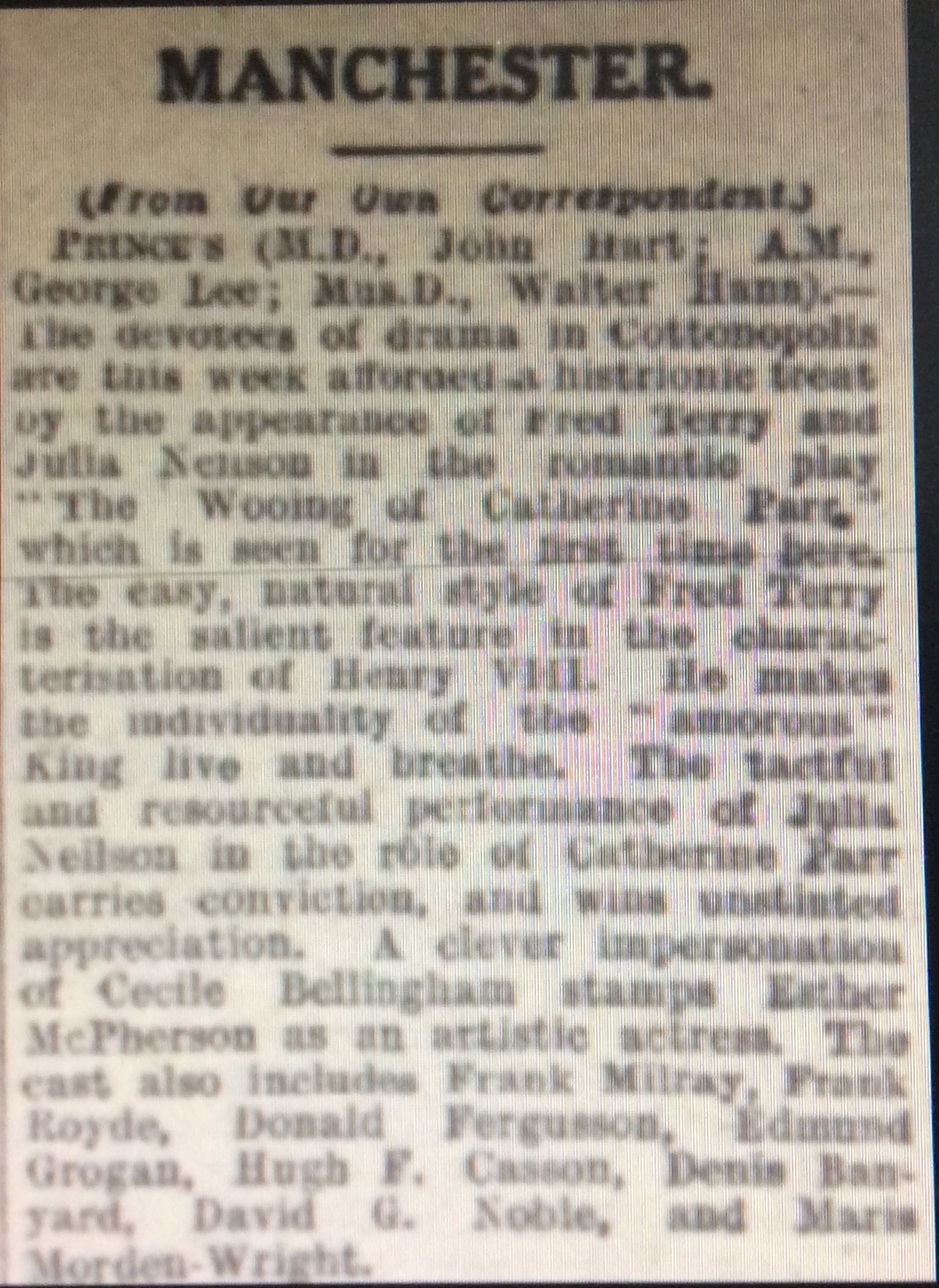
In terms of biographical detail, I can’t do better than show just one cutting from The Stage (22 September 1927), of which there are many similar ones; and then show the following pieces about the artist and actor Frank Burton Mayes aka Milray.  The first one is copied from the e-bay website offering for sale an attractive wood block engraving:

Frank Milray; 1888-1936, (born Mayes) actor and printmaker, as an actor he toured with the the Alexander Marsh Company 1922-24 and Julia Nielson Fred Terry Company all over the country, painting and sketching as he toured. He married Esther McPherson (1897-1965) they had a son; John Mayes (1921-2012), John acted with the well-known Shakespearean actor-manager Donald Wolfit. In 1928 Frank retired to ‘The Willows’ Pavenham, Bedfordshire.
http://www.ebay.co.uk/itm/Limited-edition-wood-block-engraving-pencil-signed-Frank-Milray-Mayes-1920s-/292380702781

And another piece:

About this Item: The Willows Presse, Pavenham, Bedfordshire, 1924. No Binding. Condition: Fine. Limited Edition. Six original linocuts of Pavenham, handprinted by the Bedfordshire actor and artist Frank Mayes, working under the pseudonym Milray, at his home, Willow Cottage, using the imprint, ‘The Willows Presse’. Each shows a street view of the village, and are hand-printed on beige paper. The prints are numbered 1 – 6, First Series, and all but one are signed in pencil, and dated 1929. Print sizes vary, but are approx. 15 x 10cm, 13 x 16cm, 13.5 x 11.5cm, 14.5 x 12cm, 12.5 x 17.5, 14 x 13cm. Each print has been recently remounted on cream card, with the original backing card retained (each bears a printed slip with an impression of the artist’s house, and the wording “Handprynted by Milray at the Willows Presse, Pavenham, Bedfordshire” Underneath is a small panel with the wording “Pavenham Village 1st Series” and the handwritten number (1 to 6). Frank Mayes used the name Milray as an actor from the early 1920s and when signing his work as an artist. When he was not engaged as an actor on tour throughout the UK he lived in Pavenham, from 1923-1931, after which he and his family moved to the neighbouring village of Stevington until his death in 1936. The original portfolio which contained these prints is present, although in very poor condition. It bears the same imprint as the prints, but at the bottom is hand-written, “6 Mounted Proofs”, suggesting that these were the very first printing of each linocut. The prints themselves are in fine condition, and are most attractively done. Signed by Illustrator. Seller Inventory # 005912.
https://www.abebooks.com/book-search/title/pavenham/

As to John Quinton Mayes, I know little other than what is summarised above in the portraits of his father.  For posterity, he deposited family papers about himself, his father and mother, and other McPherson actors.  Wouldn’t it be a treat to see these documents about two Backler descendants! They are described as follows on the website of the Harry Ransom Centre at the University of Texas, Austin: http://norman.hrc.utexas.edu/fasearch/findingAid.cfm?eadid=00340

The John Mayes Family Papers, circa 1879-1970s, document the lives and lengthy careers of three generations of British actors, writers, and artists. Among the primary family members were brothers Herbert Pearson (1866-1955, born McPherson) and Quinton McPherson (1871-1940); Quinton’s daughter Esther McPherson (1897-1965) and her husband Frank Milray (1888-1936, born Mayes); and the son of Esther and Frank, John Mayes (1921-2012). John Mayes, who acted with the well-known Shakespearean actor-manager Donald Wolfit, brought together his family’s papers with his own, including his research and notes about the family.

1.2.1  As noted with reference to the family tree above, there is another Mayes/McPherson child, but the person is perhaps still living – I cannot trace any sign after the mid 1950s.  I do know who it is…

And there we leave the last batch of descendants of the children of Sotherton Backler and his wives Fran Harris and Hannah Osborne – except, of course, for my direct line descended from Samuel Backler (1784 – 1870) and his daughter Susannah Mary Backler (1817 – 1883), to which we will turn in the next post.

31. Highgate Cemetery – last resting place for some Backler ancestors

In which we view the rather wooded (understatement!) last resting place of some Backler/Abelin ancestors, and reflect on how moving it is to be there, despite the absence of any visible marker.

I see from my photographs that it was way back in 2010 that I ventured to north London to visit Highgate Cemetery.  New online records had shown this to be the last resting place for Samuel Backler and his wife Mary [nee Pellatt].  What was once a major privately-owned cemetery, run by the London Cemetery Company, is now under the care of the charitable Friends of Highgate Cemetery, a similar arrangement to those of the other great municipal cemeteries such as Nunhead in south London, where other Backlers are interred.  Nowadays the focus of the Friends is not only on burials, which continue to take place in quite small numbers, but also on conservation of both its memorials and of nature in line with its overall purpose to ‘promote the public benefit’.

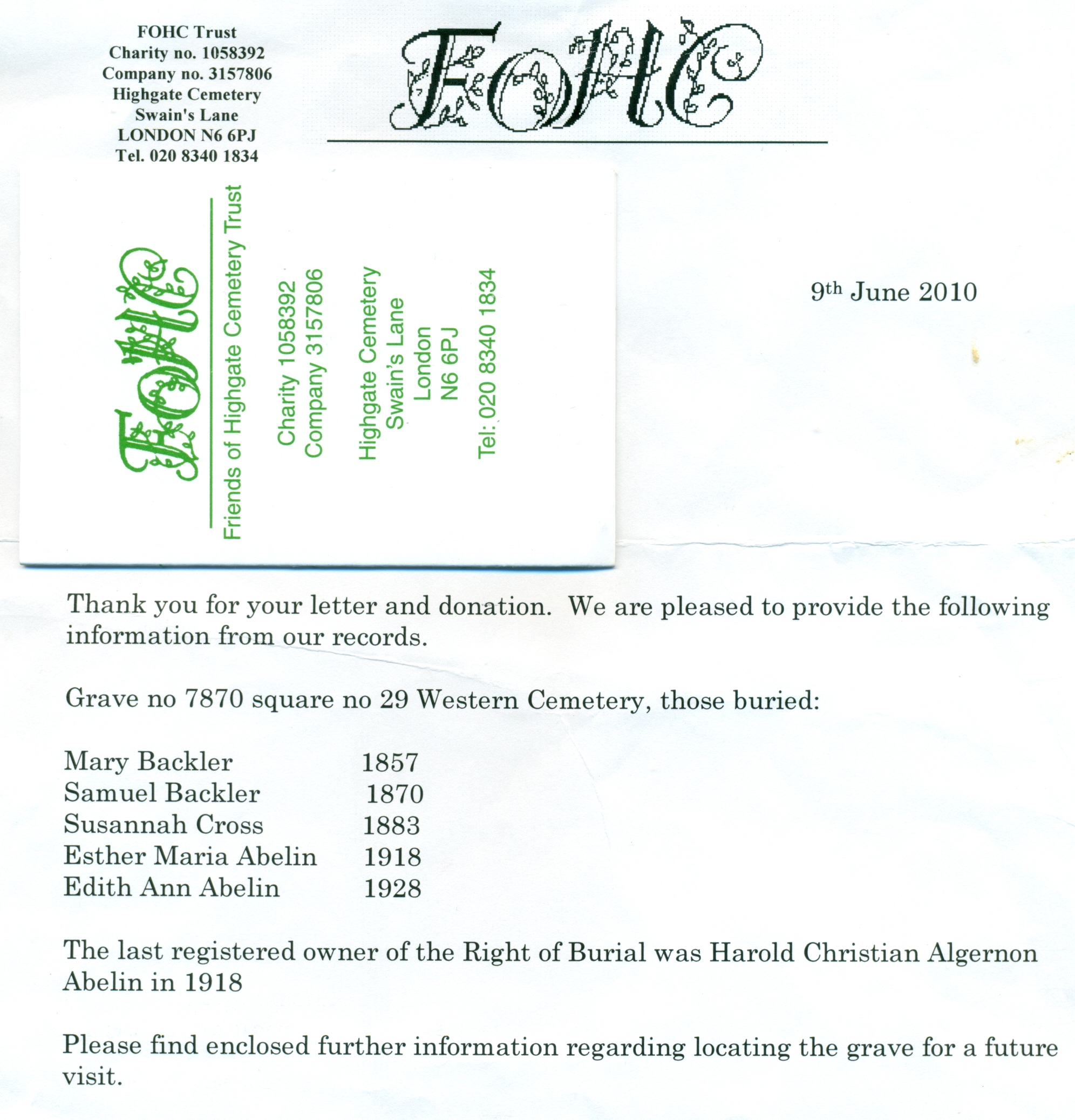
On writing to the Friends, I received a letter revealing that more folk than Samuel (1870) and Mary (1857) shared the gravesite: their daughter Susannah (1883) (whose marriages to James Boulding and Edwin Cross will feature in future posts); Esther Maria (1918) (wife of Magnus Christian Abelin); and their daughter-in-law Edith Ann (nee Foster) Abelin (1928).

I had high hopes as I arrived at the Cemetery for my appointment to be escorted to the gravesite.  Immediately, however, I was warned by my guide that there was nothing to see.  Up the hill we marched, past the famous sites of the Egyptian Avenue and the Terrace Catacombs, curving around to the right along a roughly paved path.  My guide had searched out the area previously, so knew when to turn right off the path, into a treacherous wooded and overgrown section, with monuments in different states of repair, and unstable ground.

We reached a spot where he had laid out sticks to mark the spot – and that was it!  I was very moved, albeit a bit disappointed. Despite the presence of monuments nearby, my guide had explored the area, probing with his stick, and had not found a memorial at our site.  There was surely once one there, but no longer.

This was an area in the early West Cemetery on high ground, which at the time of the earliest Backler burials would have had a view over London.  It was a fashionable and beautiful site, allowed to become run down during the 20th century.

A very special place: Highgate Cemetery is a Grade 1 listed site, and is a very special place not only for those whose ancestors and more recent relatives are interred there, but also for anyone interested in its historical importance for London.  I feel privileged to have ancestors for whom it was their last resting place, and have become a life member of the Friends in order to support their ongoing work.  I am sorry I now live so far away!

More about the Cemetery, its history and present day events can be found at: https://highgatecemetery.org/

29. Henry Apsley Pellatt (1835-1905) A Registration of Convenience – using the new GRO ‘mother’s maiden name’ facility in tracing some birth registrations

CNV00036In which we explore another unusual marital relationship (or not) and the parentage of several children, this time of Henry Apsley Pellatt, son of Henry Pellatt and his wife Mary Backler. It all centres around one of the houses above, in Roupell Street, near Waterloo Station in London.

A distraction:  I was meant to be exploring the life and times of my 3x great grandfather, Samuel Backler (1784-1870).  Once before I was diverted from the chronological account of my Backler ancestors by the story of Thomas Meriton Pellatt – or Sargeant, at https://backlers.com/2014/11/06/thomas-meriton-pellatt-or-sargeant-who-is-the-father/   Thomas was the son of Samuel Backler’s oldest daughter, Mary Backler, and her husband Henry Pellatt – or was he?  I described my suspicions in the blog post.

Now, in thinking about Samuel’s bankruptcy in 1831, the topic of a recent post, I have come across some interesting stuff about another of Mary and Henry’s sons – Henry Apsley Pellatt (c. 1835-1905).  I cannot resist writing this all up while it is fresh in my mind.  It illustrates how powerful is the new General Register Office facility to search for births after 1837 by mother’s maiden name.

My curiosity was piqued by my inability to find any record of the birth of Henry Apsley Pellatt’s four children, who appeared as follows in the 1861 Census:

In the Borough of Marylebone, Parish of Old Pancras, 1 Tavistock Square:

  • Henry A Pellatt, Head, married, 26. Proprietor of Boarding Establishment.  Born Middx London
  • Mary Pellatt, Wife, Married, 32. Born Middx. London
  • Mary Ann Pellatt, Daur, Unmarried. 6.  Born Surrey N.K. [registration district not known]
  • Jessy Pellatt, daur, unmarried, 3. Born Surrey N.K.
  • Henry A Pellatt, son, unmarried, 1. Born Surrey N.K.
  • Willm M Pellatt, son, 5 days. Born Middx St Pancras

Additionally were a Nurse, a Waiter, and three other servants, as well as two other families.

In retrospect, I could have wondered why the birthplace of the three older children was ‘not known’, in the County of Surrey.  Why didn’t the parents have this information to hand?

The 1871 Census showed the family far from London, in Hanley, Stoke upon Trent, Staffordshire, at 10 Windmill Terrace:

  • Henry A Pellatt, Head, married, 37. Commercial Traveller. Born [inexplicably] in Richmond, Yorkshire.
  • Mary Pellatt, Wife, married, 43.  Born Middlesex, London.
  • Henry A Pellatt, Son, 11. Born Surrey, Kennington.
  • Mary A Pellatt, Daur, 16. Born Surrey, Camberwell.
  • Jessy Pellatt, Daur, 13. Born Surrey, Camberwell.
  • William H Phillips, Boarder, unmarried, 30, Banker’s Clerk. Born Staffs Leigh.
  • Ann Kelly, Servant, unmarried, 19. Born Staffs, Stone.

By 1881 the family were, at best, difficult to trace.

  • Young Henry Apsley Pellatt and Jessy Pellatt had died.
  • Father Henry Apsley Pellatt is next sighted in Australia, on the occasion of his marriage in 1885.
  • Mother Mary (nee Tull, see below) Pellatt is, I think, found as a Lodger, Music Teacher, married, age 52, born Middx St Georges in the East, in the home of Albert and Elizabeth Paul and their family, at 74 Daneville Road, Camberwell.
  • Young Mary Ann (born 1854) is not to be seen until her marriage on 21 July 1885 to 48 year old Widower, Frederick Martin Howard, Publican, of Camberwell New Road.  Mary Ann is shown as ‘27’ [this is a bit out…], spinster, father Henry Apsley Pellatt, Farmer [presumably, by this time, a farmer in Australia].  Witnesses were Mary Ann’s uncle William Cowper Pellatt and his wife Eliza Ann.  I cannot find anything more about this couple, anywhere!

No birth registrations surname Pellatt:  I could find no birth registrations for the children of Henry Apsley Pellatt and his wife Mary.  I tried FreeBMD, Ancestry, findmypast and the GRO newly-released digitised indexes, all to no avail.  But these children had to be somewhere.

I decided to search just on ‘Henry Apsley’ – no surname.  This search turned up a Henry Apsley Pellatt Middleton, birth registered in Sep quarter 1859, Newington 1d  203. A search for this person on the GRO birth search showed the mother’s maiden name as TULL.  The actual certificate shows that he was born on 8 July 1859, at 15 Allen’s Terrace, Lorrimore Road, Walworth.  The father was shown as John Middleton, the Mother as Mary Middleton, formerly TULL.  She registered the birth, as of the above address, on 19 August 1859.

Searches on the names ‘Mary Ann’, ‘Jessy’, and ‘William M’ revealed that all appeared under the surname ‘Middeton’, mother’s surname TULL.

‘Middleton/Tull’ births: I decided to go back to the beginning of the Middleton/Tull partnership and find all the births registered to those two names – starting with the marriage of Mary Tull to John Henry Middleton, and looking at Census records along the way.

Marriage:  On 25 June 1839 at the Parish Church of St Giles Camberwell in the County of Surrey, John Henry Middleton,  of full age, Bachelor, married Mary Tull, spinster, possibly also of full age (although this is written only once under the ‘age’ column).  He was of Orchard Row, a Slater, and his father Jno Middleton was also a Slater.  She was of Portland Row, her father Jno Tull also a Slater.  The couple both signed the register, as did their witnesses, John Middleton and Elizabeth Middleton [his parents?].

1841 Census:  The 1841 Census finds this couple in Mile End:

John (20) Slater and Mary (15).  Were they really of full age when they married two years previously?

Now for a search on Births registered, using the new GRO indexes:

  • John Charles Middleton (mother’s maiden surname: TULL) Mar 1843 Stepney 02 496
  • Henry William Middleton (TULL) Dec 1849 Lambeth 04 319
    • Death: Henry William Middleton Dec 1849 Lambeth 04 243
  • Harriet Hannah Middleton (TULL) Sep 1851 Lambeth 04 329
  • Mary Ann Middleton (TULL) Sep 1854 Camberwell 1D 438
  •  Eliza Middleton (TULL) Mar 1856 Lambeth 1D 244
    • I believe Eliza’s death may have been registered as Eliza Pellatt, ‘11’ (I am told the GRO register list sometimes lists the figure which should be months, as years…) in 1857 MAR qtr, Newington, 1D 153.  The Newington location would match with the registration of Jessy’ s birth, below.
  • Jessy Middleton (TULL) Sep 1857 Newington 1d 194
    • Death: Jessy Pellatt: SEP 1872. Lambeth 1D 291
  • Henry Apsley Pellatt Middleton (TULL) Sep 1859 Newington 1d 203
    • Death: Henry Apsley Pellatt MAR 1876 Hackney 1b 331
  • William Mill Pellatt Middleton (TULL) Jun 1861 Pancras 01B 43
    • Death: William Mill Pellatt:  Jun 1861 Pancras 01B 29
  • Florence Pellatt Middleton (TULL) Dec 1862 Kensington 01A 9
    • Death: Florence Pellatt Dec 1862 Kensington 1a 13

And finally – giving the game away, with the Pellatt surname …

  •  Frederick William Pellatt (TULL) Mar 1864 Brighton 02B 186
    • Death:  MAR 1867 Marylebone 1A 388

Eureka – the 1851 Census reveals all:  It was only latterly that I thought to check out the Middletons in the 1851 Census.  Lo and behold, there they were in the household of my many times great aunt Mary Backler and her husband Henry Pellatt, the very same couple whose relationship had troubled me when I was looking into the parentage of their [supposed, presumed, or actual] son Thomas Meriton Pellatt, later Sargeant.

The picture at the start of this post is of the houses on Roupell Street, which are in a conservation area and remain largely unchanged today.  They were built between about 1825 and 1835, and were intended as artisans’ conttages – an interesting choice for the fairly large family of lawyer Henry Pellatt AND the Middletons!

Residing at 66 Roupell Street, very near the later-built Waterloo Station, were:

  • Henry Pellatt, Head, married, 55. Solicitor.  Born Surrey Peckham
  • Mary Pellatt, Wife, married, 38. Born Middlesex Islington.
  • Henry [Apsley] Pellatt, Son, 16, unmarried, Clerk.  Born Middlesex Islington.
  • Victoria Pellatt, Daughter, unmarried, 14. Born Middlesex Holborn.
  • William Pellatt, Son, 8, unmarried, Born Middx Shepherd’s Bush.

At the same address, separate household:

  • John Middleton, Head, married, 32. Slater. Journeyman. Born Hartford [sic] Hertfordshire
  • Mary [nee TULL] Middleton, Wife, Married, 28. Born Middx. St George.
  • John Middleton, Son, 8, Scholar, Born Middx St George.

Well, well.  It looks as if Mary (Tull) Middleton was due to set up a liaison with Henry Apsley Pellatt, 12 years her junior, the first child of this union to be Mary Ann Middleton [mother surname Tull], born in 1854 and to appear from 1861 as Mary Ann Pellatt in the household of Henry Apsley Pellatt and his supposed wife Mary.

I cannot find anything other than the birth record for ‘Eliza Middleton’, born 1856, but I feel fairly sure her death was recorded as Eliza Pellatt in 1857 MAR quarter, as described above.

Further children clearly (well, presumably) attributable to Henry Apsley Pellatt though registered under the Middleton surname, are

  • Jessy (1857-1872);
  • Henry Apsley (1859-1876);
  • William Mill (1861-1861);
  • Florence (1862-1862); and, the only child registered as ‘Pellatt’:
  • Frederick William (1864-1867).

A marriage for Henry Apsley Pellatt and Mary Ann Tull?  This marriage cannot be found, but something changed to enable baptism of four of the children in 1867:

  • little Frederick William, on 18 February 1867, when he was three years old and just before his death;
  • Jessy and Henry Apsley on 16 November 1867, at St Marylebone.
  • Mary Ann on 30 November 1867 in St Marylebone

Henry Apsley Pellatt in Australia: The marriage of Henry Apsley Pellatt to Elizabeth Skinner was registered in Victoria, Australia, in 1885.  He died in September 1905, and is buried at St Kilda Cemetery, Victoria Australia.

What happened to Mary (nee Tull) Middleton Pellatt?  I believe, as stated above, that she appears in the 1881 census as a music teacher.  After that I can find no further census records anywhere, nor marriage, nor death.  Hmm….

What of the supposed half siblings, the children of John Henry Middleton and Mary Tull?

  • John Charles Middleton (Mother maiden surname TULL) Mar 1843 Stepney 02 496
    • He married Mary Ann Molland and died in 1936. He worked in the foreign office, after being recorded as a drummer boy in his youth (1861 Census), perhaps reflecting the fact that his mother was a music teacher.
  • Henry William Middleton (TULL) Dec 1849 Lambeth 04 319
    • Death: Henry William Middleton Dec 1849 Lambeth 04 243
  • Harriet Hannah Middleton (TULL) Sep 1851 Lambeth 04 329
    • Harriet Hannah appears to have had a relationship similar to that of her mother.  She took up at some point with George Hagley, Lighterman, with whom she had several children, whose births were registered under the surname of Middleton, with no Mother’s maiden name given, indicating that the births were illegitimate.
    • Like the children of Henry Apsley Pellatt and Mary Tull, some of these children were baptised long after they were born.  No marriage is in evidence for Harriet and George.  For the record, the children were (registered with no mother’s maiden name shown):
      • George Hagley Middleton Sep 1871 Lambeth 1d 292
        • Death: Sep 1871 Lambeth 1d 212
      • Kate Hagley Middleton. SEP 1872, Lambeth 1D 347.
      • [twin] Edith Hagley Middleton SEP 1874 Lambeth 1d 337
        • Death: SEP 1874 Lambeth 1D 200
      • [twin] George Hagley Middleton SEP 1874 Lambeth 1d 337
        • Death: JUN 1884 Woolwich 1d 694
      • Arthur Hagley Middleton JUN 1876 Lambeth 1D 358
        • Death: SEP 1876 Lambeth 1D 205

And then, something changed, perhaps the death of George Hagley’s first wife, to allow the final two births to be registered under the surname Hagley, with mother’s maiden name now shown as Middleton.

  • James John Hagley  DEC 1878  Lambeth 1d 349.  Mother’s surname Middleton
    • Bap. 24 April 1891, Birth shown as 28 August 1878.  Parents George (Lighterman) and Harriet, 48 York Road.
  • Harry Joseph Hagley DEC 1884 Lambeth 1d 361
    • Death: DEC 1884 Lambeth 1d 214

The 1881 Census shows at 48 York Road, Lambeth: George Hagley, 52, married, Lighterman living with Harriet, wife, 29 and three children, Kate, 9; George 7; and James, 3.

In 1891 the couple are at the same address, with children Kate and James, and George’s widowed sister Jane Sharpe, age 65.

George died early in 1901, so in the 1901 Census, Harriet Hagley was a 51 year old widow, a boarder at 4 Vidal Road, Tulse Hill, Reg district of Lambeth.  She died in 1909 at the Constance Road Workhouse in the parish of St Giles Camberwell.  She had many descendants, who can be seen on an Ancestry family tree.  I can pass on  the relevant information to anyone wanting more information.

Alas…no blood relations for me… As so often seems to happen with my family, some of my best record discoveries are of folk who are no blood relation to me!  These various Middleton/Hagley folk acquire some new Pellatt half-siblings and half aunts and uncles, some of whom will have some Backler and Pellatt ancestors.  But in fact, since all the Middleton/Pellatt children seem to have died in childhood or infancy, this may not make a lot of difference.


28. Samuel Backler (1784-1870): a quiet end

In which we follow as far as possible the final years of Samuel Backler.  We mention in passing two daughters Susannah Mary Backler (1817-1883) and Esther Maria Backler (1830-1918), of which more in future blogs. In a previous post we followed the fortunes of Samuel’s oldest daughter Mary Backler (1830-1882)  through her marriages to her cousin Henry Pellatt (of which more to come in the next blogpost), and Waldo Sargeant. 

Alas, the 1841 census for part of Middlesex is missing.  Presumably Samuel, Mary and their two unmarried daughters lived together, but their circumstances following the traumatic bankruptcy in 1831, when they lived in Kensington, are unknown.  Other than at the marriage of his daughter Susannah, the only confirmed sighting we have of Samuel before the 1851 Census is a design registration  of 1847, held at The National Archives as follows:

Reference: BT 45/6/1046
Description:

Useful Registered Design Number: 1046.

Proprietor: Samuel Backler.

Address: 4 Cambridge Terrace, Islington, London.

Subject: Spatula.

Category: Surgical and Medical Instruments etc.

Date: 1847 April 28
These are the designs submitted to the Patents, Designs and Trade Marks Office under the terms of the Non – ornamental (‘Useful’) Designs Act 1843.  The quote in italics below is from a presentation at the National Archives by Julie Halls, the Archives’ specialist for registered designs and the author of Inventions that didn’t change the world (Thames & Hudson, 2014).

‘These designs were registered for copyright under what was called the Utility Designs Act of 1843. This came about primarily as a result of the expense and difficulty inventors found in patenting their ideas during the first half of the nineteenth century. The system had become notoriously expensive and inefficient, and there were concerns that it was holding back innovation. An inventor would have to negotiate a labyrinthine system, taking his design to as many as 10 different offices, with a fee payable at each, and petitions, warrants and bills were prepared several times over, signed and countersigned, before a patent was approved. In his short story ‘A Poor Man’s Tale of A Patent’, Charles Dickens asked: ‘Is it reasonable to make a man feel as if in inventing an ingenious improvement meant to do good, he had done something wrong?’

‘A solution came about in the form of the 1843 Act, which was for ‘any new or original design for any article of manufacture having reference to some purpose of utility, so far as such design shall be for the shape or configuration of such article’. Under the Act, proprietors were given three years’ copyright protection at a cost of £10, as opposed to up to £400 for 14 years’ protection for a patent.

‘Although the Act was meant to apply to the appearance and not the function of useful objects, which was still supposed to be patented, in practice it was widely perceived as a cheaper and quicker form of protection than the convoluted patent system, and the law struggled to make a distinction between the two. Thousands of inventors chose to register their designs, resulting in the unique documents we hold at The National Archives.

‘To copyright a design the inventor had to take or send to the Designs Registry, originally based at Somerset House in London, ‘two exactly similar drawings or prints of the design made on a proper geometric scale’. He, or less often she, would also need to provide the title of the design – quite often deciding on a pseudo-scientific name for what could often be quite a mundane object. Explanatory text also had to be included, saying what the purpose of the design was and what was new about it.

( http://media.nationalarchives.gov.uk/index.php/inventions-didnt-change-world-history-victorian-curiosities-2/ )

I have a beautiful photo of the original design of this ‘heated spatula’, copyright by The National Archives, which I can forward for personal use, on request.  There is no sign that this design was ever put into production, but the design itself is a thing of beauty.  The photo, purchased from the National Archives online, is of the original document, which would have been handled by Samuel himself.  Awesome!

The address given on the design shows that the family lived in Islington, where Susannah Mary Backler had married James Boulding in 1844 at St Mary’s Parish Church.  On the marriage certificate, Samuel Backler was styled ‘Gentleman’, the first time we have seen him designated as such. Perhaps he felt the need to keep in step with James Boulding’s father Samuel Boulding, who all along, as we shall see in the future, was styled the same.

By the 1851 census, however, we find that Samuel is recorded as a ‘Clerk’.  (I wonder if this is an error by the census enumerator, as it seems likely that Samuel would have described himself as a Chemist.)  The family are living at 2 Old Paradise Row, Islington, and as we shall discover in a future blogpost, nothing would be seen now or in the future of James Boulding.  The family are listed as follows:

  • Samuel Backler, Head, married, 66. Clerk [sic]. Born Middlesex, Stoke Newington
  • Mary Backler, Wife, married, 60. Born Middlesex Holborn
  • Esther Maria Backler, daughter, unmarried, 21. Born Middlesex Bayswater
  • Susanna Boulding, daughter, 34, married.  Born Middlesex Oxford Street
  • Susanna Mary Boulding, grand daughter, 5, scholar at home. Born Middlesex, Islington
  • Apsley Samuel Boulding, grandson, 3. Born London, Fleet Street

Backler places of residence:  In these times, most folk rented, often on an annual basis, rather than owning their own properties.  While we know Samuel and Mary were in Kensington/Bayswater at the time of his bankruptcy in 1831, we do not know when they moved to Islington.  Once there, however, they seemed to stay quite local, although we have no way of knowing how many other addresses they had than those listed here:

1847: 4 Cambridge Terrace (registered design application)

1851: (census) 2 Old Paradise Row (facing Islington Green, on the north side)

1857: (wife Mary’s death certificate) Rheidol Terrace  (east of, and roughly parallel to Essex Road in Islington)

1861: (census) 14 Angell Terrace (in the block bounded by Rheidol Terrace, River Lane, Lower Road and Queens Head Lane in Islington).  Here, Samuel is found as a 77 year old Accountant [sic], a widower, with his daughter Esther M, 31, single, and one servant.

1870: (Samuel’s death certificate)  11 Maria Terrace  (since re-named Lambert Street, on the census enumerator’s route of Albion Grove (re-named Ripplevale Grove), and Thornhill Road in Barnsbury – can be seen on the map accompanying a historic walk around Barnsbury at: https://www.islington.gov.uk/~/media/sharepoint-lists/public-records/leisureandculture/information/factsheets/20112012/20120303localhistorytrailbarnsbury

The map below incorporates two old maps, and shows how local the various addresses were, over a period of decades.

Screenshot (145)Maps: http://london1868.com/weller19.htm#image and http://london1868.com/weller18.htm#image  Both maps from David Hale and the MAPCO : Map And Plan Collection Online website at http://mapco.net

An address in Bishopsgate? See: https://www.oldbaileyonline.org/browse.jsp?id=t18340703-106&div=t18340703-106&terms=Backler#highlight  3rd July 1834

It seems to me there is no way of knowing if the court case described in Old Bailey records in 1834 refers to ‘our’ Samuel Backler and his wife Mary.  Here, Samuel is described as a silversmith (not an unusual occupation for someone with an apothecary’s background), and Mary as a ‘staymaker’.  Was this the family’s next step after the bankruptcy of 1831?  An address in the City of London is not impossible, as both Samuel’s and Mary’s origins were related to City Livery Companies, and I am not aware of any other couple in the area known as Samuel and Mary Backler. (Please correct me if I am wrong!)

The gist of the case was that ‘HARRIET BATE was indicted for stealing, on the 9th of June , 2 spoons, value 9s.; 10 yards of crape, value 2l.; 1 printed book, value 6d.; and 1 handkerchief, value 6d., the goods of Samuel Backler , her master.’

MARY BACKLER deposed: ‘I am the wife of Samuel Backler, who is a silversmith , and lives in Bishopsgate-street without , and I myself keep a staymaker’s shop – the prisoner worked for me for about five years, and left – I lost some silver tea-spoons – I mentioned it to her – she said she thought it must have been the servant, who had just left – I said, “No; it is impossible, for I know her well” – she said, “Why did you not look into her box?” – I said, “Because I believed her strictly honest” – I said no more about it then – I gave the prisoner a china crape dress, containing ten yards, to get dyed, as she had said she knew where to get it dyed – I afterwards found it had not been taken to the place, and in consequence of suspicion I gave her into custody – I lost a little book from my work-room, and a handkerchief – (looking at the property) – I know the crape by a tear in it – the spoons have our initials on them.’

After the usual rather dubious evidence from witnesses about various items said to belong to the Backlers, Mary Butt was found guilty, and detained for three months after being recommended for mercy by Mary Backler.

Death of Mary [Pellatt] Backler and burial at Highgate Cemetery. As seen in the address list above, Mary Backler died in 1857, and was buried on 7 February in what would become a family plot at Highgate Cemetery.  I have visited the site, which is in a wooded area, with no stones visible.  Samuel would be buried there in 1870, along with their daughter (my 2x great grandmother Susanna [Backler] Boulding Cross – more of her in a later post) – and some others.

Interestingly, just a few weeks after Mary’s death, Samuel’s half-sister-in-law Susannah Maria [McLauchlan] Backler died in Peckham, Samuel’s half-brother the apothecary and Cupper John Backler having died nearly a decade earlier in Paris.  I have wondered how or if these half-sibling relatives were in touch with each other, suspecting that Samuel and his family might have been seen as rather a failed branch of the family.

Death of Samuel in 1870. As seen above, Samuel died on 24 May 1870, aged 85, ‘formerly dispensing chemist’, and was interred at Highgate Cemetery.  By this time his daughter Susannah, presumed widowed, had re-married; Esther Maria had a child but was not yet married to her soon-to-be Swedish husband; and the grandchildren Susannah Mary and Apsley Samuel Boulding had emigrated to the USA, or were about to do so.

Samuel seems to me the ‘not-quite’ successful apothecary son from a line of apothecaries.  Having never fully qualified as an apothecary, he seems to have moved through a range of occupations, perhaps not very successful with their business aspects, and almost certainly rocked by the trauma of his bankruptcy in 1831.  Marrying well into the highly prosperous Pellatt family, he seemed to manage to have a respectable but not very prosperous life.

And so, we bid goodbye to Samuel.  Future blogposts will look at another development in the always interesting family of Mary Backler and her cousin-husband Henry Pellatt, at an outline of Mary Pellatt’s lineage, and at the fortunes of Esther Maria Backler.  I will also do a short feature on my trip some years back to find the Backler grave at Highgate Cemetery (pretty unrewarding, just so you don’t have raised expectations).  After all that, we will at last cross the Atlantic to follow the fortunes of Susannah Mary and Apsley Samuel in New York City.