Uncategorized

52. Thomas Meriton ( -1765) and Sarah Wilkinson ( -1784) of Bermondsey – and Root: the power of Wills

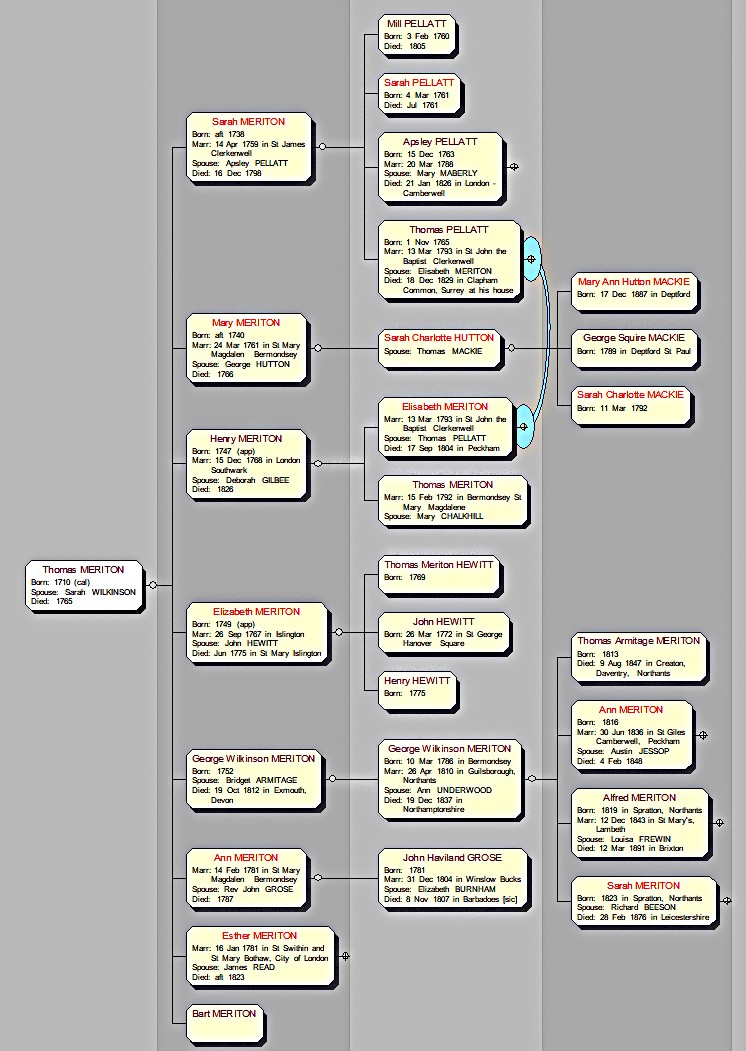
In which we meet the parents of Sarah Meriton (1739-1798), wife of Apsley Pellatt (1735-1798). Six-times great grandparents Thomas Meriton ( -1765) and Sarah Wilkinson ( -1784) had eight known children whose fates we will briefly consider in our next post. But firs,t a quick look at some of the quite complicated relationships, including that of Sarah’s short-lived sister and brother-in-law, and their three children.

On the left of the tree we find Thomas Meriton ( – 1765) and his wife Sarah Wilkinson (- 1784). More about them in a minute. Of interest in the next generation down are, of course, oldest child Sarah Meriton (1739-1798), wife of Apsley Pellatt II (1735-1798) , and mother of Apsley Pellatt III (1763-1826). He in turn, with wife Mary Maberly (1768-1822), was father of 15 children – too many to show here! – including their oldest child, Mary Pellatt (1789-1857), who married Samuel Backler (1784-1870) – the Backlers being the starting point of this whole blog! Stay with this, because there are some cousin relationships coming up. (See https://backlers.com/2017/03/21/samuel-backler-1784-1870-family-thefts-and-a-changing-career/ )

Sarah nee Meriton and Apsley Pellatt II are also parents of Thomas Pellatt (1765-1829), who married Elizabeth Meriton ( – 1804), the daughter of Sarah’s younger brother Henry Meriton ( – 1826). Thomas Pellatt and Elizabeth were parents of, among others, Henry Pellatt (1797-1860), who married Mary Backler (1813-1882), daughter of Mary Pellatt and Samuel Backler. (See:https://backlers.com/2025/08/27/51-thomas-pellatt-1765-1829-clerk-to-the-ironmongers/ ) (See also https://backlers.com/2014/11/06/thomas-meriton-pellatt-or-sargeant-who-is-the-father/ )

Meanwhile, as I was making final preparations for this post, I reflected with some frustration that I had little information about Sarah Wilkinson’s origins. So I decided to try once more to find parents, using as a starting point the name of her brother, George Wilkinson Meriton -= surely named after his grandfather? And yes, so it proved. The story below of variously interconnected families is largely drawn from the Wills of the key players.

Thomas Meriton ( – 1765). Origins? Here I have found pretty much of a dead end. Various online trees show a christening at St Sepulchre London on 27 May 1710 of a Thomas Meriton, father Thomas, Mother, Elizabeth. Another possibility is the christening of a Thomas Merriton [sic] at Greenwich St Alfege, on 2 December 1696 to Henery Merriton and Johannah. Thomas and Sarah’s first son was named Henry. But I cannot find a Will or other evidence which would confirm either of these. So Thomas’ origins remain doubtful for the moment.

Rather more satisfying – at least one generation back – is the find of George Wilkinson ( – 1762) of Clerkenwell. As noted above, a search on Wills for George Wilkinson threw up one in Clerkenwell, where at St John the Baptist, Sarah Wilkinson ‘of this parish’ had married Thomas Meriton ‘of St Olave’s Southwark’ on 5 February 1731. This George Wilkinson Will was incredibly obliging. Written on 28 November 1759, it tells us that George was an Ironmonger of St James, otherwise St John, Clerkenwell. After certain bequests (see below), all the rest, residue, real and personal estate etc etc are left to ‘my Son in Law Thomas Meriton‘, sole executor of the Will. Rather handily, and just to make sure of our family connections, two of the three witnesses were Apsley Pellatt [II] and Sarah [nee Meriton] Pellatt. How satisfying! [The bold typeface throughout this post indicates my direct ancestors.]

Root: George Wilkinson‘s Will began with a bequest which aroused my curiosity. The very first Item reads: ‘I give to my Grand Son Samuel Root and to my two Grand Daughters Elizabeth Root and Ann Wilkinson Root the sum of One hundred pounds each’, when married or they reach age 21…and Thomas Meriton is appointed their Guardian. So, in 1759 when the Will was written, there were three children of a daughter of George Wilkinson, who seemed to be orphaned. Here is how it works: George Wilkinson had two daughters, Sarah (who married Thomas Meriton in 1731) and Elizabeth, who married widowed Mason Samuel Root in St Benet, Paul’s Wharf in 1748. Guessing back from their marriage dates, I infer that Sarah was born around 1711, and Elizabeth perhaps much later – perhaps with a different mother than Sarah? Their father George Wilkinson was widowed when he married widow Sarah Bart, also at St Benet Paul’s Wharf in 1731. (This historic Wren church is just north of the River Thames, opposite Southwark and Bermondsey. I am not sure why these marriages took place there.) I have not found an earlier marriage for George, nor have I found a baptism for either daughter.

But, back to the sad Root story. There are baptism records for Elizabeth (1750-1763), Samuel (1751-1764) and Ann Wilkinson Root (1752 -). Sadly, we find a Will for their father Samuel Root of the Parish of St Mary Magdalen Bermondsey, Citizen and Mason of London, written just five years after his marriage to Elizabeth, on 4 October 1753, and proved on 15 October 1753. Samuel appoints three executors – ‘my honoured father Roger Root of the Parish of St John [Horsleydown] in Southwark Carpenter, my father in law George Wilkinson of the Parish of St James Clerkenwell Ironmonger and my brother in law Thomas Meriton of the said parish of St Mary Magdalen…Ironmonger to be joint executors’…; After debts etc, everything is left to loving wife Elizabeth Root, the three children, ‘and such other child or children as my said wife is now pregnant with…’ The usual provisions are made for education and maintenance of the children.

So, one of the Executors was George Wilkinson, whom we have seen died in 1762. What about wife Elizabeth (nee Wilkinson) and the other grandfather, Roger Root? Well, he died in 1755, when only one son proved his Will as executor, since the other Executor, son Samuel, had already died. And Elizabeth? By the time of George Wilkinson’s Will, written in 1759, she is not mentioned. Nor is there a fourth child. I wonder if she died in child birth. This leaves just one Executorand Guardian.

Thomas Meriton’s Will: And so we turn to Thomas Meriton. His Will was written on 28 January 1764 and proved by the sole Executrix, his wife Sarah nee Wilkinson Meriton on 6 November 1765. It makes no mention of the Root children, who are still minors. Why? Well, I think Elizabeth died in 1763 – there is a burial in Bermondsey for a 13-year-old Elizabeth Root. I think Samuel was buried in May 1764 in Bermondsey, brought from St John Horsleydown, in nearby Southwark, where there were Root relatives. But I am not sure about Ann Wilkinson Root, who was baptised on 12 November 1752 in Bermondsey. Presumably she was with some family member.

I think I will leave the rest of Thomas’ Will, and that of his wife in 1784, until my next post, where both Wills will introduce us to their many children. The Meritons were a prosperous family, he seeming to have been a successful Ironmonger, and she, perhaps, having inherited property and other things from her father, George Wilkinson. Considerable sums of money and jewels, and much property, feature in the Wills, as well as something of a mystery surrounding a child named Bart Meriton.

51. Thomas Pellatt (1765-1829), Clerk to the Ironmongers

In which we meet Thomas Pellatt (1765-1829), Clerk to the Ironmongers, son of Apsley Pellatt II and Sarah nee Meriton, married to his cousin Elizabeth Meriton and father to Henry Pellatt, who married his cousin Mary Backler, as the diagram below attempts to show. We learn a bit more about the Ironmongers Company and note that the Pellatts showed nonconformist tendencies throughout the late 18th and early 19th centuries, as did many of the Ironmongers.

The diagram above shows two generations in one line, ie Apsley Pellatt II is at the top left, while his son Apsley Pellatt III is at the bottom left and is the brother of Thomas Pellatt, top middle row. Hopefully readers get the gist!

We briefly met Thomas Pellatt in Post 50, noting he had been apprenticed Clerk to William Leeson and admitted free of the Ironmongers by patrimony in 1789. The Articles of Clerkship for his son Henry (see below) show that Thomas was ‘of Ironmongers Hall [by patrimony] in the City of London Gentleman and one of the Attorneys of His Majesty’s Court of Kings Bench Common Pleas and Exchequer at Westminster, and a Solicitor in the High Court of Chancery…’ He was also known to be ‘of Gray’s Inn’ .

He married his cousin Elizabeth Meriton by License at St James Clerkenwell in March 1795. They had four sons, baptised at Fetter Lane Independent Chapel, but for Thomas the future of his marriage and family were bleak. Three of the four sons died in childhood, with the deaths in Peckham of son Apsley Meriton Pellatt in 1803, aged nearly five, and young John (1800-1804), and in Brighton of first son Thomas in 1807, aged 11. He was buried there at the Union Street Meeting House and Ground – in what then was still known as Brighthelmstone. During those traumatic years, Elizabeth nee Meriton Pellatt died in Peckham in September 1804, perhaps in childbirth. This left just son Henry Pellatt, born in 1797 and articled for five years as Clerk to his father in 1815. We have already met him in posts 11 and 29, in which we traced some interesting relationships arising from the marriage and offspring of Henry and my many times great aunt Mary Backler, who had married in Kennington in 1831. I do not propose to investigate Henry any further.

Clerk to the Ironmongers Company: And so to the career and good works of Thomas Pellatt. Perhaps it was because he had precious little family that he seems to have thrown himself into a range of charitable and legalistic roles, primarily by his becoming Clerk to the Ironmongers Company in 1803, shortly before the death of his wife. He remained in this role until 1830, to be succeeded for four years by his son Henry. His name appears in many newspaper notices as signatory, Clerk of the Ironmongers. According to A History of the Ironmongers Company (Elizabeth Glover, 1991), Thomas Pellatt assumed the role of Clerk while the affairs of the Company were in some disarray. In his early years he fulfilled his legalistic and administrative duties efficiently, but according to Glover, ‘despite his excellent early work, Thomas Pellatt was .. to die with his affairs in disorder, and Henry Pellatt, the son who succeeded him for four years, was obliged to call upon his sureties, much to their indignation, for £343.2s.9d. in 1834’ (p. 105).

The Ironmongers were known for their charitable works, and for their Independent church leanings. On news of his death, the Trades’ Free Press on 26 December 1829 reported: ‘Died – a few days since, Thomas Pellatt, Esq., Clerk to the Ironmonger’s Company, Secretary to the Female Penitentiary, and Joint-Secretary of the Protestant Society for the Protection of Religious Liberty. The deceased was an eminently upright man, and a faithful friend to the various religious institutions which adorn and enlighten the country. His sudden death is greatly lamented by all who had the pleasure of his acquaintance.’

Protestant Society for the Protection of Religious Liberty: In 1815, at the time of persecution of Protestants in the South of France, a very long letter in protest appeared in many newspapers around the country, signed by Thomas Pellatt and John Wilks, joint secretaries to the Committee of the above-mentioned Protestant Society, which had met at the New London Tavern, Cheapside on 21 November 1815, The Committee expressed their ‘astonishment and deep regret’ at learning of persecution in Nimes, and stressed their belief that it should be a matter of conscience for all people how they worship God. (See, for instance, Star, London, 30 November 1815)

IN 1825, Pellatt as Secretary to the Protestant Society wrote on their behalf to condemn the many Protestants who were petitioning against a Bill to remove the various disqualifications applying to Roman Catholics, stressing their overall belief that people should be free to worship according to their consciences. (See, for instance, Morning Herald, London, 2 May 1825) Later in the century, Apsley Pellatt IV, MP, would campaign on behalf of Jews.

London Female Penitentiary: The London Female Penitentiary was founded in 1807, and from the beginning, Thomas Pellatt was the ‘Gratuitous Secretary’. In 1817 he underwent a lengthy examination by the Metropolitan Police about the conduct, finances and more of the institution, reported on three days by the Morning Post – on 17, 18 and 23 December 1817. Thomas Pellatt stated the object of the institution was: ‘to afford an asylum to females who, having deviated from the paths of virtue, and who are desirous of being restored by religious instruction and the formation of moral and industrious habits, to a reputable situation in society.’

The word ‘Penitentiary’ derived from the 1779 Penitentiary Act, which focussed on deterrence and reform of miscreants, through religion, solitude and labour. Thus the ‘fallen women’ to whom Pellatt refers (who could have been prostitutes or sex workers, in modern parlance, but also any woman whose virginity was lost outside marriage). According to Pellatt, the people applying for admission were mainly ‘persons who have lived in service, maid servants, orphans, persons who have been left with one parent, and that parent being under the necessity of going out to work, they have been neglected and permitted to rova about the streets and with bad connexions with other females and other causes, have been led astray’. Pellatt reported ‘only some few of applications from the higher ranks’, and that the average age of admission was 17 or 18. One of the greatest causes of ‘this great evil’ was attendance at fairs: ‘We have more cases upon our books of women ruined at these nurseries of vice than of any other; those fairs I mean in the neighbourhood of the metropolis’.

Of the labour in which the women were occupied, Pellatt said: ‘Washing for hire, that is all the business of a laundry, to qualify them for service; making child bed linen and all kinds of needle work; spinning thread and worsted and knitting various articles, and general fancy works.’ The aim was to send women out to employment. But this was not a life of any luxury. The inmates had meat three times a week, on other days, soup, broth or pudding, and on Thursday, bread and cheese only, that being ‘the day on which the house is open for inspection of the public, and the sale of articles manufactured’. As for those leaving, unless dismissed for misconduct, women only left to go to employment after a maximum stay of two years, and there were more applications for servants than the institution could provide.

With the demise of Thomas Pellatt in 1829, it appears that his nephew Apsley Pellatt IV, son of Apsley Pellatt III and Mary Maberly (and brother to our very own Mary Pellatt) took over the role of Secretary. Apsley Pellatt IV was to become the famous glass maker and MP – much more of him later on.

I have tried in this post to give some flavour of the work of Thomas Pellatt, and more generally of the Pellatts as supporters of a range of liberal religious and charitable causes.

In my next post I will try to trace our Meriton line back a bit – it doesn’t go with any certainty beyond the early 19th century, but introduces a prosperous family in Bermondsey, south of the river Thames.

For an interesting piece on the London Female Penitentiary on Pentonville Road, see https://legalhistorymiscellany.com/2024/02/21/betrayed-seduced-trepanned-or-cruelly-driven-into-sin-the-london-female-penitentiary/

50. Apsley Pellatt II (1735-1798)

In which we meet Apsley Pellatt II (1735-1798). and his wife Sarah Meriton (c. 1738-1798), and their three children.  We are re-introduced to The Worshipful Society of Ironmongers,  with which Company successive generations of Pellatts would be associated for more than 100 years. 

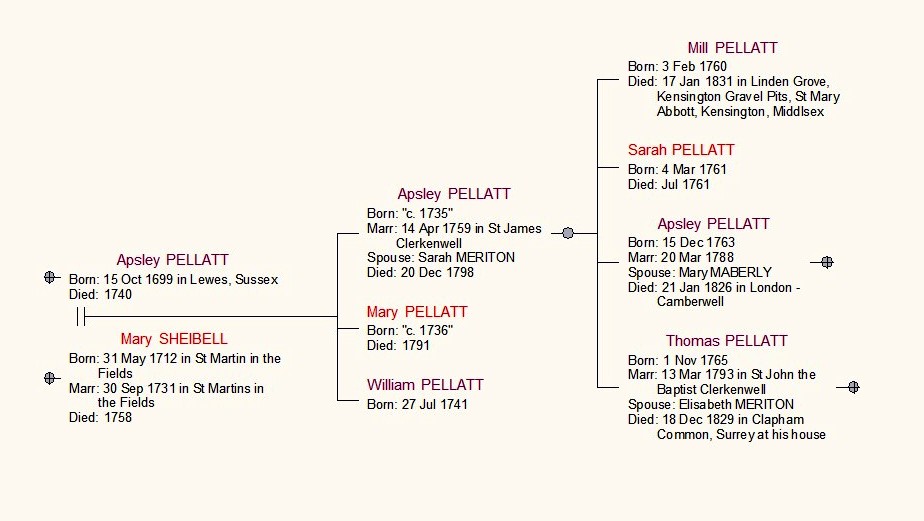
Apsley Pellatt II (1735-1798) was the oldest of three children born to Apsley Pellatt 1 (1699-1740) and Mary nee Sheibell (1712-1758).   We have seen in previous posts that Apsley Pellatt I died just five years after his oldest child’s birth.  Of the younger Apsley’s siblings, we can take a very brief look, since I can trace nothing about his sister Mary, other than that she died at Camden Street, Islington, in 1791, and in her will left many legacies to nieces and nephews, various charities, and the residue to her brother and executor, the above-name Apsley II.  Of William we know even less. His impending birth was mentioned in his father’s will.  I had long puzzled about his apparent birth date, more than a year after his father’s death, until I realised that these events took place before the change of the calendar from Julian to Gregorian in 1752.  Before this date, the first three months of what is now our calendar year were considered to be of the previous year – so that Apsley Sr died early in 1740/1, with William appearing a few months later.  Other than that – of William, there is nothing. I suspect he may have died in infancy, as he is not mentioned in the Will of his grandmother, Mary Sheibell, below.

So, back to young Apsley II.  He was to benefit from a number of legacies, for instance from his grandmother Mary (nee Houghton) Sheibell, both silver and a sum of money, payable upon his reaching the age of 21.  Before he reaches that age, the executors of the will are instructed to use the interest on these gifts ‘to put him apprentice to some genteel and reputable trade’.  And so, we renew acquaintance with the Worshipful Company of Ironmongers, whom we first met in Post 6c, John Freeman (1740-1803), Indigo Maker and Ironmonger.   To recap, John Freeman had married Ann Backler (1741-1820), who was sister to apothecary Sotherton Backler (1746-1819) and aunt to Sotherton’s son Samuel Backler (1784-1870), who in 1810 married Mary Pellatt (1789-1857), daughter of Apsley Pellatt III (1763-1826), to whom we will briefly be introduced later in this post.  The point of all this is to show that almost certainly there were long standing links between the Pellatts and the Backlers.

Apprentice: In 1750, on payment of the sum of £80, Apsley II was put apprentice to William Bliss: ‘I Apsly Pellat [sic] Apprentice to William Bliss do promise to be obedient to the Master and Wardens of the Worshipful Company of Ironmongers during my life and my said Master during my Apprenticeship. Witness my hand this 12 day of July 1750 Apsley Pellat [sic].’ (image on findmypast)

Apsley Pellatt served out his seven years as an apprentice, and was made free of the Ironmongers Company on 18 August 1757.  By this time, aged 21, he would also have come into his various inheritances, which undoubtedly gave him the resources to marry, and to set up in business as an Ironmonger, where he is to be found for many years at 13 St John Street, Clerkenwell.

Marriage to Sarah Meriton  This took place at St James Clerkenwell, Clerkenwell Green, on 14 April 1759.  Sarah was a minor, and married with the consent of her father Thomas Meriton ( – 1865).  Witnesses were Thos. Meriton (possibly/probably her father) and John Godfrey (not sure who he is).  We will learn more about the Meritons in a future  post, but here it is important to note that Thomas Meriton was an Ironmonger, albeit south of the river in Bermondsey, and not of the Ironmongers Company. It seems likely that the Pellatt/Meriton marriage resulted from the partnership between the families, as noted in the following item from The London Gazette, shortly before Thomas Meriton’s death in Bermondsey.  His marriage to Sarah Wilkinson in 1731 had taken place in Clerkenwell, so although he was located south of the river, she had links in Clerkenwell.  

London Gazette 1 January 1765: The Ironmongery Business carried on by Thomas Meriton of Dockhead, Southwark and Apsley Pellatt of Clerkenwell, was dissolved the 31st of December last, 1764. Witness our hand Thomas Meriton, Apsley Pellatt.  N.B. Thomas Meriton is to pay and receive what is Debtor and Creditor to that time.

And so, for some 30 years, Apsley Pellatt II carried on as Ironmonger of Clerkenwell.  In 1789 he was Master of the Ironmongers Company, elected to the post by the Court of Assistants.  His tenure lasted a year.

He and Sarah had four children, three sons and the sadly short-lived Sarah Pellatt (1861-1861).  Let’s look at the three sons.

Mill Pellatt (1760-1805): Was apprenticed to his father, of St John’s Street, St Sepulchre Without, on 27 July 1775.  He was duly made free of the Ironmongers Company by service to his father on 28 November 1782 (both images on findmypast).  In the 1796 Electoral Register for London, we find Mill Pellatt and Apsly Pellatt [sic] [II] as Ironmongers at St John Street.  And in 1831 we find the death of Mill Pellatt Esq on 17 January and his subsequent burial on 21 January 1831 at St Mary Abbotts Kensington.  His address was given as Linden Grove, which rang a bell – it was where Samuel Backler and Mary [nee Pellatt] Backler were living when their daughter Esther Maria Backler was born in 1830.  See Post 26!  Mary was Mill’s niece.  The Backlers were about to embark on a rather turbulent year, featuring Samuel’s bankruptcy proceedings, among other things.  

Mill Pellatt had profited handsomely from his father’s Will in 1799, but apparently became ill or somehow dependent, because his brother Apsley III’s Will in 1826 [which complicated document we will peruse at a later date] made provision for funds to be invested to produce ‘the yearly sum of eighty pounds and to pay the sum of eighty pounds yearly and every year unto and for or towards the support of my dear brother Mill Pellatt for his life’.   Presumably this care was being provided by Mill’s niece Mary Backler and her husband.

Apsley Pellatt III ( 1763-1826) we will leave until a subsequent post.

Thomas Pellatt (1765-1829) further complicates this complicated family, and I have come to the conclusion that he needs a post of his own.  In short, he was apprenticed Clerk to Attorney William Leeson on 4 October 1780, and  was made free of the Ironmongers Company in 1757 by Patrimony.  He was later to have a significant role with the Ironmongers, and in wider civic life, which is why he merits a post on his own.  For the purposes of this post, suffice to say that he married his cousin Elizabeth Meriton, daughter of Henry Meriton (Thomas Meriton’s brother) in 1795.  Their son Henry Pellatt would marry Mary Backler, daughter of Mary Pellatt (daughter of Apsley Pellatt III) and Samuel Backler. Are you staying with this?  We will leave that for the moment and just focus on the latter years of Apsley Pellatt II. 

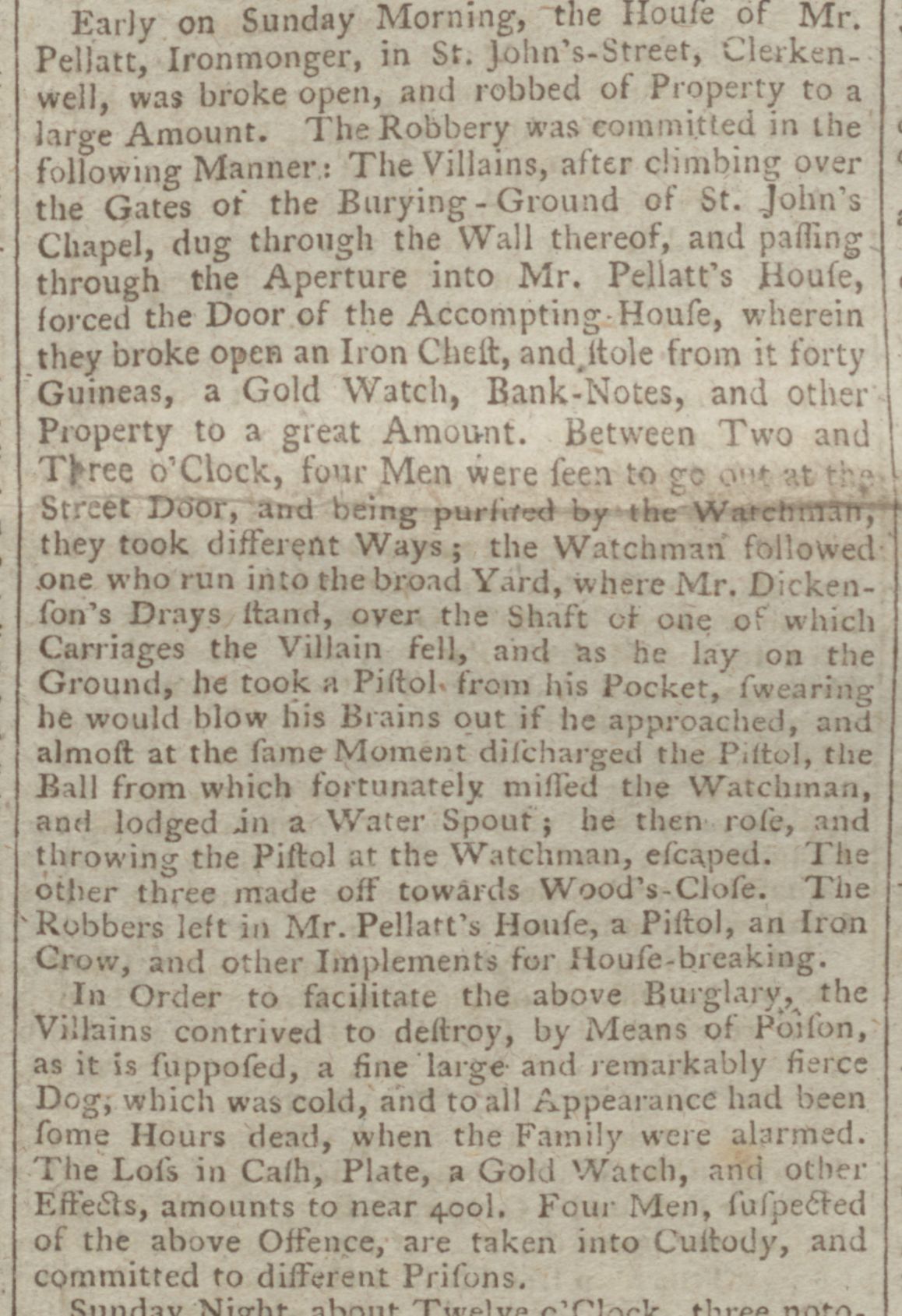
There is plenty of evidence that Apsley Pellatt II traded at St John’s Street, but perhaps none so colourful as the events described in the following newspaper clipping:

Northampton Mercury 25 October 1784. Image reproduced from British Newspapers collection by kind permission of Findmypast

This clipping tells us a lot about Apsley Pellatt at the time. His home was adjacent to St John’s Chapel and the burying ground, both on the western side of St John’s Street as it heads north towards Islington. Not far away is St James Clerkenwell, where Apsley Pellatt II married Sarah Meriton. The value of stolen goods was some £400 – around £60-80,000 today, depending on which website you peruse. They owned a dog! I have not managed to find court reports about the suspected thieves.

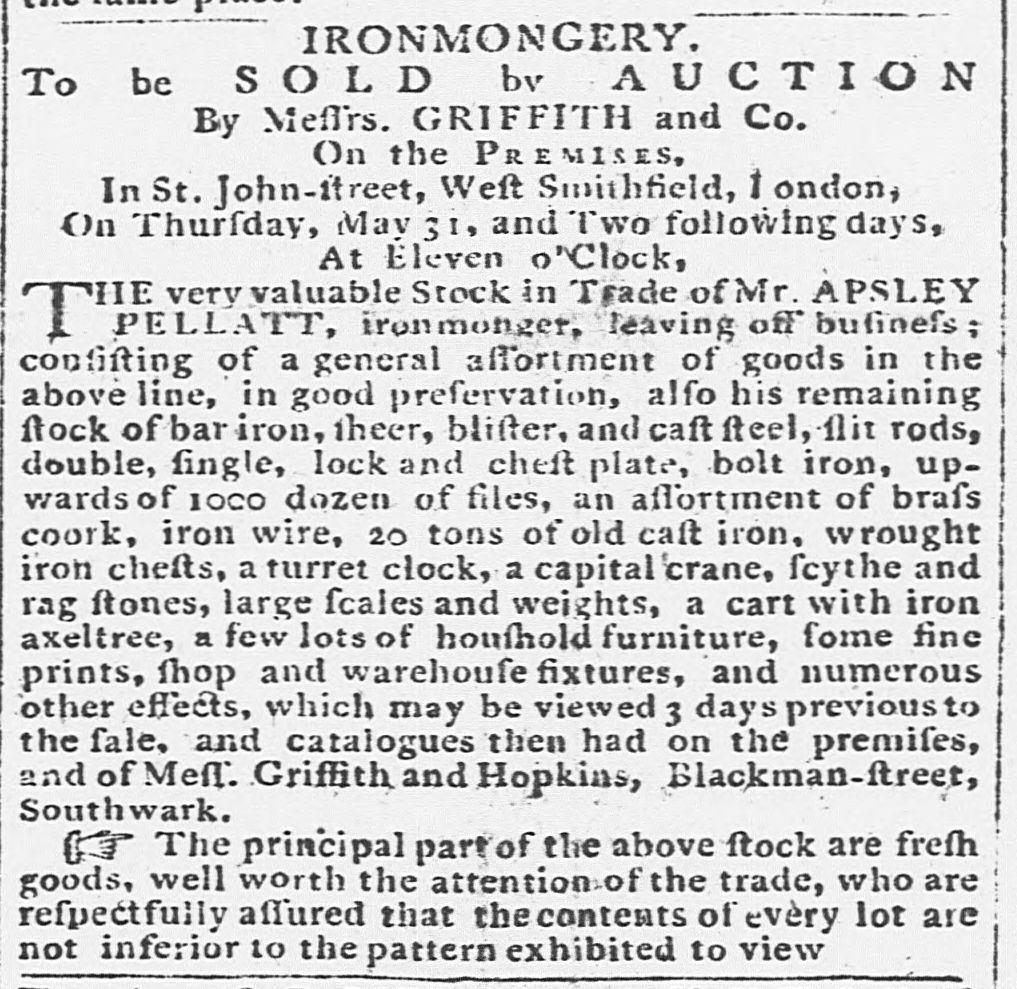
More context of Apsley Pellatt’s working life is given in the advert seen below, not long before his death in 1798. Here we see the types of goods an ironmonger would stock – iron, steel, brass – plus household furniture and effects. Presumably the Pellatts were moving from St John’s Street to Islington, where they died within days of each other at the end of 1798.

Ipswich Journal, 28 May 1798. Image used by kind permission of Findmypast, British Newspaper Collection.

Apsley Pellatt II – death and Will: The following text is taken from the online record of ‘Deeds of 9 Friars Walk, Lewes’ (ESX 21359) on the Sussex Record Office website   https://www.thekeep.info/collections/getrecord/GB179_AMS6346_1-32

On 4 & 5 Apr 1759 the Friars Estate was settled on the marriage of Apsley Pellatt and Sarah, daughter of Thomas Meriton; they mortgaged it for £2000 to Elizabeth Macie on 5 & 6 Jan 1776, who assigned it to James Louis Macie on 12 & 13 Apr 1786. Sarah Pellatt died on 16 Dec 1798 and Apsley Pellatt on the 20th leaving Mill Pellatt, Apsley Pellatt and Thomas Pellatt his surviving children; Apsley and Thomas proved their father’s will in PCC on 5 Jan 1799. The estate was auctioned on 19 Aug 1803; lot 2, a capital messuage called The Friars occupied by Sir F[erdinando] Poole at a rent of £90 and 2a 1r 28p of land, was sold to George Verrall for £2400 and £93 18s 6d for the timber. The conveyance was executed on 28 & 29 Mar 1804 by Mill Pellatt of Edgware Road in Mx, gent, Apsley Pellatt of St Pauls Churchyard, glass manufacturer and Thomas Pellatt of Ironmongers Hall, gent, to George Verrall of Lewes, gent (and his trustees John Godlee of Cliffe, merchant, Thomas Shank of Fenchurch Street, London, wine and brandy merchant and George Nelson of Palsgrave Place, Temple). Of the purchase money, £2000 was owed to Macie the mortgagee.

Given that Sarah predeceased her husband by a few days, the provisions in his Will for her were not applicable, so basically everything went to the three brothers, with Mill seeming to get a bit more than the two younger siblings. Of interest to us is that eldest grand daughter Mary Pellatt (1789-1857) was to receive £100 when reaching age 21 or day of marriage, a nice little sum for her when she married Samuel Backler (1784-1870) in 1810. In the next post we will catch up with Thomas Pellatt, then we will peruse the Meritons, and finally will move on to Apsley Pellatt III. Lots to look forward to!

49. Introducing the Scheibel/Sheibell line – an early twig from Germany

In which we meet the rather complicated Scheibel/Sheibell line, apothecaries from Friedburg, Wettaravia, Germany, naturalised as British citizens in the late 17th and early 18th centuries … but… they are not properly disentangled!

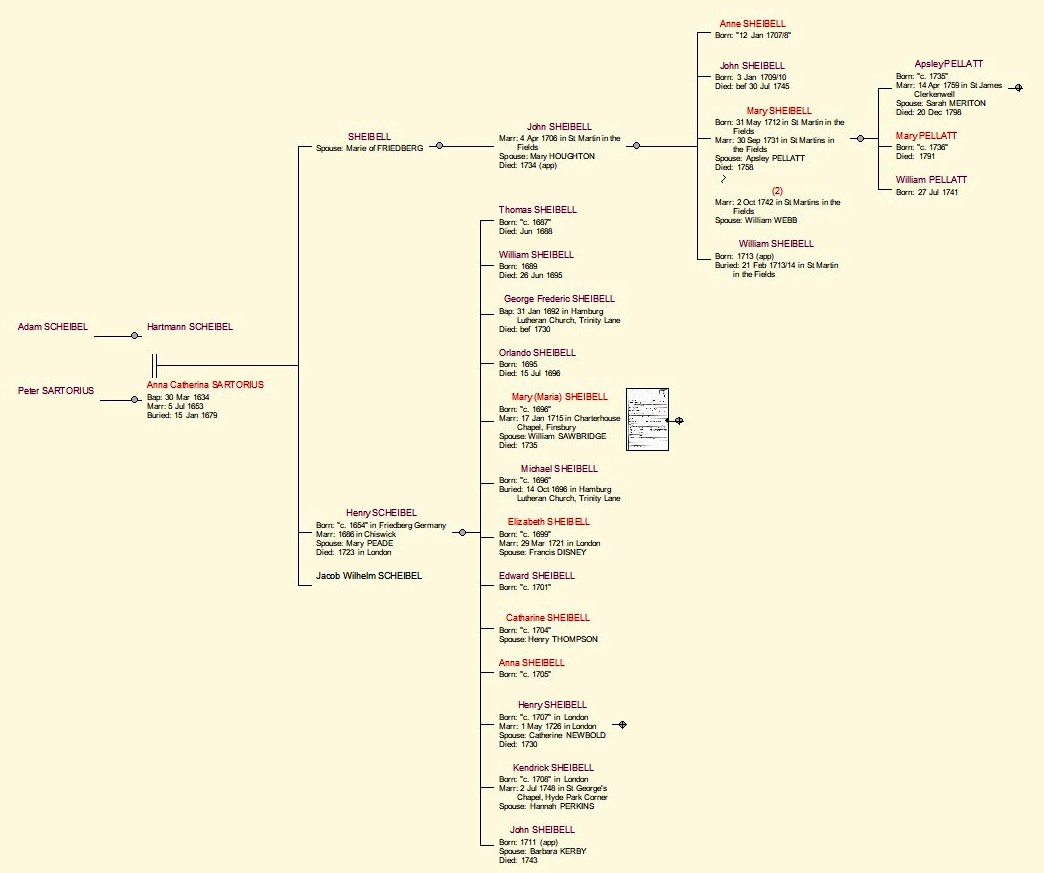
Two trees below show some pretty well known information, and some more speculative, derived from a variety of sources. The main person of interest for our purposes is Mary Sheibell (1712-1758), who married Apsley Pellatt (1699-1740/1). We are secure in the knowledge that Mary Sheibell was the daughter of John Sheibell ( – 1734) and Mary Houghton/Haughton ( – 1745). They married at St Martin in the Fields on 4 April 1706, and their four children’s baptisms are to be found in the parish registers of that church. Shown on the first tree below, they are Anne, born on 12 January 1707/8 and baptised on the 15th; a child Anne Sheibel [sic] was buried there on 5 February 1707/8, who could have been this Anne, or, feasibly, her cousin Anne Sheibell, daughter of Henry Sheibell and his wife Mary, who was born in November 1705. These Scheibells can be quite confusing. Next up for John Sheibell and Mary Houghton was John Sheibell, born 3 January 1709/10, and who died before 1745. He appears to have been somewhat troubelsome, as we will see when we look at his parents’ Wills. He had a daughter Mary by an unknown spouse. Then we come to Mary Sheibell, whose dates we have seen above, followed by the short-lived William Sheibell, who I believe was born and died in 1713.

Who was John Sheibell?

Looking at the trees below, we see that some sources show that Hartmann Scheibel, Apothecary, of Friedburg in Germany was the father of Henry Sheibell, Apothecary, and grandfather of John Scheibel, Apothecary, both of St Martin in the Fields. The naturalisation record for Henry Scheibel in 1693 clearly shows: ‘Henry Sheibell Son of Hartman Sheibell [1654-1723] and Katherine his wife born at Ffriedberg in Wetteravia in Germany’. After a certain amount of disagreement with the Worshipful Society of Apothecaries, whom we have met many times before in our Backler stories, Henry was made free of the Society in 1691. He married Mary Peade, and a ‘tentative’ pedigree for him and a line for ‘our’ John Sheibell can be seen in Miscellanea Genealogica et Heraldica, London 1912, which can be viewed online at https://archive.org/details/miscellaneagenea4191bann/page/n39/mode/2up pages 8-10.

So far, so good, for Henry, but what about our John? The Pedigree shows him as Henry’s nephew, naturalised by Act of Parliament No. 94, 4 and 5 Anne (1706), as son of Mary Scheibel, father’s name not given. However, I have combed through the very many names of naturalised folk in this Act, and the one I find is ‘John Phillip Sheibell son of John Sheibell by his wife Mary born at Ffriedberg in Germany’. Is this ‘our’ John? I have reason to believe that it is, since John Phillip Sheibell was buried in 1734 at the Savoy Lutheran Chapel, and ‘our’ John (no Phillip in the name) died in that year, stating in his Will that he wished to be buried there. If this is so, and the Naturalisation parentage is accurate, ‘our’ John was indeed the nephew of Henry and the grandson of Hartmann. The trees below do not show his father as ‘John’, which I now believe to be the case.

The rather fuzzy tree below shows the very extensive family of Henry Sheibell, Apothecary. His children were ‘our’ John Sheibell’s cousins, and detailed examination shows them featuring in various ways in each others’ lives – which I do not propose to set out in any detail.

Let’s see what else we know about our direct ancestor, John (Phillip) Sheibell ( – 1734).

Some years ago I explored the Vestry Minutes of St Martin in the Fields seeking information about John Sheibell and his son-in-law Apsley Pellatt.  I am not sure how John Sheibell became a ‘Citizen and Apothecary’, but the Vestry Minutes consider in some detail the payments to John Sheibell in his role as apothecary to the poor of the parish, and later on, in his services to the workhouse:

‘This Board takeing into consideration an Apothecary to be employed this year by the Overseers of the poor for the relief of the poor, Doe recomend [sic] Mr John Sheibell, Apothecary to be employed by the Overseers of the Poor as Apothecary & Surgeon So as his Bills do not exceed Sixty pounds for & during all this year…’[1]

This recommendation was repeated in the following two years, but in 1720 the following entry appears:

‘John Sheibell Apothecary petitioned this Board complaining of the great Costs and Charges he yearly sustains by reason of his paying a Surgeon out of his Sallary of 60 £ y And, this Board taking the same in Consideration Ordered that the said John Sheibell’s Sallary be advanced to 80 £ y And during such time as the two Outwards shall remain part of this parish’[2]

The relationship of John Sheibell and the Vestry did not always run smooth. Cost-cutting is not just a modern phenomenon: at the Vestry of 13 September 1722, the Board apparently reviewed the salary and services, and decided that £60 a year should be sufficient to serve the Poor in Medicines and Surgery. If John Sheibell was not willing to accept these terms, then another should be elected ‘in his room’.  But by Easter Monday 1723, his salary was £80, and in 1724, ‘A Memorial of Mr John Sheibell Apothecary for providing Medicines for the poor of this parish was produced for this Board and ordered to be referred to the next Vestry’ [although no mention of it is made at the next vestry]. 

More was to follow. In May 1725, on opening of the Workhouse, the Vestry

‘ordered and agreed that an Advertisement be put into the Daily Courant that if any sober, skilful Apothecary is willing to Settle at the Workhouse and to attend the poor of this parish He be desired to wait on Sr Jno Colbatch Knt at Bartram’s Coffee House in Church Court any Day between One and two in the afternoon to treat about the same’[3]

The upshot of this appeared to be that a Mr Kitchen was to be ‘imployed as Apothecary for the poor of this parish And to have 40 £ pa And Sallary for the same …’. This was followed by months of procrastination when the orders re Mr Sheibell and Mr Kitchen were referred over and over again to ‘the next Vestry’.  Apparently John Sheibell wasn’t going to give up his position without a fight, and indeed, on Easter Monday 1726, John Sheibell was confirmed as Apothecary to the poor ‘provided his Bills exceed not 60 £ p. ann.’[4]

Following John Sheibell’s death in 1734, the Vestry Minutes of 15 April 1734 record the need for consideration of employing an Apothecary for the Service of the poor of the parish. Once again the matter was referred to successive Vestries, but finally (what happened to the care of the poor in the interim?), on 16 June 1735, it was:

‘Ordered and agreed that Mr Pellatt Apothecary be recommended .. to be .. employed for the service of the Poor of this parish for the remainder of this present year’.[5]

As we already know, Apsley Pellatt was John Sheibell’s son-in-law, having married Mary Sheibell in 1731.  No further mention is made of Apsley Pellatt as Apothecary (nor indeed of anyone else).  He died in 1740, and his wife married William Webb, who later became Churchwarden and Overseer.

Wills – a good source of information

We turn now to another key source of info for this Sheibell clan. The first Will of interest is that of Mary (nee Peade) Sheibell, wife of the above-cited apothecary, Henry Sheibell. He had died in 1723, but I have not located a Will for him. His wife, on the other hand, wrote her Will in 1730, and it was proved in 1732. She scattered any number of diamond rings and monetary legacies among her many children and grandchildren, but one item clarifies the relationship between her (and her late husband) and ‘our’ John Sheibell:

Item I give to my Nephew John Sheibell and to his wife Mary ten pounds apiece for Mourning and twenty shillings apiece more for a Mourning ring and to each of their children John and Mary I give ffive pounds for Mourning and twenty shillings apiece for a Mourning ring and I do further give and bequeath to my said Nephew John Sheibell a Legacy of one hundred pounds and in case he shall depart this life before my decease then I give the said one hundred pounds to his daughter Mary Sheibell and not otherwise

The Mary Sheibell in question, of course, is ‘our’ Mary who in 1731 would marry Apsley Pellatt.

We next move to the Will of John (Phillip) Sheibell, written in April 1732, and proved in April 1734. At the time of writing his daughter Mary will have married Apsley Pellatt, in 1731; the other surviving child is John, who is mentioned with some reservations in the Will, as follows:

I give and bequeath unto my only Son Twenty pounds and six Silver Spoons And in case my said Wife shall at any time after my death find and be satisfyed that my said Son John is reformed and become discreet and sober I recommend it to her to give to my said Son John the further sum of One hundred and Thirty pounds out of my Estate and Effects Also I give and bequeath to my Son in Law Apsley Pellett and to my dear daughter Mary his Wife Twenty pounds a peice [sic] and no more for Mourning I having given her a Portion upon her Marriage with the said Mr Pellet

After one or two other legacies, and specifying his wish to be ‘interred in the Vault or in the Church Yard of the Lutheran Church within the precinct of the Savoy with as little Ceremony and Expense as may be…’, he leaves everything else in the care of his wife, who he is sure will ensure it is used for the benefit of their children.

However, soon after – too soon, really – we come to the Will of Apsley Pellatt (1699-1740). Written on 11 March 1740 and proved on the 16th of the same month, he leaves all his property in Sussex to his wife Mary, the proceeds of which should be used for the maintenance and education of all their children, including the one ‘in ventre sa mere’ – not yet born (this is William Pellatt, born 1740/41, not sure what happened to him). Basically everything is left to his wife. She would re-marry after Apsley’s death, to William Webb, but I cannot find a Will of hers in 1758, when she died. However, we do have the Will of Mary (nee Houghton) Sheibell, her mother, and grandmother to the Apsley Pellatt children. Written in July 1745, and proved in August, she requests that she should be buried near her late son-in-law Apsley Pellat [sic], at St Martin in the Fields. Her wayward son John having died, she makes the following provision for his daughter Mary [mother’s name not known]:

‘I give and bequeath unto my grand daughter Mary Sheibell the only child of my son John Sheibell deceased the sum of two hundred and fifty pounds in satisfaction of a legacy of one hundred and thirty pounds which my late husband desired me to give to my said son John if I found him prudent and careful which said sum of two hundred and fifty pounds I direct to be paid my said granddaughter when she shall attain the age of one and twenty years or be married also I give and bequeath to my said granddaughter Mary Sheibell an old fashioned two handle silver cup and a gold ring set with ten diamonds one pair of silver salts six silver teaspoons and a strainer’

Apsley Pellatt’s children, Apsley (1735-1798) and Mary (1736-1791) were also given legacies:

I give and bequeath unto my grandson Apsley Pellat the sum of one hundred and fifty pounds also I give and bequeath unto the said Apsley Pellat a ribbed silver salver also I give and bequeath unto my granddaughter Mary Pellat one hundred pounds and a silver tea pot and I direct that the said legacies to my grandson Apsley Pellat and my granddaughter Mary Pellat shall be paid to them when and as they severally attain their respective ages of one and twenty years or be married…

Additionally to these legacies, however, came provision for her nephew John Stockwell (son of her sister Elizabeth and her husband John Stockwell), and apothecary Charles Carlisle to invest the sums left to the grandchildren and use the income to support their education and to put young Apsley Pellatt ‘apprentice to some genteel and reputable trade’. (See next post!) She left the rest and residue of her estate to her daughter Mary (Houghton Pellatt) Webb, for her sole use, which makes it puzzling that no Will can be found for her in 1758. Her husband William Webb died in 1771. He left most legacies to his daughters by his first marriage, but made son-in-law Apsley Pellatt (1735-1798) one of his Executors, and left £200 to be divided among Pellatt’s children when they reached age 21.

This rounds off our rather limited acquaintance with the Sheibells. Through Uncle Henry, there were any number of Sheibell descendants, but on ‘our’ John’s side there were only a few, one, Mary Sheibell (unknown mother), daughter of the wayward John, and ‘our’ Mary, mother of the second of very many Apsley Pellatts to follow. In the next post we will see this young Apsley Pellatt begin his association with the Worshipful Company of Ironmongers, with which the Pellatts would have a long association.


All notes from Westminster Archives Centre: [1] WAC F/2006/4 Easter Monday 1717 [2] WAC F/2006/37 April 15th 1720 [3] WAC F/2006/183  May 3 1725 [4] WAC F/2006/224 [5] WAC F/2006/434

48. Apsley Pellatt (1699-1740/1). Apothecary of St Martin in the Fields

In which we acquaint ourselves with the first Apsley Pellatt and his siblings, later noting his residence in London, his marriage to Mary Sheibell (Scheibel) in 1731 and his death in 1740/1, leaving two children and a third on the way.

Apprenticeships.

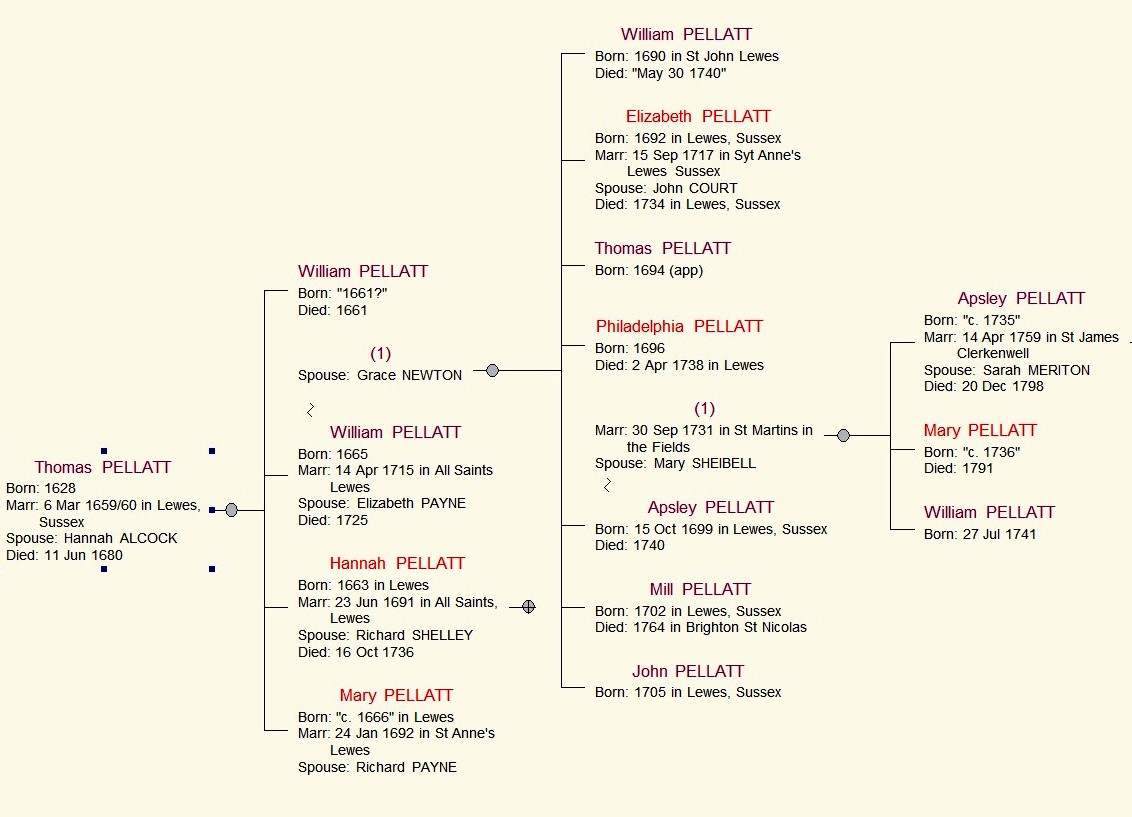
We have noted that Apsley Pellatt (1699-1740) was the son of William Pellatt (1665-1725) and Grace Newton (1664-1710). Grace died in 1710, and William was to marry for a second time to Mrs Elizabeth Taunton on 14 April 1715. I have found a Will for a William Pellatt of Lewes, Gent, written in 1719 and proved in 1725 by the sole Executrix, wife Elizabeth Pellatt. The Will is so brief as to make one wonder, simply leaving all estate, goods, chattels etc to loving wife Elizabeth. Is this ‘our’ William Pellatt? No mention of any children? It is puzzling. Had all the children been provided for at the time of the second marriage? There is no Will discovered for Grace, nor, for certain, for Elizabeth, although there is a possible one written in 1747 and proved in 1753, citing a son, ‘Thomas Tonton’ and daughter ‘Elizabeth’ as heirs. I have not researched this further.

William and Grace had seven known children, five boys of whom one, Thomas, died age 20, and the oldest, William, was presumably going to be the heir to his father. The three younger boys were put out to apprenticeships as shown in ‘Sussex Apprentices and Masters 1710-1752 ( https://www.sussexrecordsociety.org/wp-content/uploads/Digital_editions/SRS-Vol-28.pdf ), abstracted as follows:

PELLATT, Apsley, son of William P. of Lewes, Suss., esq.,to Francis Goater of Chichester, [Suss.], Apothecary; 7 yrs. from 24 June last’” [1715]; £60 – We consider below his progress to London and what is known of his later life. See https://practitioners.exeter.ac.uk/wp-content/uploads/2024/08/SUSSEX-MEDICS.pdf , p. 101, for information about Francis Goater, a prominent member of Chichester society.

PELLATT, John, son of William P. of Lewis, Suss. to Benjamin Powell of Lond, upholder; C. I. 7 yrs. ;£40; d. 7 inst. [Dec. 1720]; What happened to John? He was alive when his brother Mill wrote his Will in 1764 (see below). But I cannot reliably find him otherwise.

PELLATT, Mill, son of William P. of Lewis, Suss, gent.,to James Coulton of St Saviour’s, Southwark, [Surrey], hosier; C.I., 6yrs. ; £50; d. 9 inst. [May 1717]. Mill Pellatt’s (1702-1764) apprenticeship to James Coulton in 1717 was not to last, as James Coulton died in 1721. It does not seem that there was a London guild of hosiers then or now. I have found no evidence of what Mill did next, until we see his rather extraordinary last Will and Testament dated 14 April 1764 and proved on 30 May 1764. Mill had died and was buried in Brighthelmstone (Brighton), and his Will begins: “Dear Nephew Apsley Pellatt” – addressed to the son of his late brother, the first Apsley Pellatt, the principal person of interest in this post.

he asks Apsley Pellatt to be his sole Executor, and goes on ‘the 2 Lodgings Houses one Mine the other Mary Warners We agreed in the Court the longest liver Should Enjoy all the Goods in both houses I give to your Sister Mary Pellatt such as beding [sic] Linnen Plate China Glasses every thing that was Mine if Mary Warners will buy the goods as they stand if you think proper may sell them her I have a part of two Vessels One Capt Tho. Telson the other Capt Jno Butler those I bequeath to your sister Mary Pellatt the residue of my Effects I bequeath to you my Nephew Apsley Pellatt I have paid all my Debts so that you shall have no Demand on you except my Brother John Pellatt him I owe about a hundred pound I desire to be buried in this tow very private and frugal by daylight I believe you may Manage all this Business without the Charge of Administering this I Sign as my las Will and Testament this fourteenth Day of April One Thousand Seven Hundred and Sixty Four Witness my Hand – Mill Pellatt

To Mr. Apsley Pellatt this Will of Mill Pellatt I devise may be given him Apsley Pellatt the 30th Day of May 1764

On that day, Mr Thomas Meriton of the parish of St Mary Magdalen, Bermondsay (the nephew Apsley’s father-in-law. whom we will meet in future posts), Ironmonger, and Mr Apsley Brett of Lewes, Grocer (I think the son of Apsley Brett, Apothecary in Brighton, and apprenticed in 1756 to Will Brett in Lewes, Grocer) swore that they had long known Mill Pellatt and that the handwriting was his, so that Apsley Pellatt could duly prove the Will on that date. A Mary Warner, aged 72, was buried in Brighton on 26 December 1784, shown as from the Almshouse. Any fotrune she acquired from Mill Pellatt seems to have been exhausted.

Of the daughters of William Pellatt and Grace (Newton):

Elizabeth Pellatt (1692-1734) married John Court, who predeceased her. Her Will and three codicils left all her varied property, including The Friars in Lewes, and everything else, to her brother, the above-named Apsley Pellatt (1699-1740/1), subject to a provision by him of a yearly annuity payable to her brother William of £20 for his lifetime. It is not clear why William, the oldest sibling, should need this annuity. Even more unclear is why the Codicils should go into some detail about £500 and many goods, jewelry and other things to be left to her cousin George Nevill Newton (1696-1746), son of William Newton and his wife, Ann, possibly one of the many Paine’s I mentioned in my previous post. George lived in Brighton, as did Elizabeth in her last days, although both were buried in Lewes. Did he have some influence over Elizabeth?

Elizabeth’s sister Philadelphia (1696-1738) appears to have left little trace. She was not mentioned in her sister’s Will.

The first Apsley Pellatt in London: And so we move to our direct ancestor, Apsley Pellatt (1699-1740/1). Apprenticed in 1715 to apothecary Francis Goater in Chichester, we next find him living in central London, and appearing in the parish records of St Martin in the Fields, now a famous landmark opposite the National Gallery, in Trafalgar Square. Indeed, the present church was finished in 1726, replacing an earlier one built by Henry VIII, and so these Pellatt ancestors worshipped and were buried there. (There is no sign of them in the many memorial stones which pave the floors and walls of the present church.)

Once in London, he can be found as Apsley Pellatt, Apothecary, of Leicester Fields (now Leicester Square). The first substantive mention I have found about him concerns his appointment as Apothecary to the Parish of St Martin in the Fields, to succeed his father-in-law John Sheibell who died in 1734. Apsley Pellatt had married Sheibell’s daughter Mary in 1731. The Vestry Minutes of 15 April 1734 record the need for consideration of employing an Apothecary for the Service of the poor of the parish. The matter was referred to successive Vestries, but finally (what happened to the care of the poor in the interim?), on 16 June 1735, it was: ‘Ordered and agreed that Mr Pellatt Apothecary be recommended .. to be .. employed for the service of the Poor of this parish for the remainder of this present year’. (Westminster Archives, WAC F/2006/434). I have found no further mention of him and this role. He died at the tender age of about 41 in March 1740/1. (It is important here to use the old style Julian calendar to show the date, in which the new year (1741) would have started at the end of March, because of the birth of Apsley Pellatt’s third child, William, in summer of 1741. I had long thought this was too long after Apsley’s death in 1740, but realised that the death date of 1740 in fact referred to March 1741 under the new style which would come into force in 1752.)

As noted above, Apsley Pellatt had married Mary Sheibell (Scheibel)(1712-1758) at St Martin-in-the-Fields on 30 September 1731; he was of the parish of St James Westminster, which implies that he had a different residence prior to moving to Leicester Fields. By the time of his death in 1740/1, he and Mary had had three children. First-born was Apsley Pellatt (1735-1798); then Mary (1736-1791), and William (1741- ) (born posthumously).

Apsley Sr’s Will made provision for his very young children. His freeholds, hereditaments etc were left to his wife Mary in trust until his oldest child reached age 21, using the rents and profits for the maintenance and education of the children (including the one ‘in veintre sa mere’). Then the oldest child was to have these monies and make payments to the other offspring of interest and then, on their becoming 21, legacies of £400 each; and also an annual annuity to Mary of £25 per annum. Basically, Apsley the younger was to inherit the various properties in Sussex, including The Friars…but…he was just five years old when his father died. His mother was to re-marry to widower William Webb a year later. She would die in February 1758. We will learn more about her in my next post, when I trace what is known about the Scheibels, after which we will return to ‘Pellatt’ and review what happened to Apsley Pellatt St’s three children.

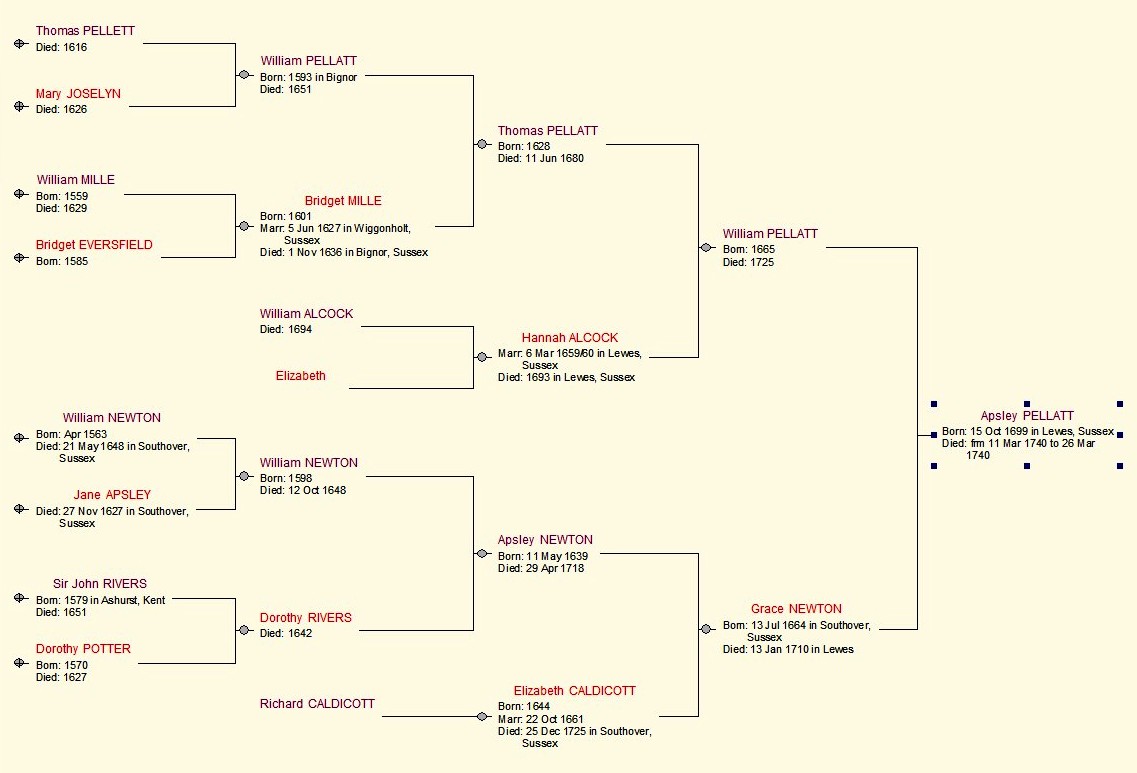
47. Starting the Pellatt line: looking back from Grace Newton (1664-1710) marrying William Pellatt (1665-1725).

In which we finally link the Newton/Rivers lines to the Pellatts, who will join the Backlers with Mary Pellatt marrying Samuel Backler in 1810. As with the Newton and Rivers lines, we find landowners and local worthies. As we move later on to London, we encounter more folk in different City of London livery companies, and in the case of the Pellatts we encounter, among other things, apothecaries, and glassmakers of the highest repute. But first things first – who were the Pellatts [or Pelletts]?

The tree above shows that the line back from William Pellatt, married to Grace Newton, starts with William (1655-1725) – then Thomas (1628-1680) – William (1593-1651) – Thomas ( – 1616). Above this last Thomas we find another William, of Charlton Court, Steyning (Sussex) (died before 1558) – Richard Pellet of Steyning (died before 1532) – William Pellett of Steyning (died before 1503).

You will note that the earliest Pellatts in this line date back to before the Dissolution of the Monasteries by Henry VIII in the late 1530s. Before this date, the lease of the Manor of Charlton in Sussex, once part of the Manor of Steyning, had been held by Syon Abbey in west London, and was granted to the William Pellett of Steyning listed above, who died around 1503. After the Dissolution of the Monasteries the title reverted to Henry VIII and the lease was then passed back to the Pellatts and held until Richard Pellett (died 1587) passed the lease to his son (Sir) Benjamin, who sold it on. Meanwhile, our line of the Pellatts had built a property at nearby Bignor Park, a few fragments of which stand today in the grounds of a much more recent stately home at which you can enjoy a very splendid wedding.

All of which is to say that the Pellatts were a locally landed, well connected family, at least two of whom were elected members of Parliament, and others of whom served in local positions of authority. They married into other landed and well connected families, and ‘our’ Pellatts ended up at the Friars in Lewes, Sussex, which was, alas, demolished in around 1848 to make way for Lewes’ first railway station, itself no longer in existence. A drawing of the Friars can be seen on this link: https://leweshistory.org.uk/2011/04/11/lewes-history-group-bulletin-9-7-april-2011/

Maberly Phillips (1838 – 1923), in his Pedigree and Genealogical Memoranda relating to the family of Pellatt describes “The Friars”: It was situated in the centre of the town, and comprised a family mansion, with gardens, orchards, fish pond, &c., the boundary walls enclosing an area of eighteen acres. (p. 124. For Part 1 of 2, see https://archaeologydataservice.ac.uk/archiveDS/archiveDownload?t=arch-285-1/dissemination/pdf/Vol_38_1892/SAC038_Phillips.pdf On page 15 of this document you can see the family tree of early Pellatts – I own an original paper copy of this tree.) Little did I know many decades ago when I enjoyed the delights of opera at the nearby Glyndebourne Festival, that I was walking on the lands of my Pellatt ancestors.

William Alcock ( – 1673) held the Friars at his death in 1672, when it passed to his daughter Hannah (1659/60 – 1693), wife of Thomas Pellatt of Bignor Park (1628-1680), and after her death in 1693 to their son William Pellatt (husband of Grace Newton), who died in 1725 and was succeeded by his second son Apsley Pellatt (1699-1740, diagram above, furthest right).  Apsley’s three grandsons (Mill, Apsley and Thomas) sold the property in 1803. We will learn much more about these latter Pellatts in future posts. 

But we get ahead of ourselves. The earliest lines are not shown in the tree above, but sufficient has been said about them for our purposes. Suffice to say we can trace them pretty far back, mainly thanks to Maberly Phillips. Early wives’ names are thin on the ground, and so the earliest I have found is that of Mary Joselyn (died 1626), wife of Thomas Pellett (died 1616). She was the daughter of Richard Joselyn of Hide Hall (in Essex), and his wife Anne Lucas of Bury St Edmonds (in Suffolk). Also we find Bridget Mille [Mill, Mylle] (1601-1636), the first wife of William Pellatt 1583-1651). She was the daughter of William Mille, M.P. (1569-1629; see https://www.historyofparliamentonline.org/volume/1604-1629/member/mill-william-1569-1629) and his wife Bridget Eversfield (1585- ) Many of these folk feature in an entertaining tome entitled A History of the Castles, Mansions and Manors of western Sussex by Dudley George Cary Elwes, London, Longman and Lewes, GP Bacon, 1876. A pdf can be downloaded from https://ia904707.us.archive.org/24/items/ahistorycastles00elwegoog/ahistorycastles00elwegoog.pdf It is well worth a look, and has an index of places at the beginning and surnames at its end. Among places of interest to our story are Greatham, Bignor, Steyning and Wiggonholt, while indexed surnames include Pellatt, Mill and Eversfield. I haven’t managed to find a similar volume related to East Sussex, which would feature Pellatts, Alcocks and Newtons among others.

I now turn to the parents of Grace Newton’s husband William Pellatt (1665-1725): Thomas Pellatt (1628-1680) and Hannah Alcock ( – 1693), daughter of William Alcock ( – 1673) and his wife Elizabeth. I have spent considerable hours trying to untangle cousin marriages among the Alcocks, Pellatts and Paynes (or Paines), since Hannah’s sister Elizabeth married a Richard Payne, and further down the line a Payne married a cousin Pellatt…but I have given that up. It is a tangled web of modest propertied families linking up with other propertied families to make ‘good marriages’, and since they don’t impact on our direct line, I am going to leave them to it.

I propose to end this post with some quotes about Thomas and Hannah and their children from the Parish Register of Lewes All Saints church, which I would very much like to visit, along with seeing the Newton manse in Southover. This parish register is part of an 823 page collection of parish records from Lewes, which can be seen on family search. This link https://www.familysearch.org/ark:/61903/3:1:S3HT-6PX3-4NX?i=495&cc=1465706 takes you to the burial record of Hannah [nee Alcock] Pellatt, which appears on image 496 of 823. From there you can navigate to others that I quote below. These entries feature much more detail than I am used to finding on parish records, which is why I give them an airing here.

[496 of 823] : Tuesday May 2nd 1693 was buried Mistris Hannah Pellatt of this parish widow. She lyeth at ye hithermost side of her seat within ye seat her husband lyeth in ye space just without ye seat with a large stone above him. She was aged 58 years wanting on [sic] month.

[465 of 823]: June 12th 1680 Then was buried Thomas Pellat of ye Ffriars who married Hannah ye daughter of William Alcock of this parish gent. He lieth before his seat which is in the North Aisle aged about 55. He died of ye small pox.

Moving down a generation, and scrolling forward through this large dataset, we find first records of births of the children of William Pellatt and Grace Newton, giving date and time of birth, and then their christenings. The interest here lies in the fact that the christenings show godparents, something I have not seen before in Anglican parish records. The first two children, William and Elizabeth, were baptised in Southover, having been born before the Friars passed to William through Hannah. So the first baptism we find in Lewes is that of Thomas Pellatt (1694-1714):

[507 of 823]: Thos Pellatt Sunday September 30 1694 Was baptized Thomas ye son of Mr William Pellatt of ye Fryers and Grace his wife. Godfathers Mr William Pellat of London [possibly William’s cousin] & Mr Richard Shelley [husband of William’s sister Hannah]. Godmistress Madam Springett widow [who appears to have died in 1695].

[508 of 823]: Philadelphia, bap 19 August 1696.

[509 of 823] My 6x great grandfather: Munday October ye 23th 1699 was baptized Apsley ye son of Mr William Pellat of ye Fryers in this parish and Mrs Grace his wife. Godfathers Mr. William Pellatt of London junior & Mr Apsley Newton of Southover Junior. Mrs Grace Butler Mistris Pellatt’s Aunt Godmother. Here we find the first of seven known Apsley Pellatts, three of whom come down my direct line.

[510 of 823] Here we look at the last in this short summary of register entries of All Saints, Lewes. It is the baptism of Mill Pellatt (1702-1764), the first in a series of so-named Pellatts, again, as with Apsley, adopting a surname as a first name. Baptised on 13 November 1702, this Mill’s Godfather was William Mill Esq of Greatham, and Godmother Madam Barbara Beard. The other Godfather Mr Apsley Newton Senior who stood for Mr Richard Hay of Horsted. In all these entries we can see various relatives standing in as Godparents.

And here, for the moment, we will leave the Pellatts. In the next post we will begin the journey of the first Apsley Pellatt from his roots in Lewes to the centre of London and his marriage to the daughter of German immigrants, with an unexpected link to Apothecaries Hall, which we considered in some detail way back at the beginnings of the Backler line.

44a. Humphrey Newton and Ellen Fitton – finding my roots

In which we discover – at last – the effigies of Humphrey and Ellen in Wilmslow Parish church.

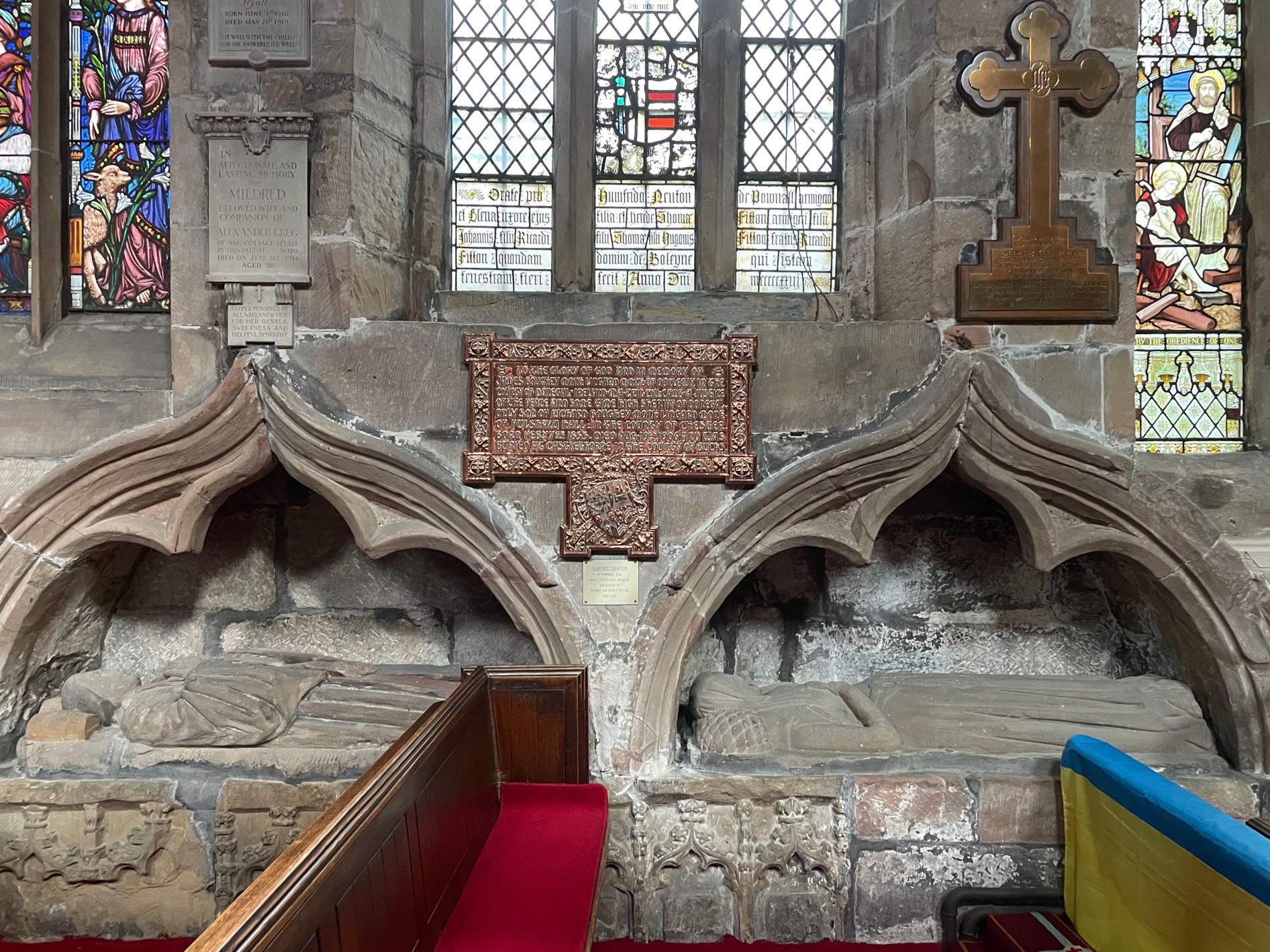
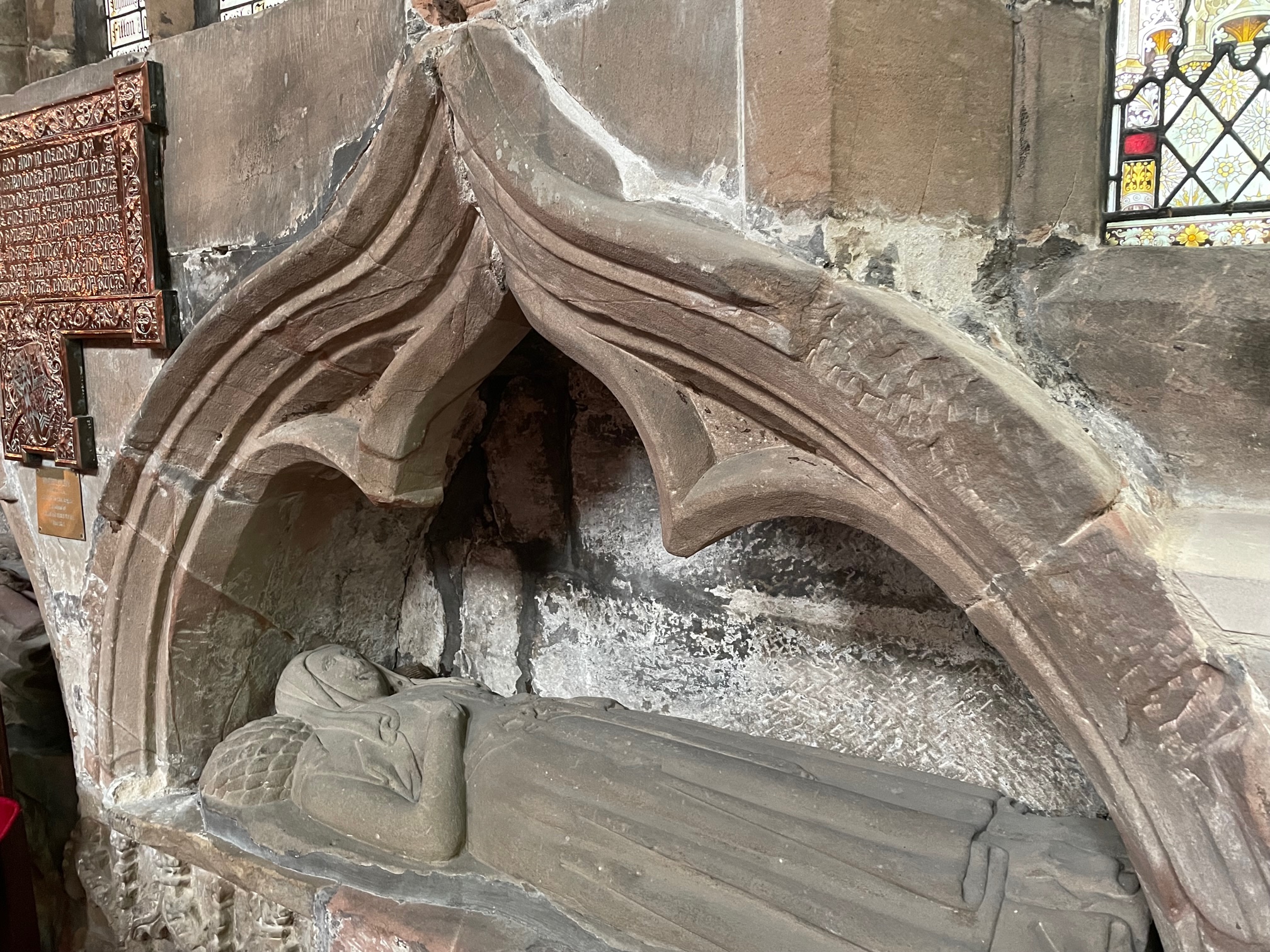
As noted in previous posts, Humphrey and Ellen were commemorated in carved effigies resting in the Jesus Chapel of Wilmslow’s St Bartholomew’s Church. For some time my bucket list had included a visit to view these effigies in person, and the opportunity arose in the summer of 2023.

The church itself is an imposing and impressive structure, much changed since the Newtons’ day, when it was undergoing its first transformation from its 13th century origins under the direction of then-rector Henry Trafford.  The Trafford family endowed the private Jesus Chapel where the Newton and Fitton effigies are to be found. 

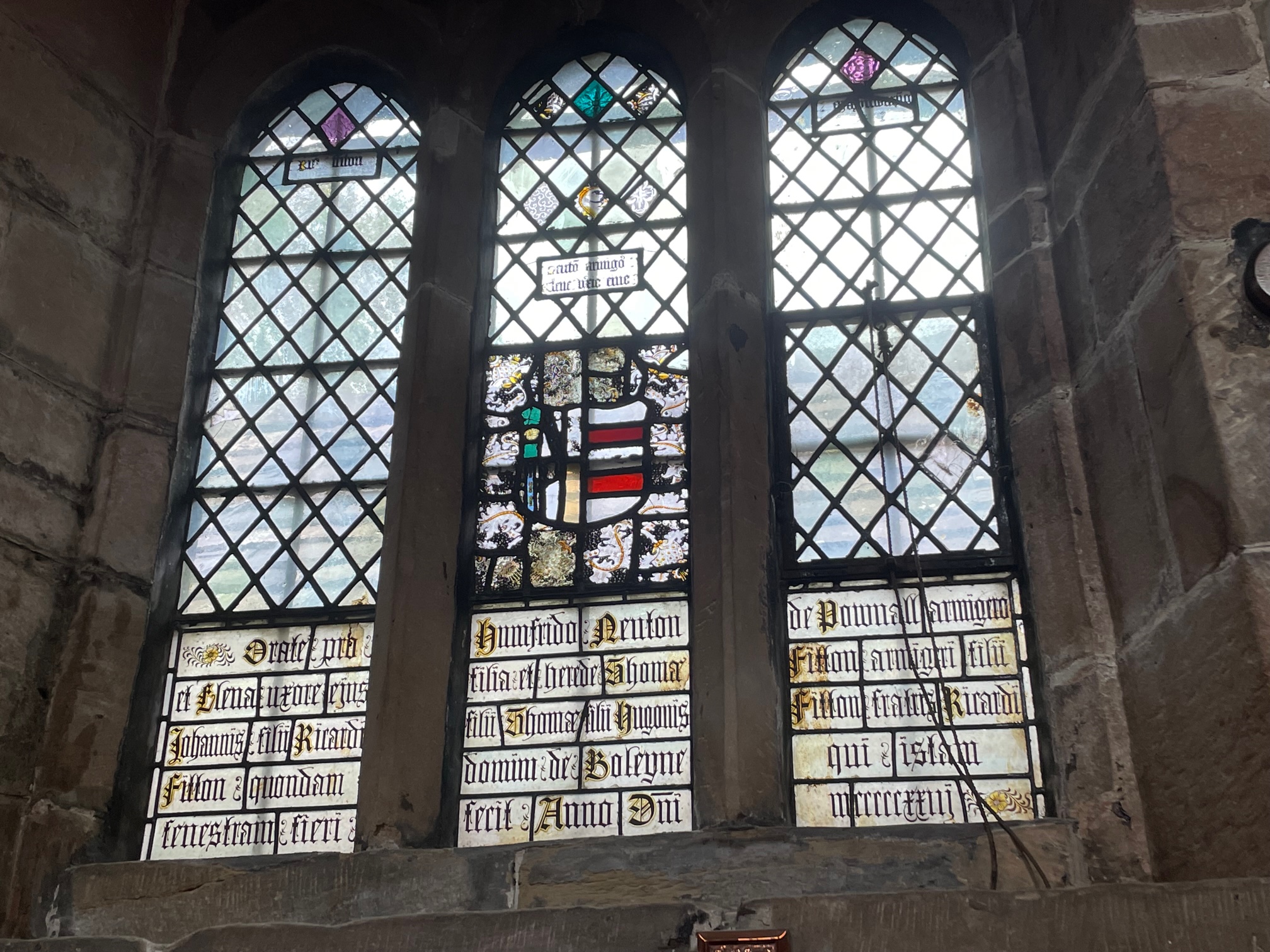
Deborah Youngs (Humphrey Newton (1466-1536) An Early Tudor Gentleman, The Boydell Press, 2008, pp 135-142) describes the effigies, placing them in the context of the Newtons’ status at the time.  For instance, they are carved from sandstone, cheaper than alabaster, a more usual stone.  And the effigies lie under a wall canopy which was probably recycled from the previous church, as were the carvings underneath the effigies.  The Newtons were unlikely to have had the resources for freestanding tombs.  Humphrey is clothed in a fur-lined civilian robe, relatively unusual at the time, when most effigies represented their subjects in military or ecclesiastical garb.  Traces of red and black paint can still be seen.  Ellen Fitton, represented as a widow, is simply dressed but, in recognition of her status as an heiress, lies closer to the east end and the altar than Humphrey, her head resting on a wheatsheaf, the symbol of the Fitton family.  Neither effigy is meant to be a realistic representation of the subject. 

The two effigies lie beneath a window inviting prayers for Humphrey and Ellen, and setting out in some detail her Fitton ancestry. The images below show first, Humphrey and Ellen, then Humphrey, then Ellen, and then the window inviting prayers for them, showing her more distinguished descent.

It felt an astonishing privilege to stand right next to these nearly-600-year-old artefacts of my ancestry.

6h. Descendants of Ann Backler and John Freeman: Pack, Grant, Grant-Ives, de Clanay Rennick, Grasby, Shore, Clarke, Hurle, Robinson…

In which we finally reach the last offspring of Mary Freeman and Richard Pack, and, with them, the end of this lengthy exploration of the Ann Backler/John Freeman line.This post rather variably, and somewhat arbitrarily, explores only fragments of later generations, particularly of the Shore line.There are simply too many of them, and I have run out of steam!

On reflection, before I tackle yet another large, extended couple of families, I note how very different the Ann Backler line is from that of her brother Sotherton Backler (1746-1819) of the Society of Apothecaries. I have not managed definitively to identify the fate of Ann’s other surviving sibling, Elizabeth Backler (1748/9 – ). As described in earlier posts, Ann’s husband John Freeman (1740-1803) had come to London from Northamptonshire, where he had been part of a very large and tangled web of families. Ann and John’s children and grandchildren inhabited a world of universities, military, clergy, the law and landed proprietors, very different from the artisans, artists and, for females, low-key lives of her brother’s family back in London. Apart from the youngest Sotherton-child, Rev Sotherton Backler (1798-1875), there seems little to link these two branches of this mid-18th century Backler line. And so, this series of posts has been a journey into modest and perhaps more grand stately homes, offspring of clergy marrying clergy, and pages of Burke’s Family Records (Shore, Cooke-Hurle and more) on Ancestry’s website. This post exemplifies all those trends. It seems a world away from ‘my’ Backler line descended from Ann’s nephew Samuel Backler (1784-1870) and his siblings.

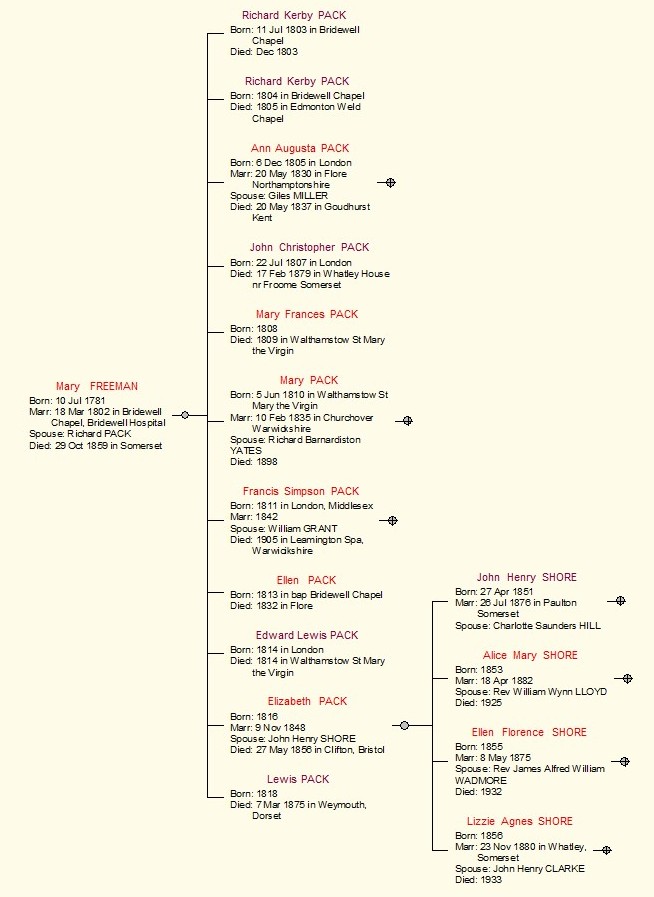
In the previous post we looked at two branches descended from Mary Freeman and Richard Pack. Here we look at two more lines, but we also note in the tree below that Mary and Richard had several more children who died in infancy or at a young age. I have just identified these in updating my data for this post, so this diagram differs from that in the previous post. Thus does family history continually evolve. First- and second-born infants both named Richard Kerby Pack died soon after birth. And later on, Ellen Pack (1813-1832) died at Flore aged 18, and Edward Lewis Pack was born and died in 1814. Clearly this otherwise prosperous family did not always have an easy time.

Moving on from where we left off in the last post, we meet Frances Simpson Pack (1811-1905) who married Barrister William Grant (1806-1868) at St George’s Hanover Square in 1842. By the time of the 1851 Census the family were living in Litchborough, Northamptonshire, where he was a land owner of 200 acres. Noting that his sons were said to be of ‘Litchborough Hall’, I found an English Heritage listing of that property, noting that it had been extensively renovated for William Grant in 1838, just a few years before his marriage to Frances. In 1861 he was described as a Magistrate and Barrister – not in practice. He died aged just 42, and by 1871, Frances was still living in Litchborough, but now with son Arthur W Grant, MA, Barrister and graduate of Brasenose College, as Head, and also with daughter Edith and youngest child, Charles E., an undergraduate at King’s College, Cambridge. By 1901 Frances was living on her own in Leamington Priors, Warwickshire and at her death in 1905, she left some £17,000 in the care of her three surviving sons, executors, her daughter Edith Frances having pre-deceased her by a year.

Some of the Grant family acquired the name of Grant-Ives, following the death of their relative Elizabeth Ives, spinster sister of Cornelius Ives, the Rector of Bradden. Use of the Ives surname and title to Bradden House, was granted by her in 1888 to Wilfred Dryden Grant, whose older brother was already lord at Litchborough Hall. On Wilfred’s death in 1919, the name passed by Royal licence to his brother Charles Eustace, as shown in the London Gazette, below. A search on ‘Grant-Ives’ brings up images of the various coats of arms adopted by different branches of the family. 

London Gazette 21 November 1919 Whitehall, August 23, 1919. The KING has been pleased to grant unto Charles Eustace Grant, of Bradden House, in the parish of Bradden, in the county of Northampton, Gentleman, Master of Arts of the University of Cambridge, and a Fellow of King’s College in the said University, His Royal Licence and Authority that he and his issue may, in compliance with a clause contained in the last will and testament of Elizabeth Ives, late of Bradden House aforesaid, Spinster, deceased, take and henceforth use the surname of Ives in addition and after that of Grant, and that he, and they may bear the arms of Ives quarterly with those of his and their own family, the said arms being first duly exemplified according to the Laws of Arms, and recorded in the College of Arms, otherwise the said Royal Licence.and Permission to be void and of none effect: And to command that the said Royal concession and declaration be recorded in His Majesty’s said College of Arms.

Of Frances’ first two children, Arthur William Grant (1842-1878) and Edith Frances Grant (1844-1904) there is little to say. Oldest surviving son, Edward Grant (1848-1910) of Lichborough (sometimes with a ‘t’) Hall and his wife Edith Helen Hulton (1859-1926) (daughter of the Rev Hulton), had three daughters, two of whom married, one to the exotically named Alexander de Clanay Rennick (1878-1949) (a Lt-Col in the Indian Army, later of Litchborough Hall). When their son was an adult he was styled Capt Richard de Clanay Grant-Rennick (1923-2004), perhaps acquiring the Grant name to preserve that Coat of Arms and the Litchborough title. These families are all easily traceable online and I will take them no further.

As noted above, Wilfred Dryden Grant-Ives (1854-1919) was diverted from his occupation of educator and tutor when he became the Lord of the Manor of Bradden in 1888. He devoted his life to public service, serving as JP and on various councils, as well as being a noted agriculturist and hunter. A rather harrowing report in the Northampton Mercury on 14 March 1919 of the inquest into his death reports that following a serious motor accident involving himself and his wife in 1918, he had become ‘not himself’ and very reclusive. His family had become very concerned about his welfare and had requested the attendance of health personnel, but on perceiving this, Wilfred had climbed out of his bedroom window onto the roof, from which he fell, his injuries resulting in his death, which was deemed accidental. A sad tale, indeed.

Wilfred and his wife Fanny Louisa Millington (1860-1951) had six daughters. An announcement of the engagement of the oldest daughter, Winifred Frances Grant-Ives (1883-1972) to Mr Gerard Arthur Kennaway, son of the Rev Kennaway in nearby Towcester, appeared in The Morning Post on 14 July 1906. However, no marriage record is in evidence, and she next appears in public records returning to England from Spain in 1916, apparently the wife of someone completely different, Charles Egbert Reynolds Sams (1877-1968), a mining engineer, with three children. The next public record is of their marriage in 1925. It’s not clear what all that means! 

Winifred’s youngest sister, Kathleen Beatrice Grant-Ives (1896-1976) married William Wright Grasby (1864-1939), veterinary surgeon (his second wife) in 1922. They had 7 sons before his death in 1939, and then a daughter was born named Diana Kathleen Grasby (1941-2005) in May 1941, two years after William’s death – it’s not clear who the father was. Interestingly, both Kathleen and Diana then became very well known for breeding ponies, including many who performed in pantomimes and at the Royal Opera House, Covent Garden!

Charles Eustace Grant (1851-1930), later Grant-Ives, as above, succeeded his brother Wilfred as Lord of the Manor. He married Madeline Isabel Whitting (1863-1949), daughter of a solicitor and niece of the Bursar of King’s College Cambridge, a post which her husband would later hold until his retirement to Bradden. They had five children. Charles and his son John Charles Grant-Ives (1889-1959) were ‘of Bradden House, Bradden Northamptonshire’. In 1933 John Charles was granted a divorce from his wife Amy (Whiteside Shaw) – I cannot see a marriage for them, possibly it was in Scotland – and custody of their three children, John Edward, Elizabeth M and Joy. She immediately married the co-respondent, Frank Boughton, and in 1948 John Charles married Dorothy M Hemsted, or Chance. 

Isabel Frances Grant-Ives (1891-1976) married Colin Fish (1888 – 1969) in 1921 and their daughter Joan H Fish was born in 1922. Ursula Grant-Ives (1892-1984), twin to Agnes below, was single all her life and died in Wilmslow, Cheshire, leaving some £76,800. She was buried in Bradden with other members of the family. Her twin, Agnes Grant-Ives (1892-1943) married geologist George M Davies (1885-1973) in 1922, his second wife.

There are plenty more Grant-Ives descendants of the above folk, but I will leave them there, and move on to the last of Mary Pack’s children with descendants, Elizabeth Pack (1816-1856) and her husband John Henry Shore – another tree is needed!

Finally, we have the children of Elizabeth Pack (1816-1856) and her landed-proprietor husband John Henry Shore (1819-1878) of Whatley in Somerset. Astute readers will note that this diagram has only their four children, in light of the resulting some 28 grandchildren, which really is a step too far! Elizabeth’s husband came from a long-established family of Shores, chronicled in Burke’s Family Records on Ancestry. His father, John Albin Shore (1775-1835), had married Mary Ann Hurle, so that when John Henry Shore Jr’s (1851- 1932) second child, Bertha Josephine Agnes Shore (1872-1958), married Captain William Armitage Cooke-Hurle, R.N. (1875-1920), they were probably related in some way I haven’t got the energy to pursue. John Henry Jr and his wife Charlotte Saunders Hill (-1900) had three daughters and eight sons, seven of whom survived to adulthood. I have found an online post which summarises some of the sons’ histories and military exploits at https://grandadswar.co.uk/capt-j-l-shore/ I have traced the outlines of their lives for my own database, but will not undertake to write them up here. I would be happy to discuss further if any reader so desires. I think John Henry Jr married twice more.

Alice Mary Shore (1853-1925) married Rev William Wynn Lloyd (1844 – 1925), they producing five daughters, three of whom did not marry, and one son, Meredydd Wynn Lloyd (1887-1967), who served in the Australian Army in WW1 and later married a French woman in Egypt. 

Ellen Florence Shore (1855-1932) married Rev James Alfred William Wadmore (1851-1918), they having two sons and three daughters.

Lizzie Agnes Shore (1856-1933) married solicitor Charles Henry Clarke (1841-1914), the son of a solicitor and his wife, Mary Hurle Clarke, the Hurle name appearing again in this family. One son, Arthur Henry Gilbert Clarke (1891-May 1916) died at High Wood in France. His early death contrasted with the career of his older brother, Major Dr Richard Christopher Clarke, RAMC, OBE whose death in 1957 in Bristol was attended by some 300 mourners, including many from the various families mentioned above, and remembering, among other things, his role as Honorary Curator of Bristol Zoo. He had served in WW1 as a medical officer. It seems youngest brother Aubrey Martin Clarke (1889-1957) also served in WW1, but then spent at least a number of years in Ceylon with his wife Evelyn Robinson (1890-1962), first cousin of Foster Gotch Robinson (1880-1967), noted cricketer, horse trainer and paper manufacturer (see his entry in wikipedia), who married in 1908 Aubrey’s sister, Marguerite Victoria Mary Robinson (1887-1963). The Robinson family were noted philanthropists in Bristol.

The very last child of Mary Freeman and Richard Pack was the unmarried son, Lewis Pack (1818-1875). Educated at Balliol College, Oxford, he is designated simply as Landowner in the 1861 Census at Southfield House, Whatley, Somerset, the home of his brother-in-law Richard Barnardiston Yates. Similarly, in the 1871 Census he is again a Landowner at the rather grand Whatley House, again in Whatley, Somerset, the home of his brother-in-law John Henry Shore. He died in 1875 and is buried in Whatley.

And so endeth the tale of the Freeman/Backler line, admittedly very selective and incomplete in this post. I had no idea when I embarked on this line some 18 months ago that it would be so enormous, albeit always interesting. It feels good to have explored it, however genetically distant from me is the resulting cast of characters. When all is said and done, they are my Backler cousins!

With some relief, I will in due course revert to the Pellatt/Rivers/Newton line!

6g. Descendants of Ann Backler and John Freeman: Pack, Miller, Barnardiston Yates, Crowther-Beynon, Towers, Brown

In which we tackle the family of Mary Freeman (1781-1859), youngest child of John Freeman and Ann Backler and her wealthy husband Richard Pack (1738-1868). – a quick summary of the Pack line and of two of the families descended from Richard and Mary, with a preponderance of Revs and Landed Proprietors!

Mary Freeman (1781-1859) was the youngest child of Ann Backler and John Freeman, and possibly the most-favourably-married. On 18 March 1802 she married Richard Pack (1768-1838) at Bridewell Chapel in the City of London. He was the son of Christopher Pack (1735-1789), of Lewis & Pack, Oil and Salt Merchants, and Ann Kirby (1730-1785) of Northampton and, rather fortuitously, sister to Richard Kirby (or Kerby), owner of Flore House in Northamptonshire (search it on Wikipedia). Richard left the property to his sister Mary in her lifetime, and then to his nephew, Richard Pack, who went on to become Sheriff of Northamptonshire in 1830. Richard Pack pre-deceased Mary in 1838. In 1841 she is found in Tunbridge Wells with her three surviving younger children, and living adjacent to the widowed Giles Miller, whose brief story we looked at above. Just at the moment I cannot find Mary in the 1851 Census. I think I have spied her there with family members but I could be wrong. In any case, she died in Somerset where her Shore family lived (see next post) in 1859. Presumably she had had to leave Flore on the death of her husband.

Richard and Mary had seven children, as can be seen above. For simplicity’s sake I will look in this post at the first three of these.

Ann Augusta Pack (1805-1837) married Giles Miller (1797-1853) of Goudhurst in Kent at Flore on 20 May 1830. Witnesses were Richard and Mary Pack. But tragedy was to strike this couple. They had one son, Edward Lewis Miller (1831-1846). A newspaper search on his name yields: ‘deeply lamented, being killed by a fall from the cliffs at Freshwater, in the Isle of Wight, Edward Lewis Miller, only child of G. Miller Esq., of Goudhurst, aged 15’.   His remains, and those of his parents, are interred in a vault in the churchyard of Goudhurst Church.

John Christopher Pack (1807-1879) inherited the Flore estate on his father’s death in 1838, but apparently never lived there. He is found in successive censuses in London as a Landed Proprietor, and died at Whatley House in Frome, Somerset, the home of his brother-in-law, John Henry Shore (see next Post, when it appears!). Flore House was sold at the time of John Christopher’s death.

Mary Pack (1810-1898) married Richard Barnadiston Yates (1801-1883) on 10 February 1835. Here life becomes quite complicated. We encounter two families with double-barreled names, two of Mary Pack’s three children marrying sibling cousins, and a grandchild marrying another cousin – maybe a second cousin? My head is spinning. The tree above shows the wider family of Mary Freeman and Richard Pack, showing the children and grandchildren of their daughter Mary. But the diagram below, starting with the Rev Richard William Yates and his wife Hester Barnardiston, is needed to show the various cousinly marriages and the second double-barreled name. Where to start? The surnames of relevance become Barnardiston Yates/Pack; Barnardiston Yates/Crowther, later to become Crowther-Beynon, and Barnardiston Yates/Towers.

Mary Pack (1810-1898) married Captain Richard Barnardiston Yates (1801-1883) in Churchover, Warwicks in 1835. He was the son of the Rev Richard William Yates (1761-1805), himself the son of Rev Richard Sutton Yates. The double name seems to have arisen from the Rev Richard William Yates’ marriage to Hester Barnardiston (1763-1843), only child of the Rev Dr John Barnardiston (1719-1778), master of Corpus Christi College, Cambridge. Mary and Richard had three children, as can be seen above: Ellen Flora, Adeline Mary and Gertrude Ann. Careful scrutiny of the tree above shows that Hester Barnardiston Yates (1796-1866), sister of the above Richard, married Rev (yes, another one) Samuel Crowther (1802-1880). They had two children, Rev Samuel Bryan Crowther (later Crowther-Beynon) and Richard William Barnardiston Crowther-Beynon, whom we will consider below. The birth date for Hester above shows 1787, which on reflection was a bit old for the children. a parish record search just now shows that the 1787 Hester died a day after birth. Her namesake was born in 1796.

Oldest daughter of Mary Pack and Richard Barnardiston Yates, Ellen Flora Barnardiston Yates (1834-1922), married the widowed and much older Rev Frederick Hopkins in 1887, when she was about 50. He died in 1907, and she died in 1922, one of her executors was a Crowther-Beynon nephew (see below). Nothing more relevant to this story!

Second daughter Adeline Mary Barnardiston Yates (1837-1918) was baptised at Flore, though the family were then living in Derbyshire. She was the second wife, married in 1869, of her cousin, widowed Richard William Barnardiston Crowther-Beynon, Captain Royal Scots 1st Regiment of Foot, who, alas, died in March 1878 aboard the troopship ‘Crocodile’ off the coast of Aden. Their daughter, Hester Mary Crowther-Beynon was christened in August that year, but died in 1879. Subsequent censuses show Adeline living in Worthing, Sussex, on private means with a small coterie of servants, until the 1911 Census finds her as a patient in the House of the Holy Road in Worthing, where she died in 1918. Available records do not show links with family, other than that her Will also cites as executor her nephew, Vernon Bryan Crowther-Beynon.

Gertrude Anne Barnardiston Yates (1838-1936), married in 1864 the older brother of the above Richard William, Rev. Samuel Bryan Crowther, M.A ., of Slines Oaks, who was Consular Chaplain at Christiana, Norway (later Oslo) from 1864-75, where their three children were born. Later on he would become Vicar of Lodsworth in Sussex, before ending his days in Beckenham, Kent. Although his father was the Rev Samuel Crowther, the name Beynon was the surname of Samuel’s maternal grandmother. For some reason it was the younger son (Richard William, above), who carried the name Crowther-Beynon. According to the Surrey Coats of Arms website, his older brother Rev Samuel Bryan, adopted the double-barreled name after Richard William’s death. So his and Gertrude Anne’s children came equipped with the Crowther-Beynon name in later life, though baptised just Crowther.

First up was Gunhilda Mary Crowther (1864-1887), who lived with her family after their return to England, until her marriage in January 1887 to William Towers Brown (1859-1887), her perhaps second cousin, son of Rev Joseph Thomas Brown, himself the son of Emma Towers, daughter of Emma Barnardiston Yates (1794-1867), sister of Richard Barnardiston Yates. But this churchly and cousinly marriage was to end in a very sad tragedy. At Easter time in April 1887, the couple set off on their wedding journey to Paris on the cross channel packet steamship Victoria. Early in the morning of 13 April, in dense fog, the steamship ran aground off the coast of Dieppe. There were some 90 passengers on board, and some 40 crew, but no record of the names of passengers. It subsequently transpired that as one of the lifeboats was lowered, it overturned, and among others, Gunhilda was cast adrift, whereupon her new husband flung himself into the water to rescue her. Both drowned, and their bodies were only recovered down the coast some six weeks later, identified by watches, rings and other articles on the bodies. A tragic funeral was held at Wokingham at the end of May, attended by very many clergy, members of Towers, Yates and Crowther-Beynon families and many more. What a sad story. I have not traced the fortunes of the three other Brown children.

Second child was Vernon Bryan Crowther aka Crowther-Beynon (1865-1941) He doesn’t feature hugely in this tale of Packs and Yates’s, so I will just say that he trained as a barrister-at-law, and was also a very well regarded antiquarian and numismatist, who can be searched online. His wife, Mary Giffard, was the daughter of another Rev – Frederick Walter Giffard.

Third child, Margaret Hester Crowther (1874-1912) appears to have lived her whole life with her parents. Just before her death in 1912, she is found with her widowed mother, Gertrude, in a 16-room house in Beckenham Kent, said to be ‘dependent on Head’. Was she infirm in some way? Her mother Gertrude died at the same address in December 1936, leaving some £42,000 in the care of her brother Vernon as Executor.

Having now completed our quick survey of the first three of Mary Freeman and Richard Pack’s children, we will leave them and turn our sights to the next post (coming very soon, I hope – it is snowing outside…) where we will look at their four younger children. Many more landed proprietors! Not sure about Revs.

6f. Descendants of Ann Backler and John Freeman (2): Philpot, Mackintosh, Bouverie Pusey, Hawker and many more

In which we look at the very many descendants of Ann Backler and John Freeman, this time the family of their fifth child, Thomas Freeman (1779-1853) and his wife Frances PHILPOT (1782 – 1857 ). We find Clergy, Royal Navy Commanders, and a very unusual marriage register record. This is quite a long post – this line of Backler descendants had very large families and I have decided to keep each family group together. I am finding it quite challenging!

This outline tree shows that Thomas Freeman and his wife Frances Philpot had seven known children. Given the gaps in latter years, it seems there could have been more. Thomas had been made Free of the Ironmongers Company in 1800, by patrimony of his Father John Freeman and just three years before John Freeman’s death in 1803, whose Will was proved in August and September 1803. On the 30th of December that year, the marriage took place between Thomas, the eldest son, and Frances Philpot. Details in a church already very familiar to Backlers, were as follows:

St Andrew by the Wardrobe. Thomas Freeman Esqr a Batchelor [sic] of the Parish of St Ann Blackfriars and Frances Philpot Spinster of the Parish of St George the Martyr in the County of Middlesex by License this Thirtieth Day of December [1803].

Bride and Groom both signed, along with an array of family members as witnesses: John Philpot (likely Frances’ father); Ann [Backler] Freeman (1741-1820) (Thomas’ recently widowed mother); Mary Gough (1769-1841) (John Freeman’s niece, who looked after his wife Ann [Backler] Freeman in her later years); S[otherton] Backler (1746-1819) (Ann Freeman’s brother, my 4x g. grandfather); [?] Freeman; Elizabeth Philpot (Frances’ sister).

Thomas Freeman (1779-1853) and Frances Philpot (1782-1857): We know relatively little about Thomas and Frances. Their first four children were born in Woodford, Essex, where Thomas left property in his Will written in 1840. Sarah was christened in Lyme Regis, Dorset, where her father was said to be ‘of London, but resident in Lyme’. Francis and Charles were born in Tooting, Surrey. At some point the family then lived in Dorking, Surrey, where Thomas had a vault created at the church in nearby Wotton, on the deaths of their two daughters, Margaret Ann and Sarah. Latterly they lived in Brighton, where the 1851 Census finds Thomas, a retired merchant, Frances, daughter Elizabeth Ann and son Francis; also Mary [Freeman] Pack (Thomas’ younger sister – see forthcoming post), her son Lewis Pack, and eight servants. In his Will drafted in 1840, Thomas left £15,000 each to his sons plus other legacies. He was clearly very well off, but the detail of the very lengthy and difficult-to-read will leaves me disinclined to research further detail. Thomas died in 1853, followed by Frances in 1857. Both were interred with their two daughters at St John the Evangelist Wotton. Children:

  • Margaret Ann Freeman (1806-1838) Nothing known other than birth and death dates and interment in Wotton, Surrey.
  • Rev Thomas Freeman (1806-1855) Born Woodford, Essex. Educated at Oxford University BA 1830, MA 1834. Married Eleanora Sophia Mackintosh (1805 – 1890 ) on 14 September 1841 in Inverness, Scotland. Thomas died in Madeira in 1855. His wife can be found in the 1861 Census (Somerset) and 1871 (London), both times with their daughter. Eleanora’s death was registered in 1890.
    • Thomas Arthur Freeman (1844-1900). Born London Marylebone, baptised at St Mary Bryanston Square by uncle (see below) W Bouverie Pusey. Educated at Oxford University Christchurch, BA 1865, MA 1868. Married first 1871 in Southampton to Loretta (Lauretta) Dowson, who died in the December quarter of 1873, as did their son Charles Thomas Freeman (1873-1873), born in the same quarter. Thomas Arthur married again in 1875 in Jhansi, Bengal, India, to Annie Matilda (aka Matilda Annie) Cave, daughter of a Colonel. Thomas Arthur Freeman was a Lieutenant in the 70th Regiment of Foot. He died in India on 20 February 1900, then a missionary for the Church Missionary Society, having been a Lieut Col in the East Surrey Regiment.
      • Their daughter Helen Matilda Freeman (1877-1950) married Sir Henry Edward Edleston Procter and they had three known children:
        • Margaret Helen Procter (1899-1980) married first Guy Nicholas Vansittart with whom she had son Arnold Mark Vansittart in 1927 before they were divorced. In 1936 she married Geoffrey Dearmer, with no known children.
        • Arthur Francis Procter (1902-1970) married Adria Margaret Acland in 1935. Their two children were Nigel Henry Procter (1937-1968)(see below) and [possibly living]
        • Katharine Joyce Procter (1909-1980) married Arnold H Piggott in 1934.
    • Frances Helen Freeman (1845 – ) Appeared in 1871 and 1881 Censuses with her mother, first in Somerset and then on Belgrave Road in London. She appears in 1903 as executrix to her mother’s sister’s will, and then in 1909 to her uncle Francis Freeman’s Will (see below). In 1929 and 1932 she is seen as a missionary, departing England for Algeria. Her London address on both occasions was given as 36 Princes Gardens, South Kensington.

A sad death: As shown above, Nigel Henry Procter died aged 21. A Coroner’s report describes how he went out hunting with his rifle on the family estate of Eastwick Manor, Hertfordshire, and was found dead with the rifle and a dead pigeon by his side and a bullet wound to the head. The Coroner adjudicated accidental death. (Hertford Mercury and Informer, 17 October 1958)

  • Catherine Freeman (1810-1873) married Rev. William Bouverie Pusey ( (1810-1888) in Richmond, Surrey. The picture is a transcript by me of the page in the parish register of Richmond Church, describing a rather unusual set of circumstances in recording the marriage.

A unique marriage record: Richmond, Surrey, St Mary Magadelene, 1813-1837.Marriages Solemnized in the Parish of Richmond in the County of Surrey in the Year 1836 William Bouverie Pusey of the Parish of Holton in the County of Oxford, Bachelor, and Catherine Freeman of this Parish Spinster were married in this Church with Consent of by License this on the Seventh day of June in the Year One thousand eight hundred and thirty six by me Edward Bouverie Pusey, Officiating Minister [William’s brother].  This marriage was solemnized between us William Bouverie Pusey and Catherine Freeman in the Presence of Henry Raymond Barker, Margaret Anne Freeman, Elizabeth Broadwood, John Philpot. So far so good.  However, perhaps not immediately obvious, the entire record, on the standard marriage form of the time, is written in the same hand.  And, although the right-hand page of the two-page spread contains the standard three marriages, the left-hand page diverges from that.  Also to be noted are two crossings out – ‘by me’ and the ‘us’ of ‘between us’. The explanation is as follows: In the same hand as the text above, with all the printed words for what should have been the second marriage record crossed out, we read:The Entry made by me above contains of the Parish  particulars authenticated by the document pasted in below, the said document being Signed by all the Parties thereto in their were married in this  own handwriting respectively with Consent of as the Law requires at the this celebration Day of of Marriages in the Year One thousand eight hundred and  Dr. Pusey by Me Professor of Hebrew at Oxford This Marriage was solemnized between us officiated at this marriage by my permission and the key of the iron Chest in which this book was, being broken in the Lock, and the In the Presence of Parties not being able to stay until the Register could be procured, Dr. Pusey and the other subscribing Parties of executed the Parish document placed below.  The truth of all the particulars stated above is attested of by me Parish Samuel Whitlocke Gandy Vicar of Richmond. Below this statement is a delightfully scrappy rendering of the first italicised text above, complete with individual signatures.  To the right of the text on the pasted-in piece of paper are drawn two right-angle lines of a square, the resulting space below stating:This memorandum was made by me, the key of the box, wherein the Register was kept, being broken in it, and the Register not being to be obtained [sic].  EB Pusey June 7 1836. At the bottom of the pasted-in scrap is written: NB. This is the document referred to above. Saml W Gandy

Further investigation of the distinctively-named Bouverie-Puseys reveals that William and Edward’s father Philip Bouverie had taken the name ‘Pusey’ when inheriting the Pusey family’s estates in the village of Pusey in Berkshire.  William Bouverie Pusey (1810-1888), who married Catherine Freeman (1810-1873), as above, was for many years Rector of Langley in Kent.  His brother Edward Bouverie Pusey (1800-1882) was, as stated above, Professor of Hebrew at Oxford and canon of Christ Church.  During his student years at Oxford he began to take an interest in theological matters, then spending two years pursuing these interests in Germany.  On returning to England, he was appointed to his professorship in 1825 by the Duke of Wellington, then Prime Minister.  After that he engaged in many years of theological controversy, which I fail to understand, but which can be followed in his many-paged Dictionary of National Biography entry, viewed on Ancestry, or in many various entries which come up via a search on his name. (Citation details: Surrey History Centre; Woking, Surrey, England; Surrey Church of England Parish Registers; Reference Number P7/1/9.  Seen on Ancestry.co.uk )

And so, after their marriage was recorded in unusual fashion due to the malfunctioning key to the lock of the parish chest, Catherine Freeman and William Bouverie Pusey went on to have four children:

  • Catherine Freeman and William Bouverie Pusey
    • Henry Bouverie Pusey (1837-1869) His notice of probate describes him as ‘formerly a Lieutenant in Her Majesty’s 76th Regiment … a Bachelor … who died on or since 13 May 1869 at sea …’, with letters of administration granted to his Father.
    • Edward Bouverie Pusey (1838-1921) married Esther Eliot Cox Hales (1847-1927) in Colchester, Essex. The 1881 Census shows Edward in Constantinople, Commander R.N. of the ship “Bittern”, a gun vessel with 3 guns. By 1891 he was retired, living in Paddington, London. He died in Bournemouth in 1921. He and Esther had four children:
      • Catherine Louisa Bouverie Pusey (1872-1942) married John Bowyer Buchanan Nichols (1859-1939), an artist and poet. See Wikipedia entry. Among their children were:
        • Robert Nichols (1893-1944) poet (esp. of the Great War) and playwright. Married Norah Denny. See entry in Wikipedia.
        • Sir Philip Bouverie Nichols, KCMG (1894- 1962 ) Diplomat, married Phyllis Mary Spender-Clay in Surrey in 1922. Among the witnesses were ‘Astor’ – she was the grand daughter of William Waldorf Astor – 1st Lord Astor. Sir Philip’s biography can be found on Wikipedia, which reports that the couple had two daughters and two sons.
        • Irene Nichols (1896-1977) married George Henry Gater
        • Ann Sadelbia Mary Nichols (1902 – ), Sculptress, married Henry George Strauss, M.P., then Lord Conesford.
      • Edward Bouverie Pusey (1873-1958) married as retired army officer in 1914 in Sydney NSW, to Lilian Evelyn Ryan, daughter of a civil servant there. The couple are found in Hove, Sussex in 1939, and Lilian is recorded as dying in 1957. Edward died in 1958, his probate record showing probate granted to Widow Ursula Winchester [nee Lind] Bouverie Pusey, a marriage record for the couple having been recorded in the June quarter of that year! She died aged 87 in 1972.
      • Ethel Mary Bouverie Pusey (1876-1955) married Hon. Adrian Verney Cave (1874-1952) (later Lord Braye, who died en route to the funeral of King George VI). They had three children:
        • Thomas Adrian (‘Lord Braye’ 1902-1985) RAF and Royal Hussars. Married Dorothea Donoghue (1906-1994) of Philadelphia, one daughter:
          • Mary Penelope Verney-Cave, Baroness Braye of Stanford Hall, Near Lutterworth, Leicestershire, married to Edward Henry Lancelot Aubrey-Fletcher. She served a number of years as a Conservative member of the House of Lords until she became one of 653 hereditary peers excluded from the Lords after the House of Lords Act 1999.
        • Ambrose Verney-Cave (1906-1988)
        • Lucy Verney-Cave (1905-1980) married Lucien Falkiner who died in the 2nd World War.
      • Lucy Bouverie Pusey (1888-1966) married Cmdr. Henry Maclean Fothergill (1882-1963) in 1920, one son known of:
        • Cmdr. Christopher Henry Fothergill R.N. (1921-2014) married Linda K Browne in 1965.
    • William Bouverie Pusey (1840 – ). nothing known.
    • Frances Mary Pusey (1845-1911). Little known. ‘Living on own means’ in successive censuses.
  • Elizabeth Ann Freeman (1812-1891) Died unmarried at Aylesbury Villa, Hove, Sussex. A record in Ancestry’s Records of the Removal of Graves and Tombstones notes that she founded in 1855 the Brighton Home for Convalescent Children. Among other bequests she bequeathed £2,000 to Helen Mathilda Freeman and left a bequest to the Home for Invalid Children, which may have been the successor to the Home she founded.
  • Sarah Freeman (1814-1839) As noted above, she was buried at Wotton in Surrey.
  • Francis Freeman (1816-1909) Died at Belgrave Mansions, Grosvenor Gardens, London – where I once worked. How he obtained his fortune of some £112,000 is not clear. Among others, he left bequests of £15,000 each to his niece Frances Helen Freeman (see above) and his nephew Edward Bouverie Pusey (see above).
  • Charles Freeman (1823 – ) civil engineer, East India Merchant and J.P. in Sussex, married in 1846 in Plymouth, Devon to Louisa Mary Hawker (1824-1885). The last known sighting of the couple was 1881 in Tormoham Devon, where they lived with youngest daughter Adelaide, and 9 servants. I cannot find a death record for Charles. They had 7 children as follows (bear with it – this is the last, albeit enormous, family in this line!):
    • Francis Ford Freeman (1847-1908) M.A. St Andrews, Rectifier and Spirit Dealer, married to Lucy Emma Haden (1853-1929).
      • Harry Reginald Freeman (1877-1959) Rectifier and Spirit Dealer, married Emma Smith in 1905, 3 children: Mary Freeman, born 1906; Robert 1907. Francis 1910.
      • Paula Freeman (1879- ) married Stephen Hardcastle Clarke (1865-1928) Five children, Lucy Theodosia Merioneth; Margaret Patricia Hardcastle Clarke; Charles Nicholas Swift Clarke; Ralph Christopher Gooding Clarke (he was a Japanese prisoner of war); and Venetia Dolores Love Clarke.
      • Louisa Marie aka Isa Freeman (1880-1924) married David Rimington Heaton (1894-1960) Three children, Ursula, Leila and Virginia Lucie.
      • Margaret Elinor Freeman (1883-1972) married Stephen Nairne Mackenzie. Two children, Elinor Laura Mackenzie and Margaret Griselda Mackenzie
      • Ursula Freeman (1885 – )
      • George Bovet Freeman (1886-1964). On his marriage to Kathleen Mary Martin he was said to be District Commisioner, Gambaya, Northern Territory, Gold Coast Colony.
      • Lucy Haden Freeman (1889-1976) married first Richard Bayly Murphy, who died 1912, one daughter; married second Sir Wintringham Norton Stable, High Court Judge, brother of spouse below.
      • Archibald Francis Freeman (1889-1940), lived in Wales but died at the Railway Station, Grantham. Married Enid Gertrude Stable, sister of Sir Wintringham above.
    • Jessie Louisa Freeman (1849-1868)
    • Reginald Charles Freeman (1852-1915) married Elizabeth Charlotte Wharton (1853-1943). Three children: Claude Reginald Charles Freeman (1886-1957); Dorothy Dundas Freeman (1891-1975) married George Thomson, two children; Arthur Cyril Bruce Freeman (1896-27 Sep 1918, CWGC Grave at Hermies Hill British Cemetery)
    • Elinor Mary Freeman (1854-1868)
    • Frederick Arthur Freeman (1858 – )
    • George Hartley Freeman (1863-1863)
    • Adelaide Catherine Freeman (1886-1937)

That was exhausting – and very time-consuming. There is yet another branch to explore descending from John Freeman and Ann Backler, and we can then return to the Pellatts, whom we haven’t seen for over a year. These Freeman families are enormous! But here it is – for the record.